AI APIs for Agencies: Scale Client Creative Production
Build a multi-client AI creative workflow with separate briefs, approved assets, controlled variants and review. Learn where Token360 fits.
INDUSTRY WORKFLOWS · MARKETING & CREATIVE AGENCIES
AI APIs for agencies are most useful when repeated client work can share a production process while keeping briefs, source assets and approval decisions separate. Text, image, audio and video generation can become steps in that process. The agency still owns creative direction, client-specific checks and the decision to release each deliverable.
For a marketing agency or creative studio, the practical question is not how many assets a model can generate. It is whether the team can produce the right assets for several clients without mixing their claims, references, revision history or permissions. A faster generation queue is useful only when the review process can keep up.
Read first: Choose AI models by business use case. This article focuses on recurring multi-client production, rather than account ownership or the final delivery package.
When does an agency need an API workflow?
An API workflow fits recurring work with identifiable inputs, repeatable production steps and enough volume to justify integration. It is less compelling when every commission needs a different creative process. Begin with a recurring service the team already understands, such as adapting approved campaign concepts into a defined set of formats.
A studio creating an occasional hero film may get more value from interactive tools and hands-on editing. An agency producing regular campaign refreshes for multiple brands may benefit from connecting its brief system, approved assets, generation tasks and review queue. The distinction is the repeatability of the work, not the size of the agency.
Before building, identify one repeated handoff that causes friction. Does a producer retype the same approved claims? Does a designer repeatedly retrieve the same reference pack? Does the account team struggle to identify which brief generated a preview? Automate a stable handoff before attempting to automate the whole creative service.
What can be shared across clients, and what must stay separate?
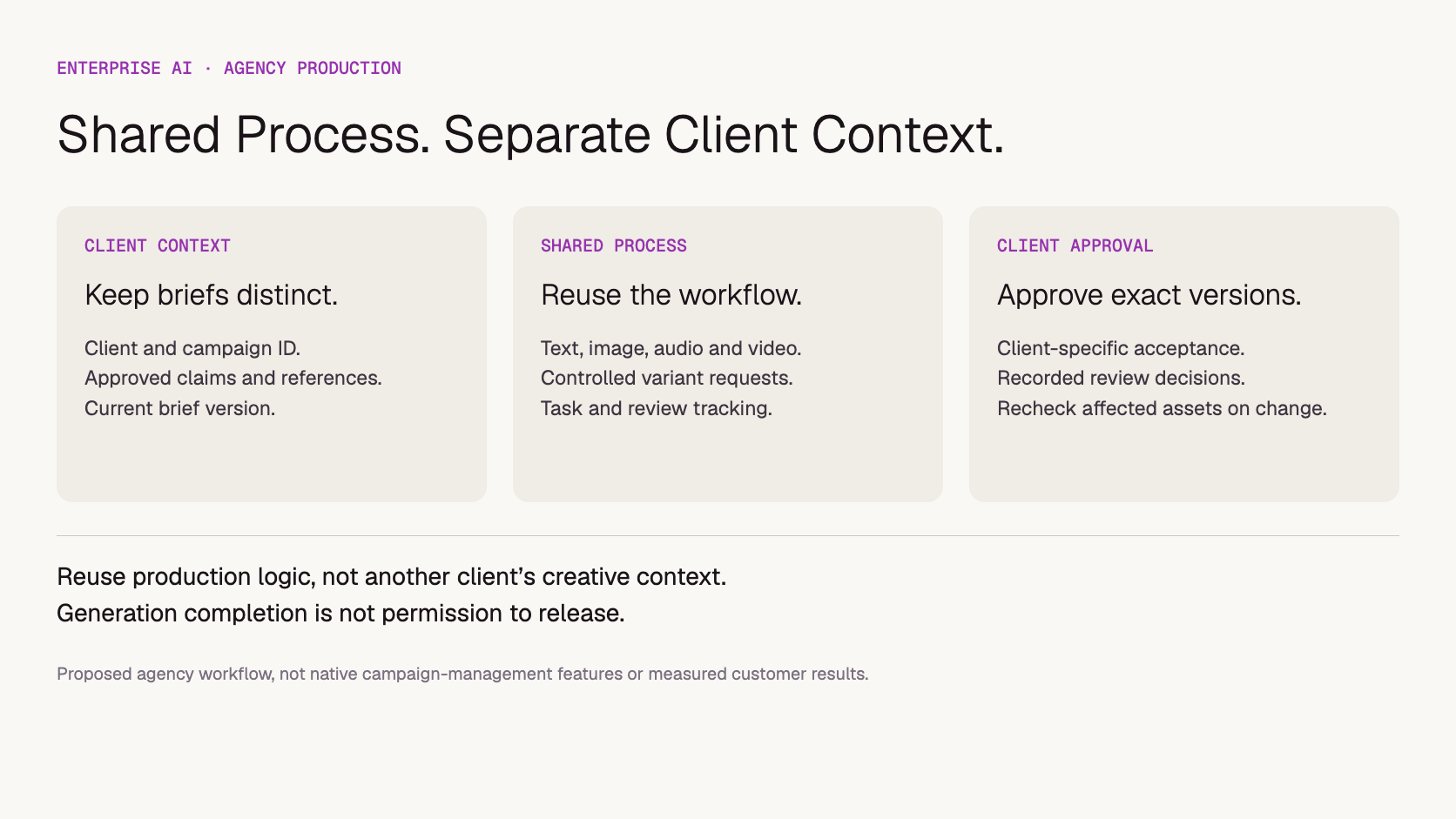
Share workflow templates, validation rules and job-state handling. Keep client-specific materials and decisions attached to an explicit client and campaign record. A reusable template should define where approved claims and references belong; it should not silently carry another client's claims, examples or assets into a new request.
Production element
Reusable across clients?
Control to preserve
Brief fields and review stages
Usually, as templates
Client-specific requirements remain configurable
Brand voice, product claims and references
Only with explicit permission and relevance
Load the correct approved client context
Model integration and task tracking
Often
Keep client identifiers, permissions and asset paths distinct
Approval decision
No automatic reuse
Tie approval to the exact asset and brief version
Generic technical checks
Often
Use the destination format required by this campaign
For example, copying a successful prompt from a skincare account into a headphone campaign can carry more than tone. It may retain unsupported benefit claims, a competitor's visual references or a disclosure intended for a different product. Separate the generic instruction from the client context and inspect the assembled request before submission.
Client labels alone are not access controls. The agency's application must enforce who can load source materials, inspect outputs and release assets. Confirm the provider's actual account and data-processing arrangements separately; this workflow does not establish contractual or technical isolation by itself.
What should a client campaign record contain?
A useful campaign record links the approved brief to the materials and decisions needed to produce it: client identifier, campaign identifier, brief version, permitted claims, reference assets, delivery formats, reviewers and release conditions. It should also distinguish what the client has approved from what the agency is still exploring.
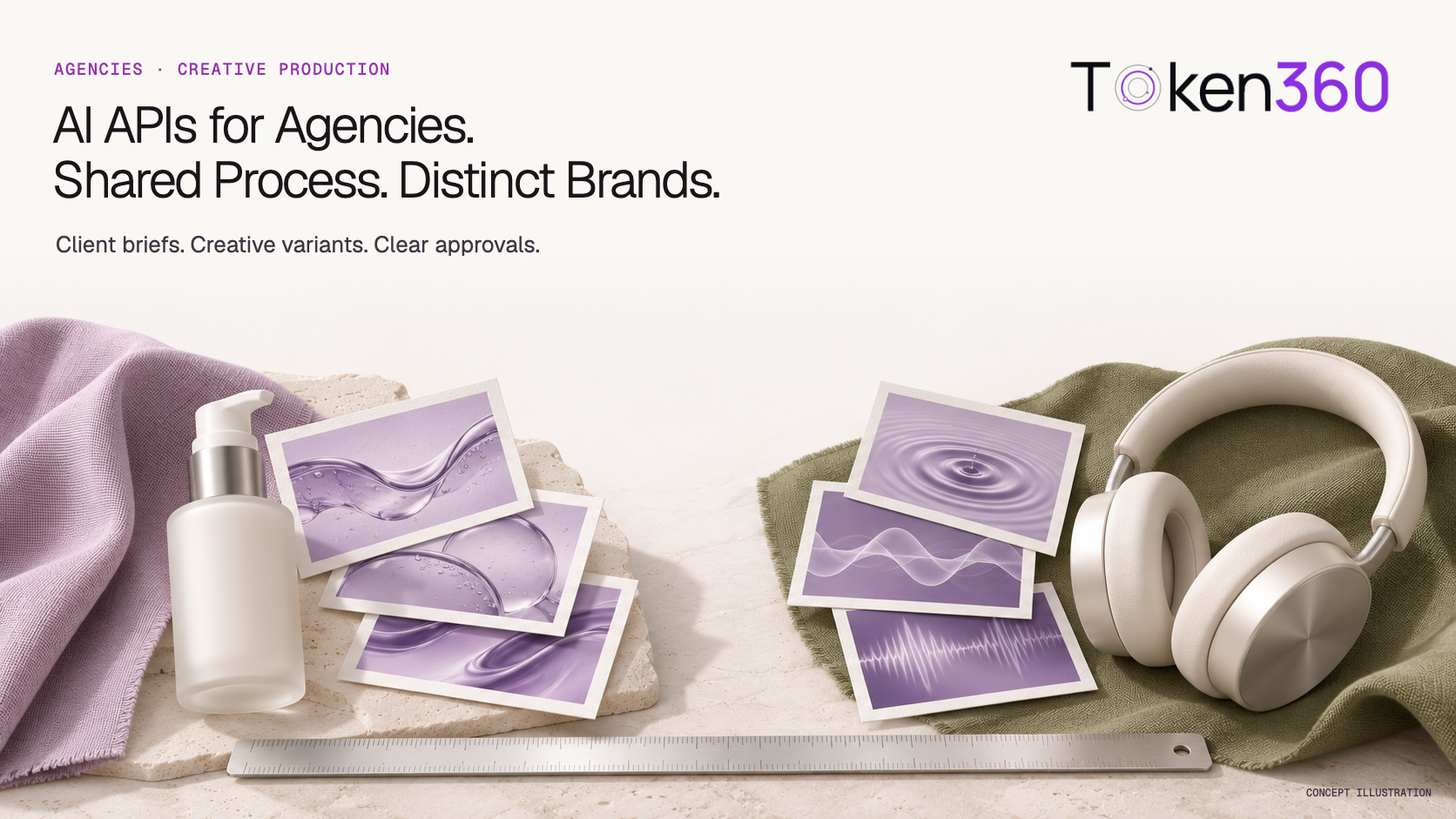
Consider a hypothetical agency preparing campaigns for a skincare brand and a headphone brand. Both need copy, images and short video. The skincare brief may prohibit medical claims and require a specific package reference. The headphone brief may require a particular control layout and exclude unverified noise-reduction claims. The generation steps can be similar while the acceptance conditions differ.
Keep the record compact enough to use. Link to authoritative documents rather than pasting every contract into a prompt. A producer should be able to answer: which brief is current, which references are authorized, what cannot change, and who can approve the result? If those answers are missing, generating more variations will not repair the brief.
Use the blank campaign production register to record these relationships. It is a proposed planning tool, not a Token360 feature or a completed customer dataset.
How should text, image, audio and video tasks connect?
Connect modalities through the same approved campaign record, with separate acceptance checks for each output. An approved copy draft should not automatically authorize its use as narration. An attractive image should not automatically become a video reference. Carry the relevant source version and review decision into each downstream task.
The process can be shared; client context and release decisions remain specific. Proposed agency workflow.
Start by approving the concept and claims. Generate a small image direction set, select suitable references, and then produce the video or audio variants the brief requires. This sequence avoids spending on downstream assets that depend on a concept the client has not accepted.
A generation response is a production event, not a creative approval. Record the model configuration and task identifier beside the output. If a model cannot preserve a required product detail, the producer needs a route to revise, edit or use a different production method. Do not turn every failed detail into another automatic generation attempt.
The distinction between approved asset access and approval workflows also appears in Adobe's GenStudio brand-governance documentation, which describes asset repositories and routing for review. Those are Adobe product capabilities, not evidence that an inference API supplies an agency's complete approval system.
Use the AI content brand review guide to turn each client’s brand rules into checks reviewers can apply across creative variants.
How can agencies prevent variant production from overwhelming review?
Define the purpose of each variation before generating it, then limit work in progress to what reviewers can assess. Separate creative exploration from production adaptation. Exploration asks which direction to pursue; adaptation applies an accepted direction to specified formats, messages or audiences. Mixing them makes both scope and approval harder to manage.
A hypothetical campaign could request two message angles in three formats. That creates six planned combinations before alternatives, edits or retries. This is an illustrative planning calculation, not a recommended production quota. The account lead should decide which combinations serve the brief and which merely add review work.
Agree on rejection reasons that change the next action: unsupported claim, wrong product detail, brand mismatch, technical format failure or subjective direction change. These should not all become “generate again.” A technical format failure may need an export correction; a direction change may require client clarification before more assets are made.
Track time waiting for review separately from model generation time. If drafts are ready but approvals take days, buying faster inference will not remove that bottleneck. For experiments involving audience performance, use the separate AI video ad-testing framework; an approved variant is not evidence of better campaign performance.
The Nano Banana Pro brand-concept prompt review examines what a brand name alone establishes in a generated visual brief. Use the recorded limitations when setting a review rubric.
What happens when the client changes the brief?
A brief change should identify which approved and in-progress assets are affected. Preserve the previous version, create a new source version and decide what needs review again. Avoid quietly updating a shared prompt while leaving downstream assets marked approved under an earlier set of instructions.
If the headphone client changes the approved product color, affected image and video outputs need visual review. If only a delivery deadline changes, the visual assets may remain valid. If a claim changes, copy, subtitles, narration and any visible text may all need attention. Impact should follow the changed requirement rather than trigger a complete regeneration by default.
Record whether a request corrects a production error or introduces new creative scope. That distinction supports the agency's discussion with the client, without deciding the commercial outcome automatically. Agree on responsibility and revision terms in the project arrangement; do not infer them from a model task's status.
What should an agency ask an AI API supplier?
Describe the workload the agency needs to run: modalities, approximate task mix, peak delivery windows, source-material constraints and acceptance requirements. Ask which parts of that workload are supported and which commercial or operational requirements need agreement. A model catalog alone does not answer how the agency will deliver a client campaign.
Model fit: Can candidate models handle representative briefs and required reference inputs?
Capacity: What concurrency and queue behavior are available for the expected production window?
Commercial scope: Which usage units apply, and how are additional attempts and model changes reflected in the quote?
Client material: What data-handling arrangements apply to the selected services and materials?
Operational responsibility: Who handles incidents, escalation and changes to the available models?
Token360's enterprise offering provides access across text, image, audio and video models, with custom enterprise pricing and tenant-wide key audit. Its public page marks priority support and SLAs as coming soon; higher throughput is a contact-sales item. Confirm the actual engagement terms rather than treating roadmap language as a standard commitment.
Token360's role here is the model-access and enterprise procurement layer. The campaign register, client-context controls, asset reviews and publishing decisions described above belong to the proposed agency workflow. They are not presented as native Token360 campaign-management features. For account-control questions, see who should own the company's AI API account.
How should the agency evaluate a first pilot?
Choose one recurring service and evaluate the complete path from approved brief to accepted deliverable. Record why outputs were rejected, how much review and correction they required, and whether the final assets met the agreed scope. A pilot should reveal the production work that remains, not just demonstrate that generation runs.
Include representative difficult inputs, such as a constrained product reference or a late claim revision. Keep the existing delivery method available for comparison. Define the observation window and the meaning of “accepted” before collecting results; otherwise a fast concept preview may be compared unfairly with a finished client deliverable.
Useful measures include elapsed time to approval, reviewer time, correction work and model usage per accepted deliverable. Report them separately before combining costs. This article contains no measured agency savings or client results. The proposed workflow is a starting point for an agency-specific pilot, not a forecast of its outcome.
When the campaign includes physical materials, use the print production brief workflow to pass approved dimensions, quantities and artwork into production.
Frequently asked questions
Can one AI API workflow serve several agency clients?
Yes, the orchestration can be reused if the application keeps client context, permissions and asset records separate. Reusing the workflow does not authorize reusing client materials. Confirm both the technical controls and the relevant client permissions before submitting inputs.
Will an API automatically keep generated assets on brand?
No. Model access does not by itself establish brand compliance. Approved references, explicit requirements and human review still matter. Validate the details that affect acceptance, including product appearance, claims, voice and channel requirements.
Should an agency build its own creative platform?
Only when the repeatable workflow and integration benefits justify the work. Existing creative tools may be sufficient for small or highly bespoke projects. An API can automate a narrow repeated step without requiring a complete custom platform.
Can the agency promise faster delivery after adopting AI?
Not from generation speed alone. Delivery also depends on briefing, selection, review, corrections and client approval. Measure the complete service before changing delivery promises, and distinguish a pilot observation from a contractual commitment.
Where does Token360 fit in an agency's stack?
Token360 can supply model access across text, image, audio and video, with enterprise commercial requirements scoped to the engagement. The agency must still design its campaign workflow and verify the models, capacity and terms needed for its client work.
Evidence scope: editorial workflow analysis using company-confirmed positioning and public documentation checked November 11, 2026. Client scenarios and planning examples are hypothetical. No customer deployment, controlled model evaluation or production savings are claimed.
Enterprise AI
API
Bring your next idea to life.
Create a video scene in Creator, or explore models for images, audio, and text to find the right capabilities for your project.


 Guides
 Guides
 Guides