AI Video Ad Testing: Why More Variants Don’t Automatically Mean Better Evidence
AI video ad testing needs more than creative variants. Compare hypotheses, audience allocation, and success metrics before treating a new asset as a winner.
AI video ad testing works best when generation serves a defined comparison. Producing twelve videos gives a team twelve creative options. It does not automatically create twelve useful experiments, identify the best message, or demonstrate incremental sales.
The commercial opportunity is real at the workflow level: teams can explore more ways to show a product. But the ability to generate assets and the ability to learn from audiences are separate constraints. A useful creative strategy connects the two before spending on distribution.
Read first: the text-to-video API workflow explains the production side of turning a brief into an asset.
This is an editorial decision framework, checked October 30, 2026. Google Ads documentation supplies the platform examples. The creative brief and allocation calculations below are hypothetical, not Token360 campaign results or a claim that AI-generated ads outperform conventional production.
The bottleneck can move from making ads to interpreting them
Imagine a team that previously commissioned one product video per launch. It can now generate different openings, backgrounds, and demonstrations. The tempting next step is to publish every acceptable version and rank them by a dashboard metric.
That ranking answers a narrower question than it appears to. If versions ran against different audiences, at different times, or with different offers, the observed differences combine creative and distribution effects. Even identical budgets do not establish equivalent exposure or comparable viewers.
More assets are valuable when they expand meaningful choices. They become harder to interpret when every version changes the product claim, camera movement, narrator, duration, and call to action simultaneously. The team may find a usable ad without learning which element to repeat.
A creative library is not an experiment design
Separate three objects in the production brief: the hypothesis, the asset, and the experiment arm. The hypothesis states the question. The asset is the finished video. The arm is the condition being compared, which may contain one or several assets depending on the design.
Object
Example
What it establishes
Hypothesis
A product demonstration opening works better than a problem statement
The intended comparison
Asset
A reviewed fifteen-second video with a particular opening
Something that can be distributed
Experiment arm
A campaign condition containing the demonstration version
The treatment whose outcome is measured
Google’s detailed video-experiment guide describes a basic two-arm creative test and a separate custom path. It also specifies campaign eligibility, so a procedure for one campaign type should not be assumed to apply to every placement. Check the current video experiment documentation when planning implementation.
The practical implication is independent of the interface: decide what the comparison should mean before choosing how many assets to generate. If a team wants to compare complete concepts, changing multiple creative elements can be intentional. The conclusion must then concern the concept package, not an isolated hook.
Original example: twelve assets, one focused question
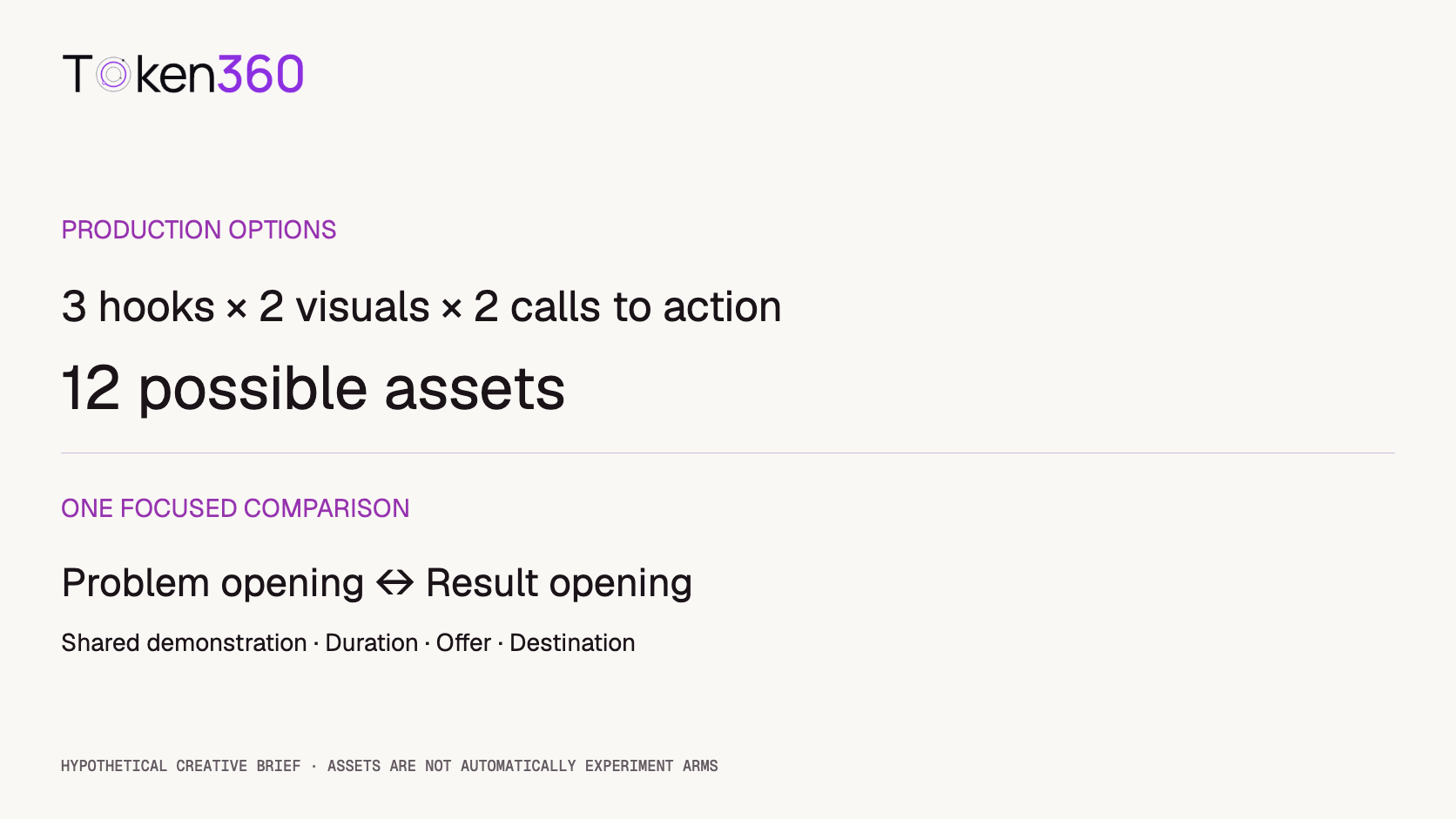
Consider a hypothetical software advertiser with three opening messages, two visual treatments, and two closing calls to action. The complete combination set contains 3 × 2 × 2 = 12 assets. That is a production count, not a recommendation to launch twelve arms.
One opening shows a frustrating manual task. A second shows the finished result. A third names the product benefit. The visual treatments are a close product demonstration and an abstract animation; the closing messages offer either a trial or a demo.
A focused first comparison could use the problem opening and result opening while retaining the same demonstration, duration, offer, and destination. Generating several candidates for each opening is still useful: production review can select a technically sound execution for each condition before launch.
However, one selected execution per message does not establish that every possible result-first ad will outperform every problem-first ad. Execution quality remains part of what was tested. Replicating the comparison with other executions would strengthen a broader messaging claim.
Hypothetical production space and a narrower experiment answer different questions.
Why audience allocation deserves its own budget conversation
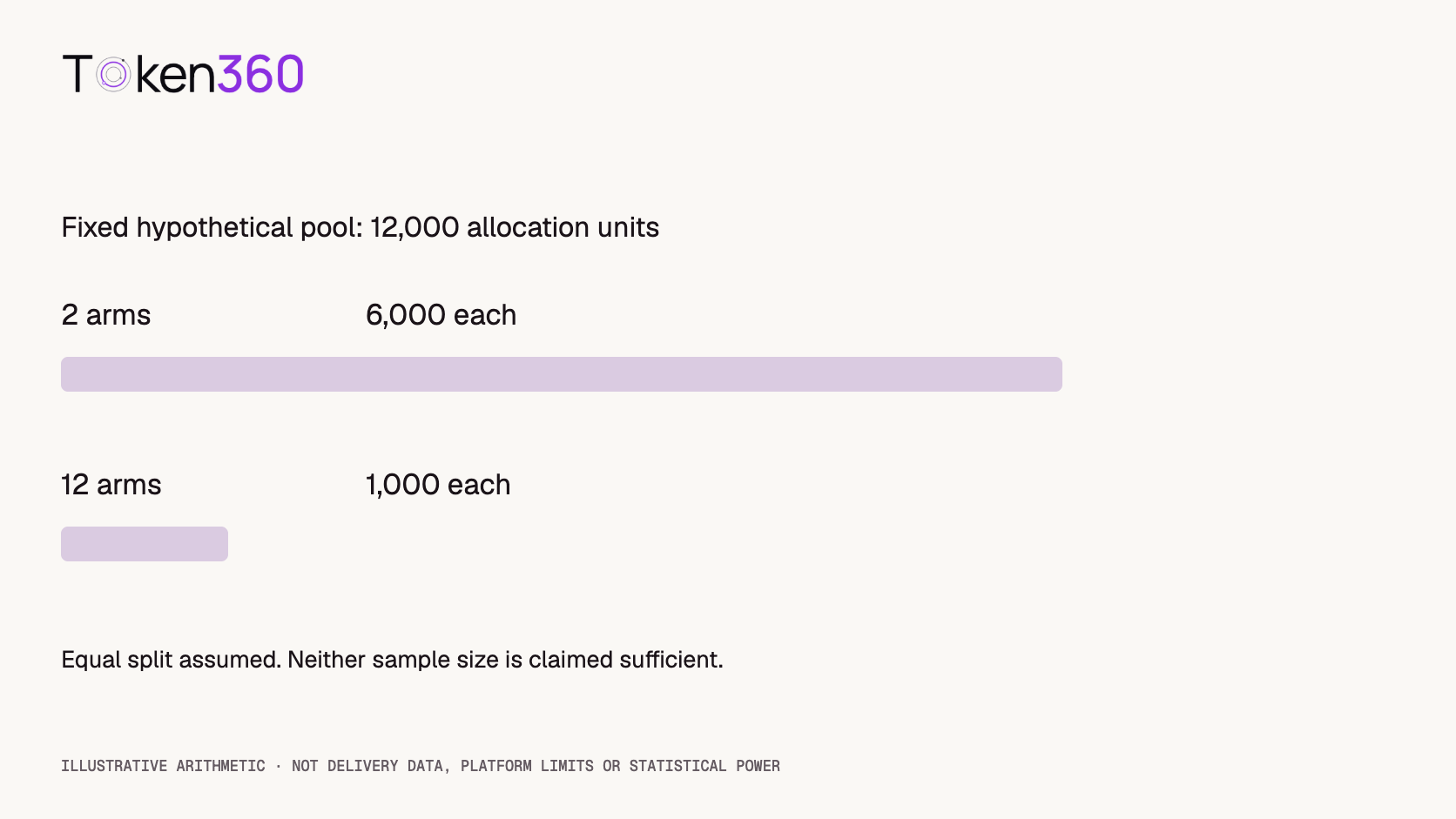
Here is a deliberately simplified planning calculation. Suppose a fixed pool contains 12,000 eligible allocation units and is divided equally. Two arms receive 6,000 units each. Twelve arms receive 1,000 each. The second design spreads the same pool six times more thinly per arm.
Hypothetical design
Total allocation units
Equal allocation per arm
2 arms
12,000
6,000
12 arms
12,000
1,000
These units are arithmetic placeholders, not measured impressions, independent people, or conversions. This is not a sample-size or statistical-power calculation, and the twelve-arm case is not a Google Ads configuration recommendation. Real delivery and the platform’s assignment mechanism must be examined separately.
The example shows why cheaper asset creation does not remove the need for sufficient evidence. The required sample depends on the metric, baseline rate, effect worth detecting, uncertainty tolerance, and experimental design. A team should not infer that either 1,000 or 6,000 is universally sufficient.
Original arithmetic under equal-allocation assumptions; not observed delivery or a power estimate.
Choose the decision metric before seeing the winner
A video can be attention-grabbing and still fail to attract suitable customers. Match the primary metric to the decision: an awareness question differs from a qualified-lead or purchase question. Track supporting metrics to explain behavior, without silently replacing the original objective after results arrive.
For example, a dramatic opening might increase clicks while attracting people who misunderstood the offer. A calmer demonstration might generate fewer clicks but more relevant inquiries. This is a hypothetical tradeoff, not evidence that either style generally performs better.
Write down the conversion definition, attribution window, exclusions, evaluation period, and what would count as a meaningful improvement. Include a quality check appropriate to the business, such as lead relevance. Let delayed outcomes mature before treating partial results as final.
Google’s experiment overview describes dividing traffic or budget to compare changes over a defined period. That is a different evidential setup from simply comparing the totals of separately delivered ads. See Google Ads’ experiments overview.
Separate creative screening from audience evidence
Internal review can reject unreadable product text, incorrect demonstrations, broken audio, or an inaccurate offer before paid distribution. It can also confirm that the two intended treatments are genuinely different. These checks protect the test from avoidable production errors.
An internal reviewer’s preference does not establish customer preference. Likewise, a model-generated score of “persuasiveness” is an evaluation input, not observed campaign performance. Use screening to make candidates eligible; use the planned audience comparison to evaluate the selected commercial question.
Keep a durable mapping from each ad identifier to its final file, prompt version, model identifier, source assets, and human edits. The submitted API response alone is not the complete creative record if the video was later trimmed, dubbed, or overlaid with a different offer.
For production acceptance criteria, adapt the AI model evaluation framework. Keep those criteria distinct from the campaign’s success metric.
Write conclusions at the level the evidence supports
“Version B received more clicks in this delivery period” is an observation. “Version B improved our chosen metric under this experiment” is a stronger statement requiring the relevant experiment evidence. “Result-first openings are always better” is a much broader claim that one comparison cannot support.
Read uncertainty alongside the estimated effect. A small apparent lead may be inconclusive; a precise difference may still be too small to matter operationally. Google publishes a statistical methodology for experiments, including its confidence-interval approach. Do not assume every campaign report or external spreadsheet reproduces that method.
When evidence is inconclusive, preserve that outcome. A team can still make a constrained business choice, such as retaining the cheaper approved asset, while recording that the test did not establish a performance advantage. That is more useful than relabeling an uncertain result as a win.
Where Token360 fits in the creative pipeline
A generation API can support asset production and make production inputs easier to record. It does not, by itself, randomize ad exposure, validate attribution, or measure incremental revenue. Those responsibilities belong to the experiment and analytics workflow.
Check Token360’s model capability documentation and the selected model schema for the required inputs and outputs. Then connect approved files to the advertising workflow using stable identifiers. Evaluate generation cost separately from media spending and outcome uncertainty.
FAQ
What is AI video ad testing?
It is the evaluation of video advertising that uses AI-generated components or assets. A controlled comparison needs a defined question, comparable conditions, and an outcome metric; generating variants is only the production step.
Should every generated variant become an experiment arm?
No. Review can remove unusable or redundant candidates first. Choose arms around the question and available evidence, rather than the maximum number of files the production system can create.
Can I change the hook, visuals, and offer together?
Yes, when comparing complete concepts is intentional. Interpret the result as a comparison of those packages. It cannot isolate the contribution of the hook without additional design work.
Is click-through rate enough to choose the best video?
Only when it answers the intended decision. A conversion-focused business should also consider the relevant downstream outcome and quality, with definitions selected before reviewing the results.
How many impressions does a test need?
There is no universal number. Baseline performance, the effect worth detecting, assignment method, and uncertainty requirements matter. The 12,000-unit example above illustrates allocation only.
Does generating ads through Token360 prove a performance improvement?
No. Production capability and advertising effectiveness are separate claims. This article includes no measured campaign uplift, and no model or platform is presented as a guaranteed winner.



 Tutorial
 Comparison
 Tutorial