AI Video Client Handoff: What Makes a Generated Clip a Deliverable?
Plan an AI video client handoff with final exports, version records, approval scope, and publication notes that turn a generated clip into a usable deliverable.
An AI video becomes a useful client deliverable when the recipient knows which file to use, what was approved, and what still needs a decision. A successful generation establishes that a system produced an output. It does not establish that a brand team can publish that output without reconstructing the production history.
This distinction matters for agencies, in-house studios, and product teams commissioning video. The handoff is where creative work becomes someone else’s operational responsibility. A strong delivery package reduces ambiguity without turning every small project into a documentation exercise.
This article presents a Token360 editorial framework, not findings from a client survey. Its examples and counts are hypothetical. Platform disclosure information and provenance definitions were checked against official sources on October 30, 2026.
A good-looking preview can still create a poor handoff
Consider a hypothetical product launch. A creative team sends a compelling preview in a chat. The recipient approves the general direction. Later, another person downloads a similarly named export and schedules it for publication. The export contains an older price card and different music.
The failure is not necessarily generation quality. It is a broken connection between the approval and the delivered file. “Looks good” referred to one preview, while the publishing team received another object. Producing a higher-resolution version would not fix that mismatch.
For handoff purposes, approval should point to an identifiable version and a stated scope. A review of the visual concept is different from approval of product claims, soundtrack, captions, or a channel-specific export. The team can keep the process lightweight while making those distinctions explicit.
Define the deliverable around the recipient’s next action
The most useful question is what the recipient must do next. A media buyer may need final exports for named placements. An editor may need a master and separate audio. A product marketer may need the final copy, caption file, and a record of the approved demonstration.
Recipient
Next action
Handoff information that helps
Publishing team
Schedule the correct version
File-to-placement mapping and publication notes
Editor
Make an agreed adaptation
Source files, dependencies, and permitted change scope
Brand or product owner
Confirm the intended message
Final preview, claims, and unresolved questions
Campaign analyst
Connect results to creative
Stable asset identifier and campaign mapping
Do not promise editable source materials merely because the output was generated through an API. A rendered clip is not an editing timeline, a layered project, or a reusable scene. Agree on which materials exist and which are included before treating them as part of the delivery.
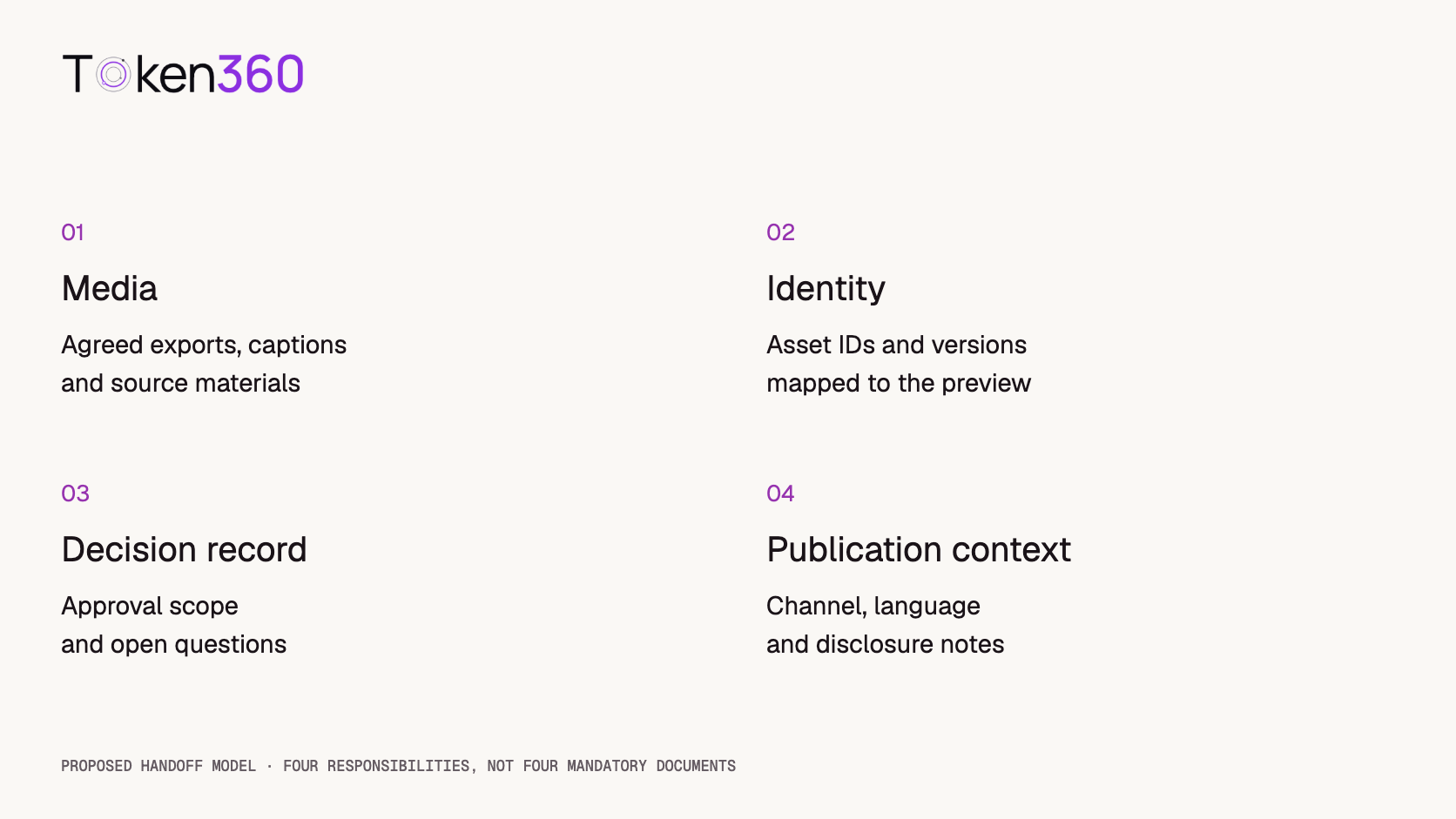
Four layers of a practical delivery package
The following four-layer model is an editorial proposal. It is not a certification standard or a requirement imposed by Token360. Its purpose is to keep a playable file connected to its meaning and intended use.
Media: the approved exports and any agreed master, caption, or audio files.
Identity: stable asset IDs, version labels, and a mapping to the approved preview.
Decision record: what was reviewed, who approved it, and which issues remain open.
Publication context: intended channel, language, placement, and disclosure information for the publisher to evaluate.
The package can be a folder plus a short manifest. It need not expose internal prompts, confidential references, API credentials, or every discarded attempt. Include only the production information the recipient needs or that the project agreement calls for.
A proposed operating model: four connected responsibilities, not four mandatory documents.
Original scope example: one concept, six delivery files
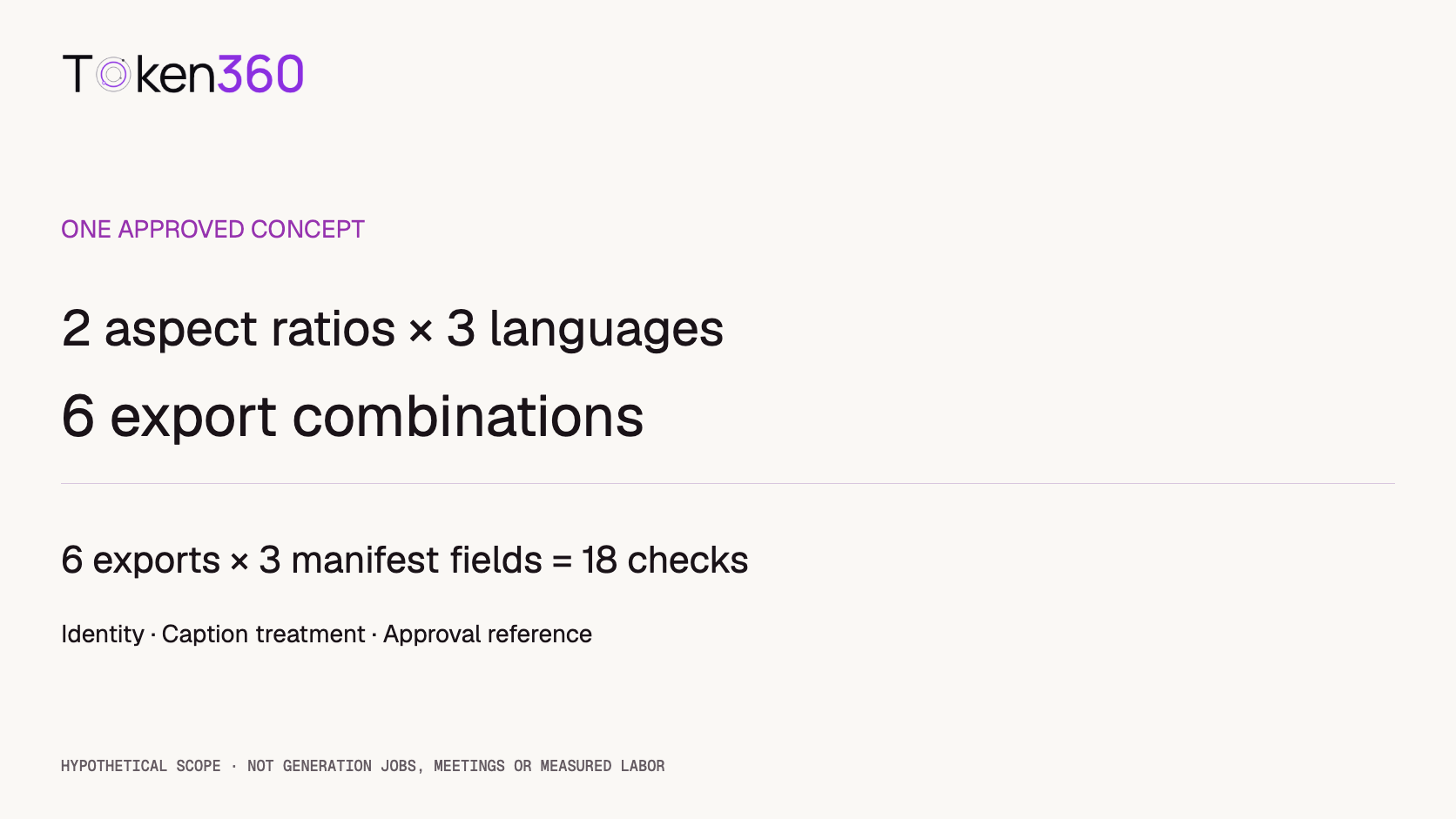
Suppose a team agrees to deliver one approved concept in two aspect ratios and three language versions. That creates 2 × 3 = 6 delivery files, assuming one export for each ratio-language combination. It does not mean six independently generated videos.
If each export needs confirmation of its identity, caption treatment, and approval reference, the manifest contains 6 × 3 = 18 field checks. These are record checks, not measured review hours, separate meetings, or a prediction of project cost.
Planning input
Hypothetical value
Approved concepts
1
Aspect ratios
2
Language versions
3
Final export combinations
6
Manifest fields checked per export
3
Total field checks
18
For example, launch-A-v03-vertical-en could identify a particular export. A separate row records the final filename, the caption treatment, and the approval reference. The exact naming convention matters less than keeping the relationship understandable and stable.
This small calculation exposes a common scoping issue: one creative idea can produce several deliverables. A revised headline might affect every language version, while a crop adjustment affects only one ratio. The change request should identify the affected exports rather than silently replacing the entire folder.
Original hypothetical scope arithmetic. Counts describe exports and records, not generation jobs or measured labor.
Approval should travel with the exact version
A lightweight approval record can state the asset ID, preview reference, reviewer, date, and approved use. Add open issues in plain language. “Visual direction approved; final product text pending” is more actionable than an unlabeled green checkmark.
Once an approved export changes, treat the new file as a new revision. A spelling correction may require only a narrow review; a different product demonstration may require a broader one. The review scope should follow the actual change rather than restarting everything or assuming nothing matters.
Keep technical acceptance separate from content approval. A file can decode correctly while showing the wrong product feature. Conversely, an approved message can sit in an export with a missing audio track. The AI model evaluation framework can help define production criteria before the handoff stage.
Publication notes need to describe what was generated
The publisher may not have attended the creative review. Give that person a concise account of the synthetic elements: generated scene, altered voice, replaced background, or generated music. Avoid a vague “AI used” note that leaves the recipient guessing what viewers will see or hear.
YouTube’s current guidance requires disclosure for realistic AI-generated or meaningfully altered content and includes specific examples. It also distinguishes minor edits and non-realistic content. Check the platform’s GenAI disclosure guidance for the actual asset and publishing context rather than assuming every use of an AI tool has the same treatment.
This handoff note supports a publishing decision; it does not replace the platform’s upload controls or establish that an asset satisfies every requirement. Record the intended destination so a later reuse on a different channel prompts a fresh check of the applicable guidance.
Content Credentials add provenance, not approval
Content Credentials can carry signed, tamper-evident information about an asset’s origin and history. They are not the same thing as a client’s approval record. The C2PA FAQ also distinguishes provenance from digital rights management: the credentials describe history rather than controlling use.
The C2PA explainer makes a further distinction: provenance alone does not determine whether depicted content is true, accurate, or factual. A product claim still needs a suitable review even when a file has verifiable credentials.
Where the workflow supports provenance, inspect the final export rather than assuming credentials survived every edit. Keep the ordinary asset manifest as well. That record can connect the delivered file to the project even when the receiving system does not display provenance information.
A useful delivery metric is avoidable clarification
Teams often count generation attempts and rendering time. For handoffs, also consider recording why recipients return with questions. “Which file is final?”, “Is this language version approved?”, and “Does this include the music?” point to different gaps.
A small internal pilot could track the number of handoffs requiring clarification, the categories of missing information, and the time until the recipient can proceed. Define the unit consistently: one project, one export, or one package. Do not compare a project-level rate with a file-level rate.
These are proposed measurements, not results from a Token360 study. They can help assess whether a delivery manifest earns its maintenance cost. If the recipient still cannot identify the approved file, adding more descriptive fields is unlikely to solve the underlying version problem.
Where an API workflow helps—and where ownership stays human
An API workflow can make generation inputs and outputs easier to associate with an asset ID. Its request record is one part of the history, not proof of publication readiness. Human edits, soundtrack changes, and client decisions may happen after generation completes.
Use Token360’s model capability documentation and the selected model’s schema to confirm supported output options. This article does not claim that Token360 automatically produces client approval records, Content Credentials, or channel-specific disclosure decisions.
Assign a delivery owner who can resolve the final mapping between approved preview, export, and intended use. That responsibility is often more valuable than another round of filenames containing “final.”
FAQ
What is an AI video client handoff?
It is the transfer of the agreed video assets and the information needed to use them. A practical handoff identifies the final files, approval scope, intended destinations, and remaining decisions.
Is an MP4 enough for delivery?
Sometimes, if that is the agreed scope and the recipient has all necessary context. Otherwise, captions, a version manifest, a master, or publication notes may also be needed.
Should clients receive every prompt and failed generation?
Not automatically. Agree on the materials required for the project. Preserve useful internal records while sharing only the information needed for delivery or specifically included in the scope.
Does one approval cover every export?
Only if the approval explicitly covers those versions. A language change, crop, soundtrack, or revised offer can introduce differences that were absent from the reviewed preview.
Do Content Credentials prove a video is approved or accurate?
No. Provenance information and client approval answer different questions. A credential does not replace review of a product claim or confirmation of the intended use.
How can a team evaluate its handoff process?
Track missing-file incidents, clarification requests, and whether recipients can identify the approved version. Keep definitions consistent and compare against the team’s own baseline before claiming an improvement.



 Tutorial
 Comparison
 Tutorial