Decide who controls your AI API account when an agency builds the application. Separate administration, billing, working access and handover duties.
ENTERPRISE AI · ACCOUNT OWNERSHIP
When an agency builds an AI application your company intends to operate, company-controlled API administration is usually the clearer starting point. The agency can receive the access needed to build and support it. If you are instead buying an agency-operated service, an agency-held account can fit—but billing, visibility and exit responsibilities must be explicit.
AI API account ownership is a business operating decision, not just the choice of who clicks “sign up.” A company may pay for the project while the agency alone controls the account, recovery details and production credentials. Another company may hold the account but have no one prepared to manage it. Neither arrangement becomes workable simply by naming an “owner.”
Scope: “Ownership” here means administrative and commercial responsibility for the API relationship. It does not determine intellectual-property rights in code, prompts or generated assets. This is an editorial decision framework, not a customer case study or a claim about Token360 account-transfer entitlements. Public sources were reviewed on November 10, 2026.
Read first: If you have not decided what you are buying, start with AI software versus model API access. An agency delivering a finished managed service creates a different relationship from an agency building software for your company to run.
Which ownership arrangement fits the service you are buying?
Choose the arrangement according to who will operate the application after delivery. Company-controlled administration fits a company-operated product. Agency-controlled administration can fit a genuinely managed service. The important distinction is whether the agency is delivering your application or supplying an ongoing service of its own—not whether one party is more technical.
Decision
Company-controlled API account
Agency-operated service account
Primary relationship
The company maintains the inference supplier relationship.
The agency maintains the supplier relationship for the service it operates.
Agency's role
Build or support the application through approved access.
Operate the service and report against the agreed scope.
Company's responsibility
Name administrators, approve spending and maintain operational coverage.
Agree visibility, service obligations and an exit arrangement.
Key question at handover
Can the company continue operating without the departing builder?
What can the company retain or move when the managed service ends?
These are proposed operating patterns, not a statement that every provider supports every delegation or transfer mechanism. Confirm the available account roles and supplier terms before choosing one. If the agency operates several clients under an account, ask how your project's usage, access and records are separated; a client label alone does not establish isolation.
What does “company control” need to include?
Company control should cover administration, recovery, billing visibility and authority to approve changes. It is more than possession of a working inference key. The business needs a named internal owner and a recoverable administrative route, while technical operators need enough information to maintain the application without depending on one external person.
Record which organization holds the supplier relationship, who can change administrators, where recovery messages go, and who can approve spending or resolve a billing issue. Use company-managed identities where the platform supports them. Assign a backup owner or approved recovery process rather than making a contractor's personal mailbox the only path back into production.
Do not confuse the account owner, bill payer and application operator. They can be different parties by agreement, but their responsibilities should be visible. For example, finance may approve payment, an internal platform team may administer the account, and an agency may maintain the application. The record should identify all three roles.
Having the API account under company control also does not transfer control of the hosting environment, domain, source repository or data store. Review those dependencies separately. An application can remain dependent on the agency even after its inference credentials are replaced.
How much access should the agency receive?
Give the agency access matched to its actual work, using the roles and scopes the provider supports. Building an inference integration does not automatically require authority over organization-wide administration or billing. When broader access is necessary, name the reason, approver and review point rather than granting it indefinitely by default.
AWS's identity and access guidance recommends least privilege and regular review of unused permissions. Those are useful general design principles here; AWS-specific roles or temporary-credential features should not be assumed to exist in Token360.
Separate the credentials used by the running application from the access used by people managing it. For the Token360 distinction, read management API keys versus inference API keys. A successful model request is not a reason to distribute the company's administrative credential to every developer.
If the platform cannot express the scope you need, revise the workflow. A company administrator may need to perform the privileged setup while the agency works through a narrower integration. Verify the supported access model instead of inventing a role name or assuming that a separate key creates a separate account boundary.
Who pays for development, production and rework?
Decide who funds each class of usage before the agency starts. Development experiments, production traffic and remediation can have different budget owners. Separate the supplier's usage charges from the agency's implementation or managed-service fee so both parties understand what is included, what requires approval and how unexpected consumption will be handled.
With a company-held account, direct usage visibility can help the company review costs, but it also needs someone to act on that information. With an agency-operated service, the company may receive a bundled price rather than raw supplier charges. Either can work if the commercial scope and reporting basis are clear.
Ask whether the quoted project price includes testing, how additional usage is approved, and what reporting accompanies a monthly service charge. Do not assume all failed generations are unbilled or that every retry is the agency's responsibility. Use the actual billing record and the agreed project policy to resolve those questions.
Token360's company-confirmed position is that it does not charge a separate service fee. That does not determine what an agency charges for development or operations. Keep those separate relationships visible. For internal department allocation after purchase, use the AI API chargeback guide.
What should remain accessible if the agency changes?
The company should know which operational records and application assets it needs to continue the agreed service, and how it will obtain them. Define that handover before production. A supplier account may not be transferable, and changing the name on a project document does not establish that its credentials, history or assets can move.
A practical handover inventory includes the supplier account reference, application configuration, model identifiers, parameter choices, deployment instructions, secret-storage locations, billing records available to the company, and the contacts responsible for incidents. Record where secrets are managed; do not place live keys in the handover document.
Also identify resources outside the model API: uploaded files, storage buckets, callback endpoints, scheduled jobs and application databases. A company-controlled inference account does not help if the application still needs an agency-owned callback service that disappears when the engagement ends.
For an agency-operated service, the achievable handover may be different: exported business records and a transition period rather than the agency's entire infrastructure. Establish what the agreement permits and what the supplier can support. Do not assume source-code rights, account assignment or credit transfer follow automatically from paying invoices.
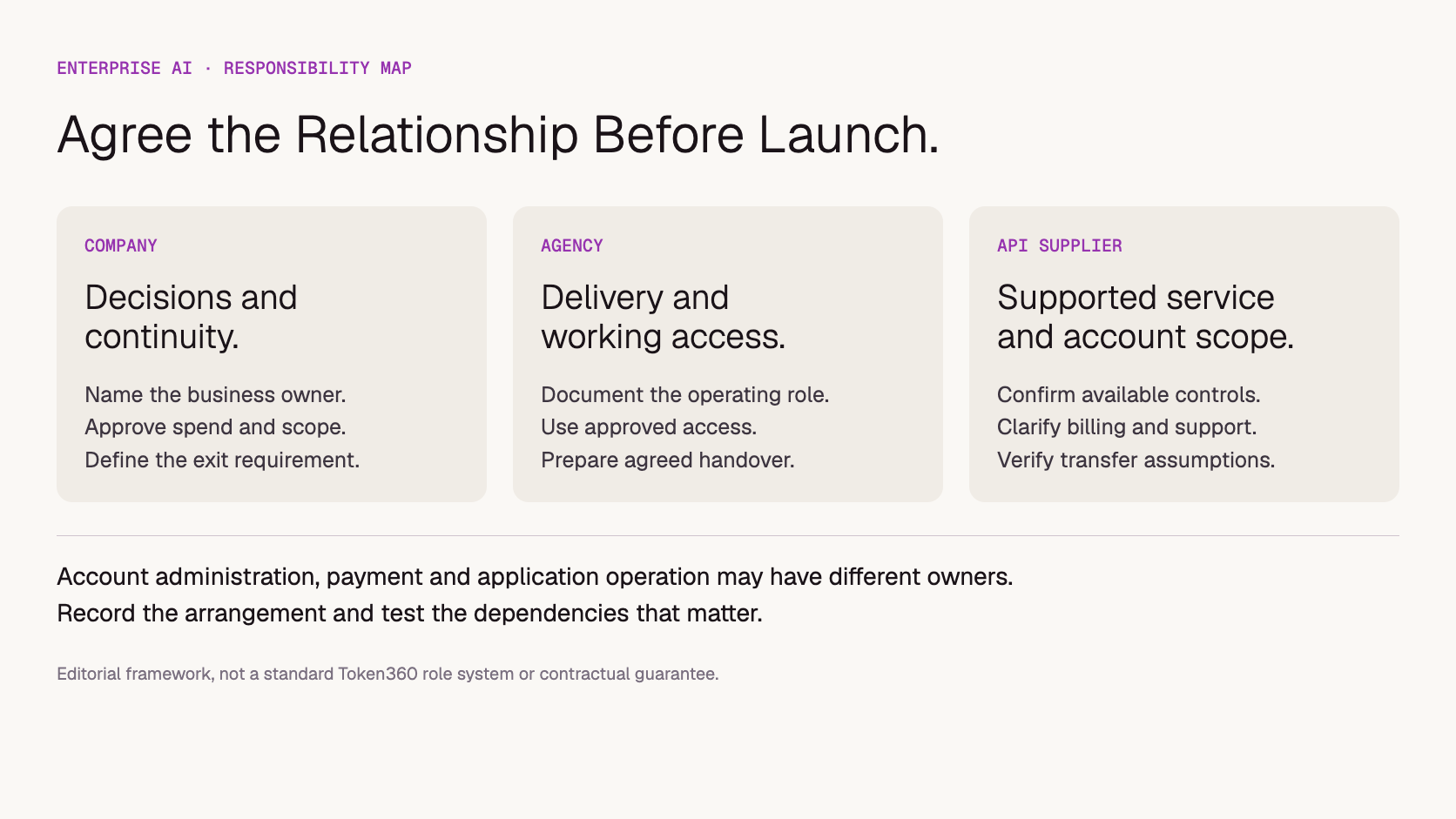
An editorial responsibility map; it does not describe a guaranteed provider role or transfer feature.
How can you check the arrangement before launch?
Run a controlled operational handover check before relying on the application. Verify that the company's designated owner can reach the account information they need, that production runs under the intended credentials, and that another authorized operator can follow the deployment record. The goal is evidence of continuity, not simply a promise to hand things over later.
For an illustrative company-owned support application, that check could confirm that the internal owner can inspect usage, a second operator can locate the approved configuration, and a test deployment works without the agency founder's personal account. This is a proposed check, not a completed Token360 test or a universal feature list.
Use a non-production environment or a planned change window for disruptive access changes. Do not revoke the only working production credential just to prove independence. If the company cannot operate without the agency, record that as a dependency with an owner and a planned resolution rather than calling the handover complete.
The API key offboarding guide covers the detailed revocation and verification procedure. This article's decision comes earlier: who should retain control and what must remain operational when that procedure is needed.
What should you confirm with Token360?
Describe the intended relationship to Token360 before choosing the account structure: which company will buy inference, who will administer it, and whether an external agency will build or operate the application. Confirm the available member and key controls, reporting scope and recovery process. Do not assume an account can later be reassigned between organizations.
The Token360 enterprise page, reviewed November 10, 2026, describes enterprise accounts, sub-accounts, tenant-wide key audit and unified wallet billing. These public capabilities are relevant to administration, but do not establish a complete agency-management package, cross-client isolation guarantee or account-transfer procedure.
Token360 supplies access to text, image, audio and video models, with enterprise pricing, capacity, contracts and compliance requirements scoped to the engagement. Ask which entity and workloads the proposal covers. An agency's existing commercial arrangement should not be assumed to transfer unchanged to a client-held account.
A concise supplier question is: “Our company will operate the finished application, and an external agency will build it. Which supported structure lets us retain administration and billing visibility while giving the agency the required working access?” If the agency will operate the service instead, say so explicitly; that changes the relationship being reviewed.
What should the project record say?
Write down responsibility for administration, payment, operations and exit in one reviewable record. Each item needs a named owner, evidence of access or responsibility, and any unresolved dependency. The document should be understandable to procurement and the future operator, not only to the developer who created the first API key.
Decision to record
Evidence to keep
Who controls the supplier relationship?
Organization and account reference, named administrator and recovery process.
Who authorizes and pays for usage?
Billing basis, approval route and development/production scope.
What may the agency access?
Supported roles or credential scope, purpose and review point.
Who operates the application?
Deployment record, incident contact and coverage arrangement.
What happens when the engagement ends?
Permitted deliverables, transition responsibilities and verified continuity checks.
Use the blank AI API account ownership template to capture these decisions. It is a planning record, not a contract or a platform configuration file. Resolve uncertain capabilities with the supplier and uncertain obligations with the parties responsible for the agreement.
Can the agency use its own API account for a demonstration?
That can be a reasonable prototype arrangement if usage, data and costs are approved for the demonstration. Decide the production structure separately before relying on the prototype's account for a live business application.
If our company pays the bill, do we automatically control the account?
No. Payment does not establish who can administer, recover or transfer an account. Verify the account arrangement and applicable terms instead of using the invoice payer as a substitute for that check.
Can we just copy the agency's API key at handover?
A copied key does not establish account control, billing visibility or an approved long-term arrangement. Confirm the intended organization and supported access structure, then complete the appropriate credential and deployment transition.
Does a company-held account mean we do not need ongoing support?
No. The application still needs maintenance and incident ownership. Your company can retain account control while contracting an agency to perform those tasks through approved access.
Does Token360 guarantee account transfer from an agency to a client?
This article does not establish that capability. Confirm the supported process and commercial scope with Token360 before promising an account transfer or assuming that balances, terms and history will move.


 Guides
 Guides
 Guides