Last updated: September 28, 2026
A video generation request times out. Should your application send it again?
The answer depends on what timed out.
A failed status check may require another read of the same task. An interrupted download may require retrieving the existing video again. A submission timeout is more complicated: the provider may already have accepted the generation, even though your application never received the response.
Treating these situations as the same error can create duplicate videos, additional charges, and confusing results for users.
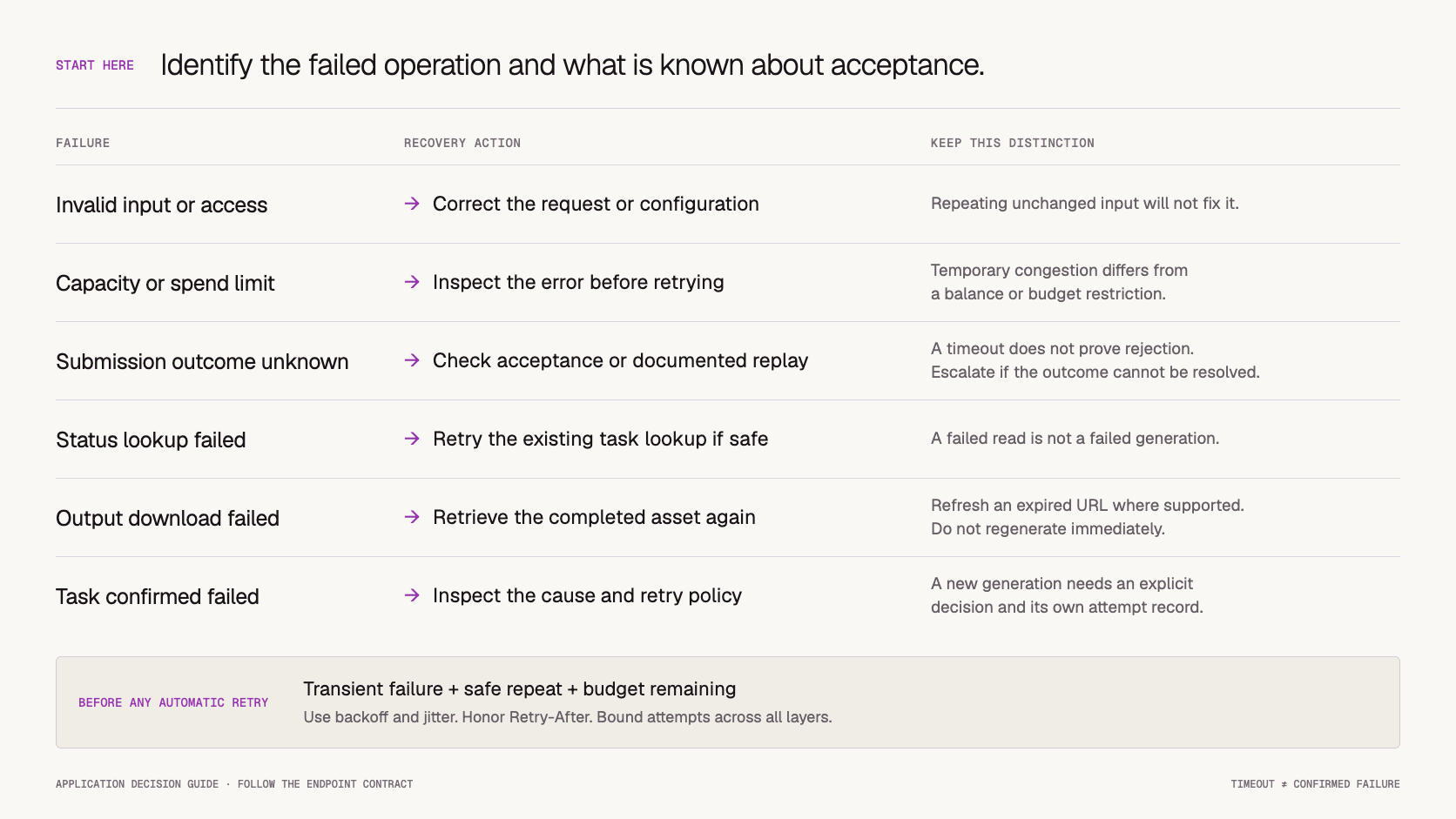
Reliable AI video API error handling starts by identifying the failed operation and what is known about its outcome. Only then should the application decide whether to retry, wait, correct the request, or escalate.
The core rule is straightforward: retry an operation only when another attempt is useful and safe.
This guide explains how to classify failures, preserve uncertain submissions, use idempotency correctly, bound retry traffic, and design recovery paths that users and operators can understand.
Before You Read
This guide assumes your application already stores video jobs and tracks their progress.
For the surrounding workflow, start with:
For the concrete task states used by Token360, review Poll Video Generation Status.
This article focuses on choosing the correct recovery action after one of those operations fails.
AI Video API Errors at a Glance
The HTTP status is useful evidence, but it is not the complete decision.
A timeout during submission and a timeout during polling can look similar at the transport layer while requiring different recovery behavior.
Why a Generic Retry Loop Is Not Enough
A generic retry loop assumes that repeating the request is both helpful and harmless.
That assumption does not hold for every video operation.
Reading task status observes existing work. Submitting a generation can create new work. Downloading a completed asset retrieves a result that may already have incurred generation cost.
Google Cloud’s retry strategy guidance separates two questions: whether the response indicates a transient problem, and whether the operation is idempotent. That distinction applies to video integrations, although Cloud Storage’s specific defaults do not.
For each failed operation, ask:
-
Is another attempt likely to succeed without changing the request?
-
Could the previous attempt already have taken effect?
-
Does the endpoint document a safe way to repeat it?
-
Is there enough time and budget for another attempt?
An error handler that answers these questions can recover selectively instead of multiplying work.
Classify the Failure by Operation and Outcome
Primary purpose: Choose recovery based on what failed, not just the returned status code.
Record the operation before sending the request. At minimum, distinguish submission, status lookup, output retrieval, and cancellation where supported.
When a failure occurs, capture the HTTP status, provider error code, model, request ID, task ID, and the application’s acceptance assessment.
Useful acceptance categories include:
-
Not submitted: The application rejected the request locally.
-
Confirmed rejected: The provider explicitly rejected it before task creation.
-
Confirmed accepted: A task ID or equivalent acknowledgment was recorded.
-
Unknown: The request may have been accepted, but the application cannot confirm it.
Do not assign “confirmed rejected” based on a vague transport error or a generic server response alone. The endpoint’s contract determines what the response proves.
Preserve the original error alongside your internal category. Normalization makes the product consistent; the original details remain necessary for investigation.
Implementation consideration: Redact credentials, private media URLs, and unnecessary prompt content from routine logs. Retain identifiers that support correlation.
Correct Validation and Access Errors Before Retrying
Primary purpose: Avoid repeated requests that cannot succeed without a change.
An unsupported resolution, invalid media file, or missing required parameter needs a corrected request.
Authentication and permission failures need a different intervention: repair the key, environment configuration, model entitlement, or workspace access.
Repeating the same request does not fix either class.
Validate predictable constraints before submission where practical. Check required fields, supported combinations, media format, and input availability. Backend validation is still necessary even if the interface restricts the available choices.
Do not silently remove requested features or switch models to make an invalid request pass. Such changes can alter the intended result.
For example, if a selected model does not support the requested audio behavior, explain the constraint and let the user choose an acceptable configuration.
Implementation consideration: A corrected generation is a new intent when its meaningful parameters change. Do not reuse an upstream idempotency key with a different payload unless the provider explicitly supports that behavior.
Preserve Uncertainty After a Submission Timeout
Primary purpose: Prevent an unknown outcome from becoming an accidental duplicate generation.
The most consequential failure occurs when the provider accepts a request but the response disappears.
Your application cannot safely conclude that the task failed. It also cannot assume that resubmitting will return the original result.
Use the available evidence in order:
-
If a provider task ID was recorded, inspect that task.
-
If documented idempotent replay is available, follow its exact rules.
-
If a documented client-reference lookup exists, search using the original reference.
-
If none of these mechanisms exists, retain the unknown state and investigate before creating another paid task.
Generic reconciliation cannot recover an identifier that the provider never exposes or makes searchable.
Avoid matching tasks solely by prompt text. Two legitimate requests may use the same prompt, and choosing the wrong task can attach an unrelated output to the job.
Implementation consideration: An exhausted submission timeout is a local observation. It is not a terminal generation result.
Use Idempotency Keys for One Intended Operation
Primary purpose: Make supported retries refer to the same generation intent.
Create an operation ID when the application accepts the user’s generation request. Persist it before making the external call.
If the provider supports an idempotency key, associate that key with the operation and reuse it for retries within the documented scope and retention window.
Do not generate a new key on every retry. That turns repeated attempts into separate identities.
The request must remain consistent. A key reused with a different model, prompt, duration, or input asset can produce a conflict or undefined behavior, depending on the API.
The Amazon Builders’ Library explains caller-provided request identifiers in making retries safe with idempotent APIs.
Application-level deduplication remains useful even when upstream support is absent. It can stop a double-click from creating two local jobs. It cannot prove that an external submission executed only once.
Implementation consideration: A field named request_id may provide correlation without replay protection. Verify its documented semantics before treating it as an idempotency key.
Apply Bounded Backoff Only After Establishing Retry Safety
Primary purpose: Recover transient failures without overwhelming the service.
Once an operation is safe to repeat, schedule retries with increasing delays and jitter.
Backoff creates space between attempts. Jitter prevents many clients from retrying at the same moment.
Set both a maximum attempt count and a total elapsed-time budget. Account for request duration as well as waiting time.
Where the provider returns valid Retry-After guidance, do not retry earlier than instructed. If the delay exceeds the remaining interactive deadline, schedule background recovery or surface a deferred state instead of keeping the user request open indefinitely.
An illustrative decision flow is:
handle_failure(operation, error):
    classification = classify(operation, error)

if classification.requires_change:
        return needs_action

if operation.creates_work and replay_safety_is_unknown:
        return needs_reconciliation

if not classification.is_transient:
        return stop_or_review

if retry_budget_is_exhausted:
        return defer_or_escalate

schedule_safe_retry_with_backoff_and_jitter()
This is application pseudocode, not a provider retry specification.
Implementation consideration: Exhausting the retry budget stops automatic attempts. It does not establish that the underlying generation failed.
Control Retries Across the Entire Stack
Primary purpose: Prevent individually reasonable policies from combining into excessive traffic.
An SDK, gateway, worker, and application can each retry the same operation.
In a simplified example, three application attempts combined with three SDK attempts per call can produce nine upstream requests. Additional layers can multiply that further.
Choose which layer owns retries for each operation. Disable overlapping automatic policies where possible, or explicitly account for their combined limits.
AWS’s guidance on controlling and limiting retry calls recommends bounded backoff with jitter and warns against retry amplification across application layers.
Inspect client retry settings when upgrading an SDK. A default suitable for a read operation may be inappropriate for a paid generation submission.
During sustained failures, admission controls can limit new work while recovery continues. If a circuit breaker is used, define how it opens, how it permits recovery probes, and which operations those probes may safely perform.
Implementation consideration: Apply time and attempt budgets across the logical operation, rather than resetting them whenever a request enters another component.
Distinguish Capacity Limits from Spending Restrictions
Primary purpose: Avoid retrying conditions that require account or policy changes.
A rate-limit response does not always mean that waiting a few seconds will solve the problem.
Temporary provider congestion, exhausted account balance, and API-key spending limits can require different actions even when they share an HTTP status.
Token360’s rate limits, timeouts, and retries guidance distinguishes temporary capacity errors from quota and spending restrictions. It recommends inspecting the error body rather than relying only on the status.
For temporary capacity limits, delay safe retries and reduce admission pressure. For balance or spending restrictions, stop repeated attempts and direct the authorized account owner to the relevant action.
Do not silently switch to an unrestricted key or another account to bypass a configured budget.
Implementation consideration: Keep locally queued work visible. Users should be able to distinguish waiting for capacity from waiting for an account issue to be resolved.
Separate Task Failure from Status and Download Failure
Primary purpose: Recover the failed step without repeating successful generation.
An accepted task that reaches a documented failed state is different from a task whose status cannot currently be read.
A failed status request leaves the last known task state intact. Retry the read or schedule reconciliation according to the operation’s budget.
A confirmed task failure requires inspection of the failure reason. Invalid input, policy rejection, and temporary execution faults should not share one automatic response.
Output retrieval is another separate stage.
If generation completed but downloading fails, retry the existing asset. Check whether the URL expired, whether a fresh download location is available, or whether the storage destination failed.
Token360’s video download endpoint supports retrieving completed output, including a fresh signed URL. An expired link therefore does not automatically justify regeneration.
Implementation consideration: Preserve generation outcome and delivery outcome separately. “Video generated, delivery pending” is more accurate than marking the entire job failed.
Give Users an Accurate Recovery State
Primary purpose: Explain what is known and what action is available.
A generic “Something went wrong” message hides distinctions that matter to users.
The interface should explain whether the application is waiting, checking an uncertain submission, retrying delivery, or requesting a correction.
Preserve the original configuration so users do not have to reconstruct it.
An explicit “Generate again” action creates a new generation intent. Link it to the earlier attempt and define which output the interface will display if both eventually succeed.
Only describe charges or refunds when billing records support the statement. Token360’s billing and usage documentation notes that asynchronous billing can finalize after a task first reaches a terminal state.
Implementation consideration: Do not infer “no charge” from an error message, a timeout, or the absence of a usable output.
How to Test Safe Recovery Before Launch
The most useful tests reproduce ambiguous outcomes, not just clear failures.
Use a controlled test provider, simulator, or approved test environment to isolate the application’s behavior.
Record the observed number of provider calls, not just the number of application retry events.
Also inspect user messages, stored states, usage records, and support diagnostics. Recovery is incomplete if the backend behaves correctly but the interface encourages an unnecessary duplicate submission.
How Token360 Fits into the Recovery Workflow
For a Token360 integration, keep submission, status lookup, and output retrieval as distinct operations in your backend.
The platform’s documented retry guidance cautions against blindly replaying asynchronous submissions after ambiguous timeouts. Apply that distinction before using any general retry configuration.
Store the identifiers returned by each operation and use the existing task when investigating progress or retrieving output.
Do not assume that every model or endpoint supports a universal idempotency header. Verify the specific replay contract before enabling automatic submission retries.
Connect application-visible cost information to recorded billing data, and preserve the distinction between estimated usage and finalized charges.
The application remains responsible for choosing when to retry, when to request a correction, and when an unresolved outcome needs review.
Implementation Checklist
Before enabling automatic recovery, confirm that the application can:
-
Identify the failed operation.
-
Distinguish rejection, acceptance, and unknown outcomes.
-
Preserve operation, task, and request identifiers.
-
Apply provider-supported replay protection correctly.
-
Bound retries across all participating layers.
-
Respect retry timing and spending restrictions.
-
Recover status reads and downloads independently.
-
Give users an explicit new-generation action.
-
Retain unresolved attempts for investigation.
-
Support cost statements with recorded billing information.
Frequently Asked Questions About AI Video API Error Handling
Which video API errors should be retried?
Transient failures may qualify when the operation is safe to repeat. Evaluate the operation, acceptance state, provider error details, and replay contract together.
Does a timeout mean the video failed?
No. The provider may still be processing the task, or it may have accepted a submission whose response was lost.
Should I retry every 429 response?
No. Inspect the error details. Temporary capacity limits differ from exhausted balance, quota restrictions, or spending controls.
Does an idempotency key prevent all duplicate generation?
Only within the provider’s documented guarantees, scope, and retention window. Local deduplication alone cannot guarantee exactly-once upstream execution.
How many retries should I allow?
There is no universal count. Set bounded attempts and elapsed time for each operation, account for lower-layer retries, and define what happens when the budget expires.
Should I regenerate a video if its download fails?
Usually, retrieve the existing output again while it remains available. Check for an expired URL or a storage failure before considering a new generation.
What if the provider exposes neither idempotency nor a searchable reference?
An uncertain submission may require investigation or operator review. Do not assume that a generic reconciliation process can discover an unidentifiable task.
Is a deliberate user retry the same as an automatic retry?
Not necessarily. An explicit new-generation action represents new intent. Preserve its relationship to the original attempt and define how late results and costs are handled.
What to Read Next
After defining safe recovery behavior, continue with the controls that prevent failures from accumulating under load:
-
AI API Capacity Planning for Rate Limits and Concurrency: Plan admission, queueing, and concurrent work around available capacity.
-
Batch Video Generation Guide for Partial Completion and Recovery: Apply recovery to groups of jobs while preserving successful items.
-
Billing and Usage: Reconcile generation attempts with recorded usage and customer-visible charges.
These resources extend error handling from individual requests to workload operations.
Ready to Build Safer Video API Recovery?
Start by recording which operation failed and whether generation was accepted.
Add a retry only after establishing that another attempt is safe. Preserve existing tasks and outputs, and give unresolved outcomes a clear recovery path.
Open the Token360 developer documentation →



 Tutorial
 Tutorial
 Prompt Guide