The right Replicate alternative depends on what you need to replace: a hosted model endpoint, a custom inference environment, or the workflow around generation and delivery.
For hosted generative media, fal and WaveSpeedAI are candidates to investigate. For shared access across supported modalities, consider Token360. For control over inference code and workers, evaluate Runpod. Together AI is another option when your workload matches its supported serverless or dedicated inference offerings.
These are starting points for a shortlist. The deciding factors are the exact model, required controls, operating behavior, and cost of delivering an acceptable result.
A platform can list the model family you want and still lack the particular operation your application uses. Replacing a working integration therefore requires more than changing a base URL.
Token360 publishes this comparison and is one of the options discussed. Official documentation was checked on October 8, 2026. The recommendations below are workload-based assessments, not measured performance rankings.
Before you read: AI Gateway vs Direct Model APIs explains the access-layer decision. Multimodal API Guide provides context for applications combining text, image, video, and audio workflows.
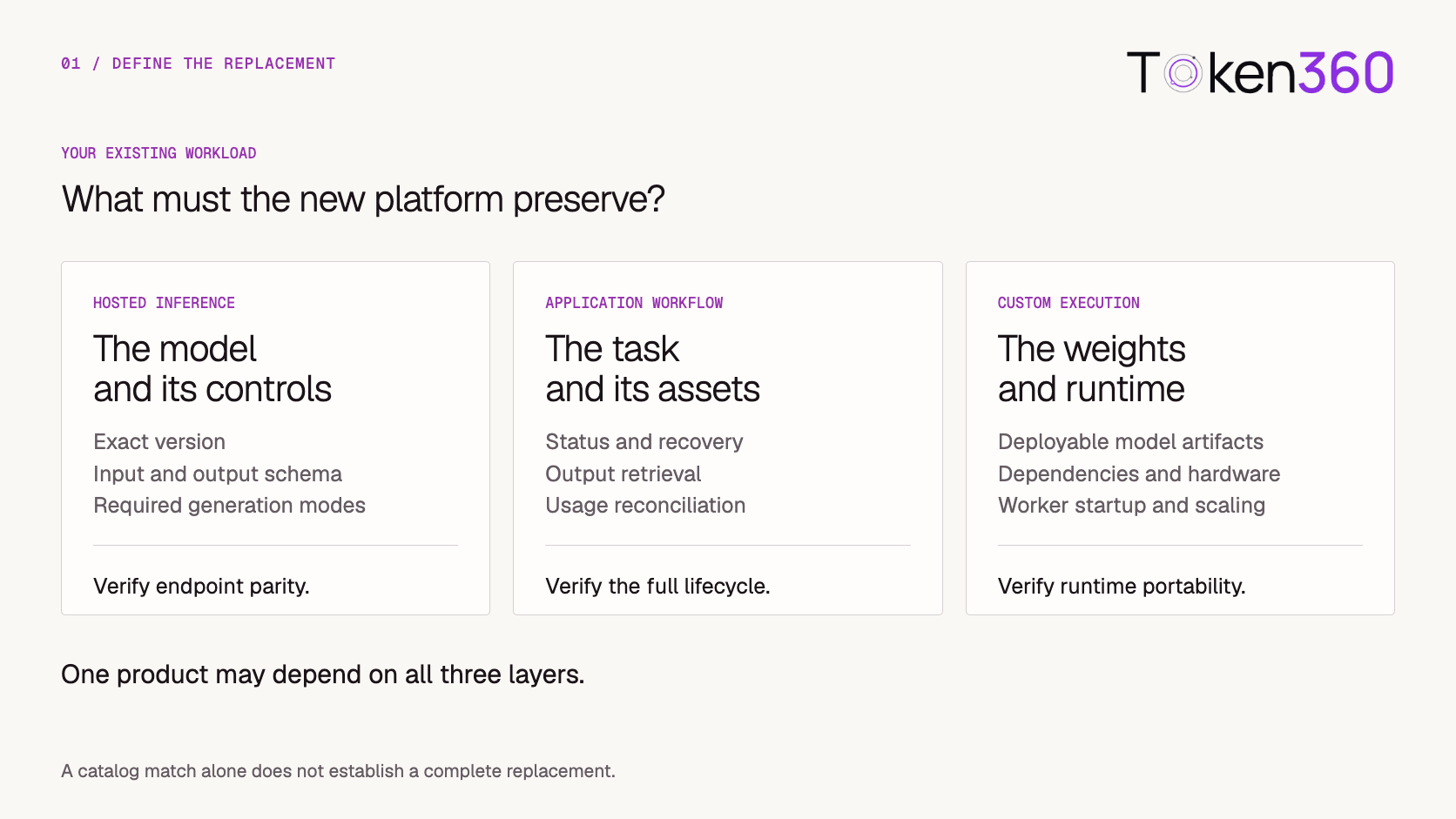
Identify What You Need to Replace
Start with your current Replicate integration.
Replicate represents model runs as predictions containing inputs, outputs, status, and associated metadata. It also documents deployments with dedicated endpoints and configurable infrastructure. These are different parts of the service and may require different replacement strategies. See the official documentation for predictions and deployments.
Inventory the dependencies your application actually uses:
For example, an application calling a public image-generation endpoint may mainly need a compatible model route and reliable file delivery.
An application using custom preprocessing, private weights, and a specific runtime has a larger migration scope. Finding a similarly named model in another catalog does not reproduce that environment.
Write down the reason for moving as well. “Reduce delivery cost” and “support a missing reference-input mode” lead to different evaluations.
Replicate Alternatives at a Glance
Use this table to narrow the investigation before testing endpoints.
These categories describe the evaluation focus in this article. They are not exhaustive descriptions of every product each company offers.
No catalog size, architecture label, or vendor speed claim establishes the best choice for your application. Your shortlist should survive an exact-model check before you invest in a migration.
fal: Evaluate Supported Generative-Media APIs
fal is a candidate when the workload you want to move is available through one of its published model routes. Its documentation describes asynchronous inference through a queue, including request submission and subsequent result handling. See fal’s asynchronous inference documentation.
For a media application, begin with a representative operation: image editing, image-to-video generation, or another task your users already perform.
Compare the actual schemas. Check reference-image handling, supported output settings, optional controls, and response fields. A shared model name does not establish a shared request contract.
Then test the surrounding application behavior. Your adapter must preserve the request identifier, interpret status correctly, retrieve the output, and handle a client restart without losing the task.
Shortlist fal when: a documented route covers the model and controls you need.
Resolve before moving: whether the full operation works under your expected request mix and account limits.
For a broader comparison around this platform, continue with fal.ai Alternatives.
WaveSpeedAI: Evaluate Catalog Access and Workflow Integrations
WaveSpeedAI documents media-generation capabilities and several access methods, including REST APIs, SDKs, ComfyUI, and n8n integrations. That makes it relevant when an application and a creative or automation workflow need access to supported models. See the WaveSpeedAI overview.
Evaluate the integration you will actually operate.
A workflow node may expose a different set of fields from a direct API call. Confirm that it supports the model operation, reference inputs, and output options your team depends on.
Test a complete sequence: submit a job, wait for completion, retrieve the asset, and pass it to the next production step. Include a delayed task and an interrupted download.
Also confirm the limits associated with the account you will use. A successful single request does not demonstrate that a batch workflow can sustain its required concurrency.
Shortlist WaveSpeedAI when: the supported catalog and integrations match how your team builds and operates media workflows.
Resolve before moving: whether the chosen integration preserves the required controls and recovery behavior.
Token360: Evaluate Shared Model Access
Token360’s overview describes access to language, image, video, and audio models through a shared platform. Its current catalog is the starting point for checking the model families available for evaluation. See the API overview and model catalog.
This approach is worth evaluating when an application combines several model dependencies and the team wants a common access layer.
Build a dependency list at the operation level. “Video generation” is too broad if your application specifically needs image references, a particular duration, and generated audio.
For every dependency, confirm the public model identifier and endpoint contract. Check how provider responses map into your application’s task and asset records.
Do not infer custom-weight deployment or complete Replicate compatibility from shared model access. Those requirements need their own evidence.
Shortlist Token360 when: its supported operations cover your workload and a shared access layer addresses a concrete integration need.
Resolve before moving: any gaps in model-specific controls, output metadata, or operational behavior.
Runpod: Evaluate Custom Inference Execution
Runpod Serverless provides a worker-based execution path for AI and compute-intensive workloads. Its documentation describes workers that scale with demand and can scale down after an idle period. See the Runpod Serverless overview.
This makes it relevant when your migration requires control over inference code, dependencies, or deployable model artifacts.
First establish that the workload is portable. You need access to the necessary weights and dependencies, together with permission to deploy them. A proprietary model available through a hosted API is not automatically available as downloadable weights.
Then evaluate packaging and runtime behavior: image builds, model loading, memory requirements, worker startup, and failed-job recovery.
Your team must also decide who owns updates and incidents. Moving to custom execution changes the responsibilities around the inference service, even when the infrastructure provider manages the underlying servers.
Shortlist Runpod when: runtime control is a requirement and your team can maintain the inference package.
Resolve before moving: whether startup, capacity, reliability, and engineering effort fit the workload.
Together AI: Match the Model to the Serving Option
Together AI publishes a serverless model catalog and separate documentation for dedicated model inference. Evaluate the serving option that matches your requirement. Availability in one offering should not be assumed to establish availability in another. See the serverless model catalog and dedicated inference overview.
Begin with the exact operation and its required features. For a language workload, that may include streaming, structured responses, or tool use. For a media workload, the important checks may be input assets, output settings, and asynchronous task handling.
If you are considering dedicated inference, separately examine capacity configuration, deployment procedures, and the cost of maintaining the required availability.
Shortlist Together AI when: the chosen model and operation are supported through the serving option you intend to use.
Resolve before moving: whether that specific configuration meets your feature, capacity, and delivery requirements.
Compare Total Delivery Cost and Operational Fit
Compare alternatives using the same workload and a consistent accounting boundary.
A lower headline rate may be offset by additional attempts, output cleanup, idle capacity, or engineering work. Different billing units also make direct price-table comparisons misleading.
Use two separate views:
For generative media, calculate recurring cost per accepted deliverable. Count rejected attempts in the spending total, and define what qualifies as an accepted output.
For language workloads, use a representative request mix and an explicit quality threshold. A cheaper response that fails the product’s acceptance criteria is not an equivalent result.
Measure delivery time through the point your application needs. If the user requires an asset in your storage, an upstream completion timestamp is only one milestone.
For custom execution, test both startup and steady-state behavior. For every candidate, record concurrency and sample counts so the results remain interpretable.
Set hard requirements before assigning scores. A mandatory input mode, output format, or operational constraint should not be averaged away by strengths elsewhere.
Validate With One Representative Workflow
Choose an operation with known inputs and a written acceptance test.
For example, an image-to-video workflow might require preserving a product’s appearance, producing the target format, storing the file, and recording the final cost. Evaluate the candidate against that complete outcome.
Use a small but representative test set containing routine inputs and known difficult cases. Keep every attempt, including request errors and rejected outputs.
Separate two kinds of compatibility:
-
Contract compatibility: requests, status handling, and outputs can be translated correctly.
-
Outcome compatibility: the resulting content or response meets the product’s requirements.
Passing the first does not establish the second.
Test recovery deliberately. Restart a worker after submission. Interrupt retrieval after generation completes. Deliver the same completion notification twice if the integration uses notifications.
Your system should recover without silently losing work or charging the user twice for the same business operation.
Record the exact model, route, settings, date, and acceptance results. If the candidate serves a different model version, describe the exercise as a model change as well as a provider migration.
Migrate Gradually and Preserve In-Flight Tasks
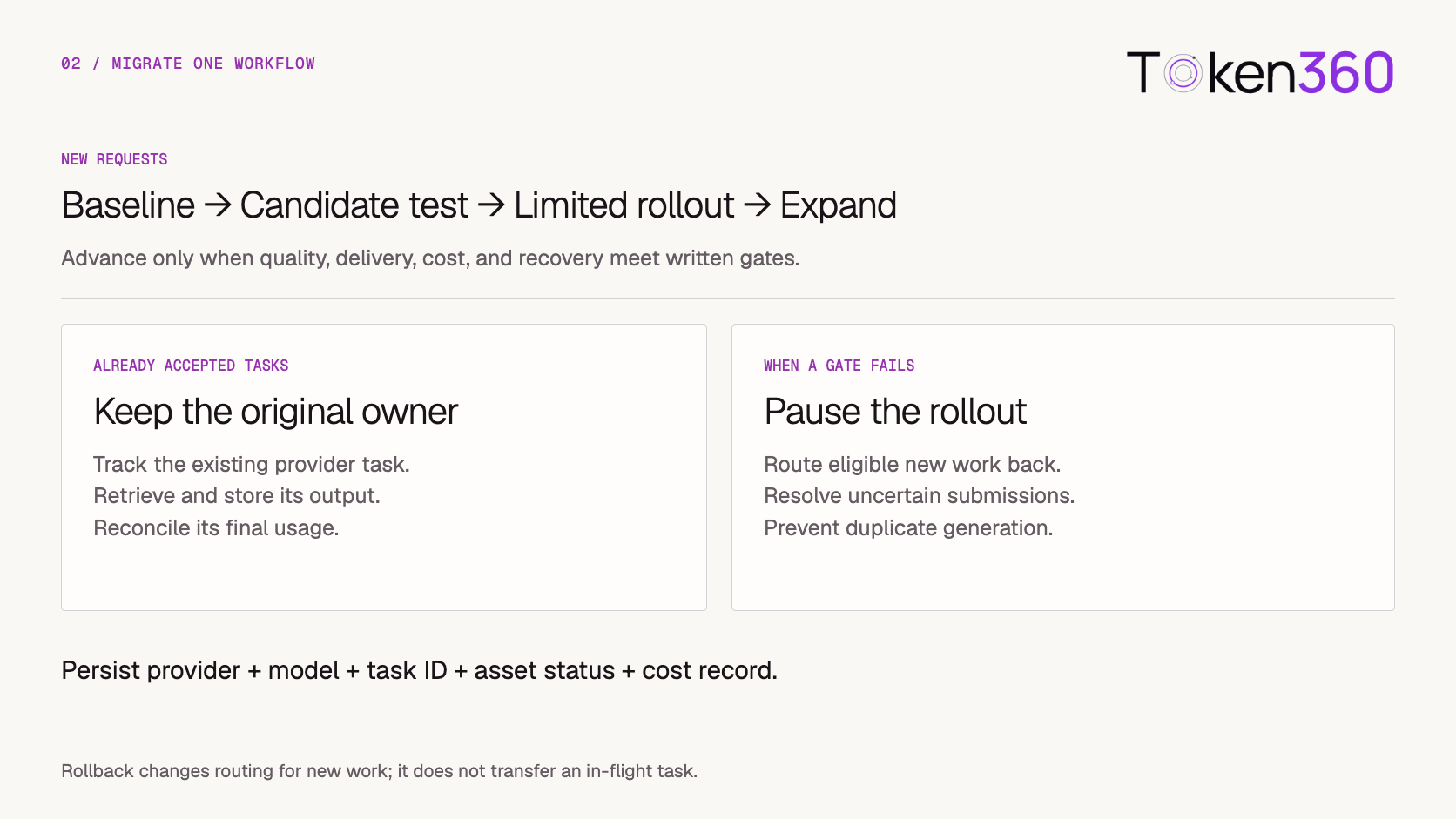
A migration should distinguish new requests from tasks the existing provider has already accepted.
Store the provider and task identifier for each accepted job. Continue tracking that job through its original provider until its output and usage are resolved.
A safe rollout follows four stages:
Define rollback conditions before routing production work. These may include unacceptable output quality, retrieval failures, or an unexplained increase in delivery cost.
Rollback changes where eligible new requests go. It does not transfer an already running task to another provider.
Be especially careful after a submission timeout. The upstream service may have accepted the request even though your application did not receive the response. Resolve that uncertainty where possible before sending a replacement job elsewhere.
For a fuller implementation checklist, read How to Migrate AI Model Providers Safely.
When Staying With Replicate Makes Sense
Keep Replicate when the current integration meets your requirements and the alternative has not demonstrated enough benefit to justify the move.
This can be the right decision when you depend on a specific model version, a working custom deployment, or behavior that would be costly to reproduce.
A partial migration may also be appropriate. Move a verified workflow while retaining the provider that still serves another dependency well.
Document the decision in concrete terms:
Move this operation because the candidate preserves the required controls and meets our quality, delivery, and cost thresholds. Keep the remaining workflows on their current provider until they pass the same evaluation.
That statement is more useful than naming a universal winner. It defines what changes, what evidence supports the change, and which workloads still need testing.
Frequently Asked Questions
Which alternative is closest to Replicate?
It depends on the part of Replicate you use. Hosted catalog inference, custom execution, and application-level task handling are separate requirements. Compare each dependency against the candidate’s documented offering.
Is there a drop-in replacement for the Replicate API?
Do not assume one from catalog overlap. Verify request schemas, model identifiers, task states, output formats, and error behavior. An adapter may still be required even when the model family matches.
Which Replicate alternative is cheapest?
This article does not establish a price winner. Compare current billing for the exact configuration, then include retries, rejected outputs, infrastructure commitments where applicable, and ongoing operating effort.
Can I move a custom model to any provider?
Only if the destination supports the required deployment path and you can supply the necessary artifacts and dependencies. Check runtime compatibility and deployment permissions before committing to the migration.
Can I keep Replicate and add another platform?
Yes. You can route eligible new workflows to another provider while keeping existing dependencies. Preserve provider ownership for every task and account for the additional monitoring and maintenance.
Where should I start?
Inventory one production operation and define its acceptance test. Then check whether the candidate covers the exact model and controls before running a limited evaluation.
Explore models on Token360 to check your dependency list against the current catalog.
What to read next



 Tutorial
 Comparison
 Comparison