The right WaveSpeedAI alternative is the one that preserves the creative controls and delivery workflow your application depends on.
For a supported image or video model route, investigate fal. For hosted predictions and applicable custom deployments, consider Replicate. For shared access across supported modalities, evaluate Token360. If one model family is central to your product, its direct provider API may also belong on the shortlist.
These options solve different problems. A useful comparison starts with a real operation, such as generating a product video from approved reference assets, and follows it through to a usable file in your own storage.
Model availability is only the first check. Reference handling, default settings, asynchronous tasks, workflow integrations, and recovery behavior can all affect whether a replacement works.
Token360 publishes this guide and appears in the comparison. Official documentation was checked on October 8, 2026. This article does not claim a measured latency, quality, or price winner.
Before you read: Start with Multimodal API Guide for applications combining media types, or AI Gateway vs Direct Model APIs for the architectural choice between shared access and individual provider integrations.
Define the Reason to Switch
Write the problem you want to solve before comparing platforms.
WaveSpeedAI documents media-generation APIs and access through tools including SDKs, ComfyUI, and n8n. A replacement may therefore affect both application code and the creative workflows built around it. See the WaveSpeedAI overview.
Turn the reason for switching into a requirement you can verify:
Separate mandatory requirements from preferences.
A missing reference-input mode can disqualify a route. A different SDK interface may simply require adapter work. Treating both as equal disadvantages makes the comparison less useful.
Also record the current baseline. If you cannot describe what WaveSpeedAI already delivers, it will be difficult to show that another option improves the workflow.
Build a Shortlist Around the Requirement
Use the following table to decide which options deserve an endpoint-level evaluation.
| Alternative |
Reason to evaluate |
Important tradeoff |
| fal |
Published media routes and model-specific schemas |
Route differences still require adapters |
| Replicate |
Hosted predictions and applicable custom deployments |
Hosted inference and custom deployment need separate checks |
| Token360 |
Shared access across supported AI modalities |
Confirm every required control on the chosen model |
| Direct provider API |
A specific provider’s native interface |
Separate credentials and operational contracts |
This is a shortlist by use case, not a ranking.
Avoid treating a platform’s overall model catalog as evidence that a particular combination of inputs and settings is supported. A model family may appear in the catalog while a specific editing mode or reference feature requires a different endpoint.
Evaluate the route you will call with the account and configuration you expect to use in production.
fal: Compare the Exact Media Route
fal is a candidate when a published model route matches your image or video operation. Its documentation describes asynchronous inference through a queue, with request submission and subsequent status and result handling. See fal’s asynchronous inference documentation.
Start with the individual route’s schema.
Map the fields your application currently sends: prompt, reference assets, aspect ratio, output settings, and any required creative controls. Compare allowed values and defaults as well as field names.
An unnoticed default can change the result without producing an API error. For example, a workflow may generate an asset successfully while using a different framing or audio setting from the one the product expects.
Preserve the original creative request alongside the provider-specific payload. This makes it easier to determine whether a failure came from the model, an adapter transformation, or a missing parameter.
Evaluate fal when: a documented route covers the specific media operation you need.
Confirm before switching: input mapping, task handling, output retrieval, and acceptable results under your workload.
Replicate: Separate Hosted Predictions From Custom Deployments
Replicate provides a prediction workflow for running models and a separate deployment path with infrastructure controls for applicable models. Those capabilities should be evaluated as distinct options. See the documentation for predictions and deployments.
If you are replacing a hosted media call, begin with the exact served model and its input and output contract.
If you need custom preprocessing, particular dependencies, or deployable weights, investigate the deployment path. Confirm what must be packaged and maintained.
Do not assume that custom deployment support makes every hosted model portable. A proprietary model exposed through an API may not be available as weights you can deploy yourself.
The distinction matters because it changes the migration effort. Replacing one hosted request may require an adapter; moving a runtime also requires deployment and operating work.
Evaluate Replicate when: its hosted operation or applicable deployment path addresses your requirement.
Confirm before switching: which path you need and whether it reproduces the complete workflow.
For a broader platform comparison, read Replicate Alternatives for Production AI Workloads.
Token360: Evaluate Shared Access Across Modalities
Token360 describes a shared access layer for language, image, video, and audio models. Its API overview explains the integration starting point, while the model catalog identifies current entries to investigate.
This approach is worth evaluating when your product combines several model dependencies.
Consider an application that writes a creative brief, generates a still image, and produces a video from that image. Each step needs its own capability check, even when access is provided through one platform.
Verify the public model identifier, operation, input assets, supported settings, and result handling for every step. Check that your adapter retains the metadata needed for tracking and troubleshooting.
A shared interface does not establish that an existing WaveSpeedAI payload, workflow template, or task identifier will transfer unchanged.
Evaluate Token360 when: its supported operations cover your application and a shared access layer addresses a concrete integration need.
Confirm before switching: model-specific controls and the complete file-input-to-output workflow.
Direct Provider APIs: Evaluate a Focused Model Dependency
A direct API can be useful when one model family is essential and its documented controls drive the product.
For example, Google’s Veo API guide documents image guidance, frame-specific generation, video extension, and native audio for its supported configurations. The exact combination still needs to be checked against the selected model and mode. See the official Veo API guide.
Direct access is not automatically faster, cheaper, or more feature-complete for every operation. Verify the particular advantage you expect.
It also introduces a separate integration contract: authentication, task tracking, errors, output retrieval, account limits, and billing must fit your application.
Keep your own operation identifier and asset record, even if you use only one provider. The application should be able to track a business request without making a provider’s task ID or temporary file URL its permanent content identity.
Evaluate a direct API when: a verified native capability or operating requirement justifies the integration.
Confirm before switching: that the benefit remains meaningful after implementation and maintenance costs.
Build a Creative-Control Compatibility Matrix
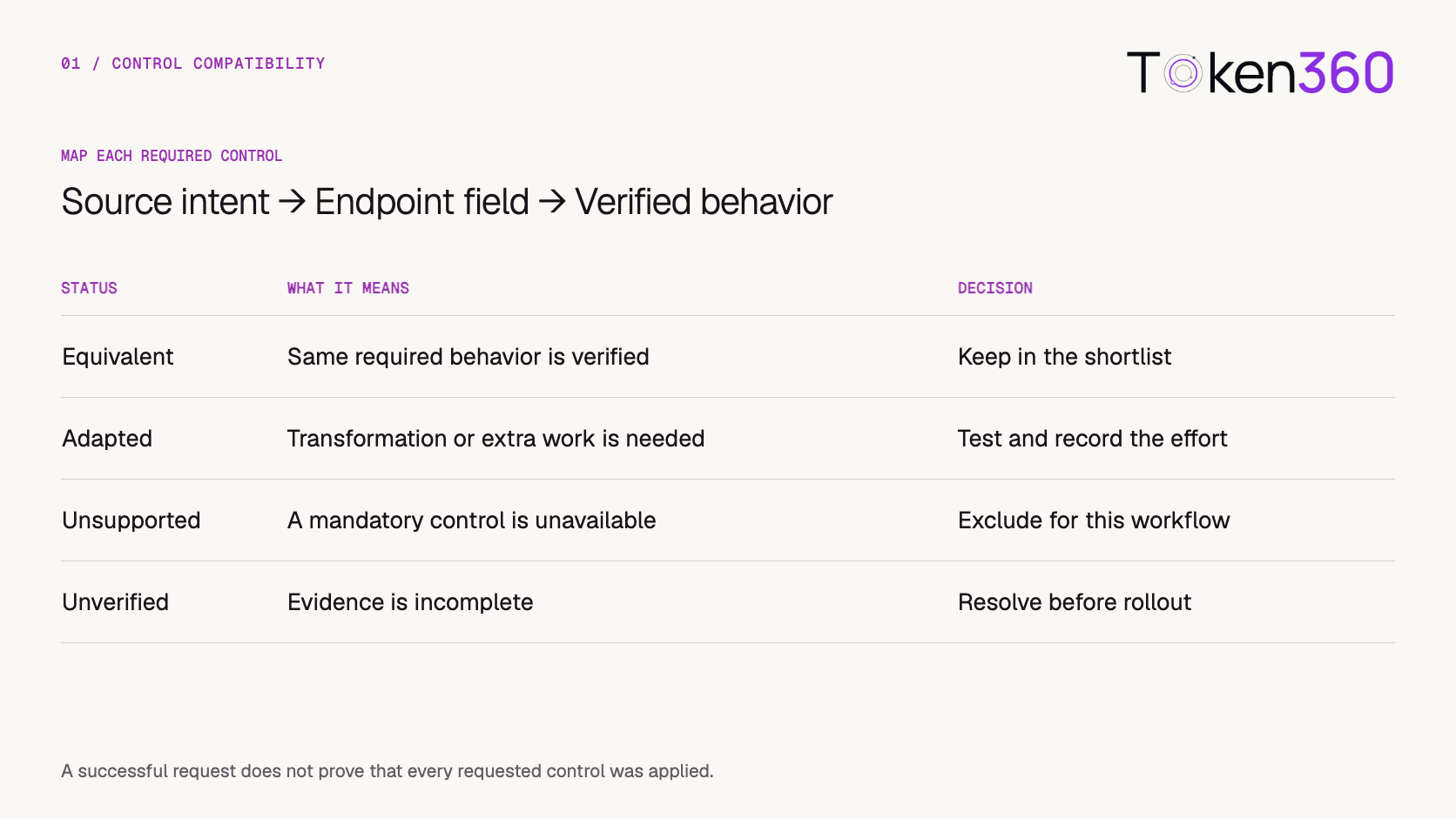
Before benchmarking outputs, classify every required control.
For an image-editing workflow, the checklist might include multiple references, a mask, output dimensions, and preservation of unedited regions.
For video, it might include first-frame guidance, an ending constraint, reference inputs, audio behavior, and the required delivery format.
These are evaluation dimensions, not claims that every platform supports every feature.
Record the meaning of each field. A reference image used to guide appearance is not necessarily equivalent to a required first frame. Renaming a field does not establish semantic compatibility.
Test unsupported options deliberately. Your adapter should reject an unavailable mandatory control rather than silently remove it and return a successful but unsuitable output.
A successful request proves that the service processed something. It does not prove that every part of the creative request was applied.
Revalidate n8n and ComfyUI Workflows
Treat an existing workflow as a dependency graph.
You may be able to reuse its overall structure, but each provider-specific boundary needs validation:
Inspect what the installed integration actually exposes. A visual node may support fewer controls than the underlying API, or represent files differently from your existing workflow.
Test with the same source asset through both the current and candidate workflow. Check the intermediate payloads as well as the final output.
If an integration requires an additional upload, conversion, or download step, include it in the evaluation. Those steps can affect latency, cost, and failure recovery.
Preserve the working workflow version during the trial so you can compare behavior and restore the previous path if needed.
Test Delivery and Recovery, Not Just Generation
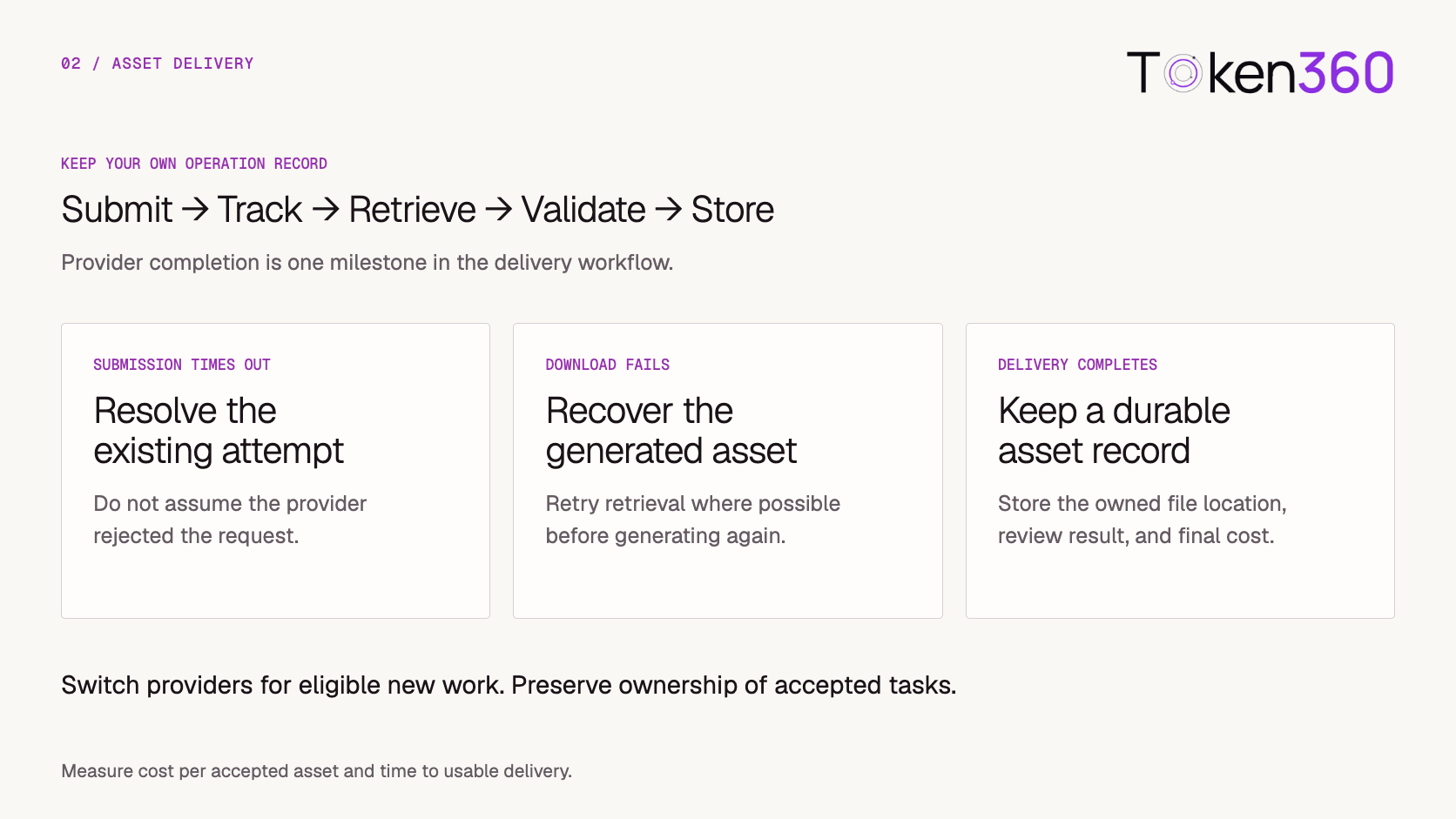
Measure the full path from source assets to usable delivery:
Submit → Track → Retrieve → Validate → Store
An upstream task can finish successfully while your application still fails to deliver its output.
Run at least three recovery checks.
Submission timeout: Interrupt the connection after sending a request. Determine how your application handles uncertainty about whether the provider accepted it. Use documented reconciliation or idempotency mechanisms where available; do not assume a timeout means no job exists.
Retrieval interruption: Stop a download after generation finishes. Check whether the existing asset can be retrieved again before creating a new generation.
Application restart: Restart the worker while a task is pending. Confirm that the provider and task identifier were saved and that tracking can resume.
Also make completion processing safe to repeat. A repeated status check or notification should not create duplicate asset records or repeated downstream actions.
Store the file in your own durable storage when your product requires ongoing access. Preserve its relationship to the original operation, provider task, review outcome, and cost record.
Compare Cost per Usable Asset
Use the same authorized source assets, business briefs, and acceptance rules across candidates.
Where equivalent settings exist, match them. When a candidate requires a different workflow, record the change and assess its additional preparation or editing effort separately.
Track both generation spend and the broader cost of delivery:
Generation cost per accepted asset = total billed generation spend ÷ accepted assets
Production cost per accepted asset = generation, preparation, review, editing, and delivery costs ÷ accepted assets
Define “accepted” before testing. For a product image, an altered logo or shape may be a hard rejection. For video, missing action, incorrect dialogue, or an unusable final frame may determine acceptance.
Include rejected attempts and billed retries in the spending total. Keep request errors visible rather than removing them from the evaluation record.
Set a consistent attempt budget and record sample counts. A small test is useful for identifying failures, but it should not support broad claims of superiority.
If no assets are accepted, the cost-per-accepted-asset calculation has no usable denominator. Report the spend and zero-acceptance result.
For a more detailed pricing framework, continue with AI Video API Pricing and Cost per Usable Clip.
Switch Only When the Improvement Is Verified
An alternative should solve the requirement that started the investigation.
You can add a second provider for a defined workflow without replacing every dependency.
Route only eligible new work to the candidate. Keep tasks already accepted by WaveSpeedAI associated with their original provider until their outputs and usage are resolved.
Write fallback rules around capability requirements. A backup that lacks a mandatory control should not silently receive the request as if it were equivalent.
Document the final decision with the tested model, route, settings, workload, date, and evidence. This gives the team a basis for reevaluation when a model version or endpoint changes.
Frequently Asked Questions
What is the best WaveSpeedAI alternative?
There is no universal winner established here. fal, Replicate, Token360, and direct APIs belong on different shortlists depending on the model controls, deployment needs, and workflows you need to preserve.
Can I reuse the same request payload?
Do not assume so. Compare field meanings, allowed values, defaults, and output formats. Use a tested adapter where translation is necessary.
Can I keep my existing n8n or ComfyUI workflow?
You may reuse parts of its structure. Revalidate credentials, input mapping, task handling, output mapping, and retry behavior at every provider-specific boundary.
Is a direct model API always cheaper?
No price advantage is established by the access pattern alone. Compare the exact configuration and include attempts, delivery work, and the cost of maintaining the integration.
Can I use a second provider only for fallback?
Yes, for workflows whose requirements the backup has passed. Define how uncertain submissions and already accepted tasks are handled so fallback does not create avoidable duplicates.
Where should I begin?
Choose one real image or video operation. Write its mandatory controls and acceptance rules, then check candidate endpoints before running a delivery test.
Explore models on Token360 to compare your required operations with the current catalog.
What to read next



 Tutorial
 Comparison
 Comparison