Last updated: September 10, 2026
fal.ai has become one of the most comprehensive infrastructure platforms for generative media.
Its current Model APIs provide access to 1,000+ production-ready models spanning image, video, audio and multimodal generation. Developers can use synchronous requests, asynchronous queues, streaming and, for supported workloads, real-time WebSocket inference. fal also lets teams deploy their own models through Serverless or use dedicated GPU compute.
That makes finding a fal.ai alternative more complicated than simply looking for another image-generation API.
Different alternatives solve different parts of the problem.
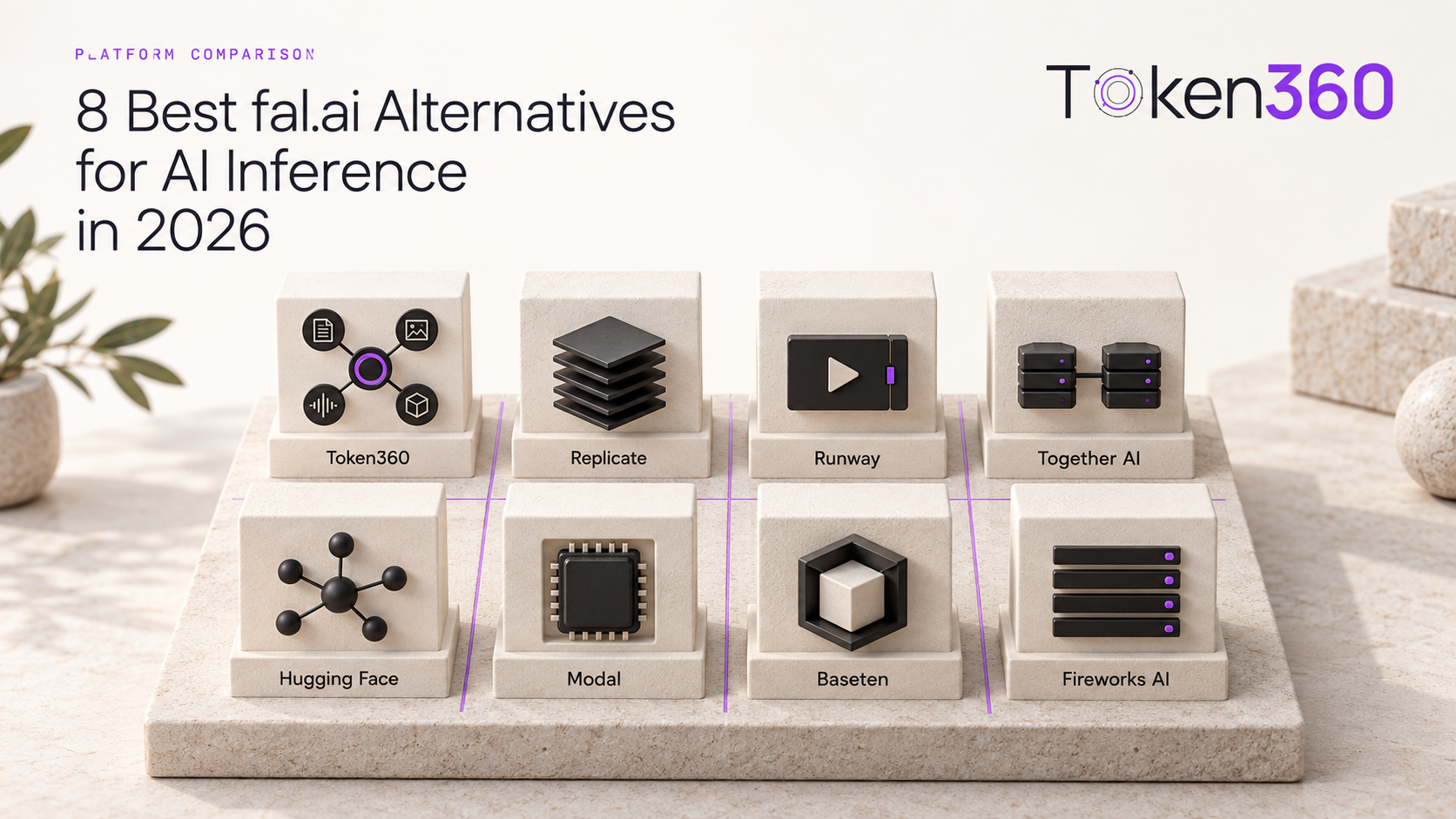
Token360 is worth evaluating when you want language, image, video and audio models behind one enterprise-oriented gateway.
Replicate is strong for experimenting with a broad model ecosystem and deploying custom models.
Runway Dev is highly relevant to creative applications centered on image and video generation.
Together AI combines serverless model access with dedicated inference infrastructure.
Hugging Face Inference Providers is attractive for teams already working in the open-source model ecosystem.
Modal is closer to programmable serverless GPU infrastructure.
Baseten focuses heavily on production deployment of open and custom models.
Fireworks AI is oriented toward high-performance open-model inference.
The right alternative therefore depends on whether you want to consume models, deploy models, control GPU infrastructure, consolidate multimodal APIs or optimize a creative-production workflow.
fal.ai Alternatives at a Glance
Important: these products are not perfect one-to-one substitutes.
For example, switching from fal.ai to Modal means taking on more model-serving responsibility, while switching to Runway Dev means choosing a more specialized creative API environment.
That distinction is important because a “competitor” can solve the same business requirement through a very different architecture.
Why Look for a fal.ai Alternative?
fal already addresses several difficult infrastructure problems well.
Its current platform advertises 1,000+ model endpoints, queue-based reliability, automatic scaling and pay-per-use billing. Its documentation also reports historical uptime above 99.99%, although that figure is fal's own reported platform metric rather than an independently audited comparison.
So the reason to evaluate an alternative usually is not simply:
“We want another platform with AI models.”
More realistic reasons include:
-
you also need a large language-model stack;
-
you want one gateway across text, image, video and audio;
-
you want a more creator-oriented abstraction;
-
you want to own more of the inference stack;
-
you need VPC or self-hosted deployment;
-
you are heavily invested in Hugging Face;
-
you need dedicated throughput;
-
you want a different billing model;
-
you need centralized enterprise account controls.
A useful comparison therefore has to look beyond model count.
How We Evaluated fal.ai Alternatives
We considered seven practical dimensions:
Model access
Can the platform expose ready-to-use models, or do you need to deploy them yourself?
Modality coverage
Does it support only language models, or image, video, audio and multimodal workloads as well?
Custom deployment
Can your team bring private, fine-tuned or open-source models?
API abstraction
Are you consuming standardized model APIs, or building your own inference services?
Infrastructure control
Can you choose GPUs, deployment topology, region or dedicated resources?
Pricing model
Are you paying per generated output, token, GPU second or reserved capacity?
Enterprise operations
Does the platform offer governance, account management, billing controls and deployment options suitable for production organizations?
Disclosure: This article is published by Token360, which is included in the comparison. Product features and pricing are based primarily on vendor documentation reviewed on September 10, 2026.
Token360 — Best for Consolidating Multimodal AI APIs
Best for: teams that need language, image, video and audio models under one API and want fewer separate model-provider relationships.
Token360 approaches the problem differently from fal.ai.
fal is heavily centered on generative-media inference and GPU infrastructure. Token360 is structured as a unified AI gateway that exposes current language, image, video and audio models through one OpenAI-compatible environment.
The current production catalog includes 80+ models, with examples such as Claude Opus 5 for language, Nano Banana Pro for image generation and Seedance 2.5 for video generation.
For developers, that means the same top-level platform supports:
/v1/chat/completions
/v1/images/generations
/v1/videos
and speech-related workloads.
Token360 handles authentication, model routing, usage metering and billing at the gateway layer.
unified AI gateway
Why Token360 Is an Alternative to fal.ai
Consider an application that needs:
Claude → image model → Seedance → speech model.
fal can cover substantial parts of the media side of that stack, but Token360's product architecture is intentionally designed to put the different modalities into one gateway relationship.
That can be attractive when the main problem is not:
“How do I run one diffusion model as fast as possible?”
but:
“How do I reduce the number of AI vendors and integrations my application has to operate?”
Enterprise Controls
Token360's current enterprise features include tenant-wide API-key auditing, unified wallet billing, sub-account management, custom enterprise pricing and dedicated account management.
Several additional items—including custom model deployment and serverless GPU infrastructure—are explicitly marked Coming Soon on the current Enterprise page.
Therefore Token360 should not currently be positioned as a complete replacement for fal's custom Serverless/GPU infrastructure.
That would overstate the product.
Where Token360 Stands Out
Token360 is especially relevant when:
-
you need both LLM and generative-media APIs;
-
you want OpenAI compatibility;
-
you need multiple modalities in one account;
-
consolidated billing matters;
-
your enterprise team wants centralized keys and sub-accounts.
Potential Trade-Off
fal currently has a much larger public media-model ecosystem—1,000+ Model APIs versus Token360's 80+ production models—and fal already provides its own Serverless custom-model infrastructure.
So if your primary requirement is maximum generative-media model breadth plus custom GPU deployment, fal may remain the stronger fit.
Replicate — Best for Exploring a Large Model Ecosystem
Best for: developers who want to experiment with many public models and also deploy custom models.
Replicate is one of the closest well-known alternatives to fal.ai in terms of the basic developer experience:
choose a model → send an API request → receive generated output.
Replicate says thousands of open-source models have been contributed to its public ecosystem. It separately maintains more than 100 official models, which are always warm, use stable APIs and are priced through predictable metrics such as images, video duration or tokens.
That official-model distinction is important.
A community model and a maintained production endpoint should not automatically be treated as equivalent.
Custom Models
Replicate also allows developers to package and deploy their own models using Cog, Replicate's open-source packaging system. Private models typically use dedicated hardware rather than sharing a public queue.
This makes Replicate suitable for both:
model consumption
and:
custom model deployment.
Replicate Pricing
There is no single Replicate platform rate.
Some models are billed according to hardware runtime, while others use input/output units. Official models often use predictable units such as generated images, seconds of video or tokens.
Replicate vs fal.ai
A useful high-level distinction is:
fal emphasizes optimized generative-media infrastructure and a unified production model ecosystem.
Replicate emphasizes broad model experimentation, community models and easy custom model deployment.
Both increasingly overlap.
Potential Trade-Off
Replicate's very large community ecosystem means developers still need to evaluate which endpoints have the stability and maintenance characteristics required for production.
Runway Dev — Best for Creative and Video Applications
Best for: applications whose core product is video, image, audio or professional creative production.
Runway Dev has evolved beyond simply exposing Runway's own generation models.
Its current developer pricing covers video, image, audio, video upscaling, HDR workflows and real-time functionality. Runway also allows developers to use several third-party video models and route generation through its Model Router.
Runway developer credits currently cost $0.01 per credit. Individual models then consume different numbers of credits based on duration, resolution and input/reference media.
For example, its current public pricing lists:
Runway vs fal.ai
Both are relevant to generative-media developers.
But the emphasis differs.
fal combines a huge media-model API catalog with custom Serverless and dedicated GPU compute.
Runway is more directly tied to creative application workflows and professional media outputs.
If you are building an AI filmmaking, editing or creator product, Runway deserves serious consideration.
If you need to deploy arbitrary custom GPU workloads, fal offers a broader infrastructure story.
Potential Trade-Off
Runway is not designed primarily as a general-purpose serverless cloud for arbitrary machine-learning services.
Together AI — Best for Moving From Serverless to Dedicated Inference
Best for: teams that want to begin with managed inference and later move into provisioned or dedicated infrastructure.
Together AI currently provides several deployment modes:
Serverless Inference
Provisioned Throughput
Dedicated Model Inference
Dedicated Container Inference
This creates a useful progression.
A startup can begin with serverless model APIs during experimentation and later reserve throughput or dedicated infrastructure as the workload becomes more predictable.
Together's current pricing catalog spans chat, vision, image, audio, video, transcription, embeddings, reranking and moderation, rather than being limited to LLMs.
Together AI vs fal.ai
Together is a stronger alternative when the infrastructure requirement centers on:
-
open and multimodal models;
-
dedicated inference;
-
fine-tuning or deeper model infrastructure;
-
language-heavy workloads alongside media.
fal remains especially strong in the generative-media ecosystem, particularly where image/video model breadth and media-optimized inference are the primary requirements.
Pricing
Together's serverless pricing is model-specific. Current language-model pricing, for example, is typically expressed per million tokens, while media modalities use different units.
Again, don't compare a video-generation price from fal against an LLM token rate from Together and call one platform cheaper.
Potential Trade-Off
Together is closer to an AI infrastructure platform than a creator-first generative-media marketplace.
That can be a strength or weakness depending on the application.
Hugging Face Inference Providers — Best for the Open-Source Model Ecosystem
Best for: developers already using Hugging Face for model discovery, libraries and open-source AI workflows.
Hugging Face Inference Providers currently provides routed access to 200+ models from multiple inference providers.
Developers can use one Hugging Face account and route inference through supported providers without separately setting up every provider account.
Hugging Face also supports custom provider keys. In that mode, requests still flow through Hugging Face tooling, but the underlying provider bills the user directly.
No Hugging Face Markup on Routed Provider Pricing
Hugging Face currently states that routed Inference Provider requests use the same provider rates with no additional Hugging Face markup.
That is a useful difference for teams comparing gateway economics.
Hugging Face vs fal.ai
Hugging Face stands out for model ecosystem integration.
The path can be:
Discover model on Hugging Face → test it → route inference → later deploy dedicated endpoint.
fal's path is more tightly optimized around ready-to-use generative media plus its own serving infrastructure.
Dedicated Inference
Hugging Face also offers dedicated Inference Endpoints, where teams select infrastructure and are billed for deployed compute. Current endpoint pricing is calculated according to the underlying instance and billed by actual deployment time, with hourly rates presented for convenience.
Potential Trade-Off
Hugging Face's breadth can mean a less opinionated production abstraction.
Teams looking specifically for a highly optimized generative-media platform may prefer fal or a specialized creative API.
Modal — Best for Teams That Want to Build the Inference Layer Themselves
Best for: engineering teams that want serverless GPU infrastructure instead of a prepackaged catalog of model APIs.
Modal is meaningfully different from fal Model APIs.
Modal describes itself as a serverless cloud for compute-intensive applications, including generative AI models, batch workflows and job queues.
Instead of primarily choosing a prebuilt media endpoint, developers can write Python infrastructure that specifies:
-
container environment;
-
model code;
-
GPU type;
-
scaling behavior;
-
web endpoint;
-
storage;
-
job execution.
Modal then handles the underlying serverless compute lifecycle.
Modal GPU Pricing
Modal currently charges GPU resources by actual execution time.
Selected current rates include:
Modal's Starter tier currently includes $30/month in compute credits, three workspace seats, up to 100 containers and 10 GPU concurrency. Its Team tier is listed at $250 plus compute and includes higher concurrency and operational controls.
Modal vs fal.ai
This is best understood as:
fal Model APIs
“Give me Kling / Nano Banana / another model as an API.”
versus:
Modal
“Give me serverless GPU infrastructure so I can build and serve the model/application myself.”
fal does also offer Serverless and Compute, so the two companies increasingly overlap. But Modal remains especially compelling when the engineering team wants to own the serving code.
Potential Trade-Off
More control creates more responsibility.
With Modal, your team may need to choose and package the model, build the endpoint and manage inference behavior rather than simply calling a pre-optimized marketplace model.
Baseten — Best for Production Custom and Open-Model Deployment
Best for: organizations that want production-grade infrastructure for custom, fine-tuned and open-source models.
Baseten focuses on serving models through its Inference Stack, with both ready-to-use Model APIs and dedicated deployment infrastructure.
Its current Basic plan has no monthly platform fee beyond usage and includes dedicated deployments, Model APIs and training. Baseten also currently states SOC 2 Type II and HIPAA compliance on its pricing page.
For larger organizations, Baseten's Enterprise options include:
Baseten vs fal.ai
Baseten is especially compelling when the requirement is:
“This is our model. We need to serve it reliably at production scale.”
fal is especially compelling when the requirement is:
“We want immediate API access to a very broad catalog of generative-media models, and perhaps custom deployment later.”
Baseten does provide ready-to-use Model APIs, but its current public API catalog is more strongly oriented toward language and multimodal language models than fal's media-heavy marketplace.
Potential Trade-Off
If you mainly want dozens of current image/video models without owning the deployment lifecycle, fal, Replicate or Runway may provide a more natural developer experience.
Fireworks AI — Best for High-Performance Open-Model Inference
Best for: developers whose core workload is open language and vision models and who care about moving from serverless to dedicated inference.
Fireworks AI currently offers three major infrastructure paths:
Serverless Inference
Training
and:
On-Demand Deployments
Its current serverless catalog is focused heavily on modern open language and vision models such as GLM, Kimi, DeepSeek, Qwen and MiniMax model families.
Serverless workloads are billed primarily by tokens, while on-demand deployments use GPU-based pricing. Fireworks also offers Standard, Priority and Fast serving tiers for supported models.
Fireworks vs fal.ai
Fireworks is not the closest fal replacement for a video-generation product.
Instead, it is worth evaluating when what you actually need from fal is:
managed inference infrastructure, not fal's specific media-model marketplace.
A useful distinction is:
fal → strong generative-media catalog
Fireworks → strong open-model language/vision inference
Potential Trade-Off
If your product revolves around current image-to-video, video-to-video or audio-generation models, fal's catalog is currently much more directly aligned with that use case.
fal.ai vs Its Alternatives: Which Platform Fits Which Workload?
The best choice becomes clearer when the comparison starts with the workload.
The correct question is therefore not:
“What is the best fal.ai replacement?”
It is:
“Which part of fal.ai are we actually trying to replace: its model catalog, generative-media APIs, serverless infrastructure, GPU compute or enterprise deployment layer?”
fal.ai vs Token360
Choose fal.ai when:
You primarily need generative-media infrastructure.
fal currently offers 1,000+ production-ready model APIs, including image, video, audio and multimodal systems, alongside Serverless deployment and dedicated GPU Compute.
It also exposes several inference methods—including direct calls, queue-based async jobs, streaming and real-time connections for supported models.
Choose Token360 when:
You need a broader application-level AI gateway combining language + image + video + audio.
Token360 supports OpenAI-compatible clients, centralized model access, metering and billing across its production catalog.
Its current enterprise product also provides sub-accounts, unified wallet billing and tenant-level API-key auditing.
Do not claim:
Token360 has more models than fal.
It doesn't.
Token360 already has the same GPU deployment infrastructure as fal.
Its public Enterprise page currently marks Serverless GPU Infrastructure as Coming Soon.
The legitimate Token360 differentiation is multimodal gateway consolidation and enterprise operating structure, not winning every infrastructure category.
fal.ai vs Replicate
fal.ai and Replicate overlap heavily in model consumption.
Both allow developers to choose current models and call them programmatically without owning the underlying serving infrastructure.
The difference is emphasis.
fal currently promotes a tightly optimized catalog of 1,000+ production-ready endpoints and positions its infrastructure around high-performance generative media.
Replicate combines more than 100 maintained official models with thousands of community-contributed models, plus Cog for custom-model deployment.
A useful shorthand is:
fal → optimized generative-media production platform
Replicate → broad model experimentation and deployment ecosystem
But the two platforms increasingly overlap, so teams should evaluate the exact models and production requirements rather than relying on category labels alone.
fal.ai vs Runway
If you are building a video or creative application, this may be a more relevant comparison than fal vs an LLM inference provider.
fal gives developers broad access to image, video, audio and other generative-media endpoints while also providing lower-level Serverless and Compute infrastructure.
Runway Dev is more creator-workflow focused. Its current developer pricing spans generation, upscale, HDR, audio and real-time media functionality, and its API catalog includes multiple video models rather than only Runway's own models.
Therefore:
Need broad media inference + custom infrastructure → fal
Need creative application APIs and production-media workflows → Runway
Neither statement implies universal superiority.
fal.ai vs Modal
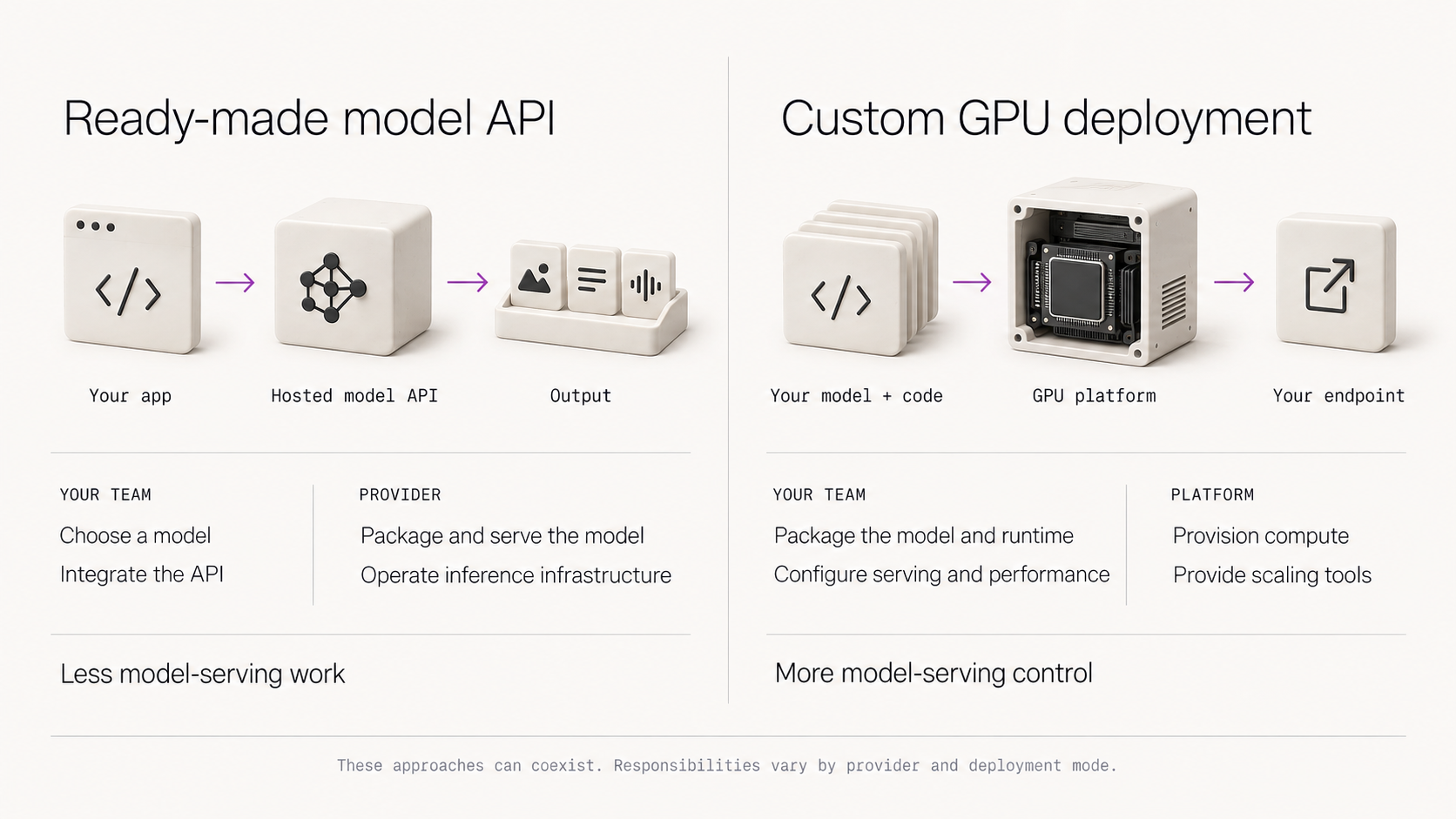
This is primarily a question of abstraction level.
With fal Model APIs, a developer can call a ready-to-use optimized model endpoint.
With Modal, the developer typically brings the serving application or model and uses Modal to provision and autoscale the required infrastructure. Modal describes itself as a serverless cloud rather than a model marketplace.
So:
fal saves model-serving work.
Modal gives you more model-serving control.
If your ML engineering team wants to customize runtime, dependencies, inference engines and GPU allocation, Modal may be more attractive.
If your product team wants to make a model call today without thinking about GPU serving, fal is usually closer to that requirement.
How Much Does fal.ai Cost?
fal.ai does not have one universal API price.
Its current Model API pricing depends on the underlying model and output type. Video models may charge per output second or per generated video, for example.
For custom infrastructure, fal publishes GPU prices separately.
Current list pricing includes:
fal also advertises lower contracted/effective rates, such as H100 pricing “as low as” $1.89/hour, so those discounted figures should not be presented as the universal on-demand rate.
This distinction is important.
Do not write:
“fal H100 costs $1.89/hour.”
The accurate statement is:
fal currently lists H100 at $4.50/hour, with advertised discounted pricing as low as $1.89/hour depending on commercial terms.
Should You Use a Model API or Serverless GPU Platform?
Use a ready-made model API when:
You want to ship quickly.
Your team does not want to operate inference.
You use common commercial/open models.
The vendor already optimizes the model.
Your workload is straightforward.
Examples include:
fal Model APIs
Replicate official models
Token360 model APIs
Runway Dev
Use serverless/custom GPU infrastructure when:
You own or fine-tune the model.
You need custom dependencies.
You need a specialized inference engine.
Your team wants deeper performance control.
Deployment architecture is strategically important.
Examples include:
fal Serverless
Modal
Baseten
Together dedicated infrastructure
The two approaches are not mutually exclusive.
Many teams start with hosted model APIs and only move particular high-volume or proprietary workloads to custom infrastructure once the economics or technical requirements justify it.
Frequently Asked Questions About fal.ai Alternatives
What is the best fal.ai alternative?
There is no single best alternative because fal.ai combines several products.
Token360 is a strong option for multimodal API consolidation; Replicate for model experimentation; Runway Dev for creative applications; Together AI for managed-to-dedicated inference; Hugging Face for open-source ecosystem integration; Modal for programmable serverless GPU infrastructure; Baseten for custom production deployments; and Fireworks for open-model language and vision inference.
What is the closest alternative to fal.ai for image and video APIs?
Replicate and Runway Dev are among the closest alternatives when the requirement specifically centers on generative-media APIs.
Replicate maintains more than 100 official production-oriented models plus a much larger community ecosystem, while Runway Dev provides dedicated video, image and other creative APIs.
Token360 is also relevant when image/video generation must coexist with language and audio models in the same gateway.
Is Token360 an alternative to fal.ai?
Yes, for some workloads.
Token360 is a stronger direct alternative when the requirement is one API across language, image, video and audio, along with consolidated billing and enterprise account controls.
It is not currently a full replacement for fal's custom Serverless and dedicated GPU infrastructure.
Is Replicate better than fal.ai?
Neither is universally better.
fal emphasizes optimized, production-ready generative-media endpoints and its own serving infrastructure. Replicate combines maintained official models, thousands of community models and custom-model deployment through Cog.
The better option depends on the models, workload and amount of infrastructure control required.
What is the best fal.ai alternative for self-managed inference?
Modal and Baseten are strong candidates when a team wants substantially more control over how models are deployed and served.
Modal provides programmable serverless GPU infrastructure, while Baseten offers custom model deployments with options extending to VPC and hybrid environments for enterprise customers.
What is the best fal.ai alternative for open-source models?
Hugging Face, Replicate, Together AI, Baseten, Modal and Fireworks all serve different open-model workflows.
Hugging Face is especially strong for model discovery and provider routing, while Modal and Baseten give engineering teams more control over deploying the models themselves.
Does fal.ai support more models than Token360?
Based on the companies' current public documentation, yes.
fal advertises 1,000+ production-ready model APIs, while Token360's current production catalog contains 80+ models.
Those numbers are not directly equivalent, but fal currently has the materially larger public model catalog.
Need One API Across Language, Image, Video and Audio?
fal.ai is a strong option when generative-media inference and GPU infrastructure are central to the workload.
For teams whose challenge is instead managing AI across multiple modalities and vendors, Token360 provides one OpenAI-compatible gateway across language, image, video and audio models.
The current production catalog includes 80+ models, while enterprise accounts can use unified billing, sub-accounts and tenant-wide API-key auditing.
Explore the Token360 model catalog
Read the Token360 API documentation


 Tutorial
 Comparison
 Comparison