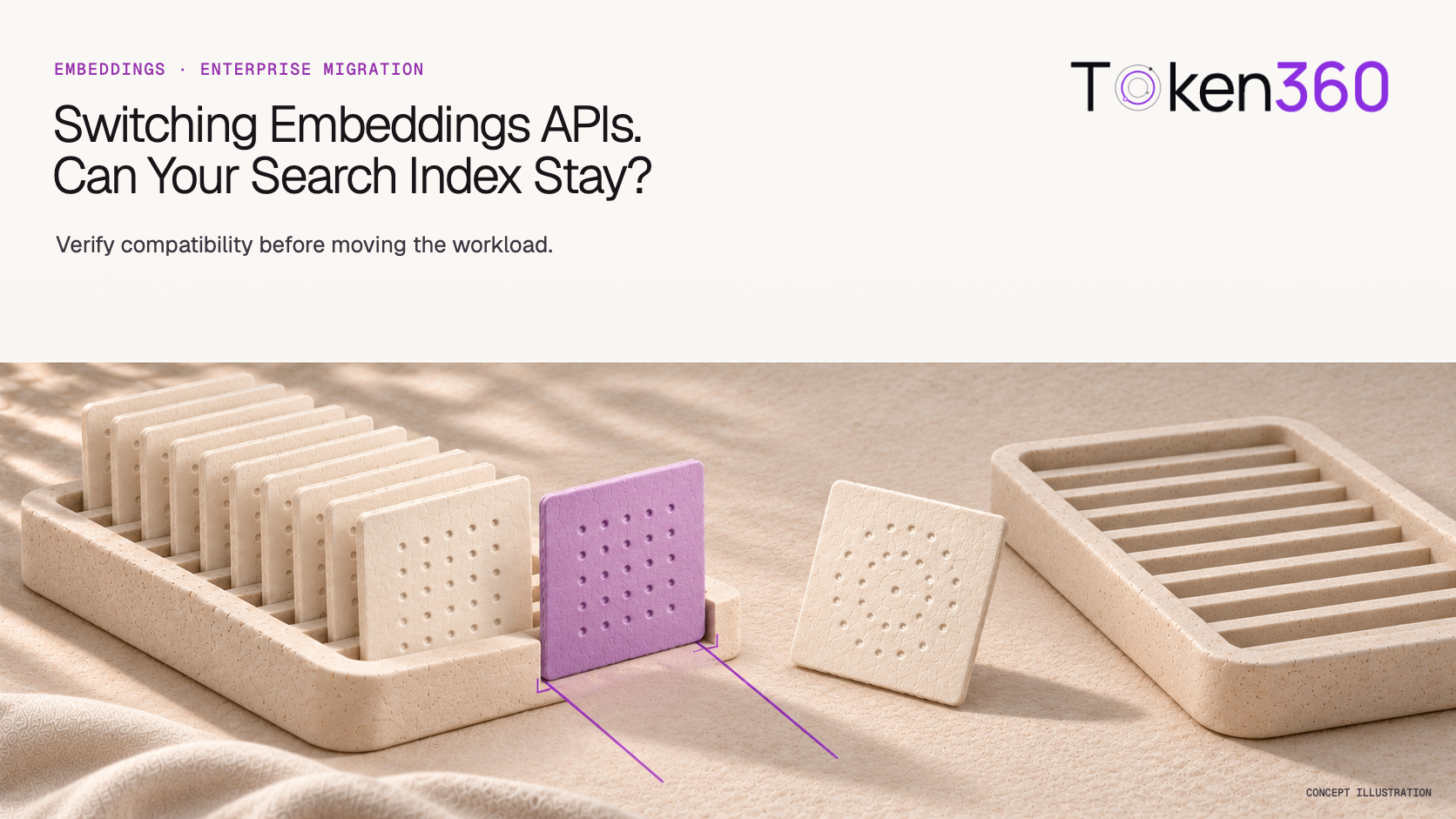
Switching an OpenAI embeddings API supplier does not automatically require rebuilding your search index. Reuse is a possibility only when the new service preserves the embedding model and configuration that produced the stored vectors, and compatibility is verified. A different model or vector configuration requires a separate migration assessment before production traffic moves.
An enterprise considering a new model supplier may already have a substantial searchable document collection. The purchasing question is not just whether the replacement API returns a successful response. It is whether the search investment can stay in place—and who pays for any required re-embedding, validation and cutover work.
This is a procurement and acceptance framework for an existing embeddings-based search system. It is not a measured Token360 migration, a guarantee of endpoint availability or a claim that two suppliers produce identical vectors. Official documentation was reviewed November 22, 2026. The example and worksheet are proposed evaluation tools.
Does changing the supplier mean changing the embedding model?
A supplier change and a model change are separate events. A new route might serve the same model and settings, or it might use a different model behind a similar interface. Procurement should identify which change is proposed before accepting a promise that the existing index will continue to work.
The OpenAI embeddings API converts input text into vectors. Those vectors can be stored for search; the API response is not itself a complete search application. OpenAI documents the returned vectors and model metadata in its embeddings API reference. That gives the technical team fields to record, but a response label alone is not independent proof of the underlying service.
Separate the proposed commercial change from the technical change.
| Proposed change | Question to resolve | Initial decision |
|---|
| Supplier or billing route only | Is the actual model and vector configuration preserved? | Evaluate index reuse; do not assume a rebuild or compatibility. |
|---|
| Embedding model changes | How will both stored documents and incoming queries use the new model consistently? | Plan a separate vector migration and retrieval evaluation. |
|---|
| Output dimensions change | Does the existing vector field accept the new shape, and how will stored vectors be updated? | Do not send incompatible vectors into the existing field. |
|---|
| Document preparation changes | Are chunks, extracted text or identifiers changing as well? | Separate the ingestion change from the supplier test; assess affected records. |
|---|
Microsoft's vector generation guidance says to use the same embedding model for indexing and querying. The practical implication is that replacing only the query-side model is not a safe default when the stored document vectors came from another model.
What evidence should a supplier provide before promising index reuse?
Ask the supplier to identify the actual embedding model, supported output dimensions, input handling and any transformations applied by the serving path. Compare that description with the configuration that created your index. Treat a matching API format or vector length as necessary integration information, not sufficient evidence of semantic compatibility.
Two arrays can have the same length while representing text differently. Matching the database's shape requirement is only one check. For example, Pinecone's index configuration reference requires matching vector type and dimension and a supported similarity metric when configuring integrated embeddings. That structural requirement does not certify that arbitrary models share the same vector space.
OpenAI's embedding guide also documents configurable dimensions for its third-generation models. Record an explicit dimension setting where used; do not rely on a remembered default or a generic “OpenAI-compatible” label.
- Model identity: exact requested model, the supplier's mapping to the served model, and how model changes are communicated.
- Vector configuration: requested dimensions, output encoding and any documented post-processing relevant to your index.
- Input behavior: whether the submitted text is passed through unchanged, and what happens to oversized or invalid inputs.
- Existing index record: model configuration, preparation pipeline, vector-field definition and the document identifiers used when it was built.
- Scope of the claim: which configuration the supplier has confirmed, what remains untested and who will approve reuse.
If the historical configuration is missing, write “unknown” rather than reconstructing it from the vector length. Recover build records or regenerate a controlled sample before deciding. This is an embedding-specific acceptance question; the broader AI portability guide covers the other assets a company should retain.
How can you test reuse without rebuilding the entire index first?
Keep the existing document index fixed and compare baseline and candidate query paths on a controlled set of business questions. Also compare embeddings for identical sample inputs to investigate unexpected differences. Agree on retrieval acceptance criteria before running the test, and preserve a rollback route while the candidate remains unapproved.
The following is a proposed test, not a completed experiment:
- Capture the baseline. Save the model configuration, request inputs, index version, filters and relevant document IDs. Use approved test data.
- Choose representative queries. Include normal wording, company terminology, supported languages and questions with no relevant document. Have a domain reviewer identify acceptable results.
- Change only the embedding route. Keep the retrieval engine, filters, result count and any reranking settings fixed. This makes a supplier-path difference easier to isolate.
- Inspect outputs and retrieval. Check vector shape and model metadata, then compare returned documents against the relevance judgments. Numerical comparisons can reveal differences; they are not a substitute for retrieval evaluation.
- Record the decision. Approve the tested scope, investigate discrepancies, or plan a new index. A passing sample supports that sample and configuration, not a universal equivalence guarantee.
For a hypothetical internal policy search, a query about parental leave should retrieve the relevant approved policy under both paths. If the candidate returns unrelated travel guidance despite a successful API response, stop the cutover and investigate. If both return relevant documents in a slightly different order, judge that difference against the agreed business criteria rather than requiring identical rankings by default.
Do not change the embedding model, chunking strategy and search engine in the same comparison and attribute the result solely to the supplier. Nor should generated answer quality hide retrieval problems: review the retrieved evidence before evaluating a language model's final answer.
Use the worksheet template below to record configuration, baseline evidence, candidate evidence, open questions and approval ownership.
What should the quotation include if re-embedding is necessary?
Separate recurring model usage from one-time migration work. A quote should identify the corpus to process, the applicable billing meter, validation work and any period of parallel operation. Index storage, engineering and rollback responsibilities should be explicit, so a lower API rate is not mistaken for a lower migration cost.
OpenAI describes embedding usage as billed on input tokens in its embedding documentation. For a supplier quotation, ask which rate and terms apply to the actual corpus and query workload. Do not infer a Token360 rate from an upstream public rate or assume an enterprise discount applies automatically.
| Cost or responsibility | What to specify |
|---|
| Re-embedding scope | All documents or an identified subset; source snapshot; preprocessing owner; estimated billable input. |
|---|
| Index changes | Whether a new vector field or index is required, who builds it and who pays for temporary storage. |
|---|
| Validation | Test inputs, relevance review, acceptance owner and treatment of failed runs. |
|---|
| Parallel operation | Which old and new services remain active, for how long, and under which charges. |
|---|
| Cutover and rollback | Who changes routing, what triggers rollback and when the old path may be retired. |
|---|
Ask for “migration included” to be translated into named deliverables. Providing a working API key is different from rebuilding your company's document index. For that division of work, use the supplier-switching support checklist; this article owns the narrower decision about existing embedding vectors.
What should you ask Token360 before moving an embeddings workload?
Start by asking Token360 whether it can provide the exact embedding model, endpoint and configuration required by your existing index. Include your model records and proposed acceptance checks. Confirm availability before requesting migration terms; general model access or API compatibility does not establish that a particular embeddings service is available.
Token360 serves enterprise model procurement across text, image, audio and video. Its model-capability documentation directs buyers to the selected model page and public schema for supported capabilities. This article does not establish current availability of a specific OpenAI embedding model through Token360.
If the required service is available, discuss an enterprise quote using separate estimates for migration input and ongoing query traffic. Token360 uses tiered enterprise quotes: higher usage receives lower quoted rates, subject to the quoted scope and terms. There is no separate service fee; model usage remains chargeable. Neither statement promises free reindexing or implementation work.
We currently use [model and configuration] for [index and search use case]. Can you supply that exact service? Please identify any differences, the evidence available for compatibility testing, and the responsibility and cost for re-embedding if required. We will approve index reuse only after the agreed evaluation.
A lower quotation can justify an evaluation, but it cannot establish that stored vectors remain usable. Keep the purchasing decision tied to the confirmed service, measured retrieval behavior and explicitly scoped migration work. Preserve the old route until the new one has passed the agreed acceptance process.
Worksheet template
Check,Baseline evidence,Candidate evidence,Acceptance criterion,Open question,Owner,Decision
Actual embedding model,,,,,,
Dimensions and vector configuration,,,,,,
Input preparation,,,,,,
Fixed index and retrieval settings,,,,,,
Representative query relevance,,,,,,
No-result cases,,,,,,
Usage and migration scope,,,,,,
Rollback and final approval,,,,,,


 Guides
 Guides
 Guides