AI for Cleaning Companies: From Inspections to Actions
Use AI APIs to connect cleaning inspection notes, photos and follow-ups. Keep recurring issues, reported fixes and verified closure separate.
INDUSTRY USE CASES · COMMERCIAL CLEANING
Commercial cleaning companies can use AI model APIs to organize inspection notes, connect related reports and draft corrective-action summaries. Keep every finding tied to a site, inspection point and dated source. A useful assistant helps supervisors decide what needs attention; it does not prove hygiene from a photograph, establish why a problem happened or close a task without verified follow-up.
For a multi-site cleaning operator, the challenge is often the gap between collecting evidence and acting on it. Supervisors may have scored checklists, phone photos, shift notes and client messages. A weekly summary can sound reassuring while hiding an unresolved issue, combining different locations or presenting an old photograph as current evidence.
This article focuses on that quality-review workflow: what was observed, whether it relates to an earlier finding, what action was assigned and what establishes closure. It is not a guide to autonomous cleaning, chemical selection or staff performance scoring.
Evidence boundary: The workflow and office-site example below are proposed, not a measured Token360 customer deployment. Official documentation was checked November 14, 2026. No inspection-software connector, visual detection benchmark or savings estimate is claimed.
Start with preparing a supervisor's review pack from existing records. A text model can group notes by inspection point, identify missing information and draft action summaries. An image-capable model may describe visible features in authorized photographs. The supervisor should review those outputs alongside the original evidence before assigning work or reporting a result to the client.
That is a narrower and more testable task than asking AI to “manage cleaning quality.” The assistant can save a reviewer from navigating scattered records without becoming the authority on whether an area meets a contractual or professional standard.
Existing operational software may already capture the necessary data. Swept's inspection documentation, for example, describes location-specific inspection plans, ratings, comments and attached photos, including capture and upload timestamps. This provides a concrete example of source records an organization might work with; it does not establish that Token360 has a Swept integration.
Work item
Useful AI assistance
Review still required
Weekly site review
Organize observations and unresolved findings
Check source coverage and inspection dates
Possible recurring issue
Suggest related records with links
Confirm the same location, task and issue identity
Corrective-action draft
Summarize the finding and missing follow-up
Assign an appropriate action, owner and due date
Client update
Draft a concise, evidence-linked status report
Approve claims and distinguish reported work from verified closure
What information must stay attached to each finding?
Retain the site, area, inspection point, observation time, source identifier and applicable service scope. Separate the person reporting a problem from the person assigned to investigate it. Keep photo capture time distinct from upload time, and preserve uncertainty when a timestamp or location is unavailable. Without these fields, a fluent summary can connect records that describe different situations.
A useful finding record has four parts: the reported observation, supporting evidence, current status and next review action. For example, “supervisor noted debris beneath reception seating” is an observation. “Evening crew skipped the area” is a causal claim that needs additional evidence. The assistant should not convert the first into the second.
Record whether the task belongs to routine service, periodic work or a request outside the current scope. A complaint about a periodic task does not establish that it was due on the previous shift. Include the relevant schedule or scope version rather than allowing the model to infer frequency from the phrase “weekly cleaning.”
If the client reports a problem through several channels, keep those source messages but avoid counting each copy as a new incident. Similarly, several findings from one inspection are not necessarily several failed visits. Define the unit being summarized before showing counts or trend claims.
How should AI distinguish a repeat issue from a repeated report?
Treat recurrence as a review decision supported by location, task and time, not as a similarity score between sentences. Two records may refer to the same unresolved observation, two separate occurrences or different areas with similar wording. The assistant should present the candidate relationship and its evidence, leaving uncertain cases separate until a supervisor confirms the connection.
Fictional example: An office-site supervisor records a marked reception entrance on Monday. A client emails the same photo on Tuesday. On Wednesday, another image shows a mark near the staff entrance. A cleaner has meanwhile recorded “entrance completed,” without identifying which entrance or attaching a follow-up inspection.
A careless summary could report three failures followed by a completed fix. A more useful review pack would distinguish the records:
Source
What is established
What remains open
Monday inspection
A reported mark at reception at the inspection time
Cause and subsequent condition
Tuesday email with reused photo
The client is following up on evidence already received
Whether a new observation occurred
Wednesday staff-entrance image
A potentially separate finding at another entrance
Capture time, exact inspection point and relationship to the first finding
“Entrance completed” note
A worker reported an action
Which finding it addresses and whether a follow-up verified resolution
The supervisor can then request the missing area reference and review the current condition. The model has helped expose gaps; it has not determined a root cause. A legitimate outcome is “insufficient evidence to establish recurrence,” especially when photographs lack context or records use inconsistent room names.
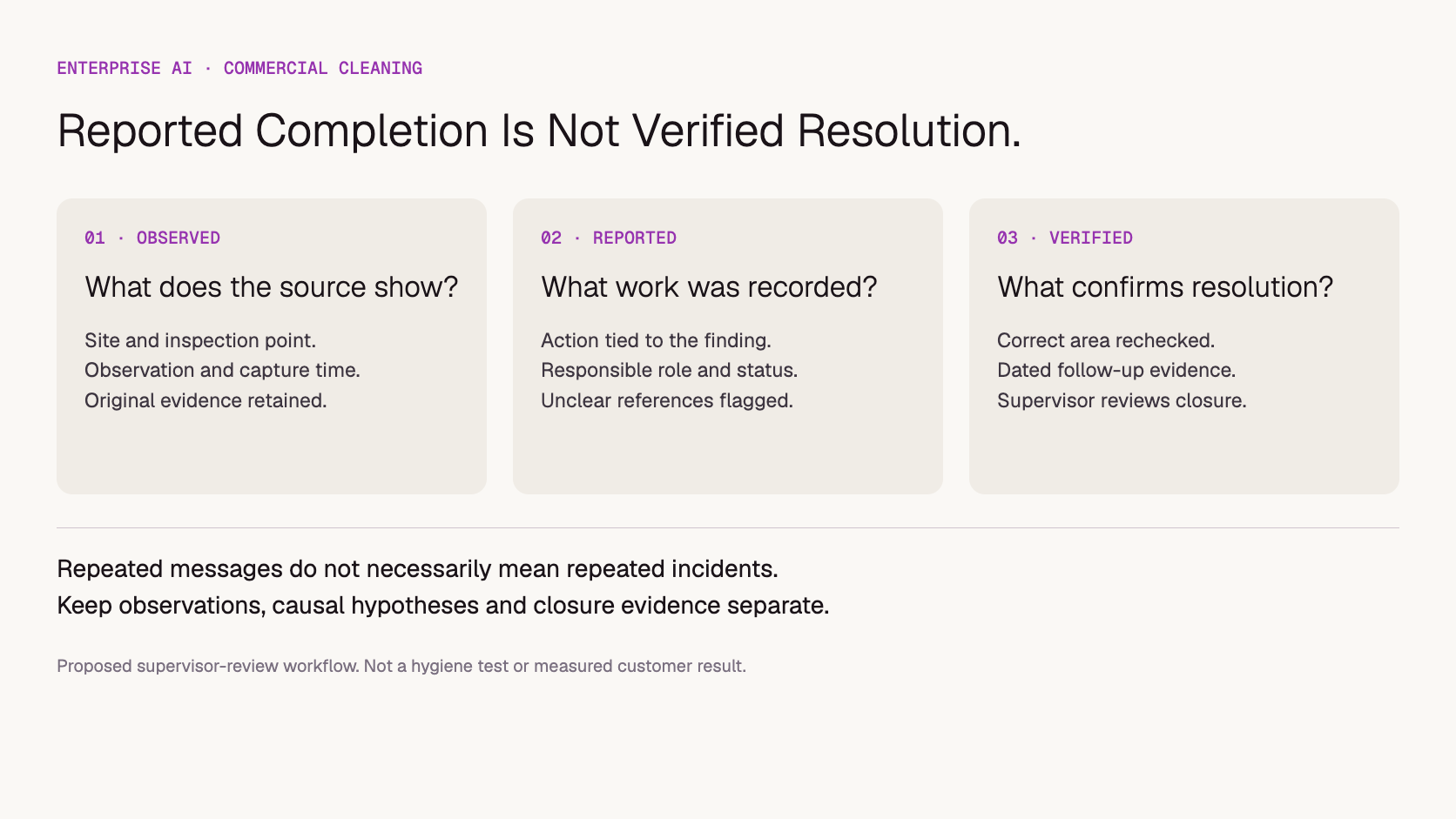
Proposed evidence states for a reviewed action register. Reported completion is not the same as verified resolution.
What can photographs and shift data actually establish?
Photographs can support observations about visible conditions within their frame. Shift records can show recorded attendance or time against a schedule. Neither source, by itself, proves why a quality issue happened or whether every required task was completed. Use each source for the question it can answer, and keep causal explanations provisional until an appropriate review supports them.
A photo showing an apparently clear floor does not prove disinfection, reveal an odor or show the condition outside the frame. Avoid presenting a generated visual score as a hygiene certificate. For this workflow, the image model's role is to help a person locate and describe visible evidence, with ambiguous images routed back for review.
Likewise, less recorded time is not automatically worse cleaning. Swept's schedule variance documentation explains comparing scheduled and recorded time and using the report to guide further investigation, including inspections. Our proposed approach keeps time variance and quality findings as separate signals rather than deriving a quality judgment directly from duration.
Do not use a model-generated explanation as the sole basis for a personnel decision. A missed sign-in, blocked access, changed workload and an incomplete inspection can produce different interpretations of the same summary. Ask the operational owner to resolve discrepancies before the explanation enters a client report or staff review.
How should corrective actions reach a verified closure?
Use explicit states for a finding: awaiting clarification, reviewed, action assigned, completion reported and follow-up verified. Define who can change each state and what evidence is required. AI can draft the action and summarize new records, but the workflow should not mark an issue resolved merely because a later message sounds positive or uses the word “done.”
For an approved action, record the responsible role, the exact inspection point, the expected follow-up and a due date chosen by the supervisor. Keep cleaning procedures with the organization's approved operating instructions; the model should not invent a chemical treatment or method from a surface photograph.
The closure record should point to the original finding and the follow-up evidence. If a follow-up checks a different area, that does not close the original issue. If no one has verified the result, the client update can accurately say “corrective work reported; follow-up pending.” That wording provides useful progress without claiming an outcome the records do not support.
This differs from drafting a single field-service report: the focus here is the relationship across observations and actions over time. The broader approval-workflow guide explains why an accepted AI output should remain separate from execution authority.
Should the operator use existing software or a custom API workflow?
Prefer existing cleaning-management software when its inspection and reporting features already meet the requirement. Consider a custom model-API workflow when information is distributed across systems or clients need a review format the current tools cannot provide. The business case must include integration, access control and supervisor review, not just the price of summarizing a batch of notes.
Start by checking exports, supported APIs and access permissions in the software already used. Do not assume a product has a connector because it has a report screen. A controlled export may be sufficient for a pilot, while a production workflow needs explicit ownership of synchronization, missing records and status updates.
Approach
Best-fit requirement
Main evaluation question
Native inspection reports
Consistent records inside one operational system
Can supervisors already find unresolved work quickly?
Rules and dashboards
Stable fields, due dates and straightforward counts
Can deterministic logic answer the question reliably?
Model-assisted review
Varied free-text notes, images and client messages
Does interpretation help enough to justify review and integration?
Use ordinary database logic for joins, permissions and due-date calculations where possible. Use the model for language interpretation and drafting. The distinction helps prevent a convincing narrative from overriding the action register. For the broader purchasing decision, see AI software versus model APIs.
How can a cleaning company test the business value?
Evaluate whether supervisors receive a more accurate, usable review pack with less total preparation effort. Use permitted historical records, preserve the original sources and create a human-reviewed reference. Track missed findings, incorrect links and unsupported closure claims separately from writing quality. A polished client summary should not pass if it hides unresolved work or attributes it to the wrong site.
Include difficult cases: a reused photograph, different sites with similar room names, a changed inspection checklist, a reported fix without follow-up and a client request outside the contracted scope. Check whether the assistant preserves those distinctions. Do not judge the pilot only on well-structured reports that were easy to summarize manually.
Measure reviewer time, correction time, model charges and the number of review packs accepted under your criteria. Calculate cost per accepted pack, including rejected drafts and allocated integration effort. Compare that with the same preparation task performed through the existing process; keep scope and record volume comparable. No numerical savings claim is established by this proposed test.
Use the blank cleaning-action review register to capture source references, proposed relationships, reviewer decisions and closure evidence. Add a separate assessment of confidentiality: site photos may contain people, badges, documents or client information unrelated to the cleaning issue. Limit the input to authorized, relevant material.
Bring a defined workload: the number and size of review packs, whether images are necessary, required languages and the systems supplying evidence. Token360 provides enterprise access to text, image, audio and video models, with negotiated pricing, dedicated capacity, contracts and compliance requirements scoped to the engagement. Model access still needs an application and an accountable operational review process.
For a first deployment, a text-only summary from well-structured notes may be sufficient. Add image interpretation only if it improves a specific review task and the selected model supports the required inputs. Audio transcription may be useful for supervisor voice notes, but it introduces another source that must retain its identity and review status.
As checked November 14, 2026, the Token360 enterprise offering describes model access and enterprise commercial options. Confirm actual model availability, capacity and data terms for the proposed route. This article does not claim a built-in cleaning-management integration, automatic inspection certification or a universal service guarantee. See Token360 resources and company information for platform context.
Before sending client records, separate data retention from model-training policy and confirm the applicable terms. For procurement, compare the full operating cost of model APIs, including review and integration, rather than treating low inference cost as evidence of a successful quality program.
Frequently asked questions
Can AI certify that a room is clean from a photo?
This workflow does not establish that capability. A photograph may support a visible observation within its frame, but it cannot establish every aspect of cleaning or hygiene. Use the organization's applicable inspection methods and qualified reviewers for acceptance.
Can AI identify recurring cleaning problems?
It can suggest related observations for review. Confirm site, inspection point, date and issue identity before calling them recurring. Repeated emails or reused photos may describe one unresolved issue rather than multiple occurrences.
Does a shorter shift prove that cleaning was incomplete?
No. Recorded time and inspection findings answer different questions. Investigate discrepancies with the operational context and source records instead of using a duration difference as an automatic quality or personnel judgment.
Does Token360 include cleaning inspection software?
This article describes a proposed use of model APIs, not a ready-made inspection application. The operator needs its own workflow or software integration, source records, permissions and supervisor review. Confirm the required model capabilities and commercial scope before deployment.
What is a sensible first pilot?
Prepare a weekly review pack for a bounded set of authorized site records, without automatically closing tasks or sending client messages. Compare the draft against a human-reviewed reference, measure corrections and review effort, and expand only when the results justify it.



 Guides
 Guides
 Guides