AI APIs for Field Service: From Notes to Service Reports
Use AI APIs to draft field service reports from notes, audio and photos, while preserving completed work, unresolved issues and technician review.
INDUSTRY USE CASES · FIELD SERVICE
AI APIs for field service can help turn technician notes, voice recordings and site photographs into draft service reports. The useful output preserves what was observed, what was completed and what remains open. Technicians review the draft against the visit record before it becomes a customer report or changes a work-order status.
A technician finishes a visit with a short voice memo, several photographs and an incomplete form. The office needs a readable report. The customer wants to know what happened and what comes next. A model can help organize the material, but a polished sentence such as “the equipment is fully operational” creates a problem if the technician only recorded that a visual check was completed.
This article is for equipment service providers, maintenance contractors and software vendors serving field teams. It focuses on post-visit documentation, with an illustrative example and a practical evaluation plan. It does not report a deployed Token360 field-service application or measured productivity gains.
Which documentation work is worth automating first?
Start with assembling and rewriting evidence already captured during a visit. A model can organize rough notes, separate completed work from follow-up and prepare a customer-facing explanation. It should not fill missing inspection results, diagnose an unrecorded fault or convert a technician's tentative observation into a confirmed finding.
Three outputs are useful candidates: an internal visit recap for the next technician, a customer report explaining the work, and a draft follow-up request for the service office. They may use the same source material, but they serve different readers. An internal note can retain troubleshooting shorthand; the customer version needs clear language without exposing unrelated internal comments.
The business case depends on how much time goes into assembling these records and how much correction a draft requires. If technicians already complete a short structured checklist that directly produces an adequate report, a template may be enough. If details are distributed across voice notes, photographs and free-text fields, model assistance has a more specific job to do.
Keep the scope centered on documentation. A visit report, a work-order status update, a customer acknowledgment and an invoice are different records. Improving the first does not automatically justify changing the others.
What evidence should a service-report draft use?
A report draft needs the correct work order, asset identity, visit context and attributed observations. Connect each statement to a note, field, recording segment or photograph where possible. Missing evidence should remain visible to the reviewer; information from a previous visit should not silently become a statement about today's work.
Input
Useful contribution
Check before using it
Work-order and asset records
Customer, location, asset identifier and reported issue.
Correct account, visit and equipment; distinguish history from current observations.
Technician notes or voice memo
Work described, observations, blockers and next steps.
Speaker, timestamp, unclear words and whether the statement is observation or interpretation.
Inspection responses
Recorded answers to specific service tasks.
Which questions were answered, skipped or marked not applicable.
Photographs
Visual reference for a recorded condition or asset label.
Capture time, asset association, legibility and whether the image actually supports the claim.
Parts and time entries
Recorded materials and duration.
Used versus requested parts; approved quantities; billable versus recorded time.
Follow-up records
Outstanding work and assigned responsibility.
Requested, approved and scheduled are separate states.
Structured inspection responses should remain structured evidence. Microsoft documents inspections attached to work-order service tasks that technicians can complete. A generated paragraph is useful for explaining those records, but should not replace the underlying answers or turn an unanswered question into a pass. Documentation checked November 13, 2026.
For voice input, test the transcription path independently from report drafting. Equipment identifiers, part codes, negation and spoken numbers deserve explicit review. “Did not replace” becoming “replaced” changes the service record even if every later sentence is grammatically correct. A field that cannot be heard clearly should be marked for confirmation, rather than reconstructed from what usually happens on that type of visit.
How should the report handle incomplete work?
Incomplete work belongs in the main report, with the reason and next action preserved. A good draft separates completed tasks from observations and outstanding items. It does not equate a technician leaving the site with a resolved fault, a finished work order or permission to issue a final invoice.
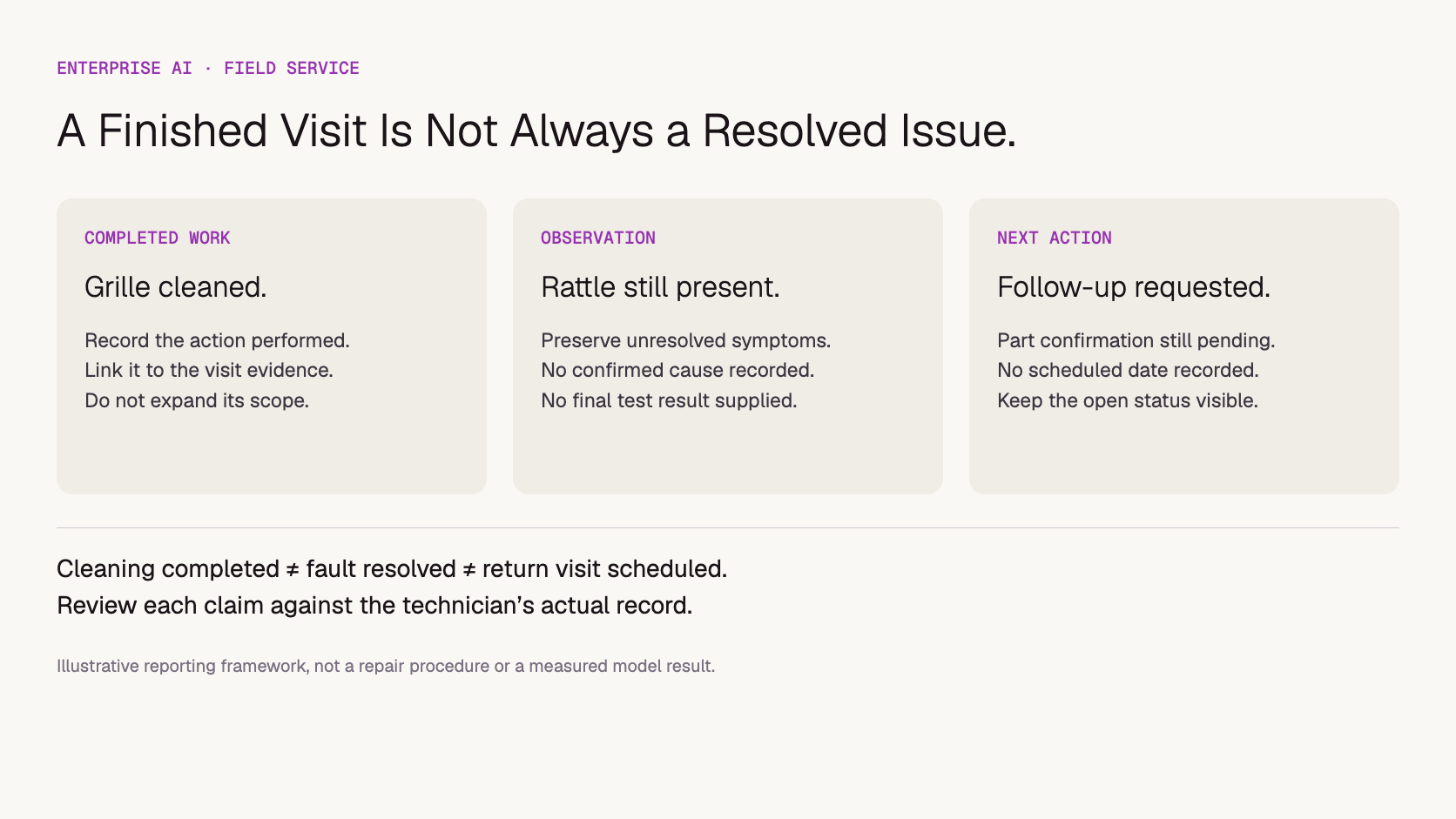
Illustrative example, not a model test: the visit record identifies ventilation unit V-17 at Site B. The technician's note reads: “Cleaned the grille. Rattle still present. Replacement part not fitted; awaiting confirmation of the correct part. Follow-up visit requested. No final operational test recorded.” A photograph shows the unit and a second image shows its label.
Report section
Evidence-faithful draft
Unsupported rewrite
Completed work
The technician recorded cleaning the grille of V-17.
The technician completed all maintenance.
Remaining issue
The technician reported that the rattle remained after cleaning.
The noise was caused by a failed motor.
Parts
No replacement part was fitted; part confirmation remains pending.
A replacement part was installed.
Follow-up
A follow-up visit has been requested.
A return appointment is confirmed for tomorrow.
Verification
The supplied record contains no final operational test result.
The unit passed testing and is fully operational.
A customer-facing draft could read: “During the visit to Site B, the technician cleaned the grille on unit V-17. The technician recorded that the rattle remained. No replacement part was fitted because the correct part still needs confirmation. A follow-up visit has been requested; scheduling remains to be confirmed.” The reviewer can then decide which additional detail the customer needs.
The report should also surface the missing test record to the technician. “No result recorded” does not establish that no test occurred, and it certainly does not establish a pass. That distinction allows the reviewer to supply the missing evidence without letting the model invent it.
Keep completed work, unresolved observations and planned actions distinct. This is an illustrative reporting framework, not a repair procedure.
Should you buy native field-service AI or build with APIs?
Evaluate the capabilities of your current field-service platform before building a separate application. Native summaries may already address internal recaps, while custom APIs can support a specialized report format or evidence spread across systems. Choose by the missing workflow capability, integration effort and review controls, rather than the presence of an AI label.
Microsoft's work-order summary documentation describes summaries that vary with lifecycle stage and notes that their content is not saved. That is a useful buying distinction: an on-screen recap is not automatically a retained, approved customer report.
A separate Microsoft feature describes text- or speech-based suggested work-order updates applied after confirmation. As checked November 13, 2026, that documentation labels the feature preview and says preview features are not intended for production use. Assess the exact capability and availability in your environment; this article does not treat a preview feature as a production recommendation.
Approach
When to investigate it
Questions for procurement
Existing field-service platform
Your evidence and work orders already reside there.
Does it retain reviewed reports, preserve evidence and support your customer format? What is licensed and production-ready?
Custom model API workflow
You need several source systems, custom review or specialized output.
Who owns connectors, transcription, document storage, access controls and report delivery?
Structured form and report template
Required inputs are consistent and technicians can capture them directly.
Can better field design solve the problem without a generative step?
A custom workflow is not inherently cheaper. It brings responsibility for the surrounding product as well as inference usage. The broader software-versus-model-API framework helps separate what the vendor supplies from what your team must maintain.
How do you keep a draft separate from operational actions?
Generate the report in a review area with no automatic authority to close a work order, book a return visit or issue an invoice. After review, store the accepted report version and its evidence references. Any operational update should use a separately authorized workflow that checks the relevant system's current state.
A sensible first implementation has five steps:
Collect the visit package. Select one work order, one asset and the appropriate visit records. Check account permissions and restrict unrelated customer information.
Prepare supported inputs. Transcribe authorized recordings where needed, retain unclear segments for review and attach properly associated photographs. Do not assume every model accepts every audio or image format.
Draft with evidence categories. Ask for completed work, observations, outstanding items and missing information. Preserve attribution and distinguish the current visit from prior service history.
Review beside the originals. Show each proposed statement with its supporting material. The technician corrects factual content; the designated reviewer approves the version intended for the customer.
Save and deliver through the application. Store the approved version with the correct work-order reference. Verify delivery or updates through actual system responses, rather than relying on the model's prose.
Offline capture needs its own handling. If a technician's photos arrive after a report was drafted, the application should identify that the source package changed and request review of an updated version. The earlier draft should not silently become the final record because it was generated first.
Customer acknowledgment also needs accurate wording. A signature might acknowledge receipt of the report without confirming that every issue is resolved; preserve the meaning of the actual acknowledgment process. Do not let a model create acceptance language that the customer never agreed to.
How should field teams test report quality?
Use real, permissioned visit records with reviewer-established reference outcomes. Include incomplete visits, conflicting notes and missing evidence, not only tidy success cases. Score whether the report faithfully represents the visit and reduces correction effort. A well-written paragraph that incorrectly closes an outstanding issue should fail the evaluation.
Evaluate each input stage as well as the final document. If the transcript changes a part number, better report-writing instructions will not reliably fix the source. If a photo belongs to another asset, more detailed captions can make the error look persuasive. Record the origin of each problem so the team can improve capture, data association or model behavior appropriately.
Unsupported completion: does the draft say work, testing or verification was completed without supporting evidence?
Omitted follow-up: does it retain unresolved issues, pending parts and missing records?
Identity and attribution: does it preserve the correct asset, visit and speaker?
Evidence fidelity: are quantities, identifiers and negative statements preserved across transcription and drafting?
Review effort: how much time is spent checking and correcting the draft, including requests for missing information?
Delivery readiness: is the approved customer version complete, appropriately scoped and linked to the right work order?
Track errors by consequence rather than averaging them into one writing-quality score. An awkward sentence is a different problem from a false “test passed” statement. Define blocking errors before the pilot starts, and report how often drafts are rejected or need additional evidence alongside the accepted cases.
For economics, compare the full process against the current report-writing process: capture, transcription, inference, reviewer time and delivery. Include the cost of rejected drafts. No timing, accuracy or savings figure has been measured for this article. Use the blank service-report review register to collect your own evidence before making a rollout decision.
Token360 provides model access for the inference steps of a custom reporting application. Your team or software partner remains responsible for collecting visit evidence, connecting field-service systems, enforcing access, storing approved reports and executing operational actions. Select models by the required input support and tested reporting quality, then scope enterprise commercial requirements around that workload.
Token360 supports access across text, image, audio and video model categories. This workflow may require transcription and language or vision-language capabilities, depending on the source records; verify the selected model's actual supported inputs and endpoint. A broad model catalog is not evidence that one model handles every stage.
The Token360 enterprise page, checked November 13, 2026, describes model access and custom enterprise pricing. Dedicated capacity, contracts and compliance requirements can be discussed for the engagement; their specific scope needs agreement. This article does not claim a native field-service connector or a blanket service certification.
Token360 charges no separate service fee, while model usage remains chargeable. That does not eliminate transcription, integration, storage or review costs in the complete workflow. See the service-fee explanation for the commercial boundary.
Bring visit volume, audio minutes, photograph counts, languages, typical record length, reporting deadlines and expected peak submissions to a commercial discussion. Include the selected models and data-handling requirements. Those details are more useful than a generic request for “an AI assistant for technicians.”
For design clarification that needs an official answer, the construction RFI workflow shows how to attach the evidence and route it for review.
Frequently asked questions
Can AI write a service report from a voice memo alone?
It can draft from a transcript or supported audio input, but the memo may omit the asset identity, inspection answers or outstanding tasks. Match it to the correct visit and flag missing evidence. A readable draft is not automatically a complete service record.
Can a photograph prove the equipment was repaired?
A photograph can support a visible observation, but it does not establish all operational results. Use the technician's recorded work and relevant test evidence. Do not convert a normal-looking exterior into a claim that an unresolved fault is fixed.
Should the report automatically close the work order?
Not merely because generation succeeded. Completion must follow the service organization's authorized process and required evidence. Report approval, work-order closure and invoicing should have explicit conditions rather than being inferred from generated wording.
Can the customer report be written in another language?
Yes, a suitable language model can assist with translation. Test technical terms, identifiers, negation and the meaning of pending actions with qualified reviewers. Preserve the approved source version and link translations to it so later corrections remain traceable.
Is this a tested Token360 field-service product?
No. This is a proposed use case and evaluation framework supported by official documentation and a clearly labeled illustrative visit. It does not claim a deployed connector, customer case study or measured efficiency gain.
Enterprise AI
API
Bring your next idea to life.
Create a video scene in Creator, or explore models for images, audio, and text to find the right capabilities for your project.


 Guides
 Guides
 Guides