AI APIs for Restaurants: Keep Menu Content Accurate
Use AI APIs to adapt restaurant menus without changing approved ingredients, prices or options. Compare workflows and test location-specific content.
INDUSTRY USE CASES · RESTAURANT GROUPS
Restaurant groups can use AI APIs to draft menu descriptions, translate approved copy and prepare campaign assets. The model should work from the correct item, location and menu version. Prices, serving options, availability and dietary claims must come from approved records, with review before publication. A convincing description is not proof that a dish can be ordered.
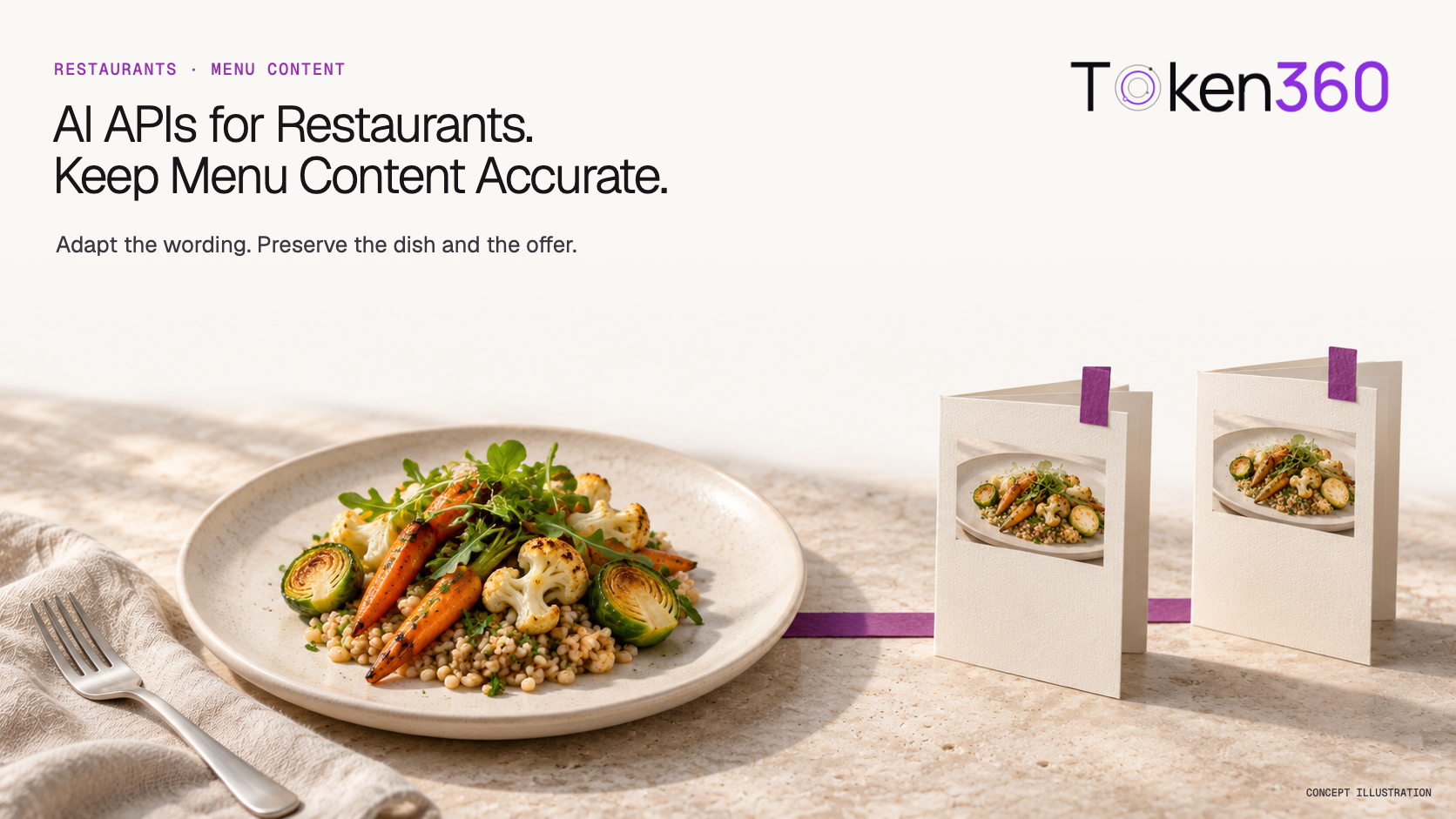
A seasonal dish can appear on a printed menu, a delivery listing, a brand website and a local campaign. Those surfaces may need different wording, but they cannot quietly become different products. A model that adds a garnish, includes a paid side or copies another branch’s price creates an operational problem even when the prose sounds appealing.
This article is for multi-location restaurant operators, franchise marketing teams and restaurant-software companies evaluating model access. It focuses on controlled menu-content production. The worked example and evaluation plan are proposed designs, not a deployed Token360 restaurant integration or a measured customer result.
Where can AI help a restaurant group first?
Start with a bounded publishing task: adapting approved dish information for a particular channel or language. Keep the item identity and commercial fields outside the model’s discretion. This gives the team a reviewable output, a known source and a clear fallback when the model adds something the restaurant has not approved.
A useful first pilot might cover descriptions for one seasonal menu at two locations. The restaurant already knows the dish ingredients, portion choices, optional extras and intended channels. The model’s job is to make that information readable within each channel’s length and tone requirements. It does not decide the recipe or offer.
Task
Useful model contribution
What the application or reviewer retains
Short menu description
Condense approved ingredient and preparation notes.
Item identity, included components and unsupported-claim checks.
Translation
Draft a localized version using an approved glossary.
Meaning, modifier distinctions, product names and local-language approval.
Campaign copy
Offer alternative headlines or descriptions.
Location, dates, price, offer conditions and final publication.
Image or video concept
Explore a composition using approved visual inputs where supported.
Actual serving appearance, portion and packaging fidelity.
Order confirmation
Explain a result returned by the ordering system.
Selection validation, pricing, order submission and transaction status.
The last row is a different project. A copy-production pilot should not quietly expand into ordering simply because the same model can answer questions. If the company mainly needs a reliable menu editor and scheduled updates, existing restaurant software may solve the problem without a custom model workflow.
Which menu facts should stay outside generated prose?
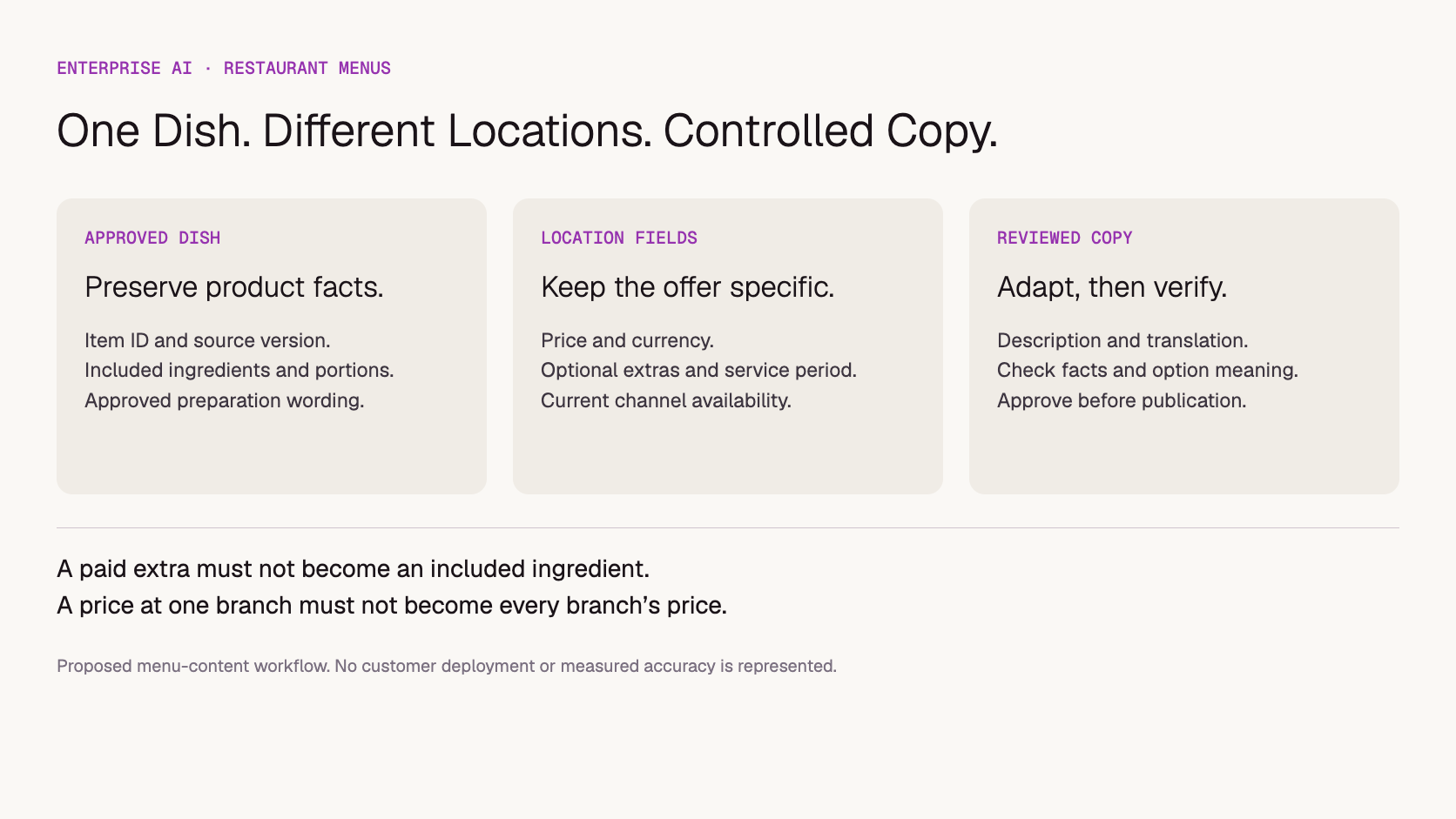
Store authoritative menu facts as structured fields and use the model to draft around them. A stable item identifier is more reliable than matching dishes by name. Location, service period, channel and version should travel with each request so that fluent copy cannot accidentally mix several valid but incompatible offers.
As checked on November 13, 2026, Square’s menu documentation describes location-specific synchronization using channels and distinguishes menu categories from regular catalog categories. The practical implication for a content workflow is that a restaurant’s menu is structured data, not merely a flat list of dish names. The exact integration depends on the operator’s platform and access. See Square’s menu-management documentation.
For each draft, assemble a small approved source packet:
Identity: item ID, display name, variation and source version.
Scope: restaurant or location, channel, language and service period.
Product facts: approved ingredients, preparation wording, included components and optional modifiers.
Approval fields: approved claims, publication status, source owner and reviewer.
Do not ask the model to reconstruct missing commercial facts from an old menu PDF. If a required field is absent, return it as missing for the content owner. Price rendering can use the validated structured value directly instead of relying on the model to type the number correctly.
Dietary and allergen statements require their own approved source and review process. A model should not infer them from a dish name, photo or incomplete ingredient list. “Not provided” must remain unknown rather than become an affirmative claim. This is a content-control boundary, not a substitute for the restaurant’s food-information procedures.
What does a location-specific menu error look like?
A location-specific error occurs when the generated text uses a real fact from the wrong context. Catch it by reviewing the draft against its exact source packet, not against a general impression of the brand. An item can have acceptable wording and still fail because it includes an extra, price or availability from another branch.
Consider this fictional, untested example. A restaurant group prepares copy for a seasonal roasted vegetable bowl. Both locations use the same approved base description, but their menus differ:
Field
Downtown lunch menu
Riverside dinner menu
Item / version
BOWL-17 / revision 6
BOWL-17 / revision 6
Base dish
Roasted vegetables, grains and herb dressing
Same approved base dish
Illustrative price
USD 14
USD 16
Optional extra
Grilled chicken, USD 4 extra
Not offered on this menu
Service period
Lunch
Dinner
A proposed Riverside description says: “Our roasted vegetable bowl with grilled chicken, available all day for $14.” It has three separate problems: the optional Downtown extra has become included, the Downtown price has crossed locations, and a dinner offering has become an all-day promise. Shortening the sentence or changing its tone would not repair the source mismatch.
A narrower draft is: “Roasted vegetables and grains with herb dressing.” The Riverside menu then renders its validated USD 16 price and dinner availability separately. This is an example of a review decision, not evidence that a particular model consistently produces the corrected wording.
Now change revision 6 to revision 7 after the restaurant approves a new dressing description. The publishing record should identify every affected adaptation. Reusing the previous translation without checking it may retain an obsolete ingredient term even if the English description has been corrected. The update is complete only when the relevant published surfaces have been checked.
A proposed publishing boundary. The model drafts copy; the restaurant’s approved records determine what is being offered.
How should translations and food images be reviewed?
Review each adaptation for preserved meaning, not just fluency or visual quality. A translation must keep an optional extra optional, and an image must not imply an included component that the customer will not receive. Use a language reviewer and an approved serving reference before treating generated material as publishable menu content.
For translation, provide a glossary of dish names and preparation terms that must remain consistent. Ask the model to flag ambiguous source wording rather than resolve it creatively. Keep the source and target text together in the review view so a reviewer can check quantities, exclusions and option relationships without hunting through separate files.
A literal back-translation can help reveal a discrepancy, but it is not independent proof that the target language is correct. The person approving the adaptation should understand the target audience and the source menu. For a pilot, log the changed term and why it mattered rather than giving each draft only a broad “good” or “bad” rating.
For food imagery, inspect the dish itself: number of components, portion, garnish, container and included sides. An attractive image with a second side dish or a different serving vessel can communicate a different offer. Use actual product photography when faithful representation is the requirement; generated concepts can remain internal creative options until the restaurant approves a suitable use.
Text, image and video capabilities need separate acceptance checks. Passing a description test does not establish that the same workflow can produce a faithful food photograph or a usable promotional clip. This separation also prevents an unnecessarily broad pilot from hiding which capability delivered value.
Should restaurants use existing software or a custom AI API?
Use the existing menu-management system when the main requirement is editing, scheduling or distributing authoritative menu data. Consider a custom AI API workflow when approved content must be adapted repeatedly across languages, brands or channels and the business can own the integration and review process. Model access does not replace the restaurant’s menu or ordering system.
Option
Best fit to evaluate
Main responsibility to check
Existing POS or menu tools
Maintain authoritative items, variations and operational settings.
Supported locations, channels, update behavior and publishing controls.
Templates plus human editing
Small menus, infrequent changes or tightly controlled wording.
Staff time, language review and version tracking.
Custom workflow with model APIs
Repeated content adaptation from approved source packets.
Data access, validation, review interface, publishing and monitoring.
Toast’s official ordering-integration checklist separates menu display, pricing strategies and ordering behavior. It also calls for displaying menus according to their availability data. That distinction matters here: a model-generated description cannot stand in for current orderability or a priced basket. See Toast’s online-ordering integration checklist, checked November 13, 2026.
Verify API access and permitted operations with the restaurant platform before selecting a model supplier. Read access, write access and distribution to a third-party channel are different integration requirements. This article does not establish a Token360 connector to Square, Toast or any delivery service. The broader AI software versus model API buying decision explains the ownership trade-off.
How do you test whether the content workflow is worth buying?
Evaluate publishable outputs against a representative set of menu changes, with reviewers checking both content and location-specific facts. Count rejected and corrected drafts alongside accepted ones. Measure the time needed to reach an approved result, not merely generation speed, because a quick draft can create more work if staff must reconcile invented details.
Build the test set from approved records your team is allowed to use. Include a simple description, an optional modifier, two locations with different commercial fields, a changed recipe description, a discontinued item, a missing field and a translation containing an ambiguous term. Add one case where the reference photo does not match the approved current serving.
Before running the pilot, define what counts as a critical failure. An altered optional-extra relationship and an unsupported food claim should not be averaged away by strong tone scores on other drafts. A style issue may be editable; a wrong source packet indicates a workflow problem that more prompt polishing may not fix.
Review dimension
Question to record
Source fidelity
Did every factual claim match the approved version?
Location and channel scope
Did any value cross from another location, service period or channel?
Language and clarity
Were optional components, restrictions and preparation terms preserved?
Human effort
How much review and correction time did the draft require?
Publication outcome
Was the approved version actually visible on the intended surface?
Use the blank menu-content review register to record source versions, defects and decisions. It contains no fabricated results. Compare the proposed workflow with the current editing process on comparable tasks; otherwise a speed claim may reflect easier dishes or a smaller review scope.
A practical internal measure is total pilot spend divided by accepted content units, with an agreed definition of a unit. Track reviewer time separately or include it consistently in both workflows. Do not compare the cost of one generated sentence with the cost of a fully reviewed, translated and published menu entry.
Where does Token360 fit in a restaurant content stack?
Token360 can be evaluated as the model-access supplier inside a restaurant’s content workflow. The restaurant or implementation team still owns source preparation, platform integration, review and publication. Choose the needed model capabilities first, then scope pricing and production requirements around the actual workload rather than assuming a model API includes a finished restaurant application.
The Token360 enterprise page describes text, image, audio and video model access and custom enterprise pricing. Availability and enterprise arrangements should be confirmed for the engagement; this is not a claim of a ready-made restaurant connector or guaranteed production throughput. For company context, see About Token360.
For a description-and-translation pilot, begin with language-model evaluation. Add visual generation only if there is a clear approved use. An enterprise discussion can cover model mix, usage, capacity, contracts and compliance requirements. Token360 has confirmed that it does not charge a separate service fee; model usage still has a cost, and the quote should state the applicable commercial terms. See what no separate service fee means.
A useful buying brief includes locations, languages, expected item changes, typical source-packet size, generation frequency and review turnaround. Distinguish scheduled seasonal production from urgent corrections. The latter needs a reliable publication and rollback process as well as model access. Prepare workload information for an enterprise quote before comparing headline token rates.
Can an AI API update a restaurant menu automatically?
It can produce proposed copy inside an integrated application. Updating the live menu requires authorized publishing access, validated fields and an approval policy. For an initial pilot, keep a human publication gate and retain the previous approved version so a rejected change can be reversed.
Can AI infer dietary claims from a food photograph?
Do not use a photograph as the authority for dietary claims. A visible dish does not establish its full preparation or ingredients. Use the restaurant’s approved information and review process, and treat absent information as unknown rather than asking the model to guess.
Do all restaurant locations need different prompts?
Not necessarily. A shared instruction template can use separate, validated source packets for each location. What matters is the correct item, service period, price and version reaching the request. Distinct prompts alone will not prevent a data join from mixing locations.
Does this workflow replace the POS or ordering platform?
No. The proposed workflow adapts approved content. Operational item data, availability, pricing and orders remain with the appropriate business systems. If ordering is added later, test it as a separate integration with explicit transaction and confirmation rules.
What is the smallest useful pilot?
Use one menu change that creates real adaptation work, such as a seasonal update across two locations and two languages. Include differing options and an intentionally missing field. Keep the scope small enough to inspect every result, but varied enough to expose incorrect assumptions.
Evidence note: official platform documentation checked November 13, 2026. The bowl example, review criteria and workflow are illustrative proposals. No restaurant deployment, accuracy result, conversion improvement or integration test is claimed.
Enterprise AI
API
Bring your next idea to life.
Create a video scene in Creator, or explore models for images, audio, and text to find the right capabilities for your project.


 Guides
 Guides
 Guides