AI APIs for Hotels: Turn Guest Messages into Service
Use AI APIs to interpret hotel guest messages, route service requests and preserve approvals, timing and ownership across shifts.
INDUSTRY USE CASES · HOTELS & HOSPITALITY
AI APIs for hotels can help interpret guest messages, retrieve relevant property information and prepare service requests for the right team. The hotel application must still verify the stay, check current operational data and confirm what staff can deliver. A polite reply is not evidence that a room is ready, a late checkout is approved or an item has arrived.
For hotel groups and hospitality software teams, the useful question is not simply whether a model can answer guests. It is whether the interaction becomes an accurate, owned request that survives department and shift changes. This article focuses on that workflow, from the first message to a verified service outcome.
Start with a bounded set of recurring requests that have clear property policies and identifiable owners. Examples include answering an amenity question, preparing a towel request or routing a luggage-storage inquiry. Keep discretionary approvals and changing availability separate from factual answers, and define when the assistant should ask a follow-up question.
A guest asking “Can I leave my bags before check-in?” may need a current property policy. A guest asking “Can I enter my room at ten?” needs a decision about the actual reservation and room readiness. Treating both as generic early-arrival questions risks giving a promise the front desk cannot fulfill.
Use a small request taxonomy that staff already understand. Avoid creating a complex classification scheme that nobody uses at the property. The model's job is to preserve intent and supply a useful draft; operations should determine which team receives it and how its progress is recorded.
What information should the assistant use?
Combine a maintained property knowledge base with the minimum authorized stay context and current operational information required for the request. Separate static policies from live status. Opening hours may come from an approved guide; room readiness or an approved departure extension must come from the appropriate operational record or staff decision.
Guest question
Required source
What the answer must not assume
When is breakfast?
Current property and date-specific service information
Every hotel in the group has identical hours.
Can I check in early?
Verified stay, policy and current front-desk decision
A clean room is automatically assigned and available to this guest.
Can I check out at two?
Applicable policy, availability and authorized approval
A request equals a granted extension or waived fee.
Please send towels.
Verified service location and task owner
The guest's former room is still the correct destination.
Has my request been completed?
Current task record or staff confirmation
A drafted or assigned task has already been fulfilled.
Oracle's OPERA Cloud Housekeeping Board documentation describes room-status information alongside reservation and profile details where applicable. It illustrates why operational context lives in hotel systems. It does not establish that Token360 can read those records or that a single status answers every guest question.
For a hotel group, scope retrieval to the correct property before generating an answer. A useful response for one hotel can be wrong at another because policies, facilities and opening hours differ. Preserve the source version and effective dates when information changes seasonally or for a specific event.
Access checks belong in the application. A room number typed in chat is not sufficient authorization to reveal guest details or change a reservation. Pass only the information needed after the application has established the appropriate identity and permissions.
How should a message become a service request?
Extract the requested service, location, timing and any important constraints, then resolve missing details before creating the task. Preserve the guest's original wording alongside the normalized request. Record a task identifier and owner only when the operational system actually accepts the request; do not use a generated acknowledgment as the task record.
Consider this hypothetical message: “Two extra towels after six, please, and don't knock if the baby is asleep.” A draft task needs the item, quantity, property-local timing and the delivery constraint. The assistant should not silently discard the last clause or invent a delivery method that the hotel has not approved.
If the guest later writes “Actually, make it seven,” update the existing request through the workflow rather than creating another delivery. Keep a reference to the earlier task, the revised time and any staff acknowledgment needed. This is particularly important when messages arrive through more than one channel.
Oracle's service-request documentation describes tracking requests, complaints and incidents associated with a guest profile, reservation or room. That is an example of a structured operational record. The proposed AI layer should work with the hotel's actual request process, whether it uses that product or another system.
The application also needs a reliable response when task creation fails. A safe draft can say the request has not yet been confirmed and route it to staff. It should not tell the guest that housekeeping is on the way merely because the model understood the message.
How can multilingual replies preserve the guest's intent?
Use translation to carry the meaning of the request, including timing, negation and conditions, rather than simply producing fluent hospitality language. Keep the original message available to staff. If an ambiguity changes what the team would do, clarify it before converting the message into a confirmed service instruction.
Small distinctions matter operationally: “after six” is different from “by six,” and “do not clean today” is different from “clean later.” A warm, polished reply that loses those details is a poor service result. Test the languages and phrasing the property actually receives.
Keep property names, room references and dates stable through translation. When an expression such as “tomorrow morning” depends on local time, resolve it using the stay and property context, or ask the guest if it remains unclear. Do not let a server's time zone silently decide the service date.
If voice is added, transcription and spoken output require their own evaluation. Verify that a room identifier or requested time survived transcription before taking action. A strong text model does not establish that the full voice workflow is reliable.
When must the front desk or another staff member decide?
Staff should decide when a request needs discretion, a live availability judgment, a sensitive response or an action outside the assistant's permitted scope. Examples include room moves, disputed charges and exceptions to property policy. The handoff should contain the guest's request and supporting context without pretending that approval has already been granted.
For a late-checkout request, distinguish three states: requested, under review and approved. If a fee or condition applies, use the authorized decision rather than generating a price or assuming it will be waived. Confirming receipt of a request is useful; presenting that acknowledgment as an approval is misleading.
Urgent incidents should follow the hotel's established escalation procedure rather than wait in a routine message queue. Define that route with the property team. The model should not be responsible for improvising emergency advice or deciding that a concerning report is harmless.
For the general distinction between a model's proposed action and a completed system operation, see whether an AI tool call actually executes a function. The hospitality application must report the actual operational result.
How should requests survive shift changes?
Keep a shared record of the request, its latest revision, the responsible team and the last confirmed state. A shift summary should highlight unresolved work and commitments, not merely compress the chat history. The next staff member needs to know what is still due and what has already been communicated to the guest.
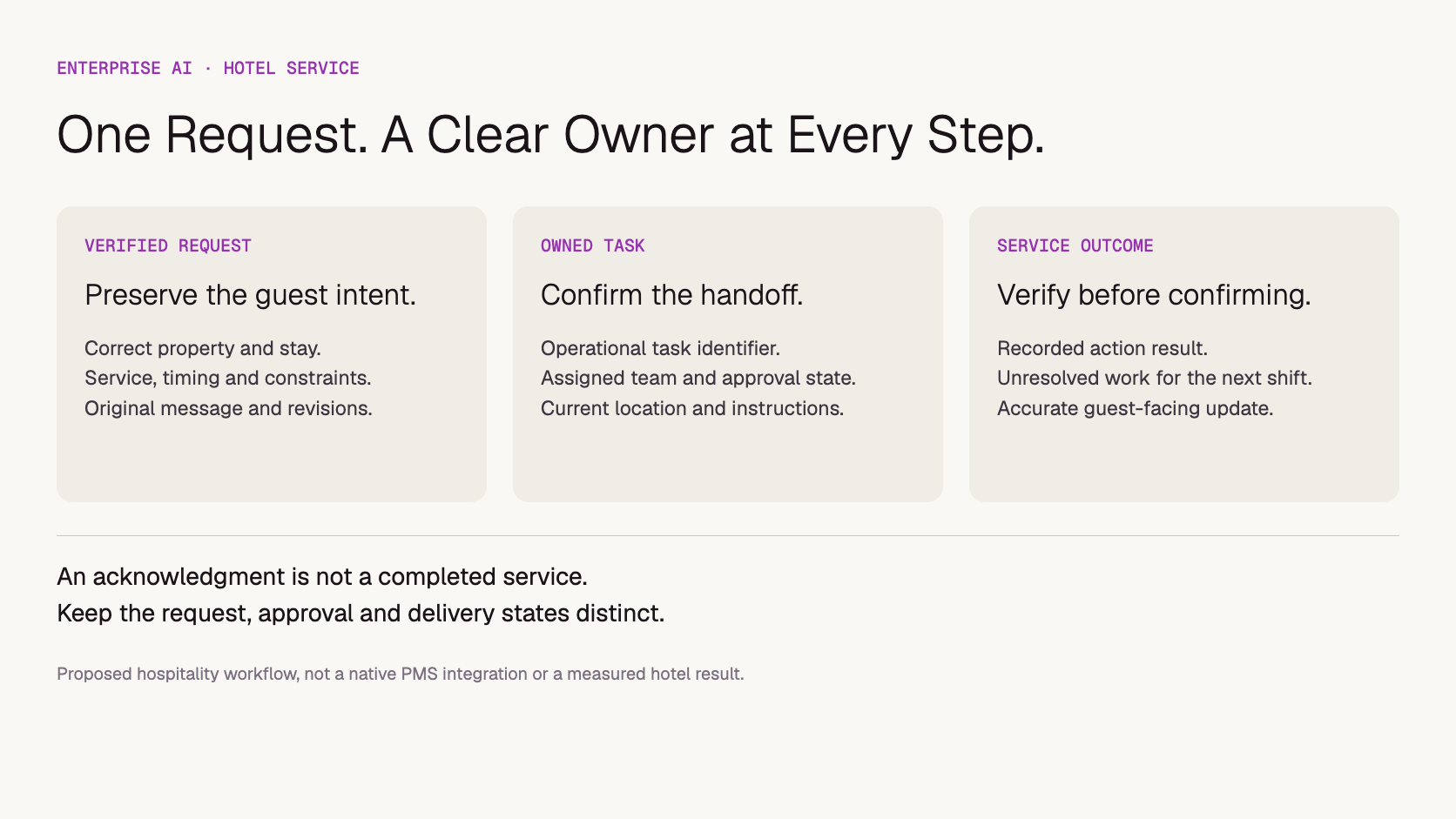
Suggested service workflow. Understanding, assignment and completion are separate states.
In the towel example, a handoff might show the original request, the later change to seven, the delivery instruction and the assigned team. It should not label the task complete because a reply was sent. Completion needs a recorded outcome from the team or system responsible for the service.
Room moves require another check. Before dispatch, verify that the destination still belongs to the relevant stay. A request created before a room change may contain a location that was correct at the time but is no longer correct now.
The guest request review register provides blank fields for request versions, timing, ownership, approval and completion evidence. It is a planning template, not a working PMS integration or a replacement for the hotel's task system.
What should a hotel measure before expanding the pilot?
Measure request accuracy and actual handoff usefulness, not just reply speed or conversational tone. Use authorized examples that include revisions, multiple requests, ambiguous times and property-specific exceptions. Separate model misunderstandings from missing source information, integration failures and operational delays so each problem reaches the right owner.
Intent fidelity: Were service, quantity, time and constraints preserved?
Context accuracy: Did the answer use the correct property, stay and current location?
Promise control: Did it avoid unsupported approval, price and completion claims?
Task continuity: Were revisions linked to existing requests instead of duplicated?
Handoff quality: Could the next team act without reconstructing the conversation?
Build an expected result for each test case with experienced property staff. Include both easy amenity questions and messages that require escalation. A system that answers all requests automatically may look efficient while mishandling precisely the cases that need human judgment.
Track inference usage, retrieval, integration work, staff review and corrections separately. Also separate acknowledgment time from service completion time. A faster message does not prove faster towel delivery or improved guest satisfaction. This article does not claim measured savings or a hotel pilot result.
Start with one property or a tightly defined request set, then evaluate other locations against their actual policies and processes. The pilot-to-production guide covers the wider rollout decision.
Where does Token360 fit in a hotel technology stack?
Token360 supplies enterprise access to models that a hotel group or software provider can evaluate for language understanding and other supported tasks. The hospitality application still manages identity, property knowledge, PMS access and service execution. Model access is one component; it is not a complete guest-service system.
As checked November 12, 2026, Token360's enterprise page describes multimodal access and custom enterprise pricing. Capacity, contracts and compliance requirements can be scoped for the engagement. This article does not claim a native Oracle integration, room inventory access, payment capability or guaranteed service performance.
For procurement, describe the property count, languages, message volume, peak periods and intended tasks. Identify whether the initial scope is staff-assisted drafting or guest-facing messaging, because acceptance criteria and operational responsibilities differ. Include the source systems and integration owner in that discussion.
Use a simple approved template when it already answers the question reliably. Reserve model generation for language variation, mixed requests or contextual drafting that creates value. The business case should be tied to usable service work, not to using AI for every response.
How do you set up a first-property pilot?
Begin with staff-reviewed messages and an approved property guide. The hospitality application resolves the property and stay, supplies the relevant policy, and asks a text model to draft the response or extract a request. Show staff the original message, proposed task and missing fields before enabling any write to the hotel's operational system.
For the towel example, a reviewable record should preserve quantity: two; timing: after 18:00 in property-local time; constraint: do not knock if the baby is asleep. Treat these as illustrative expected fields, not a tested model result. When task creation is later enabled, the hotel's integration must return a real task identifier or an explicit failure. Test the revision to 19:00 against that same identifier before adding unattended guest replies.
For guest questions about food and beverage, use the restaurant menu content workflow to verify menu versions, availability and details.
Frequently asked questions
Can Token360 directly approve early check-in?
No such capability is claimed here. Approval depends on the hotel's policy, reservation context, current operations and authorized decision. A model can prepare the request and explain the confirmed outcome.
Does a clean-room status mean the guest can enter?
Not by itself. The front desk still needs the relevant reservation, assignment and readiness checks under the property's process. Do not infer guest access from a single housekeeping field.
Can one assistant serve several hotels?
It can be designed for that scope, but the application must isolate the correct property information and stay context. Test differences in policies, languages and workflows before rollout.
Should AI translate every guest message automatically?
Translation may help, but preserve the original and check consequential ambiguity. Timing, negation and special instructions need to survive the translation before staff act.
What is a practical first hotel AI pilot?
Prepare staff-reviewed replies and tasks for a small set of recurring requests at one property. Measure accuracy, unsupported promises and handoff quality before expanding automation.
Evidence scope: proposed hospitality workflow using Oracle OPERA Cloud documentation and Token360's enterprise page, checked November 12, 2026. Guest examples are hypothetical. No hotel customer deployment, controlled model test or measured service outcome is claimed.
Enterprise AI
API
Bring your next idea to life.
Create a video scene in Creator, or explore models for images, audio, and text to find the right capabilities for your project.


 Guides
 Guides
 Guides