Build event assistants around current agendas, ticket permissions and verified bookings. Compare native tools with custom AI APIs and rehearse changes.
INDUSTRY USE CASES · CONFERENCES & EVENTS
AI APIs for events can help attendees find sessions, understand event information and ask questions in natural language. The application must supply current, approved information and enforce visibility rules before the model answers. A room change, a ticket restriction or an unconfirmed booking should not become an outdated or unauthorized promise in a fluent response.
At a conference, a technically correct answer from yesterday can be wrong today. A workshop changes rooms, a speaker withdraws or a session reaches capacity. The attendee asking “Where should I go now?” needs the latest applicable information, not a plausible summary of an old programme.
This article is for conference organizers, associations, exhibition operators and event-software teams considering an attendee assistant. It examines event-specific information changes, access boundaries and buying choices. The example and rehearsal plan are proposed designs, not a Token360 deployment or a measured customer result.
Which attendee questions are a useful starting point?
Start with event information that has an identifiable owner and a reliable published source: session details, registration instructions, venue information and approved FAQs. These questions have a bounded answer. Keep personal ticket decisions and transaction requests separate, because they require identity checks or system actions beyond generating a response.
Useful initial questions include “Which sessions cover procurement?”, “Where is badge collection?” and “When does the keynote start?” The assistant can translate everyday wording into an appropriate search and return a concise answer with a link to the official event record. A searchable agenda remains valuable; chat should make information easier to find, not hide it behind a conversation.
Recommendation requests need a different treatment from factual questions. “Which session is best for me?” may require stated interests, available time and access eligibility. Explain why a session matches the attendee's interests without implying that a recommendation reserves a place. If the event sells sponsored placements, distinguish those placements from recommendations based on stated needs.
Some questions should go directly to the organizer's established contact channel. An assistant should not improvise an exception to registration terms, invent an accessibility arrangement or resolve an operational incident from general model knowledge. A useful escalation gives the attendee the right contact or next step instead of another speculative answer.
What information needs to be current, and what needs permission?
Separate public event facts from authenticated attendee records and restricted organizer information. Give each source an owner, version and publication state. Retrieve the information that the current attendee is allowed to see, then use the model to explain it. A prompt asking the model to respect permissions is not an access-control mechanism.
Information
Authoritative source
Boundary to enforce
Session time, room and cancellation status
Approved live agenda record.
Use the right event edition, date, timezone and latest published change.
Venue guidance and event FAQs
Organizer-approved guide or knowledge base.
Exclude draft, superseded and staff-only instructions.
Ticket inclusion
Published ticket rules plus the attendee's authenticated registration.
Distinguish general policy from this person's eligibility.
Seat or appointment status
Reservation system response.
A suggestion or request is not a confirmed booking.
Speaker and exhibitor information
Published profiles and programme data.
Do not expose private contact details or unpublished changes.
Organizer operations
Restricted operational systems.
Keep internal schedules, access codes and private attendee records out of public retrieval.
Define which source wins when records conflict. An old brochure should not override an approved live session record simply because the brochure contains more descriptive text. If the application cannot determine which source is authoritative, disclose the uncertainty and direct the attendee to the current official page or staff.
Use explicit event identifiers rather than relying on the event name alone. Annual conferences often reuse session titles and venue descriptions. A model supplied with last year's programme can produce convincing answers that belong to the wrong edition.
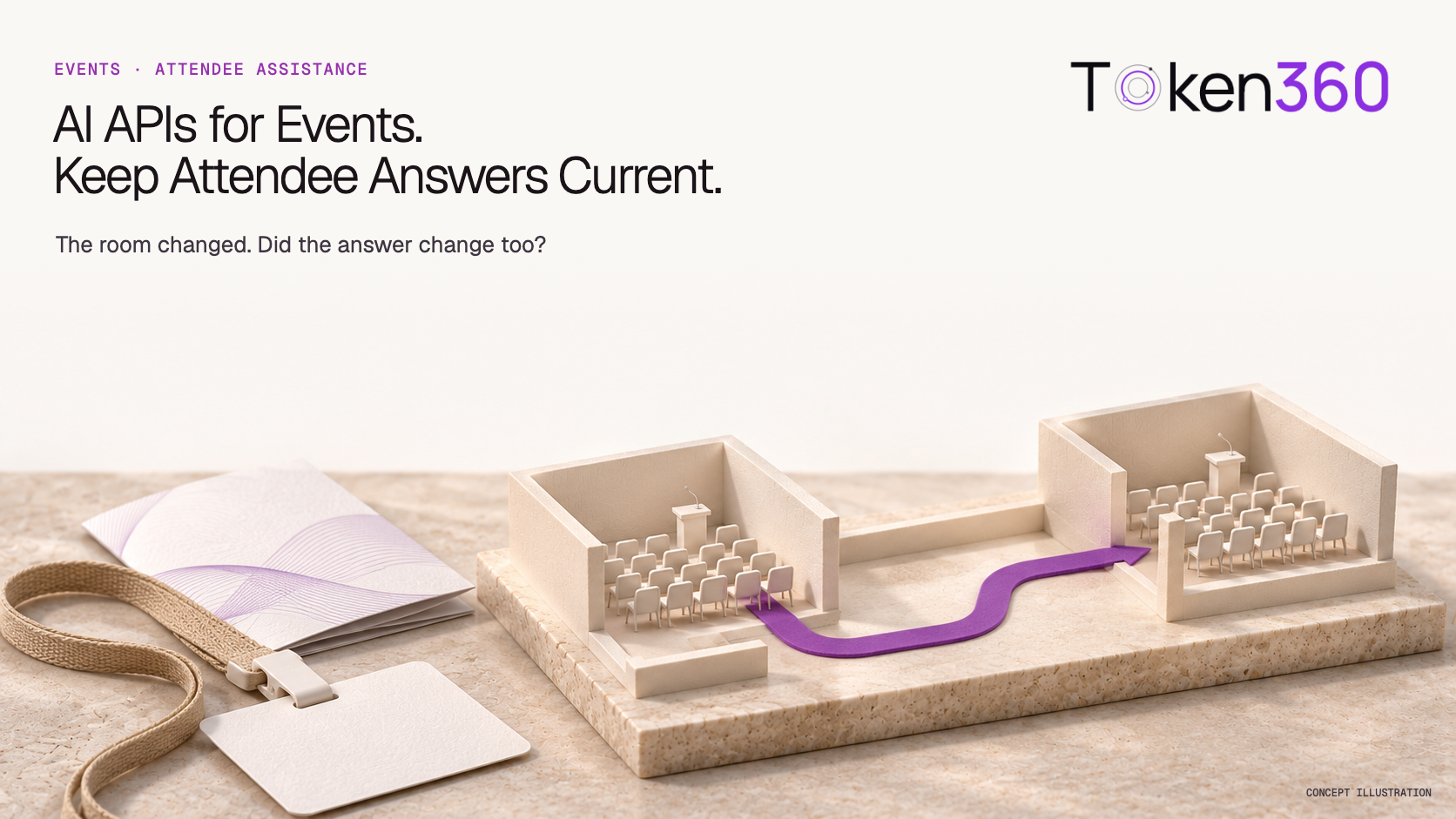
What should happen when a session changes rooms?
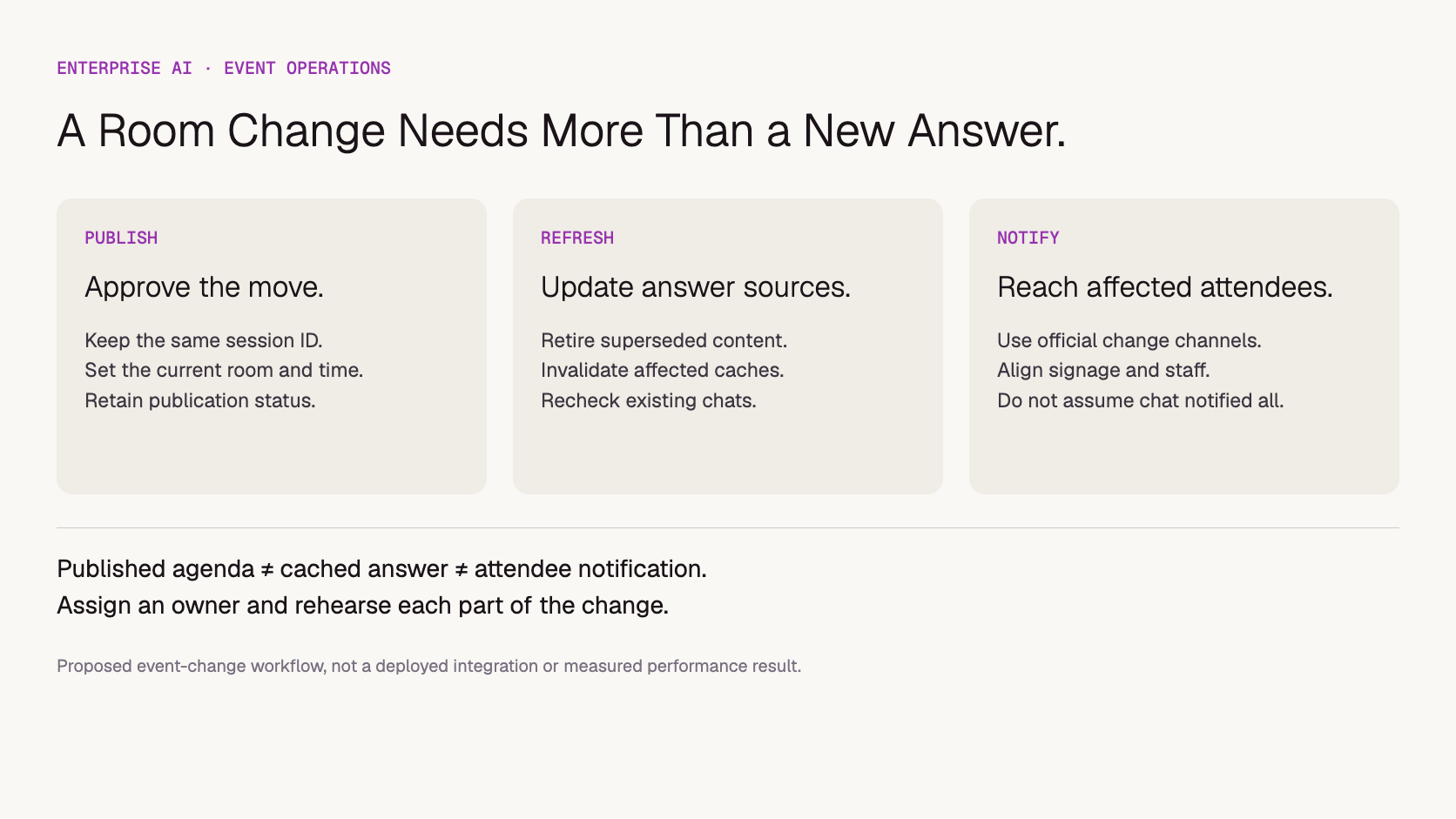
A published room change should update the source used for answers, invalidate affected cached content and be reflected in the next relevant response. Preserve the distinction between the old programme and the current agenda. Do not infer that every attendee has been notified merely because the assistant can now retrieve the new location.
Illustrative rehearsal, not a live event result: session S-204, “Buyer Roundtable,” is listed in an earlier brochure at 14:00 in Room A. The organizer approves a move to Room C while keeping the time unchanged. An attendee asks, “Is the buyer session still in A?”
System state
Appropriate answer behavior
Failure to catch
Room move approved and available
State Room C, retain the unchanged time and link to S-204's current agenda entry.
Repeat Room A from the old brochure.
Room move is only a staff draft
Use the published agenda; do not expose or present the draft as confirmed.
Announce a change that has not been approved.
Current agenda cannot be reached
Explain that the latest location cannot be verified and provide the official lookup or help-desk route.
Answer confidently from stale memory without qualification.
Another event has a similar title
Use the attendee's current event context or ask which event they mean.
Return a valid room for the wrong conference.
A suitable response after the approved change would be: “Buyer Roundtable, session S-204, is now listed in Room C at 14:00 in the event's local timezone. The earlier brochure lists Room A. Please use the current agenda entry for the latest location.” The link and timezone label should come from the actual event record, not be invented by the model.
The operational test is not just whether a newly opened chat gives that answer. Repeat the question in an existing conversation, after a cache hit, in another supported language and through each deployed channel. Check whether saved session cards or suggested replies still contain Room A. These are test cases to run, not results already established here.
Updating the answer source and notifying attendees are separate jobs. Both need an owner.
Should you use your event platform's assistant or build one?
Check the platform you already use before buying a separate model layer. Native assistants may have direct access to event content and existing visibility settings. Custom APIs become relevant when you need a different interface, multiple source systems or specific model and contractual choices that the native feature does not cover.
Cvent's October 30, 2026 Attendee Assistant announcement describes answers based on event data and organizer-approved content, with audience-aware visibility. It labels the assistant and companion Event Knowledge Base as Open Beta. That is a relevant option to evaluate, not evidence of performance at your event or a reason to treat beta availability as a contractual guarantee.
EventMobi documents a different scope: its Registration Concierge uses registration-site content, uploaded documents, ticket information and optionally session information. The documentation states that it is limited to the registration experience rather than the full event hub. These source and channel boundaries matter when choosing a product. Both sources checked November 13, 2026.
Option
When it fits
What to verify
Native event assistant
Most authoritative information already lives in one platform.
Supported channels, update behavior, visibility rules, production status and license/usage terms.
Custom API assistant
Several event systems, a custom interface or specialized commercial requirements.
Integration ownership, authentication, freshness checks, model evaluation and event-day support.
Searchable agenda and FAQs
Questions are simple and structured navigation already works.
Search quality, mobile usability, clear change notices and a reliable staff contact route.
Compare the cost of the entire deployed service. A lower inference price does not remove the work of building registration integration or maintaining source updates. The software-versus-model-API framework helps separate the product you buy from the components your team still needs to operate.
How should ticket checks and bookings be handled?
Treat ticket eligibility as an authenticated system check and bookings as explicit transactions. The model can explain the result, but should not infer privileges from a user's claim or confirm a reservation without a successful system response. Offer a public-policy answer when identity cannot be verified, while keeping personal records private.
“Does the standard ticket include the workshop?” can be answered from published ticket rules. “Does my ticket include it?” requires the person's verified registration. “Book me a seat” adds a state-changing action that may involve capacity, payment or organizer rules. These are three different requests, even if they appear in one chat.
For an initial pilot, keep the assistant read-only and link to the official registration or reservation flow. If you later add actions, show the proposed change, obtain the required confirmation and check the actual result. A timeout should trigger reconciliation with the reservation system, not a second booking attempt based solely on a repeated user message.
Never use the presence of a badge image or a typed attendee name as the complete authorization check. The application should establish identity using the event's chosen authentication process and pass only permitted records to the inference step.
How can organizers rehearse the assistant before opening day?
Test changes and failures as well as ordinary questions. A useful rehearsal checks whether answers stay correct after agenda edits, remain within ticket permissions and degrade clearly when a source is unavailable. Measure the full path from attendee question to verified answer, including retrieval and authentication, rather than timing only the model response.
Build a test set with the event team. Include session names attendees commonly abbreviate, similar speaker names, local-time questions, cancellations, room moves, ticket restrictions and unknown details. Record the approved answer or escalation outcome for each case. Avoid scoring a guessed answer as correct merely because it sounds helpful.
Freshness: does an approved change appear across new and existing conversations? What happens while an update is still propagating?
Access: can an anonymous user obtain private information? Do different ticket categories receive only applicable details?
Source fidelity: do the session ID, date, time, room and link match the current event record?
Action honesty: does the assistant distinguish recommendations, pending requests and confirmed reservations?
Language handling: are room names, times and access restrictions preserved in translated answers?
Recovery: is the official agenda or help-desk route still usable when the assistant or source system fails?
Event-day demand can be concentrated around registration and session transitions. Use your expected arrival pattern to test concurrent questions and response time, rather than assuming daily averages describe the peak. Set an operational threshold with the team and define what the application does when it cannot meet it, such as displaying a direct agenda link.
The blank event-assistant rehearsal register records these checks. It contains no fabricated latency, accuracy or traffic result. Report incorrect answers, stale responses and escalations separately; a high total response count is not proof of successful attendee support.
Assign an owner for published content, source updates, incident handling and post-event behavior. The assistant needs a plan for last-minute changes during the event and for what happens afterward. Keeping a chatbot online indefinitely with an expired agenda can create confusion for attendees looking for the next edition.
Before launch, agree who can approve a session change and how the application receives it. Record the expected refresh behavior for each source. If a connector stops syncing, expose that state to the operating team; do not rely on someone noticing a wrong answer in a chat log.
During the event, use official announcement channels for important changes. An attendee assistant answers people who ask; it does not automatically reach everyone affected. Keep the agenda, signage, staff information and notifications aligned with the same approved update.
After the event, switch to clearly dated archive information or a post-event FAQ. Distinguish replay availability from the original live schedule, review retention and access settings according to the event's policies, and prevent the old edition from being mistaken for the next one. These are application responsibilities, not capabilities supplied automatically by a model API.
Where does Token360 fit for event organizers?
Token360 can provide model access for a custom event assistant. The organizer or technology partner still owns source integration, event context, attendee authentication, transactional controls and support. Choose models by tested answer quality and language needs, then discuss commercial and capacity requirements for the event's actual operating window.
Token360 supports model access across text, image, audio and video. Language models are relevant to this question-answering workflow; supported speech input may be a separate requirement. Generating promotional images or videos is another event use case, and should not be confused with retrieving current agenda facts.
The Token360 enterprise offering, checked November 13, 2026, describes model access and custom pricing. Dedicated capacity, contracts and compliance requirements can be discussed and scoped for an engagement. Confirm concrete availability and terms rather than assuming a native Cvent or EventMobi connector, a particular SLA or guaranteed event-day performance.
Token360 does not charge a separate service fee; model usage remains chargeable. Integration, event-platform licensing, application hosting and support may still affect your total cost. See the service-fee explanation when comparing proposals.
Bring event dates, expected attendee numbers, active languages, peak question patterns, chosen models, typical retrieved context and support requirements to a quotation discussion. Estimate workload using expected active users and questions per user, then test the peak separately. Do not present a speculative traffic model as a measured demand forecast.
Can an AI event assistant replace the information desk?
It can handle selected, well-supported questions, but unresolved information and operational exceptions still need an accountable route to staff. Treat the assistant as one access point to event information, with an explicit escalation path.
Does uploading the programme make answers current automatically?
No. A static programme remains a snapshot. Define how approved changes reach the answer source, which source takes precedence and how stale cached content is invalidated. Test a real change in rehearsal.
Can the same assistant serve several annual events?
Yes, if the application separates event editions, dates, permissions and sources. Similar event or session names are not enough to establish context. Ask for clarification when the applicable event is uncertain.
Can the assistant tell an attendee they have a seat?
Only when the authorized reservation system confirms it for that attendee. A session recommendation, a personal agenda entry or a submitted request should not be described as a confirmed reservation unless the system's rules establish that status.
Is this a tested Token360 event product?
No. This article presents a proposed architecture and rehearsal plan, with an explicitly illustrative room change. It does not claim a deployed connector, verified event performance or measured support savings.
Enterprise AI
API
Bring your next idea to life.
Create a video scene in Creator, or explore models for images, audio, and text to find the right capabilities for your project.


 Guides
 Guides
 Guides