Token360 does not charge a separate service fee. Model usage charges still apply. Learn how to read the rate, billing unit and total in an API quote.
CUSTOMER QUESTIONS · PRICING CLARITY · BLOG 179
By Yuki Yu · Pricing position confirmed November 6, 2026 · Editorial update November 6, 2026
No. Token360 does not charge a separate service fee. Customers still pay the applicable model usage charges, based on the selected model and configuration or an agreed enterprise quote. “No service fee” explains the charging structure; it does not mean inference is free or establish that every workload costs less than every alternative.
Customers ask Token360 about service fees as well as latency. Those questions deserve separate answers: the fee policy describes what is charged, while latency requires evidence about how a particular workload performs. This article answers the service-fee question directly and explains how to read a quote without confusing the two.
The no-service-fee statement is company-confirmed as of November 6, 2026. Public documentation supplies the model-metering and competitor context below. This is a pricing explanation, not a customer savings study, a review of a paid invoice or a latency benchmark.
You pay for model usage under the applicable billing rule. The unit can depend on the model and its settings, so a price needs both an amount and a meter. The absence of a separate service fee does not remove the underlying inference charge or turn different models into a single flat-price service.
Token360’s billing guide describes model-dependent meters, including input and output tokens, generated images, and audio or video units. Check the live model entry for the configuration you intend to use. A video price tied to one duration or resolution should not be carried over to a different configuration without checking its rule.
Item
How to interpret it
Model unit rate
The amount charged per applicable usage unit
Measured usage
The billable quantity recorded for the request
Separate service fee
An additional service-fee layer; Token360’s confirmed position is that it does not charge one
Enterprise quote
The applicable commercial scope and pricing agreed for the customer
External costs
Items outside the model/service-fee comparison, such as the buyer’s own infrastructure; evaluate these separately if relevant
A clear quote should make the model charges understandable without requiring a buyer to reverse-engineer a percentage surcharge. Ask for the exact model, unit, rate and scope that apply to your workload.
Does no service fee mean the upstream provider’s exact price?
No. A separate service fee and the model unit rate are different commercial facts. Token360’s no-service-fee policy does not imply a particular upstream pricing formula, disclose supplier economics or promise that its model rate matches another provider’s public list price. Use the applicable Token360 rate or negotiated quote for the actual comparison.
The Token360 billing guide explicitly notes that a provider’s public price is not automatically the price of the Token360 route. That distinction matters when two services expose a similarly named model. Compare the supported configuration and billing basis before concluding that the model-charge lines are interchangeable.
For an enterprise buyer, the useful question is “What is our effective quoted unit rate for this workload?” rather than an assumption about how the supplier constructed that rate. Token360’s company-confirmed enterprise positioning permits pricing discussions based on the engagement. Neither negotiability nor the absence of a service fee establishes a universal lowest-price claim.
How does this differ from platforms that list a platform fee?
Some platforms identify an additional fee separately from model usage. Compare the fee basis as well as the rate: a charge applied when purchasing credits is not necessarily the same mechanism as a percentage added to every request. Published fee labels should be interpreted using the provider’s own documentation, not mapped onto Token360 automatically.
As checked on November 6, 2026, OpenRouter’s pricing page lists Standard and Business platform fees of 5.5% and 8%, respectively, and enterprise fee discounts. Its FAQ explains the fee at credit purchase and distinguishes it from model inference pricing. Plan-specific terms and the actual transaction remain relevant.
Service
Basis used in this article
What still needs comparison
Token360
Company-confirmed: no separate service fee; applicable model usage charges remain
The actual model/configuration rate and enterprise scope
The selected endpoint’s pricing rule and relevant commercial terms
This table compares how the available evidence describes charges. It does not rank overall value, claim that fal uses OpenRouter’s fee structure or infer every possible fal charge from one documentation page. Additional enterprise features can also make two offers different products rather than exact substitutes.
How should I compare two quotes without counting a fee twice?
Put both offers on the same workload and identify whether each displayed total already includes the relevant fee. Keep model charges, separate fees and other included items on distinct lines. Then calculate the comparable total once. Do not add a published percentage again if the quote has already incorporated it.
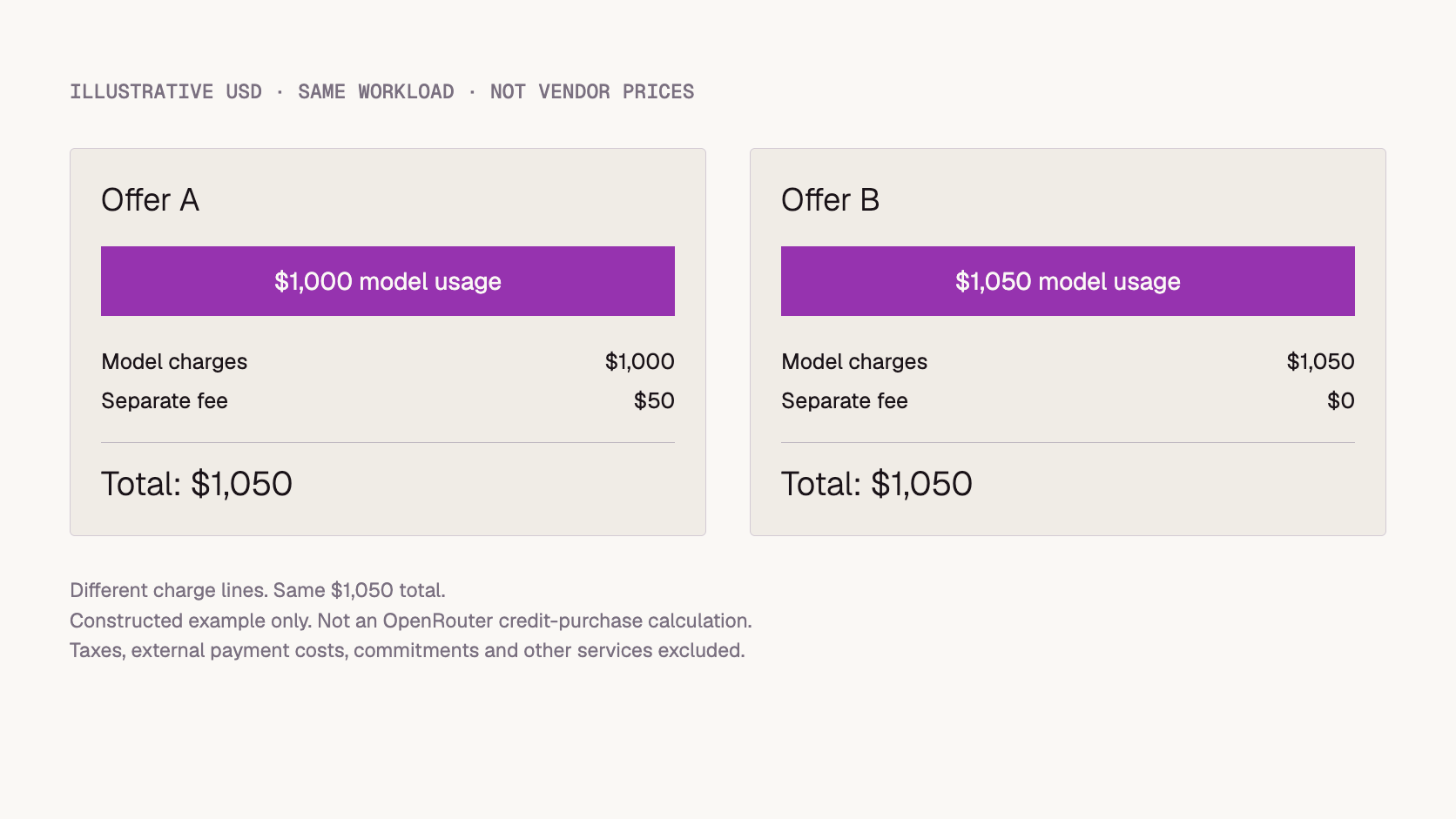
Here is a constructed arithmetic example, not a Token360 offer or a calculation of OpenRouter’s credit-purchase rules. Assume Offer A explicitly quotes $1,000 for model usage plus a separate $50 fee. Offer B explicitly quotes $1,050 for the same workload with no separate fee. Both total $1,050 under those assumptions.
Hypothetical quote
Model charges
Separate fee
Comparable total
Offer A
$1,000
$50
$1,050
Offer B
$1,050
$0
$1,050
The example holds the workload constant and excludes taxes, external payment costs, minimum commitments and other services. It demonstrates only that a no-fee label is insufficient to calculate overall savings. Actual prices and included scope determine the result.
Illustrative arithmetic, not vendor pricing. Check what the total already includes before adding a fee.
A buyer can value a simpler charge structure without assuming it wins every numerical comparison. For Token360, record the confirmed zero separate service fee and compare the applicable model charges directly against an alternative’s complete, correctly calculated offer.
What should an enterprise quote make explicit?
An enterprise quote should identify the model configuration, billing units, eligible workload and total commercial scope. Record Token360’s no-service-fee position alongside those details so the buyer can see both what is charged and how it is measured. Do not use that statement as a substitute for describing the services the engagement actually includes.
Token360 serves enterprise procurement across text, image, audio and video, with pricing, capacity, contract and compliance requirements scoped to the engagement. Its enterprise page advertises custom pricing. A buyer should still confirm the exact configuration and production requirements in the proposal rather than infer every service from the word “enterprise.”
Question
Evidence to request
Which model and settings does this price cover?
Exact model/SKU and relevant configuration
What is the billing unit?
Rate and denominator, with input/output distinctions where applicable
Is a separate service fee added?
The stated charging structure; Token360 confirms that it does not charge one
What is included in this proposal?
Defined model and service scope, not an inferred package
What usage assumptions produce the estimated total?
Workload quantities, settings and exclusions
How can we verify actual charges?
Request-level usage and billing evidence
Copy the
Copy service-fee-quote-check.csv:
field,offer_a,offer_b,evidence,open_question
Model/SKU/configuration,,,,
Usage quantity,,,,
Billing unit,,,,
Model unit rate,,,,
Model subtotal,,,,
Separate fee amount and basis,,,,
Fee already included in total?,,,,
Other included items,,,,
Comparable total,,,,
Quote validity/scope,,,,
Actual billing evidence,,,,
to keep the rate, fee basis and included total together. It is an unfilled review tool, not a signed quote. Pricing periods, minimum commitments and cross-model eligibility remain separate commercial questions and should not be inferred from the fee policy.
Why might the final usage charge differ from an estimate?
A changing final charge does not automatically indicate a service fee. The billable quantity or configuration may differ from the estimate, or additional generation attempts may have occurred. Compare the recorded request and pricing rule before classifying the difference. The right question is which line changed and why.
Token360 documents estimates as planning aids and final charges as based on measured usage and the active rule. It also notes that asynchronous billing can finalize after a job first reaches a terminal state. A screenshot of a preliminary estimate is therefore not sufficient evidence of a surcharge.
Retain the request identifier, model configuration, estimated quantity and final billing record. If they do not explain the difference, ask support to identify the charge component. Share identifiers and amounts, not API-key secrets. This article does not assert that any particular failed or repeated request is free; that requires the applicable billing evidence.
Does the fee policy tell us anything about latency?
No. Service-fee policy and latency answer different customer questions. A zero separate service fee does not prove faster inference, and a paid platform fee does not establish a particular response time. Evaluate latency using the exact model, workload and timing definition relevant to the application, alongside the commercial comparison.
For a streaming text feature, time to first visible output and time to completion serve different purposes. For generated media, a quick submission response is not the completed asset. Keep those measures separate when asking for a performance discussion. No Token360 latency result is claimed here.
This separation helps purchasing decisions: the quote explains the cost structure, while a relevant test or explicit service commitment supports a performance conclusion. Neither should be substituted for the other.
Frequently asked questions
Does that mean Token360 is free to use?
No. Model requests are subject to the applicable pricing rules. “No service fee” does not mean unlimited or free inference.
Does no service fee mean there is no commercial margin?
No such conclusion follows. The statement describes the customer-facing fee structure, not the supplier’s internal economics or upstream purchasing arrangements.
Can enterprise customers discuss model pricing?
Yes. Token360’s enterprise positioning includes negotiated pricing for the engagement. The rate and scope need an actual quote; no particular discount or lowest-price outcome is promised here.
Does the statement include every tax or external payment cost?
The confirmed statement concerns Token360’s service fee. It should not be extended to unrelated taxes or costs charged by other parties. Compare applicable totals on a consistent basis.
Read next: review the selected model’s pricing and use the billing guide to understand actual charges. For an enterprise workload, ask the Token360 team for a quote with the model rates and scope stated explicitly.
Developer Guide
API
Bring your next idea to life.
Create a video scene in Creator, or explore models for images, audio, and text to find the right capabilities for your project.



 Guides
 Guides
 Guides