AI APIs for Real Estate: Keep Listing Content Accurate
Build real estate listing content with AI APIs while preserving property facts, original media and clear boundaries for virtual staging and video.
INDUSTRY USE CASES · REAL ESTATE TECHNOLOGY
AI APIs for real estate can help teams draft property descriptions, prepare media variations and narrate listing presentations. The useful workflow starts with verified property records and original media, then checks every generated asset against them. A convincing description or attractive room image must not introduce features the property does not have.
For property portals, brokerages and real estate marketing platforms, the challenge is broader than generating content quickly. Descriptions, photographs, floor plans and videos need to describe the same property at the same point in time. Token360 can provide model access for production tasks; the listing system and responsible reviewers remain the source of property facts.
Read first: Choose AI models by business use case. This article concerns factual listing production, not speculative building design or an architecture-prompt showcase.
Which listing tasks can AI APIs support?
Use AI for bounded transformations of approved material: turning structured facts into a description, adapting an approved description for another channel, drafting narration or producing clearly identified visual concepts. Define the permitted transformation first. “Make this listing more appealing” is too broad if it allows the output to change what the property offers.
A brokerage might want consistent descriptions across many agents. A property portal might need summaries with a fixed field structure. A marketing platform might produce short presentations from approved photographs. These are different jobs, and they need different acceptance checks even if they share the same model-access layer.
Start with a task that is already repeatable. If the team cannot identify which property facts are approved or who may approve a new image, adding generation will amplify that ambiguity. Establish the source and review process before increasing output volume.
What should be the source of truth for a listing?
Use an authorized property record with a stable identifier, current source version and links to original media. Keep unknown or disputed fields explicit. The model may restate known facts, but it should not resolve conflicting measurements, infer amenities from appearance or fill an empty field with a plausible detail.
The RESO Data Dictionary provides consistent real estate data terminology and structures, including Property and Media resources. A shared field vocabulary can help connect systems, but standardized fields do not by themselves verify that a property's values are correct. Source quality and update responsibility still need owners.
For a hypothetical apartment listing, the source may confirm two bedrooms and a balcony while leaving parking unconfirmed. A generated description should not add “private parking” because similar apartments offer it. If the photography and record disagree about a feature, send the discrepancy for review instead of letting the model choose whichever produces better copy.
Keep measurements with their units and source. Do not convert an approximate room description into a precise floor area. Store the approved record separately from marketing prose so a later editor can trace a statement back to the evidence that supports it.
How should generated property descriptions be checked?
Check each factual claim against the approved record, then review whether the overall wording creates an unsupported impression. Exact numbers can be checked mechanically; descriptions of condition, outlook or location often need a knowledgeable reviewer. A sentence can avoid an explicit false number and still overstate what a buyer will find.
Generated statement
Evidence needed
Action if missing
Bedroom count or floor area
Approved property field with applicable units
Omit or flag for correction
Parking or included equipment
Verified feature or inclusion record
Do not infer from similar properties
Recent renovation
Confirmed scope and timing
Avoid turning visual style into renovation history
Travel time to a station
Appropriate route evidence and conditions
Do not invent a precise duration
View or room condition
Current verified media or inspection information
Route ambiguous wording to the listing owner
Separate factual edits from stylistic edits. Shortening a sentence should not remove a qualification. Translating a description should not strengthen an approximate claim. An output that sounds more polished may require rejection if it replaces an important uncertainty with certainty.
A useful review interface displays the source fields beside the generated text and highlights unsupported claims. That interface is a proposed application feature, not a native Token360 capability. For the data-format side, see structured model outputs; a valid schema alone does not establish factual accuracy.
Where is the boundary between virtual staging and changing the property?
Define the intended edit before submitting the image: proposed furnishings should be distinguishable from changes to the actual room. Compare the result with the original for windows, doors, walls, fixtures, visible condition and spatial relationships. A staging label should not be treated as permission to conceal structural differences.
In its July 22, 2026 statement on AI-generated listing photos, Zillow describes its Showcase Virtual Staging experience as shopper-initiated, labeled and paired with the original image. It also states that listing photos should accurately represent the home. This is a useful transparency example, not a universal rule for every listing destination.
The hypothetical apartment might benefit from a suggested sofa arrangement. But an edit that adds a window, widens a doorway or removes a visible defect changes what the image communicates about the property. Review the actual output rather than assuming an instruction to preserve structure was followed.
Keep original and derivative files linked, and retain the edit purpose. Before publishing, check the applicable platform and local requirements for altered imagery. The workflow described here is an editorial control, not a determination of legal compliance for a particular market.
Can a generated video be presented as a property walkthrough?
A generated camera move from a photograph is not evidence of the space beyond that photograph. If the video is intended to represent the actual property, validate the visible structure and sequence against verified capture. Otherwise, identify it as an illustrative visualization and avoid presenting invented spatial continuity as a recorded tour.
A single room image does not establish what is behind the camera or beyond a doorway. A video model can produce an attractive transition while inventing the connecting space. That result may work as a design concept but fail as a factual listing asset.
For a verified property presentation, an edited sequence of approved photographs or actual walkthrough footage may be more appropriate than a synthesized continuous camera move. Narration should use the same approved property record as the description, and reviewers should check the final audio for numbers, names and omitted qualifications.
The distinction matters because architecture concept prompts and walkthrough experiments explore visual possibilities. A live listing has a different purpose: helping a viewer understand a particular property. Do not transfer the acceptance standard from one use case to the other.
How should a listing-content pipeline handle approval and updates?
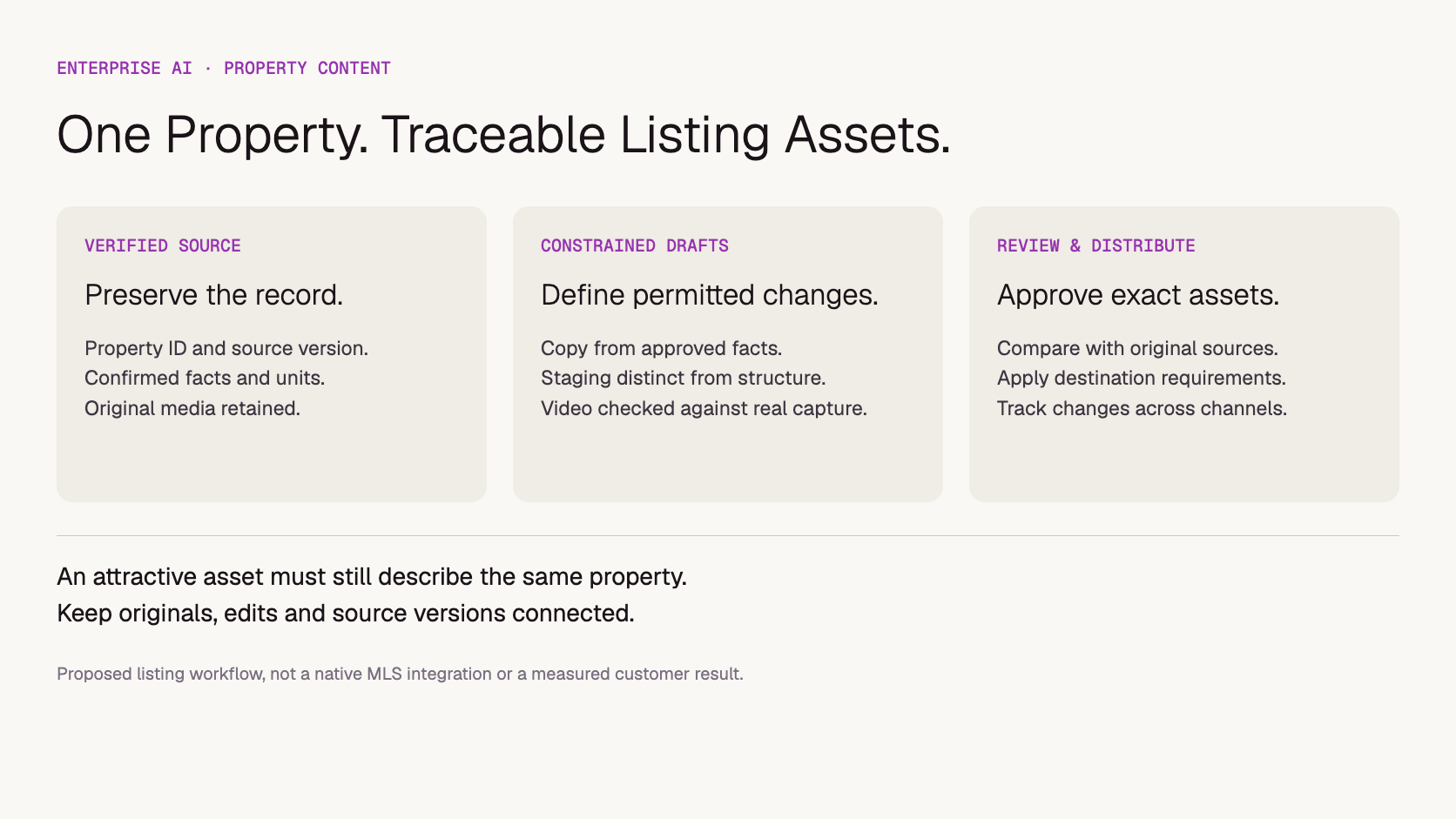
Link each asset to the property record and source media used to create it, then record approval for that exact version. When a source fact changes, identify affected assets before publishing an update. A description, voiceover and social video can become inconsistent if only one channel receives the correction.
Proposed listing workflow. Original media and source records remain traceable through review and distribution.
A change to listing status may require distribution changes without regenerating a room illustration. A corrected floor-area figure may affect copy, narration and on-screen text. Review the impact by field and asset type rather than blindly regenerating every file or updating only the main description.
Keep channel destinations in the record. A corrected asset in the internal library does not prove that the property portal, agent site and campaign page have all been updated. Verify the rendered destinations and retain the relevant release version.
The listing asset review register provides blank fields for property identifiers, original-media references, intended edits, source versions, reviewers and destinations. It is a planning aid, not an MLS integration or a completed customer dataset.
When should a team buy a listing tool instead of building an API workflow?
A dedicated tool may be the simpler choice when its editing and approval process meets the team's needs. A custom API workflow becomes more useful when production must connect to existing property data, support repeated jobs or combine several model types. Compare the total operating workflow, including review and distribution.
A small team producing occasional descriptions may not need custom orchestration. A platform that already manages property records and media may have a stronger reason to integrate generation directly. The deciding factor is whether the integration removes a repeated handoff without weakening ownership of the underlying facts.
Check what the supplier actually provides. Model access does not imply licensed listing data, portal publishing, asset rights or a review interface. For the broader build-or-buy decision, see AI software versus a model API.
What should real estate teams test before selecting models?
Evaluate representative listing tasks against source-based acceptance criteria. Include sparse records, ambiguous photographs and properties with features that must remain unchanged. Measure correction work as well as generation time. A model that produces attractive samples may still be unsuitable if reviewers must repeatedly repair unsupported facts or altered geometry.
Text fidelity: Does the output preserve confirmed facts and leave unknown fields unresolved?
Visual fidelity: Are room openings, fixtures and visible condition consistent with the source?
Asset identity: Is every derivative attached to the correct property and original image?
Update handling: Can the team find the assets affected by a source correction?
Review burden: How much expert checking and manual editing does an accepted asset require?
Keep aesthetic preference separate from factual acceptance. Reviewers can prefer one composition while rejecting it for a changed window. Record the rejection reason so the next action is appropriate: adjust the edit, use another production method, correct the source or stop the task.
A pilot should report model usage, review effort and accepted deliverables separately. This article contains no measured cost savings, listing-performance lift or staging-success rate. Establish those outcomes in the team's own workflow before making commercial promises.
Where does Token360 fit in a real estate content stack?
Token360 can supply model access for text, image, audio and video tasks within a real estate team's application. Property records, original media, rights, approval and publication remain separate responsibilities. Specify the model mix, source inputs and expected production workload before discussing enterprise pricing or capacity.
As checked November 11, 2026, Token360's enterprise page describes multimodal access, custom enterprise pricing and tenant-wide key audit. Higher throughput is a contact-sales item, and priority support and SLAs are marked coming soon. Confirm engagement-specific requirements; no native MLS connection, RESO certification or Zillow integration is asserted.
Begin with one controlled task, such as descriptions from approved records, and evaluate its errors before expanding to visual transformations. Treat visual editing as its own evaluation problem rather than assuming successful text generation establishes that the same workflow is ready to alter listing media.
Frequently asked questions
Can AI write a property listing from photographs alone?
It can draft observations, but photographs do not establish every listing fact. Floor area, inclusions, renovation history and other details need verified sources. Do not turn a visual guess into an authoritative property field.
Does a virtual-staging label make any image alteration acceptable?
No. Labeling does not establish that the image accurately represents the property or meets the destination's requirements. Compare the actual changes with the source and review the applicable publication rules.
Should original listing photos be retained?
Yes, retaining originals supports comparison, traceability and correction. Keep them linked to derivatives and available to the relevant reviewers. Confirm how originals and labels should be displayed for the specific publication destination.
Does Token360 provide property inventory or publish listings?
This workflow does not assume either capability. Token360 supplies model access; the team needs its authorized property-data source and publishing systems. Verify any proposed integration separately.
What is a useful first pilot?
Choose one repeatable task with approved inputs and a clear reviewer. Test factual fidelity and correction effort before expanding. A narrow pilot with documented failures is more informative than a collection of attractive outputs without source comparison.
Evidence scope: editorial workflow analysis using official RESO, Zillow and Token360 sources checked November 11, 2026. Property examples are hypothetical. No real listing, controlled model test, customer deployment or legal-compliance assessment is claimed.
Enterprise AI
API
Bring your next idea to life.
Create a video scene in Creator, or explore models for images, audio, and text to find the right capabilities for your project.



 Guides
 Guides
 Guides