Review actual AI usage, business outcomes and service evidence before renewal. Decide whether to retain, resize or change the next contract scope.
ENTERPRISE AI · PROCUREMENT
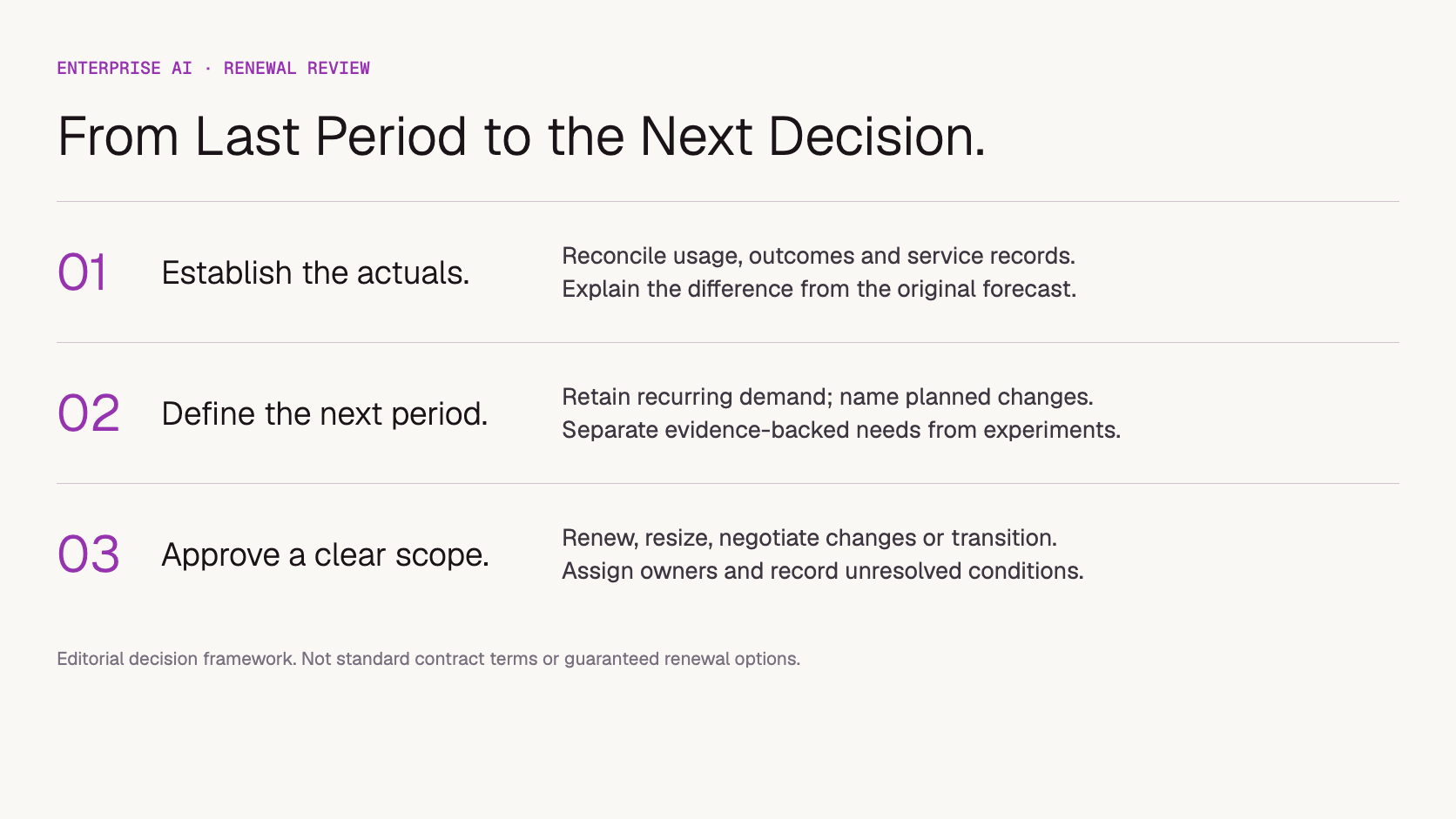
Before renewing an AI API agreement, compare the next proposal with the workloads your company actually runs—not just last year's forecast or a lower unit price. Review realized usage, accepted business outputs, service experience and upcoming changes. Then choose whether to renew the scope, resize it, negotiate specific changes or prepare a transition.
For enterprises buying inference through Token360, the renewal conversation should connect model access and commercial terms to the next period's needs. A successful first purchase does not mean the original model mix, capacity or commitment still fits. Equally, an available new model is not a reason to replace a service that continues to meet the business requirement.
Evidence and scope: This is an operational renewal-review framework, not a report of a customer negotiation or a description of standard Token360 contract terms. Examples are illustrative. Public sources were reviewed on November 10, 2026; no savings, renewal deadline or entitlement is assumed.
Read first: If you are purchasing for the first time, use the AI model access procurement checklist. This article focuses on the decision at the end of an existing commercial period.
What decision should an AI API renewal review produce?
The review should produce a clear recommendation, an accountable owner and a defined next-period scope. “Continue using AI” is too broad. Decide which workloads should continue with the supplier, which commitments need adjustment and which unresolved issues must be settled before approval. Keep the proposed action separate from the evidence supporting it.
Possible decision
When it may fit
Evidence needed
Renew the existing scope
The same workloads remain valuable and service requirements are still met.
Recent usage, outcome and service records; current proposal.
Resize the arrangement
Demand or the model mix has changed.
Actual usage and a revised forecast by workload.
Negotiate specific changes
The relationship remains useful but commercial or operating terms no longer fit.
A documented gap and an explicit requested change.
Prepare a partial or full transition
Material requirements remain unmet or a workload no longer belongs in the scope.
Validated alternative or retirement plan, plus transition effort and dependencies.
These options are a buyer's decision framework, not promises that a supplier will accept every change. A renewal can also combine them: retain a stable language workload while separately reviewing a new video use case. Avoid treating a single supplier relationship as an indivisible yes-or-no decision when the agreement and operations allow a more precise scope.
When should the review start?
Work backward from the actual notice and decision dates in your agreement, allowing time for internal review, supplier clarification and any technical validation. Do not assume a universal 30-, 60- or 90-day rule. Record the applicable dates and responsible people before comparing offers, because a useful recommendation must still be executable.
Procurement should establish the renewal mechanism, applicable notice requirements and who can authorize a change. Finance needs time to assess commitments; application owners need time to review performance; engineering needs time to investigate any proposed migration. Have the contract owner confirm the terms rather than inferring them from a billing screen or a public pricing page.
A practical sequence is to collect the evidence, agree the next-period requirement, request a scoped proposal and then approve the decision. If an alternative needs testing, schedule that before the commercial decision. Do not presume a short extension is available; raise it as a request if the review cannot finish in time.
Which actual usage should replace the old forecast?
Replace the original assumptions with reconciled usage by model, workload and business owner. Separate recurring production demand from experiments, one-time campaigns and abandoned projects. Then identify what is expected to continue. Total spend alone cannot show whether the current commitment is appropriately sized or whether next year's model mix will be different.
Start with the same period and billing basis when comparing invoices, usage records and commitments. Record input and output tokens separately where relevant, and retain the native meters for images, audio and video. Do not combine unrelated units into a single “token volume” without a defined commercial conversion.
Then ask why actuals differed from the plan. Was a rollout delayed? Did prompts become longer? Did retries consume more usage? Did employees stop using an application? Each explanation leads to a different next-period forecast. Lower usage caused by a postponed launch is different from lower usage caused by poor business adoption.
The FinOps Foundation's forecasting framework connects historical patterns with planned changes and anticipated cost and value. For an AI renewal, apply that principle by keeping a recurring-demand baseline separate from proposed growth. Name the assumptions and owners behind each addition rather than copying the last budget.
If records do not agree, resolve the discrepancy before negotiating from them. Our API billing reconciliation guide covers matching usage and charges; the renewal review uses that reconciled evidence as an input.
Did the purchased inference produce useful business output?
Review what the business accepted, not only what the API generated. A workload can consume its expected budget while creating more correction work than planned. Pair usage with an outcome measure appropriate to the task, and state how that measure was collected. Do not treat technical completion as proof that the purchase delivered value.
A support application might track reviewed answers that met the policy requirement. A marketing workflow might count assets approved for use. A document-processing system might track records accepted after validation. Keep reviewer effort or rework visible where it affects the decision; do not conceal it inside a generic “accuracy” score.
Evidence may be incomplete. If only selected outputs were reviewed, label the sample and avoid presenting its acceptance rate as a company-wide result. If no business outcome was measured, the renewal recommendation should acknowledge that uncertainty and assign an owner to establish measurement. Missing evidence is not evidence of either success or failure.
For example, a team may have reliable API access but an unusually high rate of rejected product images. Before replacing the supplier, investigate whether the model, reference inputs or creative brief caused the rework. The production quality regression guide helps separate these explanations.
How should service experience affect the renewal?
Review service experience against the requirements and commitments that actually applied. Separate supplier incidents from application defects, and unresolved issues from resolved ones. A renewal discussion is more productive when it identifies the workload affected, the business consequence and the requested improvement rather than relying on an overall impression of reliability.
Use an incident list with dates, affected operations, evidence, escalation history and outcome. If latency matters, specify the measurement method and workload conditions. A slow video job and slow first-token delivery in a chat application are different observations; an average across both would not support a useful requirement.
Distinguish a request for improvement from a contractual remedy. Do not assume that an observed problem creates a service credit or a right to terminate. The relevant owner should review the actual agreement. For defining service scope in a new proposal, use the AI API SLA checklist.
How should you compare the next proposal with the old one?
Compare the proposals using the expected next-period workload and equivalent assumptions. Review the unit rate, included scope, commitment conditions and operating requirements together. A lower rate can be useful, but it does not establish a better purchase if it requires unused capacity or excludes work your organization now needs.
The FinOps Foundation's rate-optimization framework considers negotiated rates and commitment mechanisms in relation to business objectives. The implication for this review is to assess the commercial mechanism alongside the demand it is meant to serve, rather than maximizing the displayed discount.
Review dimension
Previous period
Next-period question
Workload coverage
Models and operations actually used
Which must remain, and which are being added or retired?
Demand
Recurring usage and temporary spikes
What baseline is supported by evidence?
Commercial scope
Rates and conditions that applied
What changes, and under what assumptions?
Capacity
Observed peaks and constrained periods
Which production requirement needs to be addressed?
Operational ownership
Support and escalation experience
Who owns outstanding issues and future changes?
Keep detailed pricing mechanics in the right place. Our inference price-change guide covers quote dates and adjustment rules; the cross-model commitment guide covers eligible usage and pooled spend. Here, the decision is whether the revised arrangement fits the business's next period.
Editorial renewal framework. It does not depict standard contract options or guaranteed concessions.
What should you bring to a Token360 renewal conversation?
Bring a workload-level summary of what you used, what worked, what changed and what you need next. Token360 can discuss enterprise pricing, capacity, contracts and compliance requirements for an engagement. The resulting scope must be confirmed; this article does not establish a standard renewal policy or a guaranteed discount.
Token360 provides model access across text, image, audio and video. Based on company-confirmed positioning, inference unit pricing itself can be negotiated, and Token360 does not charge a separate service fee. A renewal should still compare the complete applicable usage charges and obligations. Neither point guarantees the lowest overall cost.
The public enterprise page lists custom pricing and tenant-wide key audit among current capabilities, while priority support and SLAs remain marked “Coming Soon” as reviewed on November 10, 2026. Confirm the specific support and contractual scope rather than carrying forward an assumption from a sales discussion.
A useful opening brief is: “These applications will continue; these models and demand patterns have changed; these issues remain unresolved; and these are the conditions we need the next proposal to address.” Attach the underlying evidence separately. This gives both parties a concrete review agenda without asserting that every request will be available.
Approval should connect commercial scope with application ownership and operating readiness. Procurement confirms the proposal, finance confirms the budget and commitments, and the business and engineering owners confirm the workloads they intend to run. Assign each unresolved condition before approval so it does not disappear between negotiation and implementation.
Record the decision in the downloadable AI API renewal review template. It provides blank fields for actual usage, outcome evidence, next-period assumptions, requested changes, owners and unresolved conditions. It contains no customer data or recommended commitment amount.
After approval, update the internal rate and scope records, named owners and relevant application configurations. Confirm that retired projects are handled deliberately rather than leaving abandoned access in place. If a transition is required, validate the replacement before retiring a critical production path; the existing provider migration guide covers that technical work.
The review is complete when the agreed scope is understood and implemented, not merely when a document is signed. Keep the evidence and decision available for the next review so the organization can compare what it expected with what actually happened.
Frequently asked questions
Should we renew if we did not use the full commitment?
Investigate the reason first. Delayed adoption, discontinued projects and changed model mix call for different decisions. Do not assume unused amounts can roll over or be refunded; verify the applicable terms and request any change explicitly.
Should we switch suppliers whenever another rate is lower?
Compare the relevant workload, acceptance requirements, operating scope and transition effort. A lower quoted unit rate is one input, not proof that the alternative offers better overall value.
Do pay-as-you-go users need a renewal review?
They may not have a negotiated term to renew, but a periodic supplier review is still useful. Focus on ongoing suitability, spend and ownership without inventing a renewal obligation that does not exist.
Can our next agreement use a different model mix?
Raise the proposed mix with the supplier and confirm its availability, pricing and treatment under any commitment. Do not assume that an existing wallet or prior agreement automatically covers the revised scope on the same terms.
What if a new model launches during the review?
Evaluate it if it addresses a real requirement. Keep experimental demand separate from the recurring workload until it has been validated; a new release alone is not a basis for a larger commitment.


 Guides
 Guides
 Guides