AI Vendor Lock-In: What Should Your Company Keep Portable?
Reduce AI vendor lock-in by retaining business assets, documenting dependencies and checking export scope before you commit to a supplier.
ENTERPRISE AI · PROCUREMENT & PORTABILITY
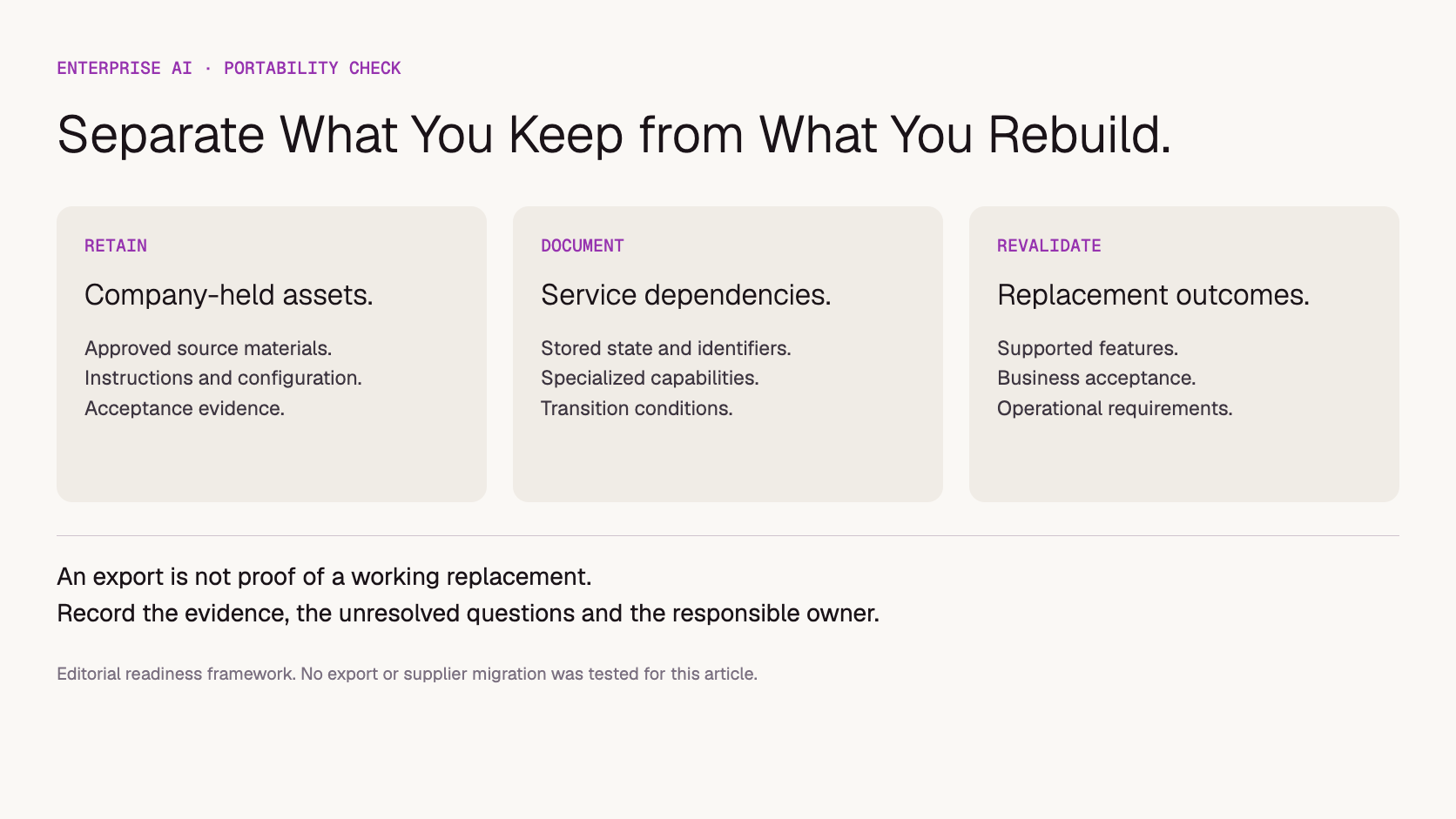
AI vendor lock-in occurs when changing a supplier requires more disruption, rebuilding or lost capability than your company can accept. To reduce that dependence, retain controlled access to your business data, application instructions, evaluation evidence and integration records. Verify what can be exported and what must be rebuilt before those dependencies become critical.
A familiar API format helps with one part of the problem. It does not automatically make model behavior, stored state, generated assets or commercial arrangements portable. The useful buying question is: “If we needed another supplier, what would we still control, and what would we have to recreate?”
Dependence can sit in the model’s behavior, the application’s stored information, provider-specific features or the commercial relationship. These layers require different checks. A company might replace its HTTP client quickly yet still need substantial work to reconstruct documents, retest outputs or replace a feature that another service does not offer.
Dependency
What makes a change difficult?
What should the company retain or verify?
Business information
The only usable copy exists inside a provider-managed workspace.
Approved source copies, permissions and a verified export path where needed.
Application behavior
Prompts and downstream logic depend on one model’s responses.
Versioned instructions, output requirements and representative acceptance cases.
Managed state and assets
File IDs, sessions or generated-media links only work within one service.
Recoverable content and mappings, within applicable retention and usage rules.
Specialized capabilities
The workflow relies on a feature with no suitable substitute.
A documented business benefit, replacement assumption and owner.
Commercial commitments
A change leaves unresolved obligations, access conditions or transition costs.
Written clarification of the applicable arrangement before committing.
Not every dependency is a bad decision. A specialized feature can be worth adopting when it materially improves an important workflow. The problem is an unexamined dependency: the team assumes that it can leave easily without checking what leaving would involve.
Does an OpenAI-compatible API prevent vendor lock-in?
An OpenAI-compatible interface can reduce the amount of connection code you need to change, but it does not establish feature or output equivalence. Check the fields your application actually uses, the returned information it relies on and the behavior it must preserve. A successful request is only the first portability check.
For a concrete example, Anthropic’s OpenAI SDK compatibility documentation, checked November 10, 2026, describes a compatibility layer with explicit limitations. It documents unsupported features and differences in how requests are interpreted. The point is not that compatibility is unhelpful; it is that the supported subset needs to match your workload.
Token360 similarly directs users to each model’s detail page and schema in its model capability documentation. Sharing an endpoint does not imply matching capabilities, parameters or limits. Treat API compatibility as an integration aid, with separate evidence for the features and results your application needs.
For the implementation detail, use the existing OpenAI-compatible API guide. The procurement decision here is broader: does your company retain enough information to assess an alternative without reconstructing the entire application first?
Which assets should remain under company control?
Retain the materials needed to explain and reconstruct the business workflow: approved source data, instructions, tool definitions, output contracts, evaluation cases and relevant configuration history. “Control” means an authorized owner can retrieve and use them within policy. It does not mean keeping every request indefinitely or collecting sensitive data unnecessarily.
Source materials: identify the authoritative documents, media and structured records behind the application. If a supplier stores a processed representation, keep track of what source material it came from. An exported file list is insufficient if the underlying contents are unavailable.
Application instructions: preserve the current prompt templates, business rules and tool definitions in a company-controlled repository or approved system. Record which application version uses them. A prompt copied from a playground without its configuration or surrounding workflow is an incomplete reconstruction record.
Acceptance evidence: retain a permitted set of representative cases, expected behavior and reasons an output would be rejected. This is more valuable than a collection of attractive demonstrations because it tells a future reviewer what must remain true when the model changes.
Generated assets: decide which outputs need durable storage and who is responsible for storing them. Do not treat a temporary output URL as a complete asset archive. Keep required metadata and usage restrictions with the asset, and follow the applicable retention policy rather than saving all output by default.
Provider credentials should be replaced through supported processes, not copied into an export pack. If an agency operates the application, separately resolve company versus agency account responsibility.
What cannot be made portable just by exporting it?
Exporting a file does not prove that another system can use it, and exporting a prompt does not prove that another model will follow it. Distinguish reusable business assets from service-specific representations. Budget for validation or reconstruction where the replacement service interprets the same material differently.
A stored file identifier is usually a reference within its originating service, not a substitute for the file itself. Likewise, a retrieval index may depend on its embedding configuration, processing steps and storage format. Ask whether you need a usable export or whether you will rebuild it from approved source documents. Do not assume another embedding model can query the existing vectors meaningfully.
Prompts require a similar distinction. The business objective and acceptance criteria may remain useful, while the instruction wording or response-handling logic needs adjustment. Even if two services accept the same JSON fields, you still need to check whether the resulting answers or media meet the application’s requirements.
These are questions to investigate, not claims that every managed service has the same limitations. Record the actual dependency and supported path for the service you plan to buy.
How much portability is worth paying for?
Invest most in dependencies that are business-critical, difficult to reconstruct and costly to interrupt. Full interchangeability across every possible supplier can create its own complexity. A proportionate policy preserves important assets and makes the cost of change visible, while allowing useful specialized capabilities when their benefits justify the dependence.
Situation
Proportionate response
What not to assume
Replaceable internal drafting feature
Keep templates and evaluation examples; document the integration.
Every experiment needs a second live supplier.
Customer-facing workflow with stored knowledge
Verify source access, reconstruction steps and acceptance evidence.
Downloading conversations also preserves the knowledge system.
Specialized media capability
Store required source and final assets; document what an alternative must achieve.
Another model can reproduce the same creative result.
Critical workflow with difficult replacement
Assign a dependency owner and evaluate an alternative or continuity plan appropriate to the risk.
A second supplier is automatically independent or ready to use.
This is different from avoiding all provider-specific features. If a specialized feature is valuable, approve it consciously: name the benefit, explain what would be lost if it became unavailable and assign responsibility for reviewing that dependency. An unused abstraction layer is not evidence of portability.
Where operational continuity requires another supplier, use the separate second AI API supplier decision guide. This article does not recommend paying for parallel capacity in every application.
What should procurement ask before signing?
Ask what information remains accessible, how it can be retrieved, which features require rebuilding and what transition conditions apply. Request answers specific to the proposed service. Public marketing language such as “flexible” or “compatible” is not a complete description of export scope, continued access or assistance during a supplier change.
Use a small set of concrete questions:
Content: which inputs, outputs and records can we retrieve, and in what usable format?
State: which sessions, file references, indexes or configurations are specific to this service?
Access: what retrieval process and access window apply if the service arrangement ends?
Assistance: what transition work is available, who performs it and how is its scope agreed?
Commercial conditions: what happens to remaining commitments, credits and charges under the proposed arrangement?
Restrictions: which terms or permissions must be checked before reusing data or generated assets elsewhere?
These are items for your procurement and legal teams to resolve with the supplier, not statements of automatic customer rights. Assign an owner to unanswered questions. An important “unknown” belongs in the buying decision, not in a folder that nobody revisits until renewal.
How can you check readiness without running a migration?
Perform a limited reconstruction exercise using an approved non-sensitive example. Ask someone other than the original builder to locate the source materials, configuration and acceptance criteria, then explain what would need to change for another service. This checks the completeness of your records; it does not prove a replacement model will perform adequately.
A proposed readiness check. No supplier change or portability test was performed for this article.
Imagine a document-summary application whose team has saved its prompt but cannot identify the source-document version or the criteria used to approve the summaries. Changing the API endpoint would not solve that evidence gap. The immediate task is to recover the missing records and ownership, before deciding whether a supplier change is justified.
Keep the exercise outcome precise: “configuration located,” “source export unverified” or “replacement evaluation required” is useful. “Migration ready” is too broad if nobody has tested the replacement. When an actual change is approved, follow the AI provider migration guide for staged validation and transition planning.
Download the blank AI portability register. It records the business dependency, company-held source, export evidence, reconstruction requirement, owner and unresolved question. It is a planning template, not proof of transferability.
Describe the workloads and assets your business needs to retain, then confirm the relevant capabilities and commercial scope with Token360. Multi-model access gives enterprises choices to evaluate, but it does not guarantee automatic export, equivalent outputs or a cost-free switch. Keep those claims separate from the availability of model access.
Token360 serves enterprise buyers across text, image, audio and video models. Pricing, capacity, contracts and compliance requirements can be discussed for a specific engagement. Use the enterprise page to begin that conversation with a dependency list and your required transition conditions. Learn more about Token360.
Frequently asked questions
Is using an AI gateway enough to avoid lock-in?
No. A gateway can simplify provider access, but the application may still depend on model behavior, stored state or specialized features. Evaluate those dependencies separately and confirm the gateway’s own export and service boundaries.
Do we need to avoid proprietary model features?
No. Use them when their benefit justifies the dependency. Document their role, the consequence of losing them and the evidence needed to approve an alternative. Avoid promising interchangeable behavior where it has not been tested.
Should we store every prompt and response?
No. Preserve the minimum approved material needed for operation, evaluation and reconstruction. Apply data minimization, access and retention requirements. A portability plan should not become an uncontrolled archive of confidential information.
Can exported prompts guarantee the same results elsewhere?
No. The instructions may be reusable, but the replacement still needs evaluation. Keep the business acceptance criteria alongside the prompts so a future team can distinguish acceptable variation from a failed requirement.
Evidence note: editorial procurement analysis using the official documentation linked above. The reconstruction example is hypothetical. No export, migration, replacement performance or cost-saving result is claimed.
Enterprise AI
API
Bring your next idea to life.
Create a video scene in Creator, or explore models for images, audio, and text to find the right capabilities for your project.



 Guides
 Guides
 Guides