Investigate AI quality regression by comparing tasks, prompts, context and model settings. Decide when to review, retest or escalate with evidence.
ENTERPRISE AI · PRODUCTION QUALITY
A drop in AI output quality does not, by itself, prove that the model changed. New customer requests, revised prompts, different source documents, routing changes and inconsistent grading can all change the result. Compare a stable set of tasks and a representative production sample before deciding whether to revise the application, escalate to your inference supplier or change models.
For enterprises using Token360, this is a practical operating question: the API may still return successful responses while employees reject more answers or spend longer correcting generated assets. AI quality regression monitoring connects those business outcomes to the specific requests and configurations that produced them.
Scope: This article presents a diagnostic framework, not a report of a Token360 incident or a measured decline in any model. Examples and the decision worksheet are illustrative. Sources were reviewed on November 10, 2026; no production performance figures are claimed.
Read first: Our AI model evaluation framework covers selecting and validating a model. This guide addresses a later question: what to investigate when an already deployed application appears to be getting worse.
What counts as an AI quality regression?
An AI quality regression is a deterioration against a defined task requirement under a meaningful comparison. “The answer feels different” is a useful report, but not yet a diagnosis. Specify what failed, what previously passed and whether the inputs, configuration and review criteria are comparable before attributing the change to a model.
For a support assistant, a regression might mean giving an outdated refund rule despite receiving the correct policy. For image generation, it might mean failing to preserve a required product feature. For audio, it could mean a pronunciation error in an approved script. For video, it might mean a required action is missing even though the file is valid.
These are different from an outage, a slower request or a higher bill. Those signals can accompany a quality problem, but they do not establish one. Keep API observability metrics alongside task-quality checks rather than substituting HTTP success or latency for business acceptance.
What should you check before blaming the model?
Start with the change history for the complete application. Compare the prompt, input preparation, retrieved context, model identifier, supported parameters and output processing. Also check whether the task mix or judging rules changed. This creates a short list of testable explanations instead of treating every disappointing answer as a provider regression.
Possible change
What a team may observe
First comparison to make
More difficult incoming tasks
Overall acceptance falls while familiar tasks remain reliable.
Compare results within the same task categories.
Prompt or application release
Errors begin near a deployment.
Replay approved cases on the previous and current configuration.
Missing or stale source material
Answers are fluent but miss the current business rule.
Inspect the context actually sent with the request.
Model or routing configuration
Behavior changes for a particular request path.
Compare recorded model and configuration details; ask the supplier about unresolved routing questions.
Review criteria or grader
Scores change without an obvious output difference.
Regrade the same saved outputs under both review versions.
Output processing
The raw response is useful but the displayed result is incomplete.
Compare raw output with what the user actually received.
A timeline is helpful, but timing alone does not prove causation. A prompt release and a new customer rollout may happen on the same day. Record both. Changing several settings again before collecting a comparison can make the original cause harder to isolate.
How do you separate harder work from worse performance?
Use two views: stable reference tasks and current production tasks. The reference set asks whether the application still handles work it previously handled; the production sample asks whether it handles today's demand. If only the latter worsens, inspect new task categories before concluding that the underlying model became less capable.
For example, imagine a service that previously handled mostly order-status questions and now receives more disputed-refund cases. Even unchanged performance within each category can produce a lower combined acceptance rate when the difficult category becomes more common. This is a hypothetical explanation, not measured customer data.
Report the category, time window, reviewed count and selection method alongside each result. A sample chosen only from complaints is valuable for diagnosing failures but cannot estimate the acceptance rate for all traffic. An unreviewed output is not a confirmed success; label the unknown portion explicitly.
Google Cloud's evaluation overview includes evaluation using production logs. That supports bringing real tasks into the review process, but the sampling and acceptance rules remain decisions your team must define. Do not send sensitive production records to a new evaluator without the appropriate data-handling approval.
The LLM hallucination-rate guide explains how the definition of a wrong answer changes the result before two evaluations are compared.
What evidence makes a regression report actionable?
An actionable record links an input, configuration, output and explicit failure reason. Preserve enough context to distinguish a model response from application behavior, while removing credentials and unnecessary personal information. A reproducible comparison is more useful than a screenshot labeled “bad answer,” especially when the supplier cannot see your internal business requirements.
Keep a versioned record of the test case, expected requirement, prompt, relevant source material, requested model, parameters, timestamp and response or job ID where available. For generated media, retain the original output file and the time position or region containing the issue. Record the resolved route only if it is actually exposed; do not infer hidden infrastructure from a model name.
The acceptance reason should describe an observable failure: “The response states a 30-day return window although the supplied policy says 14 days” is stronger than “accuracy dropped.” A reviewed, previously acceptable example helps establish the comparison, but a single historical success does not prove deterministic behavior.
Token360's model capability documentation identifies the selected model page and public schema as the source of truth for supported features. Check those when reconstructing the request. For the escalation package itself, follow our reproducible AI API bug-report guide.
When should you run a comparison again?
Recheck quality after material application changes and whenever reviewed production evidence indicates a problem. Also set a recurring review cadence based on business impact and traffic. There is no universal weekly schedule or sample count: a rarely used internal drafting tool and a high-volume customer-facing workflow need different coverage and response expectations.
Useful triggers include a new prompt, a changed knowledge source, a model switch, revised request parameters, new languages, a new customer segment or an increase in correction work. A change to the evaluator is itself a trigger because it may change the score without changing the output.
Anthropic's evaluation guidance distinguishes regression evaluation from testing new capabilities and discusses combining different grading methods. Applied here, the operational lesson is to preserve checks for previously accepted behavior while adding cases for newly discovered failures. This article's workflow is an editorial adaptation, not an implementation of Anthropic's internal system.
A repeated run can help reveal variation, but repeating the same task many times does not provide broad workload coverage. Track both the number of distinct cases and the number of attempts per case. Keep a separate confirmation set when tuning a fix so the team does not merely optimize for the failures it already knows.
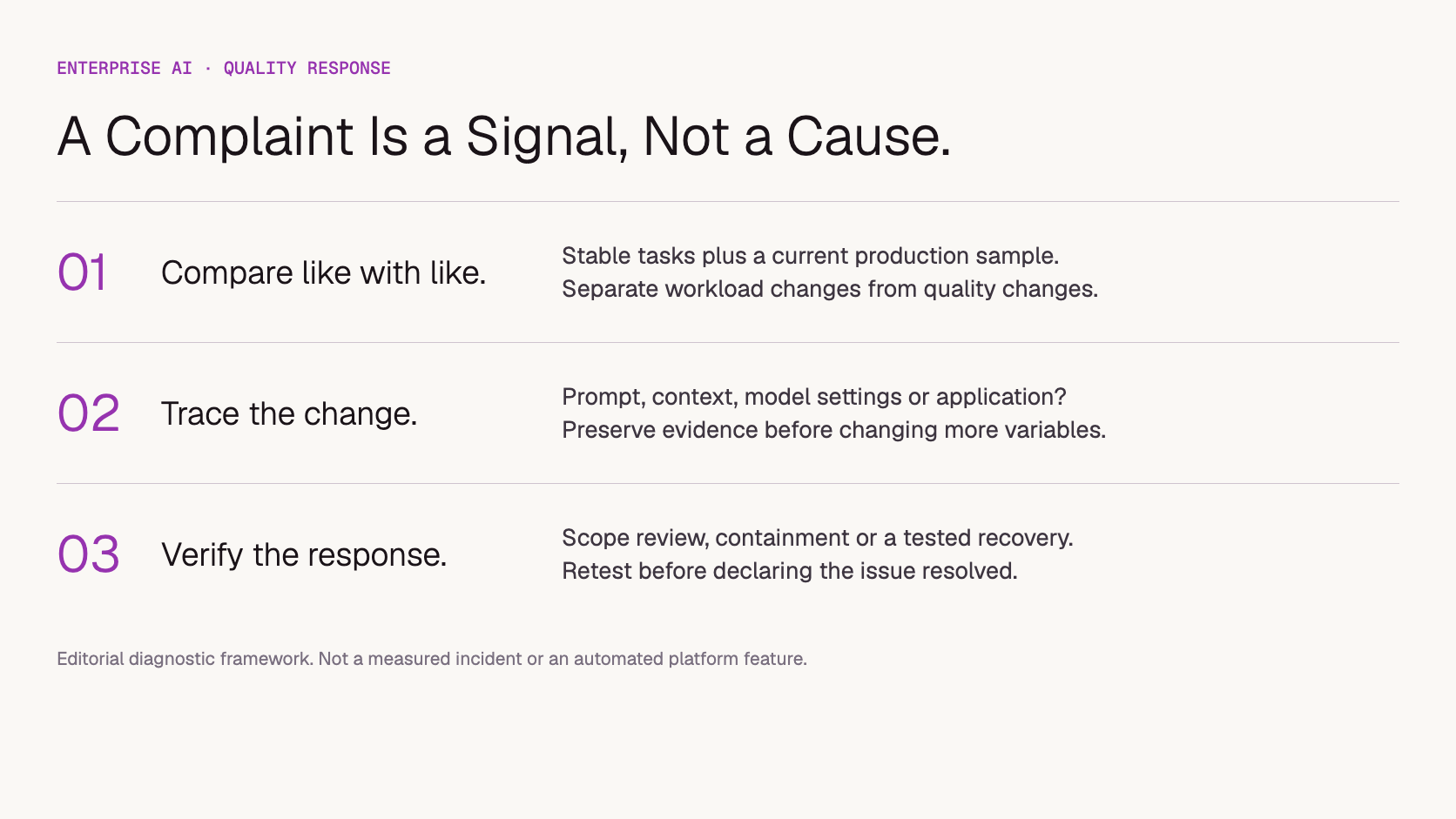
A response path for the application team, not a claim of automated Token360 quality monitoring.
Should you alert, add review or roll back?
Choose the response according to the consequence of the failure and the strength of the evidence. Some failures justify stopping an affected automated action immediately; others call for investigation or additional review. Define the owner and response before an incident, rather than inventing a universal score threshold after a complaint arrives.
Evidence
Possible response
What must be verified
One unexplained poor output
Preserve the example and inspect comparable cases.
Whether it is a repeatable issue or expected variation.
Repeated failures in one task category
Add review or restrict automation for that category.
The affected scope, including languages and input types.
Failure appears after an application change
Evaluate restoring the previous configuration.
That the previous configuration still meets current requirements.
Serious business-rule violation
Pause the affected action and escalate to its owner.
Exposure, containment and criteria for resuming.
These are decision examples, not guaranteed remedies. A rollback can restore an outdated prompt or source policy, and another model can introduce a different failure. Test the proposed recovery on the affected cases and an independent set before resuming the original scope. For decisions about review placement, use the enterprise human-review guide.
What belongs to your team, and what belongs to Token360?
Your team owns the business definition of acceptable output and the application context supplied to the model. Token360 can be the inference supplier in that workflow; evidence can support investigation of request behavior and the agreed service scope. Access to multiple models does not, by itself, provide automatic business-quality assurance.
Token360 offers model access across text, image, audio and video, with enterprise pricing, capacity, contracts and compliance requirements scoped to each engagement. A supplier discussion can clarify available model identifiers, request parameters and escalation arrangements. It cannot replace your judgment about whether an answer complies with your refund policy or a generated asset accurately depicts your product.
Before expanding a deployment, agree who receives quality reports, what evidence can be shared, and who decides whether an issue is resolved. Ask which change notifications and support commitments are available for the specific engagement. Do not assume a standard behavior guarantee, automatic regression dashboard or response-time commitment that has not been confirmed.
Use the Token360 enterprise page for the current offer and a written scope for negotiated commitments. The pilot-to-production guide covers the broader decision to expand; this quality process should continue after that decision.
What should a quality review leave behind?
Each review should leave a decision record that another person can follow: what changed, which cases were checked, what remains uncertain and what happens next. A chart without an owner or an action is not an operating process. Preserve the evidence that supports the decision, including unresolved disagreements between reviewers.
Use the downloadable quality-regression review template to record the affected task, comparison window, configuration versions, sampling method, failure criterion, evidence location, owner, action and retest condition. It is a blank working template, not a populated customer result or an automated scorecard.
Close the issue only after verifying the agreed recovery condition. If the explanation is still uncertain, say so. “We limited automated refund responses while investigating a source-context mismatch” is a useful operational record; “the model was fixed” is not justified unless the evidence establishes that conclusion.
Frequently asked questions
Does a successful API response mean the answer is correct?
No. A successful request establishes a technical outcome, not business correctness. Review the content against the actual requirement and inspect what the application displayed or executed.
Can the same model ID produce different results over time?
A model ID alone does not establish a reproducible experiment. Preserve the full request and application configuration, account for output variation, and ask about version or routing details where relevant. Do not assume an unchanged identifier proves that every contributing factor stayed fixed.
Can another AI model grade all our outputs?
A model-based grader can assist with review, but validate its decisions against human judgments on your task. Preserve the grader version and criteria. Disagreement and critical failures need investigation; a second model's approval is not independent proof of correctness.
How much quality decline should trigger an alert?
Set thresholds for the task's consequences and the evidence available. A serious business-rule failure may justify immediate containment even when aggregate scores look normal. Routine quality changes need comparable samples, a defined review window and an assigned owner.
Does changing the model automatically solve a regression?
No. If missing context or application processing caused the problem, another model may reproduce it. Compare a proposed change against the failure cases and other representative tasks before treating it as a fix.


 Guides
 Guides
 Guides