Review AI API SLA scope, measurement clocks, exclusions and remedies. Separate availability, generation latency and support response before approval.
ENTERPRISE PROCUREMENT · BLOG 154
By Token360 · Editorial review: November 5, 2026
An AI API SLA should identify the covered service, measurement method, target, exclusions and consequences of missing the target. Availability, generation latency and support response are separate commitments. Before approving an enterprise offer, connect each promise to a defined event and evidence source; a successful submission or quick support reply does not establish timely completion.
“Enterprise support included” can be valuable without telling you how quickly a failed video job will recover. “High availability” can describe a service target without defining the time from submission to a downloadable file. A purchasing review needs to connect those statements to the workload the business depends on.
This article is a technical procurement checklist, not a model contract or legal advice. Its event timeline and arithmetic are hypothetical. No outage experiment, negotiated customer SLA or provider performance benchmark was used. Ask the appropriate commercial and legal reviewers to interpret the agreement actually offered to your organization.
Read first: Token360’s limits and timeout guidance explains why a failed or delayed request needs a specific diagnosis. The contractual question is which diagnosed events count toward the agreed service measure.
What makes an SLA different from a target or a benchmark?
A benchmark reports observations under stated conditions. A service-level objective sets a target for a defined indicator. A service-level agreement connects commitments to agreed consequences. Keep these categories separate: a fast demonstration, an internal target or a historical status chart is not automatically a contractual promise to your account.
Google’s SRE guidance on service-level objectives distinguishes the measurement, its target and the agreement governing consequences. That distinction gives procurement a practical test: if the target is missed, what is the agreed process and outcome? If no consequence is defined, clarify what kind of commitment the document is making.
A useful review row contains five linked fields: service boundary, indicator, target, measurement window and consequence. An uptime percentage detached from those fields is incomplete. Record whether a value is requested by your team, offered by the supplier or accepted in the applicable agreement.
Do not turn a single successful API call into an availability or latency commitment. It can demonstrate connectivity and response handling; it cannot establish a monthly service level or a production support obligation.
Which promises should be reviewed separately?
Separate availability, request latency, support acknowledgement and service recovery because each measures a different outcome. Add capacity or output-quality criteria only when they are explicitly needed and defined. A proposal can cover one dimension without covering the others; the review should make that boundary visible rather than fill it with assumptions.
Commitment
Question it answers
Definition needed
Does not establish
Availability
Was the covered service available under its defined measure?
Eligible requests or intervals, errors, window and exclusions.
That every generation completed quickly.
Latency
How long did a defined operation take?
Start/stop events, workload, percentile and observation point.
A support response deadline.
Support response
When did the required human response occur?
Severity, channel, support hours and qualifying response.
That the incident was fixed.
Recovery
When was an agreed usable service state restored?
Restored state, evidence and any separate objective.
That lost work was recreated.
Output acceptance
Did the result meet a defined task requirement?
Evaluation method and acceptance criteria, if covered.
Protection under a generic uptime clause.
The OpenRouter pricing FAQ, checked November 5, 2026, describes Enterprise support with committed response times and dedicated support resources. It is a concrete reason to ask what the support clock measures. The FAQ does not give you a universal restoration deadline or prove that every model will complete a particular task within your preferred time.
Capacity belongs in its own review when the workload has production peaks. A higher request limit and a latency commitment are not interchangeable. Likewise, a video that is technically returned but has incorrect product details raises an output-acceptance question; do not classify it as downtime without the agreement’s definition.
Which part of an asynchronous AI job is actually covered?
Name the service boundary from the user’s workflow, then compare it with the offered coverage. For asynchronous media, request acceptance, queued work, generation, notification and file retrieval are distinct events. An agreement covering submission availability may leave completion time or downstream delivery outside scope unless those elements are expressly included.
For example, a team launching a video campaign may care about having a usable file before a publishing deadline. A submission endpoint returning a job ID addresses only an earlier step. The commercial discussion should establish whether the offer covers that endpoint, model execution, output storage, notification or some combination.
Use these questions for each selected model and feature:
Is the commitment for the gateway, a named model route or the complete workflow?
Are streaming, asynchronous jobs and media retrieval included on the same terms?
Does the target apply under a specified workload or capacity arrangement?
How are third-party failures and customer-controlled destinations treated?
What happens to the commitment after a model, route or feature changes?
As a published example of a precise boundary, the Amazon Bedrock SLA defines availability using requests and errors in five-minute intervals, with a regional monthly calculation and stated exclusions. Its definition of an error is specific. Read that document for its actual scope rather than applying its formula to a different API or to your own end-to-end video workflow. Source checked November 5, 2026; page states last updated October 4, 2023.
How do different clocks change the interpretation of one incident?
Write down the start and stop event before interpreting a duration. Submission time, job completion, first human response and recovery can all be measured from different timestamps. One incident can therefore produce several valid durations that answer different questions. The agreement must specify which one determines whether its target was met.
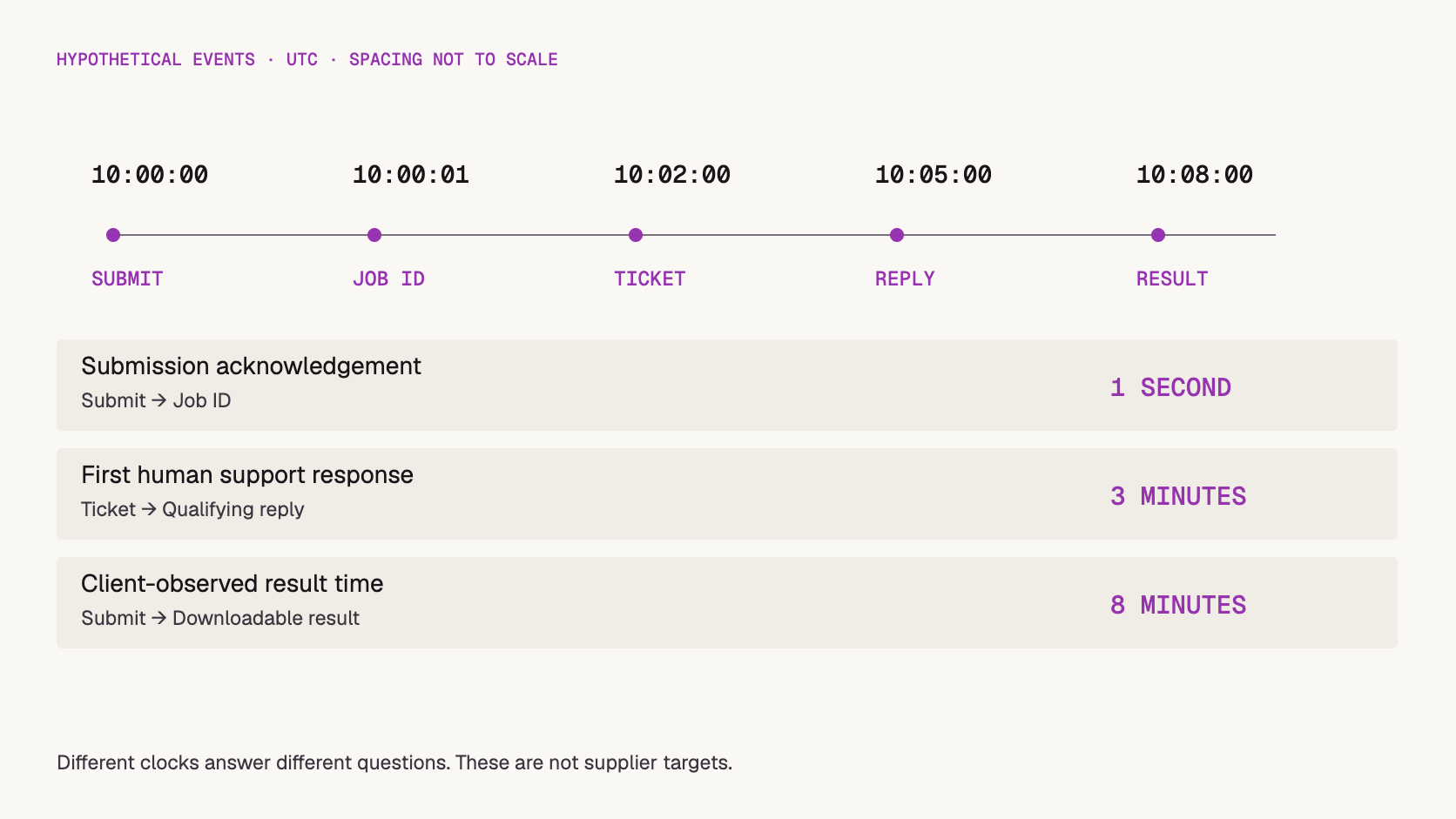
Hypothetical timeline only: assume an eight-minute video job and a support ticket opened while the job is still running. The events below are invented for explanation; they are not Token360 measurements or promised response times.
UTC event time
Observed event in the example
What can be calculated
10:00:00
Client submits the job.
Start of client-observed submission-to-result time.
10:00:01
Client receives a job ID.
Submission acknowledgement: 1 second.
10:02:00
Customer opens a support ticket.
Possible support-clock start, subject to the agreed channel and severity rules.
10:05:00
Human support provides a qualifying first response.
First response after ticket: 3 minutes.
10:08:00
A downloadable result becomes available to the client.
Submission-to-result: 8 minutes.
Illustrative clocks. None establishes an SLA breach without the relevant target, scope and measurement rules.
The example has a one-second acknowledgement, a three-minute support response and an eight-minute result time. None can replace the others. It also does not show service recovery: one completed job is not enough to establish that a wider incident has ended under a defined recovery criterion.
If a proposed latency target stops at the job ID, it answers a different question from a target ending at a usable download. If the support clock starts only when a correctly classified ticket reaches a designated channel, an earlier informal message may not start that clock. Resolve these definitions before a time-sensitive launch.
Keep measurement location explicit too. A client-observed delay includes a different boundary from a supplier-side processing measure. Ask which source is authoritative and how discrepancies are investigated, instead of treating two different clocks as contradictory evidence.
How should you read uptime percentages, exclusions and remedies?
Read the calculation and exclusions before translating a percentage into downtime or compensation. A time-based availability ratio and a request-based measure need not produce the same result. Then inspect the remedy and claim procedure separately. A headline percentage does not tell you which events count, what evidence is required or what a breach entitles you to.
Illustrative arithmetic: under a simple time-based definition with no exclusions, 30 days contain 43,200 minutes. A 99.9% target corresponds to 43.2 minutes below availability in that window: 43,200 × (1 − 0.999). This is not a provider offer, a permitted single-outage duration or a way to reinterpret a request-weighted formula.
For a concrete contractual example, the Bedrock SLA’s credit procedure includes a claim deadline and required request evidence, and ties eligible service credits to specified charges. That illustrates why finance and engineering need the same incident record. It does not establish that another supplier uses the same credit method or filing rules.
During review, ask the supplier to explain how maintenance, invalid inputs, customer configuration, network failures and upstream dependencies are treated in the proposed agreement. These are questions to resolve, not a claim that every SLA excludes all of them. Record the actual answer and source clause.
Finally, separate the commercial remedy from operational recovery. A credit can address an agreed contractual consequence without restoring a missed campaign deadline. The application still needs an appropriate continuity plan; the SLA review does not replace it.
What can Token360 buyers rely on today?
Use Token360’s current published status and the agreement applicable to your account rather than assuming that an enterprise label includes a standard SLA. The public page is a starting point for a commercial discussion. Record requested commitments separately from confirmed ones, and do not present roadmap features as generally available promises.
As checked November 5, 2026, the Token360 enterprise page lists “Priority support & SLAs” in its roadmap with the status “Coming Soon.” It invites discussion of contractual production requirements. This article therefore does not assign Token360 a universal uptime percentage, first-response deadline, restoration target or service-credit schedule.
A useful enterprise brief describes the selected models and modalities, operating hours, business-critical workflow and required service boundary. Ask the account team which commitments are available for that scope, which require further agreement and which are not currently offered. If a requirement is mandatory, keep it unresolved until the applicable terms answer it.
Technical coordination, an account contact and a signed service-level commitment should appear as separate fields in that brief. This allows procurement to recognize useful support services without accidentally promising a stronger obligation to its own customers.
What should go in the SLA review and incident record?
Keep a proposed-versus-confirmed commitment sheet alongside a minimal incident evidence record. The first establishes what was agreed; the second helps determine what happened. Link each measure to its owner and evidence source, and preserve unresolved items. Avoid collecting unnecessary prompt content when timestamps and correlation identifiers answer the operational question.
Copy the worksheet below into a local CSV file. Blank fields are for your own review:
Commitment,Covered service/model/feature,Requested target,Confirmed target,Start event,Stop event,Measurement window/percentile,Evidence source,Exclusions,Remedy/claim procedure,Owner,Agreement reference/date,Open questions
Availability,,,,,,,,,,,,
Submission latency,,,,,,,,,,,,
Generation/result latency,,,,,,,,,,,,
Support first response,,,,,,,,,,,,
Incident update cadence,,,,,,,,,,,,
Recovery definition,,,,,,,,,,,,
Capacity if separately covered,,,,,,,,,,,,
Output acceptance if separately covered,,,,,,,,,,,,
Service-credit claim,,,,,,,,,,,,
. It provides fields for scope, metric, clock boundaries, target, exclusions, remedy and evidence. It is a blank procurement aid, not an approved Token360 agreement.
For incident preparation, Token360’s support guidance requests the UTC time range, public model, endpoint, status and error code, request ID and trace ID. It advises removing secrets and sensitive material unless a secure transfer is specifically requested. Those details support investigation; they do not alone prove entitlement under an SLA.
Before production, rehearse whether your team can retrieve the relevant records and reach the agreed contact through the approved channel. Confirm who owns severity classification, progress updates and any claim submission. Record only results actually observed; a proposed exercise is not completed evidence.
These answers clarify common interpretation errors without supplying terms for a particular account. For a purchasing decision, use the actual service description, target and measurement rules in the applicable offer. Keep observed performance and contractual obligations distinct, and confirm ambiguous language with the responsible commercial and technical contacts.
Does a 99.9% uptime target mean every generation succeeds?
No. The defined measure and exclusions determine what the target means. It is not a promise that every individual output meets a creative brief or finishes by a preferred deadline.
Does a fast support response mean the problem is resolved?
No. First response and recovery have different stop events. Ask whether the agreement defines both and what constitutes a qualifying response or restored service.
Can I use status-page history to calculate a credit?
Use it as context, then apply the agreement’s own scope, formula and evidence requirements. A public incident summary is not automatically the same as the account-level measure used for a claim.
Does dedicated capacity automatically include an SLA?
Do not assume so. Capacity, availability, latency and support commitments must be confirmed in the applicable arrangement.
Is the example’s eight-minute result time a Token360 benchmark?
No. Every event in that timeline is hypothetical and used to explain clock boundaries.
Enterprise AI
API
Build faster with one AI API.
Use Token360 to call video, image, audio, and text models with one key and one bill.


 Insights
 Guides
 Guides