AI Inference Price Changes: What Should a Quote Specify?
Negotiated inference pricing is not automatically fixed. Check quote validity, rate periods, adjustment triggers and how revised prices apply to usage.
ENTERPRISE PROCUREMENT · PRICE CHANGES · BLOG 176
By Yuki Yu · Sources checked November 6, 2026 · Editorial update November 6, 2026
An enterprise AI inference quote should specify more than today’s unit rate. Record how long the offer is open, which rates apply after acceptance, what can trigger a price change and when revised rates take effect. Negotiated pricing does not automatically mean fixed pricing, and a discount does not explain how future changes are handled.
Token360’s enterprise positioning includes negotiation of model unit pricing across text, image, audio and video workloads. That creates a useful procurement conversation beyond a standard rate card: which part of the commercial arrangement can change, and under what agreed conditions? It is not evidence that every customer receives a rate lock, automatic price matching or the same discount.
This is a procurement analysis using public provider information and constructed pricing scenarios. It is not a comparison of signed customer contracts, a legal clause template or a forecast of model prices. The examples do not represent Token360, fal or OpenRouter offers.
Read first: Token360’s enterprise overview identifies custom pricing as an enterprise capability. The next step is to make the applicable price-change rules explicit in the actual quote.
How do Token360, OpenRouter and fal differ for this discussion?
The relevant distinction is what the buyer can discuss commercially, not whether a provider has enterprise customers. Separate model inference rates from platform fees and from any reserved service arrangement. Then ask how each line changes over time. An enterprise sales conversation alone does not establish a fixed price for any of those lines.
The following public-positioning comparison was checked on November 6, 2026. It identifies questions to take into a quote review; it does not rank execution quality or disclose private terms.
Provider
Public or company-confirmed commercial position
What the buyer still needs in writing
OpenRouter
Its pricing FAQ distinguishes enterprise fee discounts from inference pricing. Its enterprise page also supports BYOK with separately negotiated provider rates.
The price basis for inference and platform charges, and how changes to each are applied
fal
Its Model APIs FAQ invites volume-pricing discussions. Its enterprise offering includes dedicated infrastructure and service commitments.
Which model or service lines the quote covers and the adjustment rules for those lines
Token360
Company-confirmed positioning permits negotiation of model/token unit pricing itself by workload and volume; its enterprise page advertises custom pricing.
The actual rate schedule, eligible workload, term and any agreed change mechanism
For OpenRouter, the public pricing page says enterprise discounts apply to its fees rather than inference. That does not erase a buyer’s separately negotiated upstream deal used through BYOK. For fal, a public model price is not evidence that custom pricing is unavailable. For Token360, the ability to negotiate the unit rate does not establish that it will stay unchanged indefinitely.
This is the useful differentiation for a Token360 inquiry: ask for a workload-specific commercial schedule, then evaluate its duration and adjustment rules alongside the initial rate. Avoid the unsupported shortcuts that competitors do not serve enterprises or that Token360 always has the lowest price.
Which three dates should an inference quote distinguish?
Separate the quote’s acceptance deadline, the period during which accepted rates apply and the next review or renewal point. Those dates answer different questions. An offer that must be accepted this month might cover a later service period; neither fact alone tells the buyer whether the price can change during that period.
Date or interval
Question it answers
Ambiguity to remove
Offer validity
Until when can this quote be accepted?
Whether a delayed decision requires a new quote
Rate-effective period
Which usage is priced under this schedule?
Whether service commencement differs from acceptance
Review or renewal
When is pricing reconsidered, and by what process?
Whether a review is automatic, optional or subject to a new agreement
Consider a constructed quote offered on day 1, open for acceptance until day 14, with a proposed service start on day 30. “Valid for 14 days” does not tell you how long the accepted service rate lasts. Ask for the rate-effective period explicitly rather than treating the offer deadline as either a price lock or a service expiry.
Record time zones where exact timestamps matter. If a deployment starts later than planned, confirm whether the start delay changes the eligible pricing period. These are review questions, not default terms asserted for any provider.
Is a fixed rate the same as a fixed discount?
No. A fixed currency rate holds a specified unit price under the agreed conditions. A percentage discount needs a reference price, which may move. The two structures can produce the same initial number and different later costs. Identify the reference schedule, eligible meter and effective date before comparing the headline percentages.
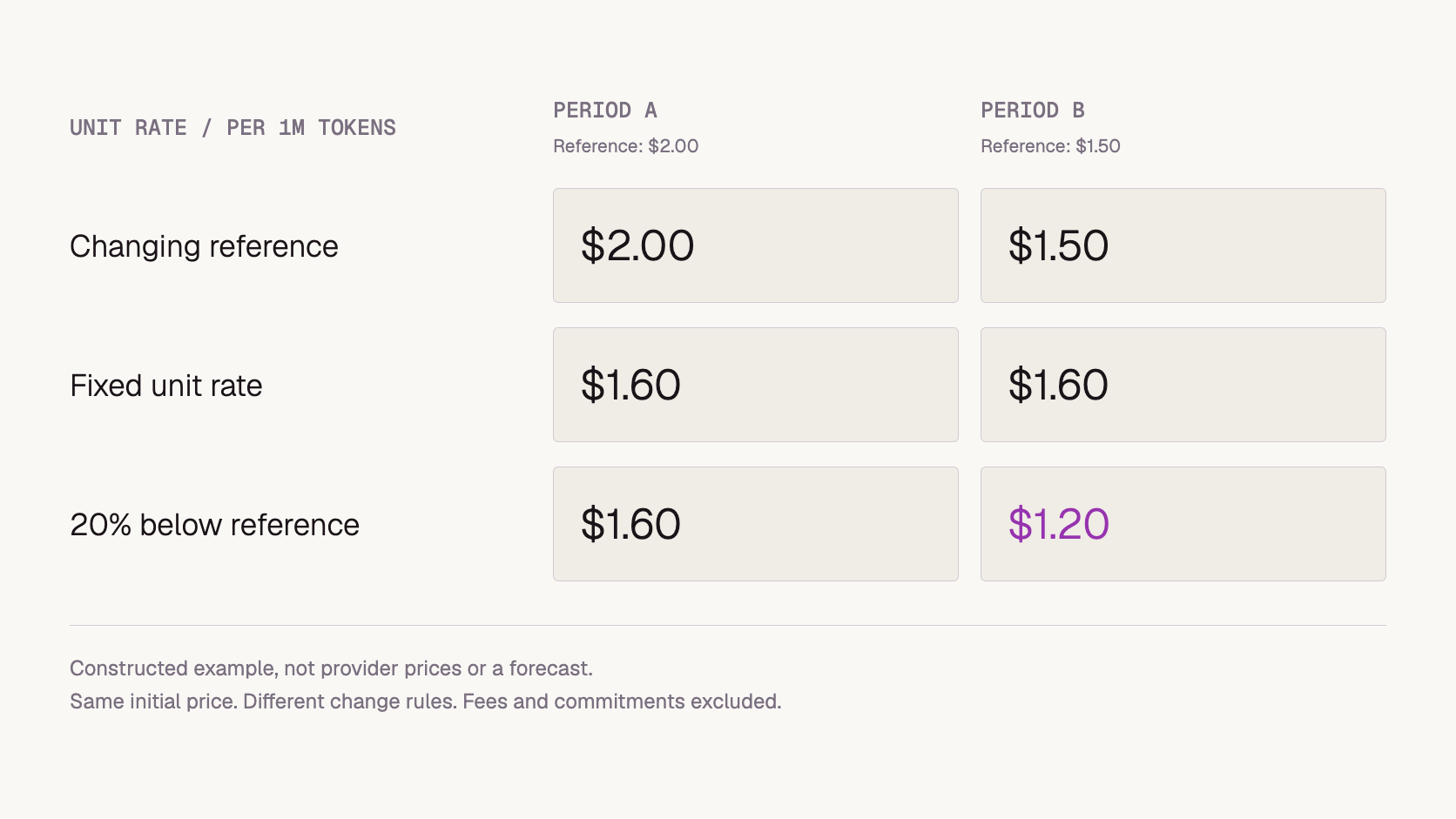
The following constructed example isolates that difference. Assume exactly 10 million billable output tokens in each period on the same model and meter. The illustrative reference rate moves from $2.00 to $1.50 per million tokens. There are no input charges, fees, taxes, minimums or other charges in this simplified calculation.
Illustrative structure
Period A: reference $2.00/M
Period B: reference $1.50/M
Pay the changing reference rate
$20.00
$15.00
Fixed $1.60/M for both periods
$16.00
$16.00
20% below the changing reference rate
$16.00
$12.00
All three results follow from billable millions × applicable unit rate. The fixed and percentage-discount examples begin at the same price but diverge after the reference moves. None is an actual offer, and the reference-price decline is an assumption, not a forecast. If the reference rose, the trade-off would be different.
A review-based arrangement is a fourth possibility to discuss: the parties revisit the schedule at a defined point. A review is not the same as an automatic reduction. Ask what happens if there is no agreement, rather than placing an assumed future saving in the approved budget.
Constructed unit-price example. The rate basis, not just the initial discount, determines the later number.
What changes should trigger a commercial review?
Review changes that alter the workload or the basis on which it was priced. Examples include a new model, a different billing meter, changed quality settings or a materially different demand pattern. Do not assume an existing discount automatically transfers to a replacement configuration just because the API endpoint stays the same.
For a multimodal application, “same monthly spend” can hide a different purchase. Replacing text generation with video seconds changes the meter. Moving from one video resolution to another may change the relevant priced configuration. Changing the input-to-output mix can change the bill even when neither published token rate moves.
Token360’s model capability guide directs users to the selected model’s public schema and pricing rules. Use that model-level information to identify the workload being discussed. Keep the quote’s commercial eligibility separate from the fact that an API accepts a request.
A useful change record includes the previous model and meter, the proposed replacement, expected volume and the decision required. Ask whether the old schedule continues, a new line is added or the workload needs a fresh quote. This is different from a technical migration plan: the question here is what the replacement costs under the agreed terms.
Which rule prices work that crosses a change date?
A price change needs an effective event as well as an effective date. For work submitted before a change and completed afterward, ask which event selects the applicable schedule. Do not assume submission, processing, completion or invoice time is authoritative unless the service terms or billing documentation establish that rule.
Imagine an asynchronous media job submitted at 23:59 and completed after midnight when a revised schedule is intended to begin. The example does not imply that a provider changes prices at midnight. It exposes a question that a date-only quote leaves unanswered: which price version applies to this job?
The same question matters for queued work, retries, pre-purchased credits and delayed charge settlement. A balance bought earlier is not, by itself, evidence that all future work uses the old unit rate. Ask for the applicable rule instead of inferring it from a payment date or the appearance of a charge in the console.
For later review, keep the commercial schedule version and its effective rule alongside the available request and usage records. Token360’s billing documentation distinguishes recorded charges from remaining balances and provides request-level reconciliation paths. It should not be read as a universal price-lock policy.
What belongs in a price-change schedule?
A reviewable schedule links each rate to a named model or service, a meter, an eligibility condition and a period. It also records the proposed adjustment process and the handling of replacement workloads. Leave unanswered fields visible. Filling them with customary assumptions creates apparent certainty without confirming the actual offer.
Field to confirm
Why it matters
Model, version and priced configuration
Identifies the purchase instead of a broad provider family
Meter, currency and included charges
Makes a unit rate interpretable and comparable
Fixed amount or reference-based formula
Explains how the price behaves when the reference moves
Eligible usage and any commitment
Identifies which work qualifies and what the buyer undertakes
Offer deadline and rate-effective period
Separates acceptance timing from service pricing
Change trigger, notice and effective event
Explains when and how a revised schedule applies
Replacement model and out-of-scope usage
Avoids assuming a rate transfers to another workload
Review, renewal and unresolved-change process
Identifies what needs a new commercial decision
Copy the
Copy price-change-review.csv:
field_to_confirm,supplier_answer,evidence_reference,effective_date_or_event,owner,open_question
Model/version/configuration,,,,,
Meter/currency/included charges,,,,,
Fixed rate or reference formula,,,,,
Eligible usage and commitment,,,,,
Offer acceptance deadline,,,,,
Rate-effective period,,,,,
Change trigger and notice,,,,,
Effective billing event,,,,,
Replacement/out-of-scope workload,,,,,
Review/renewal/unresolved change,,,,,
to record supplier answers and evidence. It is an unfilled procurement aid, not a contract, an API schema or a list of benefits Token360 promises to provide.
Apply the same questions to all offers. A fixed rate is not automatically better than a floating rate, and a larger starting discount is not automatically better than a shorter commitment. Compare the uncertainty each arrangement leaves with the buyer, alongside the workload it covers.
How should an enterprise raise this with Token360?
Ask Token360 to quote the eligible model workload and explain the proposed pricing period and change process together. Its enterprise positioning allows discussion of model-unit pricing, volume, capacity and contractual requirements. Any rate protection, automatic adjustment or replacement-model treatment must still be confirmed for the specific engagement.
A concise inquiry can say: “Please identify the quoted models and meters, the period for which the rates apply, and how upstream price changes or a model replacement would be handled. Distinguish fixed unit amounts from discounts tied to a reference schedule, and identify which usage event selects the rate.”
That inquiry goes beyond asking for a bigger discount without expanding into a generic enterprise checklist. It lets procurement and engineering evaluate the same commercial object: a defined workload, priced under a defined schedule, with a defined process for change. It does not presume Token360 will accept every requested term.
Frequently asked questions
Does negotiated pricing mean the price is locked?
No. Negotiation can produce different price structures. Confirm the rate period and adjustment rules in the actual offer; do not infer them from the word “custom.”
Does a lower public model price automatically reduce an agreed rate?
Do not assume so. Check whether the agreed rate is fixed, linked to a named reference or subject to review. A public change alone does not describe your agreement’s mechanism.
Does OpenRouter’s fee discount reduce the model’s inference rate?
Its public pricing policy distinguishes the two. Separately negotiated provider pricing through BYOK is another arrangement; include its applicable fees and terms in the review.
Does Token360 guarantee fixed or lowest inference prices?
No such blanket guarantee is established here. Token360 can discuss custom model-unit pricing, but the actual rate, duration, eligibility and any protection depend on the specific agreement.
Can the worksheet replace a contract review?
No. It helps identify commercial questions and collect answers. Procurement and the appropriate contract reviewers should resolve the final terms through the organization’s normal process.



 Guides
 Guides
 Guides