A shared AI API wallet does not define a spend commitment. Check eligible models, charge valuation and unused amounts before agreeing to a minimum.
ENTERPRISE PROCUREMENT · ELIGIBLE USAGE · BLOG 178
By Yuki Yu · Sources checked November 6, 2026
An AI API spend commitment can cover multiple models only when the agreement defines those models and charges as eligible. A shared wallet or consolidated invoice does not establish that rule. Before committing, confirm what counts, how usage is valued, which period applies and what happens when your model mix changes.
A buyer may expect most spending to come from text inference, then launch a video feature halfway through the term. Total AI spending could remain steady while the amount that satisfies the original commitment falls. The procurement question is therefore about the scope of eligible usage, not just the size of a discount.
This is a public-source procurement analysis for teams considering Token360. It includes a constructed calculation and a blank review worksheet, not a customer contract or a verified Token360 pooling offer. The figures below are hypothetical USD amounts; they are not provider prices or predicted savings.
Read first: Token360’s enterprise overview describes multimodal access and custom pricing. About Token360 provides company context. The question here is which usage a specific commercial offer would recognize.
What is the difference between a wallet and a spend commitment?
A wallet is a funding mechanism. A spend commitment is a commercial obligation measured against an agreed scope and period. One may help pay the other, but the relationship must be defined. A single balance can fund multiple services without proving that every charge satisfies the same minimum purchase obligation.
Concept
Question it answers
What it does not establish
Shared wallet
Where are funds available for eligible calls?
Which charges count toward a negotiated minimum
Consolidated invoice
Which charges are presented together?
Whether different invoice lines can offset one another
Spend commitment
How much eligible usage or payment is required over a period?
Permission to apply every model or service against it
Capacity reservation
What service capacity is allocated under an arrangement?
That the capacity can move freely between models
Token360’s billing documentation distinguishes wallet funds, enterprise credit, key budgets and recorded charges. Those operational values should not be treated as a contract-specific commitment ledger unless the agreement and reporting explicitly connect them.
Ask the supplier to explain the relationship in plain terms: “Does this balance pay for usage, satisfy a minimum purchase, or both? Which charges are excluded?” That answer is more useful than a label such as “enterprise credits” without a definition.
Which models and charges should the agreement name?
Define eligibility at the level where an exception could change the bill: model or SKU, service type, account scope and charge category. A broad phrase such as “all AI usage” leaves too much unresolved if partner-hosted models, reserved services or newly added products have separate commercial treatment. Record exclusions as explicitly as inclusions.
A usable schedule might identify named models, a versioned list of eligible SKUs, or a defined catalog category with a rule for additions. These are possible drafting approaches, not features confirmed for Token360. The supplier and buyer need to agree which approach is available and maintainable.
Boundary
Question to settle
Why it matters
Models and SKUs
Which exact entries qualify, and are later versions included?
A replacement model can be available but commercially out of scope
Charge categories
Does inference qualify? What about platform, support or reserved-service charges?
Invoice totals may exceed qualifying spend
Accounts and entities
Which tenants, teams or legal purchasing entities share the commitment?
Central reporting does not itself authorize aggregation
Adjustments
How do refunds, promotional credits or billing corrections affect progress?
Gross charges and recognized consumption may differ
Time
What event and timezone place a charge in the measurement period?
Work near a boundary may be submitted and settled in different periods
Public provider documentation illustrates why these boundaries deserve attention. As checked on November 6, 2026, fal’s Model APIs FAQ says its standard percentage discounts do not apply to Partner API models, with separately described exceptions for certain subscription usage. That is not evidence about fal commitment pooling; it shows why catalog availability alone cannot establish commercial eligibility.
Can tokens, images and video seconds be pooled directly?
Raw units from different modalities are not interchangeable. A pooled arrangement needs a common valuation rule, such as qualifying monetary charges under specified rates. Confirm whether the agreement uses actual net charges, a reference rate or another conversion. Without that rule, a combined usage total can mix quantities that have no meaningful arithmetic relationship.
Token360’s billing guide describes model-specific meters, including tokens, images and audio or video units. Use the selected model’s capability and pricing information to retain the original usage units. Then apply the agreed commercial valuation separately. Do not add “one million tokens” to “one thousand video seconds” and label the result pooled volume.
The OpenRouter FAQ explains credits as deposits from which request costs are deducted, with prices varying by model and provider. That documents funding and metering, not a universal promise that every enterprise commitment uses the same scope. Keep the same distinction when reviewing Token360 or any other supplier.
A discount can also change the speed at which a monetary commitment is consumed. If the agreement counts net charges, cheaper inference means less qualifying spend for the same workload. If it uses another basis, the calculation changes. Ask for an example using your own expected mix rather than assuming the answer.
How can the same total usage leave a commitment shortfall?
A shortfall can arise when spend moves into an excluded category even though the total bill does not fall. Evaluate the commitment against qualifying charges, not total platform spending. The calculation needs an explicit settlement rule; otherwise an estimate may confuse unused prepaid value with an additional amount still due.
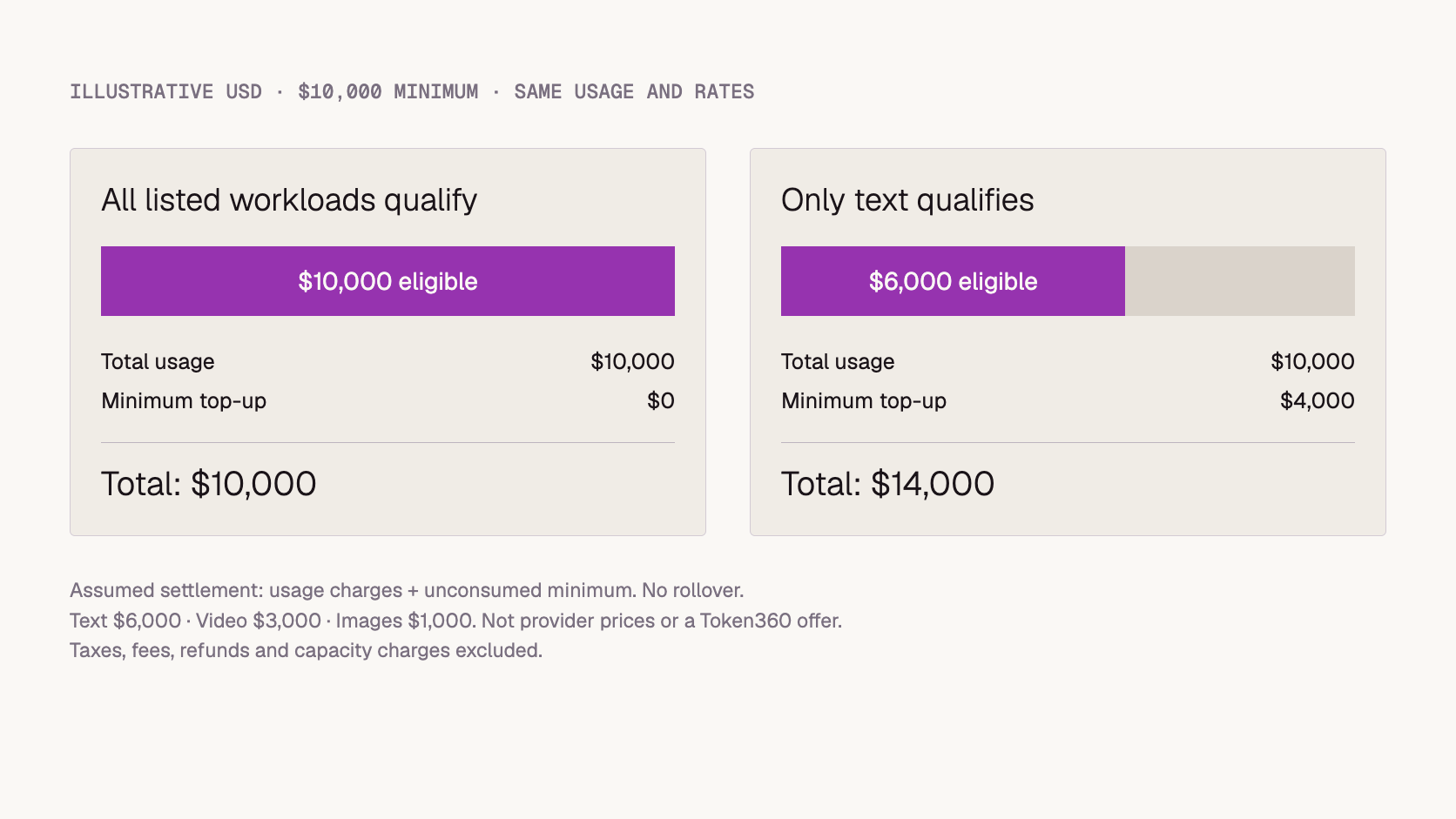
Consider a constructed one-period agreement: a $10,000 minimum, actual usage charged at agreed rates, and a period-end top-up for any unconsumed minimum. There is no rollover. Taxes, fees, refunds and capacity charges are excluded from the example. Both scenarios use identical rates and usage; only eligibility differs.
Hypothetical item
All listed workloads qualify
Only text qualifies
Text charges
$6,000
$6,000
Video charges
$3,000
$3,000
Image charges
$1,000
$1,000
Total usage charges
$10,000
$10,000
Qualifying charges
$10,000
$6,000
Period-end minimum top-up
$0
$4,000
Total under this assumed settlement rule
$10,000
$14,000
The formula for this example is total usage charges + max(0, minimum − qualifying charges). It is not a universal billing formula. If a minimum has already been prepaid, do not add the prepaid amount twice: reconcile how much of it was consumed and what excluded usage is payable separately.
Constructed comparison: identical usage and rates, different eligibility. The $4,000 top-up exists only under the stated hypothetical minimum-spend rule.
The lesson is not that pooled commitments are always better. A wider pool could come with different rates, minimums or other conditions. Compare the whole offer; do not carry this example’s numbers into a different contract structure.
What happens when the model mix changes during the term?
A change in workload mix should trigger an eligibility review before the new service becomes material. Check whether the new model is already covered, whether its charges consume the same commitment and whether an amendment is needed. Technical access and a successful API request are not evidence that the commercial schedule has expanded.
Imagine replacing a text-heavy feature with a video campaign tool. The forecast should show both total expected spend and qualifying spend under the current schedule. A stable total may hide a falling qualifying balance, as the example above demonstrates. Record the forecast change without treating it as a guaranteed usage prediction.
For a model replacement, ask whether eligibility follows a named successor automatically, requires written confirmation or starts only on an effective date. For an entirely new modality, ask the same question without assuming a shared wallet supplies the answer. Do not describe any of those mechanisms as available until the supplier confirms them.
Keep price-change rules separate. A model can remain eligible while its rate changes, or keep its rate while falling outside a particular commitment. Combining these decisions into one vague “same terms” statement makes reconciliation harder.
What should we confirm about unused amounts and overages?
Eligibility, expiry and overage are separate rules. Establish what happens to unused value at the end of the period, whether any rollover is available and how additional eligible or excluded usage is billed. Do not assume that a general credit policy answers every question about a negotiated enterprise commitment.
fal’s FAQ currently gives purchased credits a 365-day validity period and describes variable expiry for free credits and coupons. That is a provider-specific public credit policy, not a default rule for Token360 or for all negotiated agreements. The practical question is which policy governs the exact commercial instrument you are buying.
Ask for three explicit outcomes: less qualifying usage than expected, more qualifying usage than expected, and more total usage with less qualifying usage. The third scenario is easily missed because a busy account can still underconsume a restricted minimum.
Also ask whether unused value can move to another period, model group or purchasing entity, and whether any transfer needs approval. An unanswered transfer question remains an open commercial condition; it should not be modeled as savings.
How should we raise cross-model commitments with Token360?
Bring a model-mix forecast and ask Token360 to state the eligible scope of any proposed commitment. Separate current demand from plausible changes and request a worked settlement example. Token360’s ability to discuss enterprise pricing does not establish a standard cross-model pool, automatic rollover or unrestricted transfer between services.
Token360’s company-confirmed positioning covers enterprise procurement across text, image, audio and video, with commercial requirements scoped to the engagement. Its public enterprise page advertises custom pricing. Those facts support asking for a tailored proposal; they do not establish the proposal’s eventual eligibility or minimum-spend terms.
We expect to use [models/SKUs] across [accounts/entities]. Our base forecast is [usage by model and period], with a possible shift toward [new workload]. If you propose a spending commitment, please identify qualifying charges, exclusions, valuation basis, effective period, treatment of new models, unused value and overages. Please show settlement for our base mix and changed mix.
This is an original inquiry template, not a customer quotation. Copy the
Copy commitment-scope.csv:
item,supplier_answer,evidence_reference,effective_period,owner,open_question
Eligible models/SKUs,,,,,
Eligible charge types,,,,,
Excluded charges,,,,,
Account and purchasing entity scope,,,,,
Valuation basis,,,,,
Minimum amount and measurement period,,,,,
Settlement event and timezone,,,,,
New model/version eligibility,,,,,
Unused amount/rollover,,,,,
Overage calculation,,,,,
Credits/refunds adjustment,,,,,
Change approval,,,,,
to record the supplier’s answers and evidence. Assign someone to maintain the eligible-model list and check it when product usage changes.
For reconciliation, use request-level charges and the applicable commercial schedule together. Token360 documents request-level billing records and notes that asynchronous settlement can lag task completion. Do not infer final commitment consumption from Playground estimates or an account balance alone.
Frequently asked questions
Does one Token360 invoice mean all models share one commitment?
No such conclusion follows from invoice consolidation alone. Ask which models, accounts and charge categories are eligible under the actual offer. This article does not confirm a standard pooled-commitment product.
Is a dollar of video usage always equivalent to a dollar of text usage?
Only if both are eligible and the agreed valuation counts those dollars on the same basis. Different raw usage units are not equivalent, and excluded charges may count as zero toward the commitment.
Can a new model be added without renegotiating the entire agreement?
That depends on the agreed change mechanism. Request an inclusion process and effective date. Catalog access alone does not prove that a newly available model counts toward the existing minimum.
Is this the same question as whether we can get a volume discount?
No. The discount changes the price basis; eligibility determines which usage satisfies the commitment. Both can affect total cost, but they need separate answers.
Do we need paid tests to check this calculation?
No paid generation is needed to reproduce the illustrative arithmetic. An actual purchasing decision needs the supplier’s terms and a credible workload forecast. Performance tests answer a different question and do not establish contract eligibility.
Read next: use Token360’s billing guide to identify the available charge records, then discuss the model-mix scenarios with the enterprise team. Ask for the scope in writing before treating a unified bill as a unified commitment.
Developer Guide
API
Bring your next idea to life.
Create a video scene in Creator, or explore models for images, audio, and text to find the right capabilities for your project.



 Guides
 Guides
 Guides