Buying AI Model Access: What Should Enterprises Check?
Before buying AI model access, verify quality, full cost, latency, capacity, data handling and contract terms with a practical procurement checklist.
ENTERPRISE AI · BUYER DUE DILIGENCE
By Yuki Yu · Enterprise procurement analysis · Reviewed November 7, 2026
Before buying AI model access, verify the exact service, performance on your own work, full cost, production limits, data handling and written commercial terms. A convincing demo or low advertised rate is not enough. Every mandatory requirement should have an owner, supporting evidence and a clear acceptance decision before production use.
This guide covers purchasing AI model access as a service, including text, image, audio and video workloads. Acquiring model weights or commissioning a private deployment involves a different scope of ownership and operating responsibilities.
Use the checklist before committing to a model service. It is an editorial decision tool, not a report of supplier tests or a certification.
Read first: Token360’s enterprise scope to distinguish available services from requirements that need a specific discussion.
What should the procurement team verify first?
Begin by defining the purchase and the business result it must support. Name the workload, intended users, required output and consequences of failure. Then separate mandatory conditions from preferences. A supplier should not pass because it scores well on optional features while failing a requirement that makes the service unusable.
Check
Evidence to request or produce
Who should review it?
Service scope
Exact model, version where available, delivery method and supported features
Technical owner
Output quality
Results from representative tasks with documented acceptance criteria
Business and technical owners
Full cost
Itemized quote, billing units and realistic usage assumptions
Finance and procurement
Latency and capacity
Matched workload measurements and written capacity scope
Engineering and operations
Data handling
Applicable policies, processing scope and contractual evidence
Security and privacy reviewers
Use and commercial rights
Terms covering intended inputs, outputs and use cases
Legal and business owners
Support and exit
Agreed responsibilities, change process and exit provisions
Procurement and operations
For example, a marketing team may require approved product appearance in generated videos, while a support team needs reliable answers grounded in company material. Neither requirement is established by the model being available in a catalog.
The NIST AI Risk Management Framework provides a voluntary approach to incorporating trustworthiness into AI evaluation and use. It can inform a wider organizational review; citing it does not certify a supplier or replace workload-specific evidence.
Are you buying the exact model service you expect?
Confirm the model and service configuration rather than relying on a familiar family name. Ask which features are available through the proposed route, which limits apply and how changes are communicated. API access, dedicated capacity and model deployment are different purchases; their responsibilities should be described explicitly in the proposal.
A name on a price sheet does not answer whether the service supports the input format, output length, image resolution, audio language or video duration your application needs. Check those requirements against the actual model page and then exercise them in an authorized evaluation.
Token360’s model capabilities documentation identifies model-specific schemas and detail pages as the reference for supported inputs, parameters, limits and billing units. Compatibility with a common interface does not mean all models support the same features.
Request a dated scope record: the selected model identifier, enabled capabilities, exclusions and any approved substitutions. If automatic substitutions are proposed, decide whether they are acceptable for quality, data processing and commercial terms. Do not approve an unspecified replacement merely because it produces an output.
Does the model pass your own acceptance tests?
Evaluate the model on representative business tasks before treating demonstrations or public benchmarks as procurement evidence. Include normal work, difficult cases and known failure conditions. Decide in advance what counts as acceptable, who judges the output and which failures block launch. Record rejected outputs as well as examples that look successful.
For text, evaluate correctness and required behavior, not just fluency. For images and video, examine product details, continuity and whether the requested actions occur. For audio, review intelligibility, pronunciation or musical suitability according to the actual use case. Use human review where the acceptance criteria require it.
A useful evaluation record identifies the request, model configuration, output, review decision and reason. Keep the comparison fair: changing the prompt or settings for one supplier while leaving another unchanged changes what the results can establish.
There is no universal sample count that proves production suitability. Choose coverage based on task diversity and the consequences of failure. A small pilot can reveal problems, but it cannot justify a broad success-rate claim without an appropriate study design.
Agree on the decision before seeing the best example: which failures require correction, which can be handled by human review and which are acceptable limitations? This prevents “the demo looked good” from becoming the only acceptance rule.
What will accepted work actually cost?
Compare the cost of usable business output, not only the advertised billing unit. Identify which inputs, outputs and optional features are charged, then include regeneration, review and integration work where they affect the decision. Keep one-time costs separate from recurring costs, and label estimates rather than presenting them as measured savings.
Text, image, audio and video services can use different billing meters. Ask for an itemized quote tied to the actual model configuration. Confirm how unsuccessful requests, cancelled work and retries are treated; do not assume those charges disappear simply because the result was not useful to your team.
An illustrative calculation shows why acceptance matters: if a test incurs $120 in generation charges and produces 80 accepted assets, generation cost per accepted asset is $1.50. These are invented teaching numbers, not Token360 prices or test results. Human review, editing and other relevant costs would need to be added separately.
Check minimum commitments, unused balances, overages and renewal obligations in the proposed agreement. Do not infer that spending on every model qualifies toward the same commitment. The finance owner should be able to explain the assumptions behind the purchase without relying on a headline discount.
Token360 has confirmed that it does not charge a separate service fee. Model usage remains chargeable. Compare the actual scoped quote; absence of that fee is not proof of the lowest total cost.
Will latency and capacity meet production needs?
Ask for performance evidence that matches your workload and demand pattern. A response time from one short demonstration does not establish performance for larger inputs or concurrent users. Define which stage matters to the user, the expected traffic pattern and the operating conditions under which the service will be evaluated.
For interactive text, distinguish time to the first visible response from time to a complete answer. For media generation, distinguish submission, queueing, generation and retrieval of a usable file. These measures describe different experiences; a supplier should not use one as a substitute for another.
Include realistic input sizes, output settings and bursts in an agreed evaluation. Record failures and slow requests, not only an average. A promise such as “supports high volume” needs a workload, time window and capacity definition before it can support a buying decision.
Token360’s limits documentation distinguishes request rate, token throughput, concurrency, spending controls and upstream capacity. Applicable limits depend on the account and agreement. A larger budget is not itself evidence of reserved production capacity.
Ask what happens when agreed demand is exceeded: rejection, queueing, a different route or a commercial review. Have the supplier clarify which behavior is a documented feature, which is a negotiated arrangement and which has not been established.
Are data handling and usage rights acceptable?
Review the actual processing arrangement and intended use before sending sensitive inputs or distributing generated outputs. Separate retention, training use, processing location, access and commercial rights into distinct questions. Ask the responsible reviewers to assess the applicable documentation and agreement; a general security statement cannot answer every one of these questions.
The relevant data path can include your application, the gateway, an upstream provider and storage for uploaded or generated media. Token360’s security and data-handling guide explicitly distinguishes these layers. A setting at one layer should not be treated as a promise about all the others.
Request the policies and contractual evidence applicable to the selected service, including how exceptions are handled. If a certification is important, verify the entity, service scope and current evidence rather than treating a logo as coverage for every model and deployment.
For intended usage, ask legal reviewers to confirm the relevant input permissions, output-use terms, restrictions and any promised indemnity. Model access alone should not be treated as clearance to use third-party brands, likenesses, recordings or copyrighted material. This checklist identifies review questions; it does not determine the legal status of a particular output.
What needs to be written down before signing?
Document the requirements that would materially change the buying decision if they were not met. Specify the service scope, prices, responsibilities, support arrangements and treatment of changes or termination. Distinguish contractual commitments from demonstrations, sales discussions and roadmap statements. An unresolved mandatory condition should remain visible rather than being assumed away.
Ask who responds when the service fails and what that response commitment covers. A support response target is not necessarily a resolution target. If an availability commitment is proposed, reviewers should inspect its measurement, exclusions and remedy rather than relying on the headline percentage.
Plan for change as well as launch. What happens when a model is retired, a feature changes, a price changes or the supplier can no longer provide the required route? Identify notice expectations, the person responsible for review and whether revalidation is required.
Finally, check the exit path. Determine which application records and outputs you need to keep, how access ends and how outstanding obligations are handled. A successful integration does not make a service easy to leave; that needs its own practical review.
How should the final procurement decision be recorded?
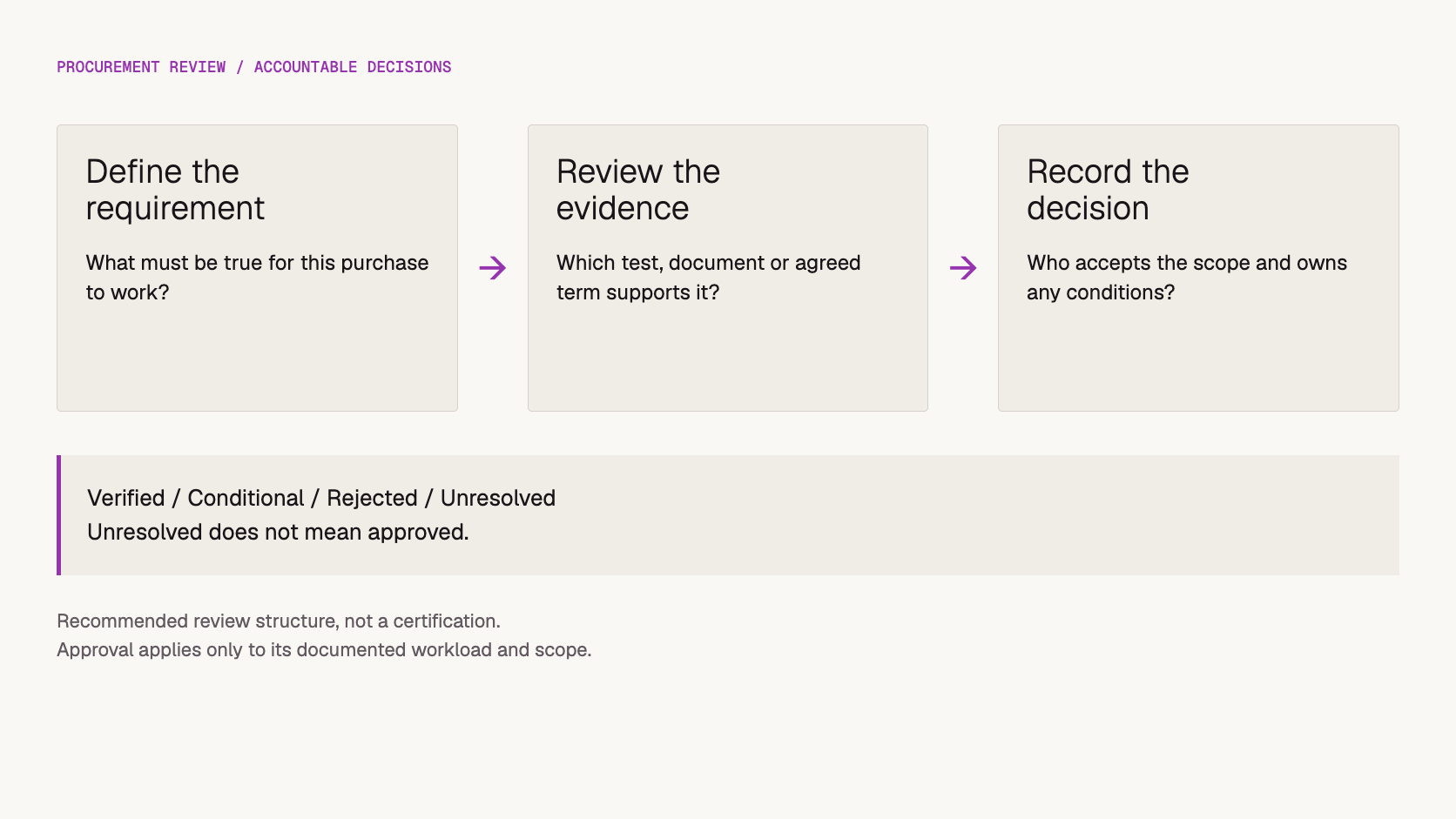
Use an evidence register that connects every mandatory requirement to a reviewer and a decision. Keep missing information distinct from a failed test or an accepted limitation. This makes the approval useful to the people operating the service later and prevents unresolved assumptions from becoming invisible production dependencies.
Recommended review structure; no supplier evaluation results are implied.
Requirement
Evidence field
Decision field
Output meets the business need
Evaluation version, reviewed outputs and unresolved failures
Approved scope and business owner
Cost is acceptable
Dated quote and workload assumptions
Approved spending scope and finance owner
Production behavior is acceptable
Test conditions and agreed capacity terms
Operating limits and technical owner
Data and usage conditions are acceptable
Applicable policies and reviewed agreement
Restrictions and responsible reviewers
For each row, record one of four outcomes: verified, conditionally accepted with an owner and deadline, rejected, or unresolved. Do not treat unresolved as approved. If a limited pilot is authorized, state which data and workload scope it permits; that is different from approving full production.
For example, if the handling of customer records is unresolved, record production use of those records as unapproved. A separately authorized pilot using permitted synthetic inputs can have a narrower scope. Its successful outputs would not resolve the missing production-data evidence. This is a hypothetical decision example, not a Token360 policy or customer result.
When discussing a purchase with Token360, bring this register alongside the workload description. Token360 focuses on enterprise access across text, image, audio and video, with pricing, capacity, contracts and compliance requirements scoped to the engagement. As of the review date, its public page distinguishes available features from roadmap and contact-sales items. Confirm the specific commitment instead of inferring a standard SLA or certification.
Frequently asked questions
Should we buy the highest-ranked model?
Use rankings to inform a shortlist, then evaluate the actual work. General benchmark performance does not establish your output quality, operating cost or production requirements.
Is the cheapest API the best procurement choice?
Only if it meets the requirements and remains economical after considering accepted output, retries, review and operating costs. Compare like-for-like work rather than a single advertised rate.
Can a pilot replace a contract review?
No. A pilot provides evidence about tested behavior. It does not establish rights, future capacity commitments, data-processing obligations or commercial remedies.
Do we need every question answered before any testing?
Define a limited testing scope and its mandatory conditions first. An evaluation using approved non-sensitive material can have a different approval boundary from production, but missing production evidence must stay visible.
What should we ask Token360 first?
Explain the business task, required model categories, acceptance criteria, expected demand and mandatory commercial or data requirements. Ask which requirements are supported today and which need an engagement-specific agreement.



 Guides
 Guides
 Guides