AI Agents vs Workflows: Which Does Your Business Need?
Choose a workflow for defined steps and an agent for bounded adaptive decisions. Compare business outcomes, permissions and total delivery costs.
ENTERPRISE AI · ARCHITECTURE CHOICES
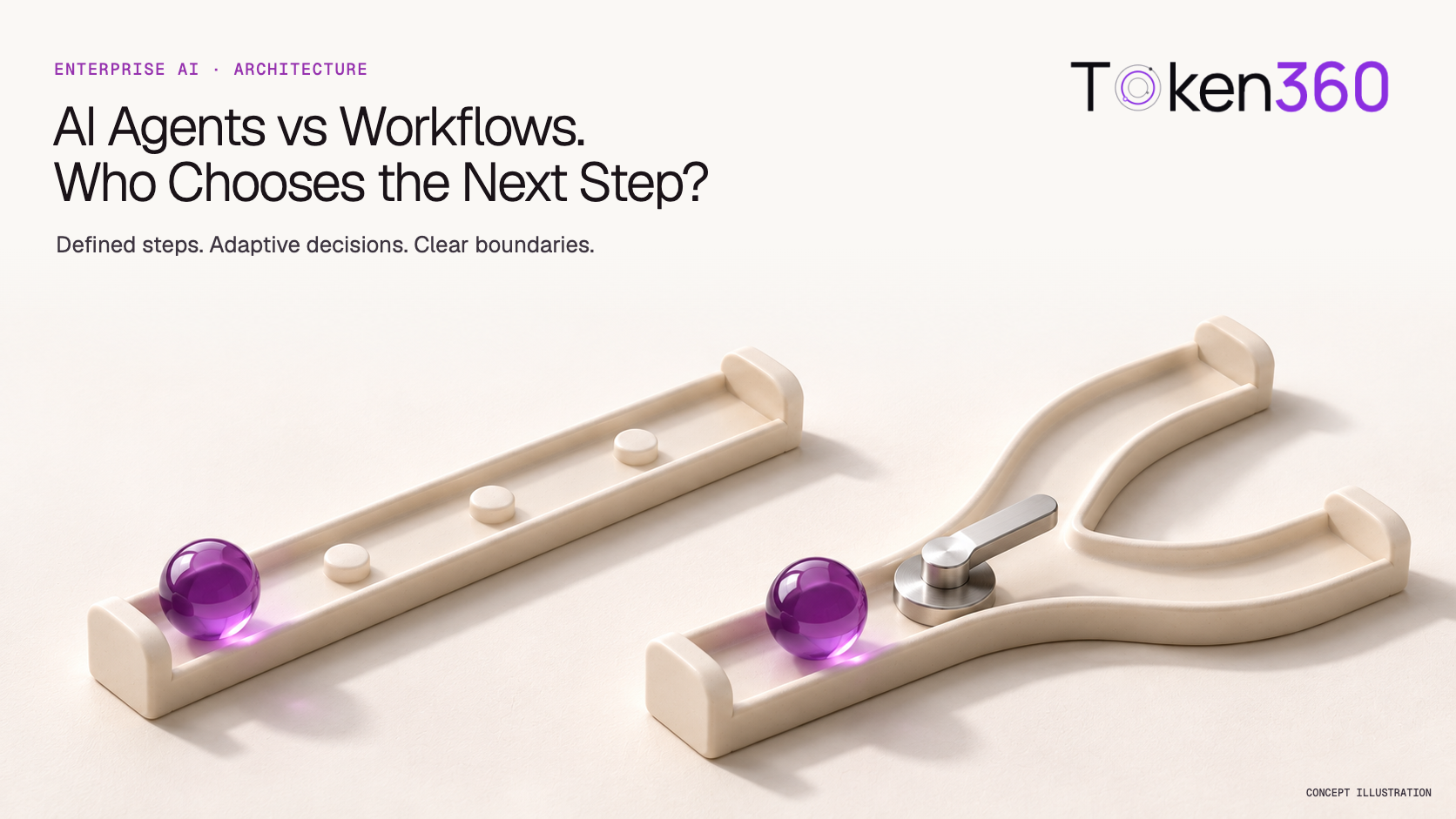
Use an AI workflow when your team can specify the steps and decision rules in advance. Consider an AI agent when the next useful action depends on what the system discovers and cannot be covered reasonably by those rules. In both cases, define the task, permitted actions, completion evidence and stopping conditions before buying more autonomy.
For enterprise buyers, the important question is who decides what happens next: application logic or the model. A chat interface, a tool call or several models working together does not answer that question. Ask suppliers to show the actual control flow behind the label.
This guide helps product and procurement teams choose an approach for a business task. It is not a framework tutorial or a claim that an agent is always more capable than a well-designed workflow.
What is the difference between an AI agent and a workflow?
An AI workflow follows an application-defined process, even when individual steps use a model. An agent gives the model responsibility for choosing parts of the process, such as the next tool or investigation step. Both can use external data and tools; neither should receive broader permissions merely because it uses a more autonomous architecture.
Anthropic's Building effective agents, published in December 2024, makes this distinction between predefined orchestration and model-directed execution. Its tooling has evolved, as the page itself notes; the distinction is useful here as terminology, not as a recommendation to adopt an older framework.
Buyer question
AI workflow
AI agent
Who chooses the next step?
Application rules within the defined process
The model chooses within the options the application permits
What should the demo explain?
The steps, branches and exception paths
Why additional actions were taken and what ended the task
What must the buyer verify?
Coverage of required cases and correct handling of exceptions
Useful adaptation without unnecessary or unauthorized action
What should happen at a boundary?
A defined stop, clarification or escalation path
A stop enforced outside the model's discretionary planning
These are working definitions for evaluating a proposal. Vendors may use “agent” more broadly. Rather than debating branding, ask for one normal case and one exception, then trace which component selected each action.
When is a predefined workflow a good starting point?
Start with a workflow when the required sequence is known and the main variation is in the content being processed. The model can interpret or generate content inside that process while application logic handles the next step. This is especially useful when the business needs an explicit path for missing inputs or failed checks.
Hypothetical example: a company turns approved product information into localized catalog copy. Its intended process is to retrieve the approved product record, draft the copy, check required fields and route the result for review. Different products change the content, but they do not necessarily require the model to invent the production process.
A workflow may include branches: missing product information can return to the owner, while a complete draft goes to the language reviewer. Having a branch does not make the process autonomous. The business has defined what causes the branch and what may happen after it.
Nor does a workflow require an LLM at every step. File validation, identity checks and exact arithmetic may belong in ordinary software. Before adding a model call, identify the interpretation or generation task that makes it useful. If a fixed rule solves the problem adequately, keeping that rule can make the system easier to explain.
When might an agent justify the additional freedom?
Consider a bounded agent when the task requires discovering which information or action is needed next, and the possible paths are too varied for a practical fixed process. The case for autonomy is the value of that adaptation. It must be demonstrated against the same business outcome a simpler baseline is trying to achieve.
Hypothetical example: an internal operations assistant investigates why an order missed its expected dispatch date. One case may require checking inventory; another may require reviewing a carrier event and an address correction. A read-only investigation could let the model choose the next authorized lookup based on the evidence it finds.
That does not establish a case for letting it cancel orders, issue credits or change addresses. Investigation and execution can have different permission boundaries. The initial deliverable might be a sourced explanation and a proposed next step for an employee.
Test whether the model's choices actually find relevant evidence. An agent that performs many lookups without resolving the case has not succeeded simply because it stayed active. Likewise, a plausible narrative is not enough if it omits the record that contradicts its conclusion.
The architecture should make unsupported cases visible. If relevant information is unavailable or the task exceeds its scope, the acceptable outcome may be an explicit escalation rather than another speculative action.
Can a business use a workflow and an agent together?
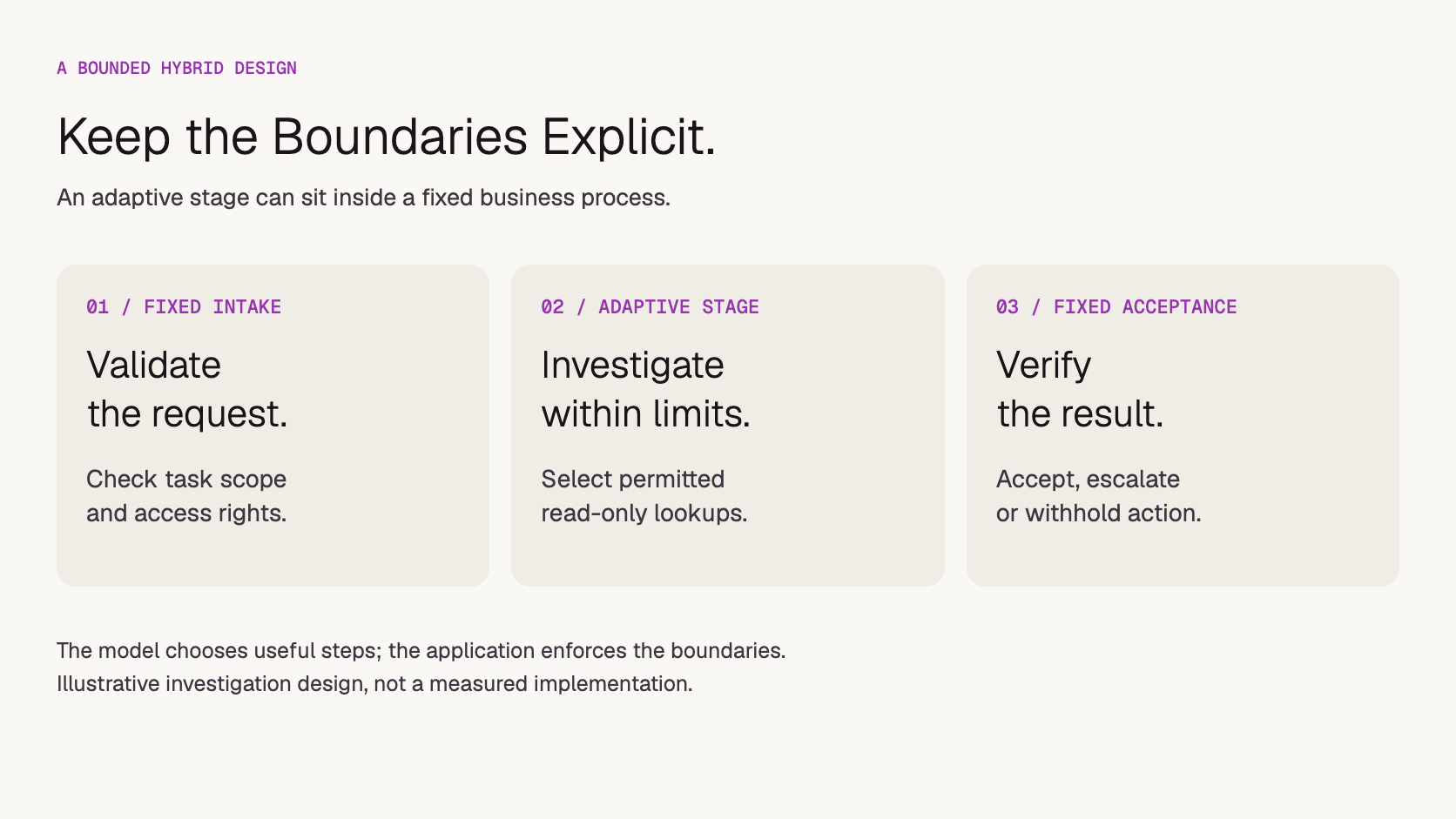
Yes. A business can keep intake, permissions and release rules fixed while allowing model-directed investigation inside a bounded stage. This lets the team test adaptive behavior without handing control of the entire process to the model. The surrounding workflow still determines when the result is accepted, escalated or withheld.
For the order example, an application could validate the employee's access, permit read-only investigation, require a structured findings report and then route any proposed account change to an authorized person. The agent chooses relevant lookups; it does not choose its own access rights or bypass the release condition.
Microsoft's agent orchestration guidance discusses combining patterns where stages have different needs. It also advises evaluating whether multi-agent orchestration is necessary. A hybrid design does not require several agents; one model-directed stage may be sufficient for the question being tested.
Proposed hybrid design: flexibility inside a defined task, with application-owned boundaries.
Keep the ownership clear. If the adaptive stage returns no usable result, the fixed workflow needs a defined response. It should not interpret “the agent stopped” as proof that the business task was completed.
What must be bounded before an agent can use business tools?
Define which data the system can read, which actions it can propose or execute, and when it must stop. Put enforcement in the application or execution layer, not only in a prompt. A model can help decide which permitted action is useful, but it should not grant itself new business authority.
Specify a task-level budget for elapsed time, tool activity and spending, with a documented response when a limit is reached. The numbers should follow the business requirement and test evidence; this article does not prescribe a universal step count. Add a clear path for tool failures, missing evidence and requests outside the allowed scope.
Before enabling a write action, establish what counts as success and how the application handles an uncertain outcome. A timeout does not establish that nothing happened. Repeating an operation without checking its state can create a different business problem from failing to perform it once.
A model-generated tool request is also not the execution itself. The tool-call execution guide covers that boundary. Where approval is required, define it using the human review process rather than assuming that a convincing explanation authorizes an action.
How should you compare an agent with a workflow?
Use the same task set, input access and acceptance criteria, then compare completed business outcomes and the resources needed to deliver them. Include ordinary cases and meaningful exceptions. Record failures and escalations separately so that extra activity, attractive prose or partial progress does not become a substitute for completion.
For the investigation example, define an acceptable result before testing: relevant evidence located, conflicting records acknowledged, no unsupported conclusion and no unauthorized action. A case that cannot be resolved from the available records should be assessed against the expected escalation behavior.
Record the following for each approach:
Outcome: accepted result, partial result, appropriate escalation or failure, with a reviewer reason.
Effort: model and tool activity, human corrections and repeat attempts associated with the task.
Delivery: elapsed time until the business can use the result, including any required review.
Boundary behavior: whether permissions, stopping conditions and failure handling held during exceptions.
These are proposed evaluation fields, not measured findings. Keep the test cases and configurations versioned, and avoid tuning exclusively against the same examples later presented as proof. A small pilot can inform a bounded decision; it does not establish performance across all departments.
If the agent resolves useful exceptions that the workflow cannot handle, examine whether that gain justifies the additional cost and operating work. If both meet the task equally well, identify what business benefit the extra autonomy supplies before expanding it. Use pilot-to-production criteria for the rollout decision.
The AutomationBench-AA completion guide examines the distinction between intermediate progress and completion evidence when interpreting an agent benchmark.
Does an agent require a larger inference budget?
Budget from the observed task path rather than the word “agent.” Adaptive investigation can involve a variable number of calls and tool responses, but a fixed workflow can also be expensive. Compare the total resources consumed by accepted tasks, including failed attempts and required human work, under the configurations you actually intend to deploy.
A supplier quote for a single model call does not describe the complete investigation cost. Estimate how often each model is used, the input and output sizes, tool-related costs and the variability across cases. Keep model charges distinct from application hosting and operational labor.
Do not multiply a quoted token price by an invented “average number of agent steps” and present the result as measured economics. Start with explicit planning assumptions, replace them with observed usage and retain the difference. The AI API TCO guide covers the broader cost boundary.
Where does Token360 fit in either architecture?
Token360 supplies model access that an enterprise application can use inside a fixed workflow or a model-directed stage. The application still needs the orchestration, business tools, permissions and acceptance process appropriate to the task. Buying model access should not be confused with buying a complete autonomous business application.
Token360's approved positioning covers enterprise access across text, image, audio and video, with pricing, dedicated capacity, contracts and compliance requirements scoped to the engagement. Discuss the workload and commercial requirements through Token360 enterprise procurement. This article does not promise a particular agent runtime or a managed workforce.
As checked November 10, 2026, the model-capabilities documentation makes tool support model-specific and describes application-side execution of returned tool calls. Confirm the exact model's supported parameters and response behavior. Sharing an endpoint does not make all models interchangeable for an agent loop.
Bring a concise architecture brief: the task, fixed steps, model-selected steps, permitted tools, expected usage range and acceptance criteria. If you are also considering MCP, use MCP versus the inference API to separate tool connectivity from model invocation.
What should the architecture decision record say?
Record why adaptive decision-making is needed, or why a fixed process is sufficient, for the selected task. Identify the evidence supporting that choice and the remaining uncertainty. The decision should be specific enough to revisit when the task changes, without becoming a blanket policy that every AI project must use the same architecture.
Use the agent-or-workflow decision worksheet to capture the task, baseline, adaptive stage, tools, boundaries, completion evidence, cost assumptions and next test. It is a blank planning aid, not a vendor scorecard or an automated architecture recommendation.
Business task,Fixed baseline,Reason adaptive decisions are needed,Adaptive stage,Permitted tools,Prohibited actions,Stop conditions,Completion evidence,Acceptance owner,Cost assumptions,Exception behavior,Next test
,,,,,,,,,,,
What else do enterprise buyers ask about agents and workflows?
Is a chatbot automatically an AI agent?
No. Chat is an interface. A chat application may call a model once, invoke a fixed process or run an adaptive investigation. Inspect how actions are selected and executed rather than classifying the system by its conversation window.
Does using several models make a workflow agentic?
No. An application can call several models in a predefined sequence. The relevant distinction is whether model decisions direct the process, not how many models are involved.
Can we add an agent only for exceptions?
Yes, if the exception stage has useful permitted actions and a clear exit. Test that stage separately and define what happens when it cannot resolve the case. The rest of the workflow can remain fixed.
Does a better benchmark score mean more autonomy is safe?
No. A benchmark result does not validate your business tools, permissions, source data or failure recovery. Evaluate the model within the intended application and keep authority tied to the task's requirements.
Evidence note: Editorial analysis by Yuki Yu. Business scenarios and proposed evaluation fields are illustrative; no agent-versus-workflow benchmark or customer result is claimed. Public sources checked November 10, 2026. Explore Token360 resources.
Enterprise AI
API
Bring your next idea to life.
Create a video scene in Creator, or explore models for images, audio, and text to find the right capabilities for your project.


 Guides
 Guides
 Guides