Which AI Use Cases Should Your Company Fund First?
Prioritize AI use cases by business need, readiness and evidence. Resolve blockers first, then fund a bounded test instead of an unproven rollout.
ENTERPRISE AI · INVESTMENT PRIORITIES
Prioritize AI use cases with a meaningful business problem, usable inputs, a clear owner and an affordable way to test the expected benefit. Screen out unresolved blockers before ranking opportunities. Fund the next evidence-producing step rather than treating an attractive demonstration as approval for full deployment. The first project should fit your company’s constraints, not a generic list of popular AI applications.
This article provides an editorial prioritization framework and hypothetical project examples. It reports no customer ROI, measured productivity improvement or validated ranking of use cases.
Read first: AI software versus a model API distinguishes finished applications from capabilities you integrate. The prioritization decision below comes before committing to a particular model or a large implementation.
What makes an AI use case worth considering?
A useful candidate identifies a specific task, the people affected, the current problem and the intended improvement. “Use AI in customer service” is too broad to evaluate. “Help agents draft replies from an approved returns policy, with review before sending” defines a workflow that a business owner can assess.
Start with the business problem, a measurable goal and the feasibility of changing the existing process. The proposal should explain why the process needs to change and what evidence would show that AI helps.
Write a short candidate brief: who performs the task, what input they use, what output they need, where the output goes and what currently causes delay or rework. Name a business owner who can judge the result. An idea without a user or owner is not ready to compete for implementation funding.
Also ask whether AI is needed. A fixed rule, a better form, an existing software feature or a corrected data feed may solve the problem more directly. The objective is improved work, not maximum model usage.
Which blockers should be checked before scoring?
Check mandatory conditions before comparing potential benefits. If the organization cannot use the required data, define an acceptable output or assign responsibility for review, a high projected benefit does not remove the blocker. Record the missing condition and the action needed to resolve it rather than hiding it inside an average score.
Readiness gate
Evidence to request
If unresolved
Usable inputs
Representative, permitted data in an accessible form
Fund data preparation or access clarification first
Defined output
Examples of acceptable work and important failure types
Clarify the business requirement before model testing
Accountable owner
A person responsible for acceptance and operational use
Keep the proposal outside the implementation shortlist
Acceptable failure handling
A review, escalation or fallback path appropriate to the task
Narrow the scope or resolve the operating constraint
Delivery path
A plausible way to put the output into the existing workflow
Investigate the integration instead of assuming it is trivial
A blocked idea can still be strategically important. “Not ready for a model pilot” is different from “not valuable.” Assign preparation work and a review date so the proposal can return with better evidence.
How should viable projects be compared?
Compare business importance, practical feasibility, user adoption and the effort needed to resolve uncertainty. Keep evidence and assumptions visible for each dimension. A scoring system can organize discussion, but the total should not override a critical constraint or imply more precision than the available information supports.
Microsoft’s business-envisioning guidance considers business value, user demand and technical feasibility when evaluating AI use cases. For an enterprise buying model access, translate those categories into questions the business and technical teams can answer together.
Importance: Is the task a material bottleneck, quality problem or capability gap?
Feasibility: Are the inputs, system connections and acceptance checks available?
Adoption: Will the intended users actually use the result in their normal workflow?
Learning effort: What is the smallest credible test that could change the funding decision?
Mark confidence separately from attractiveness. A highly attractive project supported only by a demonstration should not look identical to one backed by a documented workflow and accessible test material. Ask what could make the expected benefit disappear: difficult review, poor adoption, missing context or expensive integration.
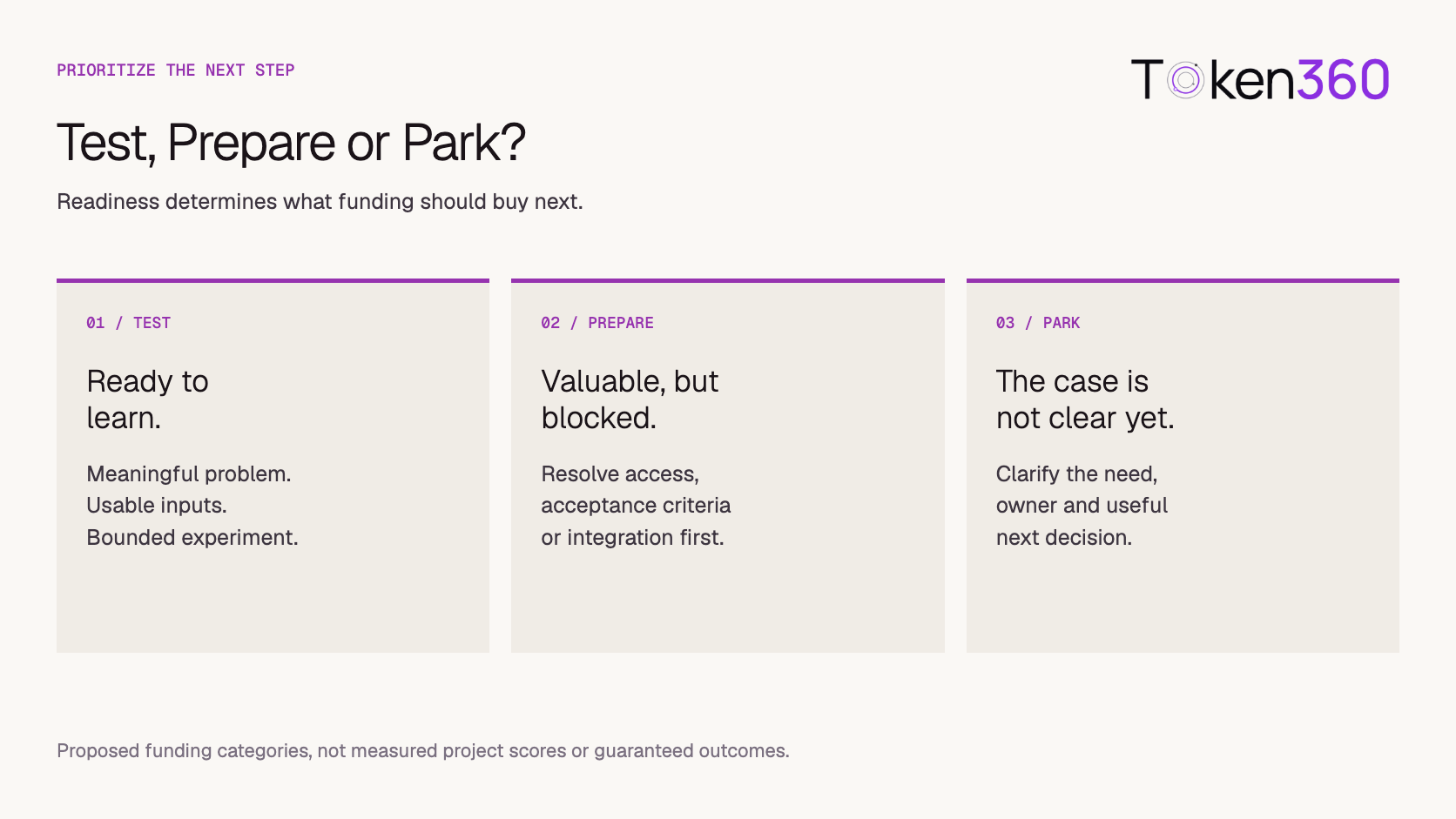
Proposed decision categories, not measured project rankings. Readiness changes what to fund next.
How could three common enterprise proposals compare?
Compare the proposals under your actual operating conditions rather than declaring a universal winner. A modest workflow with accessible evidence may be ready for a test while a larger opportunity needs preparation. The examples below illustrate how the next funding action can differ even when all three ideas are plausible.
Hypothetical proposal
Assumed current situation
Useful next action
Draft support replies for agent review
Approved policy material exists, but access from the ticket system is unresolved
Confirm the source and integration path before funding a broad rollout
Extract selected fields from incoming documents
Permitted examples and reviewers are available; outputs can be checked against source documents
Run a bounded extraction test including difficult documents
Generate campaign image concepts
Creative review exists, but the team has not defined what makes an output usable
Agree the creative brief and acceptance criteria before comparing generation volume
Under those assumptions, the document task is more ready for an evidence-producing test. That is an editorial inference from the stated conditions, not a finding that document extraction delivers more value than support or creative work. Change the assumptions and the priority may change.
For instance, a support team with a verified knowledge source and a clear backlog could be ready sooner. A creative team with approved briefs and an established review process could test useful work immediately. The method should respond to evidence rather than permanently favoring one department or modality.
Should the first AI project be low-risk or high-value?
The first project should have enough business value to matter and a scope the organization can responsibly test. Low difficulty alone can produce a demonstration nobody needs. High potential value alone can produce a costly project whose assumptions remain unresolved. Look for a meaningful problem with a manageable first decision.
A draft-and-review workflow may be a sensible starting boundary when mistakes can be caught before an external action. That boundary still requires capable reviewers and an adequate review process. Labeling something “human in the loop” does not establish that review is effective or affordable.
Keep strategic projects visible even when they need longer preparation. A portfolio can contain an immediate pilot and a separate data or integration workstream for a larger opportunity. The important distinction is what the funding buys now: an experiment, prerequisite work or a production service.
Avoid selecting a first project merely because it is easy to demonstrate. Ask whether the result will change a purchase, operating or product decision. If success would not lead to a useful next step, reconsider why the test is being funded.
What should a first funding request actually include?
Request funding for a bounded learning objective with a named decision at the end. Specify the task, representative inputs, evaluation owner, time and spending limits, and the evidence that would justify continuing. Keep the proposal distinct from a promise of full deployment or guaranteed return.
AWS’s proof-of-concept guidance treats business value, data readiness and technical feasibility as validation objectives. Use that framing to ask what the trial must establish, not simply whether the model can generate an impressive answer.
For the hypothetical document task, a bounded test could ask whether the required fields can be extracted from the company’s permitted sample set, whether reviewers can identify errors and how much correction the workflow requires. Include difficult cases and record excluded document types. Do not convert success on a narrow sample into approval for every incoming document.
Define three possible outcomes in advance: continue with the tested scope, revise a specific assumption, or stop the proposal. A trial that reveals an unsuitable workflow can still inform a good funding decision. It should not be presented as a successful production deployment.
When should model and supplier selection begin?
Start selecting models and suppliers once the candidate task and the immediate evidence need are clear enough to define a workload. That does not require every design detail to be final. It does require knowing what input the model receives, what output is acceptable and which constraints would rule out a proposal.
A document task may need text extraction or image understanding. A campaign concept task may need image generation. A support workflow may need language generation plus access to an approved source. Use the model capability documentation to verify the required inputs and outputs rather than buying a broad category label.
The separate model selection guide covers candidate shortlisting. A priority decision does not select a model automatically, and the highest-ranked general model is not proof of the best fit for the approved task.
Match procurement scope to the current decision. If usage is still an assumption, state that clearly in the brief. Discuss capacity or longer commitments using the available workload evidence and applicable terms, rather than turning an early experiment into an unsupported volume forecast.
How does Token360 fit into the prioritization process?
Token360 becomes relevant when the company needs model access to test or operate a defined workload. Its role is not to make every proposed AI project valuable. Bring a clear task brief so the model, commercial and capacity discussion can address the work the enterprise is actually considering.
Token360 focuses on enterprise procurement across text, image, audio and video models. Dedicated capacity, negotiated pricing, contracts and compliance requirements can be scoped to the engagement. Review the enterprise offering and confirm the terms that apply to the proposed workload; do not treat these arrangements as automatic features of every account.
A useful brief includes the intended users, task frequency, input examples, required outputs, evaluation owner and unresolved constraints. It can state that volumes are provisional. Background on the company is available through About Token360.
Use the AI use-case priority worksheet to keep competing proposals on the same evidence standard. It has no automatic ranking formula: owners record blockers, evidence confidence and the next funding decision explicitly.
Should we fund the department with the highest AI usage?
Not automatically. Usage demonstrates activity, not the value of the next investment. Ask what work is completed, what problem remains and whether additional funding can improve a meaningful outcome. A lower-usage team may have a more important, better-defined opportunity.
Do we need a precise ROI estimate before any test?
You need a credible reason to investigate, an appropriate spending boundary and a decision the test will inform. Early estimates should show uncertainty. Do not manufacture precise returns when adoption, review effort or integration requirements remain unknown.
Can one test justify a company-wide AI purchase?
A narrow test can support the workload and conditions it actually examined. It does not establish every team’s requirements. Treat expansion as a separate decision with its own evidence, responsibilities and commercial scope.
What if leadership wants a visible project immediately?
Choose a visible problem with a bounded, useful test rather than a demonstration disconnected from work. Agree what the result can establish and what it cannot. Visibility can help engagement, but it should not replace acceptance criteria.
When should we revisit the priority list?
Revisit it when a blocker is resolved, a trial changes an assumption or a business requirement changes. Record the reason for moving a proposal rather than reranking solely because a new model has appeared.
Read next: AI pilot to production addresses whether a tested workflow should expand. For complete project budgeting, use AI API total cost of ownership. Replace local draft links with verified published URLs before publication.
Evidence boundary: the tables and worksheet are original editorial planning tools informed by official guidance. No enterprise project was tested or scored, and no cost savings or customer outcomes were measured for this article.
Enterprise AI
API
Bring your next idea to life.
Create a video scene in Creator, or explore models for images, audio, and text to find the right capabilities for your project.



 Guides
 Guides
 Guides