Check whether business inputs are complete, usable, current and authorized before comparing AI models. Start with one task and a test pack.
ENTERPRISE AI · DATA READINESS
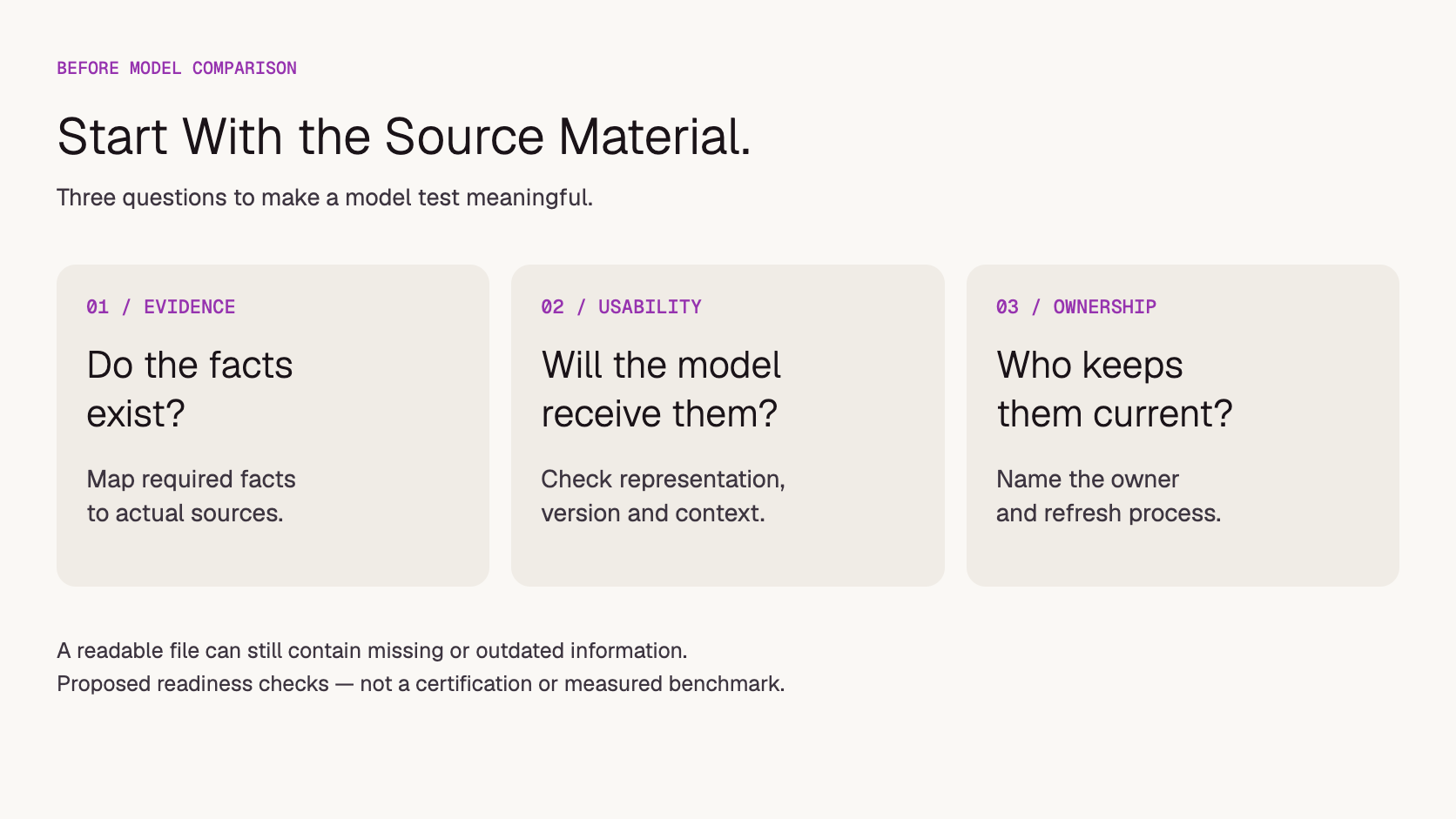
Your business data is ready for an AI task when the required evidence exists, can be used for that purpose, reaches the model in a usable form and has a clear owner and version. Start with one task and a representative sample. A more capable model cannot reliably resolve a company policy that your own records leave undecided.
For enterprise buyers, AI data readiness is a practical purchasing question: are you evaluating model capability, or asking a model to compensate for missing business information? The answer affects what to test, which supplier capabilities matter and how much preparation belongs in the project budget.
This guide concerns the information supplied to an AI application. It does not assume that you are training a model, building a data warehouse or moving your entire company archive into an API.
Read first: Define the business task using the AI use-case prioritization guide. If you already have a task, use the checks below before comparing models against it.
Do you need to clean all company data before buying AI?
No. Begin with the smallest set of sources required for one defined business task. Check whether those sources support the decision or output you want. This creates a bounded preparation effort and a meaningful model evaluation, without turning every AI proposal into an organization-wide data transformation program.
A support assistant answering product-warranty questions may need current warranty rules, product identifiers and selected case information. It does not automatically need every support conversation ever recorded. A product-image workflow may need accurate reference images and approved product details rather than a large text archive.
Write a short input specification: who will use the result, what the system must know, which source provides each fact and what should happen when a fact is unavailable. If nobody can name a source for a required fact, record that as a gap. Do not make the model's plausible guess the new source of truth.
AWS's generative AI proof-of-concept guidance treats data readiness as a separate validation task, including availability, access, quality and currency. The useful distinction for buyers is that model performance and input readiness need separate evidence; a polished demonstration does not establish both.
Which data readiness checks matter for an enterprise AI task?
Check task coverage, permission, usability, authority and freshness. These are different questions: a file can be readable but outdated, current but inaccessible to the intended user, or technically valid but missing the decisive fact. Record unresolved issues individually rather than hiding them inside one overall readiness score.
Check
Question to answer
Evidence to collect
Task coverage
Do the sources contain what the output needs?
Required facts mapped to specific sources; missing facts listed
Authorized use
Can this application and audience use these inputs?
Applicable access scope and approval from the responsible owner
Usability
Does the model actually receive the relevant content?
A checked representation after upload, extraction or preprocessing
Authority
Which record wins when sources disagree?
Named authoritative source and a conflict-resolution rule
Freshness
Is the information current enough for this task?
Effective date, update process and stale-data behavior
These checks are an editorial planning framework, not a certification standard. Their thresholds depend on the task. A historical report may intentionally use an older snapshot; an answer about current availability needs a source that reflects the required time window. “Most recently uploaded” and “currently effective” are not necessarily the same thing.
Separate missing information from delivery problems and unresolved ownership.
What problems can look like a weak AI model?
Missing facts, conflicting records and damaged input representations can all produce poor answers. Inspect the information the application actually supplied before attributing the failure to model capability. The following hypothetical scenarios show different preparation problems; they are not measured Token360 customer outcomes or claims that better inputs always solve an error.
What if a sales assistant quotes the wrong product specification?
Check whether the application received the current product revision and a stable product identifier. An old brochure and a new specification sheet can both be readable and professionally written. If the application supplies both without a rule for which applies, a confident answer may still describe the wrong version.
The first corrective action is to establish the authoritative revision for that product and effective period. Then repeat the case with the same task and model settings. If the answer remains wrong despite appropriate evidence, investigate retrieval, instructions and model behavior separately. Do not label the input correction a validated fix until the result has been checked.
What if a document workflow misses an important condition?
Inspect the content after extraction or preprocessing, including the relationship between tables, headings and notes. A condition visible in the original document may be absent from the text submitted to the model. Comparing models against that incomplete representation tests a different task from reading the original document accurately.
Retain a sample of the original and the representation actually used. A note such as “applies only to enterprise plans” can change the meaning of an otherwise correct price or entitlement. Correcting the representation is distinct from increasing the model's context limit.
What if an image-generation brief uses the wrong product reference?
Check that the reference belongs to the intended SKU and includes the views needed for the requested result. A correct front view may not establish the rear controls or an accessory hidden from view. The input can be high resolution and still be insufficient for the requested fidelity.
Document which details are visible, which are specified elsewhere and which remain unknown. A model inventing an unseen component is not evidence that the missing reference existed. For a customer-facing asset, decide whether to obtain the missing view, change the brief or route the result to human review before business use.
How should permissions and sensitive content affect the test?
Establish the permitted data scope before selecting a test pack. Use only what the evaluation needs, and confirm that the intended application, supplier route and reviewers are appropriate for that content. An employee's ability to open a source does not automatically establish that every application user should receive its contents.
Start with synthetic or appropriately de-identified material where it can test the relevant behavior. Preserve the characteristics that matter: document layout, realistic ambiguity, language and input size. A simplified synthetic example may verify the request path without representing the difficult cases in production.
Where real sensitive examples are necessary, follow the organization's authorization and handling process. Removing a person's name alone may not remove identifying context. This is a scoping decision for the responsible team, not a promise that a particular file transformation makes every dataset safe to share.
Keep source access separate from supplier handling terms. The existing data retention versus training guide addresses that supplier-side distinction. Neither a favorable retention term nor a successful API call establishes that the application should expose a document to a particular user.
What should a useful input test pack contain?
Build a versioned set of cases representing the task's ordinary inputs and important failure conditions. Include the expected evidence and the acceptable response when evidence is absent. Keep some cases separate from prompt development so that repeatedly tuning against the same examples does not become your only proof of readiness.
A practical pack includes ordinary cases, contradictory versions, missing facts, difficult formats and examples outside the application's intended scope. Select these categories because of the actual workflow; there is no universal sample count that proves readiness. Record how the sample differs from the expected production inputs.
Illustrative case: a warranty question names a discontinued product but provides no purchase date. The test record should state whether the application should ask for the date, escalate or provide only general information. Scoring it against a single invented warranty outcome would reward unsupported certainty.
For each case, record the source version, the submitted representation, the task, the evidence supporting the expected result and the reviewer. Where experts disagree about the correct outcome, resolve the policy question or label it ambiguous. An unresolved business rule is not a reliable evaluation target.
Use the model comparison stage to answer what the model does with that input pack. The separate enterprise model-selection guide covers choosing models by use case; this article owns whether the inputs make that comparison meaningful.
Who keeps the inputs ready after launch?
Name an owner for the business source and an owner for delivering its usable representation to the application. They may be different teams. A source update is not complete for the AI workflow until the application uses the right version and stops relying on superseded material where required.
The business owner decides which policy or specification is authoritative. The application owner tracks what is ingested, transformed, retrieved or supplied. The reviewer verifies whether the result meets the task's acceptance criteria. Procurement confirms supplier scope and terms. Assigning all four responsibilities to “the AI team” can leave important decisions unowned.
Record data quality, source documentation, lineage and refresh practices. Set the refresh requirement according to the business consequence of stale information.
Specify what happens when a source is unavailable or older than allowed. Options might include withholding an answer, identifying the last verified date or routing the case for review. Choose and test the behavior for the task rather than silently treating an old snapshot as current.
What should you bring to a Token360 model discussion?
Bring a bounded task, an authorized representative input pack and clear acceptance criteria. Describe the actual formats, size ranges, required modalities and update needs. That helps distinguish model-access requirements from work your team still needs to do on its sources, application and business rules.
Token360 focuses on enterprise access to text, image, audio and video models, with pricing, capacity, contracts and compliance requirements scoped to the engagement. Discuss those requirements through Token360 enterprise procurement. This article does not claim that model access automatically cleans company data, resolves conflicting policies or supplies a knowledge-base implementation.
As checked November 10, 2026, the Token360 model-capabilities documentation directs buyers to the selected model's page and schema for modalities, limits and accepted parameters. A common endpoint does not establish identical input support. Verify your actual file or reference workflow with the selected model.
Request a test that preserves the important input characteristics and records preprocessing. A demo with clean, short examples may establish basic compatibility while leaving your difficult documents or media references untested. Keep those conclusions separate when deciding whether to expand the evaluation.
For interview transcripts and survey responses, the market research evidence workflow shows how to link findings back to the approved source.
What should the readiness review decide?
End with a specific next step: proceed with the bounded evaluation, repair named input gaps or narrow the task. The output should identify unresolved issues, their owners and the evidence needed to close them. Avoid a blanket “AI-ready” label that could be mistaken for approval of unrelated workloads.
Use the AI data readiness worksheet to map required facts to sources, versions, permitted use, representations and owners. It is a blank planning aid, not a score calculator. Track missing evidence explicitly so it stays visible during supplier discussions.
What else do enterprise buyers ask about AI-ready data?
Will a larger context window fix incomplete data?
No. It may allow more input, but it does not create a missing fact or decide which conflicting policy is authoritative. First establish the evidence the task requires, then test whether the selected model can use it correctly.
Do we need labeled training data to use an API model?
Not necessarily. Using a pretrained model for inference differs from training or fine-tuning it. You still need evaluation cases and a way to judge acceptable output, even when no training dataset is involved.
Does RAG make an outdated knowledge base reliable?
Not automatically. Retrieval can surface material from a source collection; it does not inherently make the collection current or authoritative. Establish ownership, version rules and refresh behavior before treating retrieved text as current evidence.
Can we start if some data is missing?
Yes, if the task is explicitly bounded and missing-data behavior is acceptable. Test whether the application asks for clarification or declines unsupported conclusions. Do not treat that limited evaluation as proof that the full workflow is ready.
Evidence note: Editorial framework and hypothetical examples by Yuki Yu. No customer dataset, success rate or data-cleaning performance claim is presented. Public sources checked November 10, 2026. Explore Token360 resources.
Enterprise AI
API
Bring your next idea to life.
Create a video scene in Creator, or explore models for images, audio, and text to find the right capabilities for your project.



 Guides
 Guides
 Guides