Use human review where errors have material consequences and reviewers can verify and stop them. Define evidence, ownership and release rules.
ENTERPRISE AI · HUMAN REVIEW
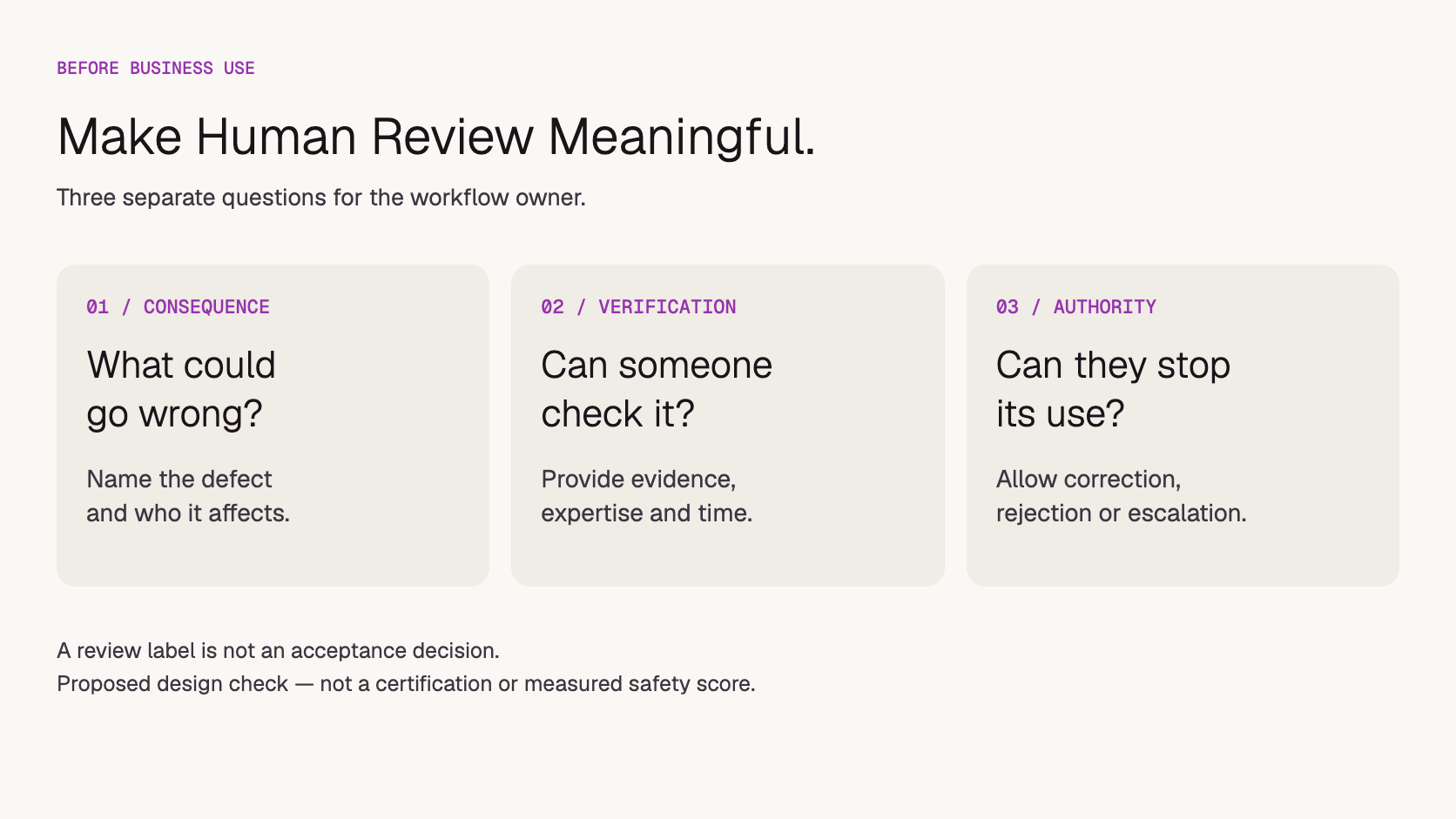
Require human review before an AI output is used when a plausible error could create a material consequence and a qualified reviewer can check it effectively. Decide by the business task, the evidence available and the ability to reverse the result—not simply by the model's reputation. Review only works if someone can change or stop the outcome.
For companies buying model access, this is a delivery decision as well as a model-selection decision. A model may produce a useful draft while the complete workflow still needs a person to verify a claim, correct a product image or authorize an action. “Human in the loop” should describe an operating process, not a reassuring label.
Read first: Use the enterprise model-selection guide to define the task and acceptance criteria. This article then helps decide who checks each result before it enters the business workflow.
What should trigger review before an AI output is used?
Start with the consequence of a wrong result, then ask whether the mistake is detectable and reversible before it matters. A plausible but incorrect draft for an internal brainstorm differs from an incorrect promise sent to a customer. The output format can be identical while the appropriate review process is very different.
Write down four questions for each workflow: Who could be affected? What would a credible error look like? What evidence would reveal it? What happens if nobody catches it? These questions are a proposed decision aid, not a universal risk score or a substitute for the organization's applicable rules.
Distinguish reviewing content from authorizing action. Checking the wording of a proposed customer email does not authorize issuing a refund. A person may approve the message but still need a separate authorized workflow for the transaction. The model's ability to suggest either step does not grant permission to execute it.
NIST's AI RMF discussion of human–AI interaction describes configurations ranging from autonomous operation to human decision-making and emphasizes clear roles. It also notes that human and AI biases can interact. Having a reviewer is therefore not, by itself, evidence that a workflow is reliable.
Does every output need a person to approve it?
No single review mode fits every task. Pre-use review, exception review and post-use sampling solve different problems. Choose a mode based on the task's consequences and tested controls. Where the organization cannot accept an unchecked error, sampling after release cannot replace the required decision before use.
Review mode
Proposed use
Main limitation
Pre-use review of every result
A qualified person checks an output before a consequential release or action
Requires evidence, reviewer time and a real ability to withhold release
Exception review
Defined checks route unsupported or unusual cases to a person
Undetected errors can pass; the routing rules need evaluation
Post-use sampling
Monitor a bounded, lower-consequence workflow and detect drift
Findings arrive after some results have already been used
Keep the task manual or redesign it
The consequence is unacceptable or effective verification is unavailable
Preserves manual work; generation is not automatically a net improvement
These are design choices, not default permissions. For example, an internal labeling task with easy correction might support sampling after testing. A draft quotation containing a customer-specific price may require pre-use review under the company's commercial policy. The same model could serve both tasks with different controls.
A proposed review design check, not a certification or a measured safety score.
What does this look like in common enterprise workflows?
Design review around the specific defect the business needs to catch. A vague instruction to “check quality” gives reviewers little guidance. A useful review brief identifies the evidence, the unacceptable outcome and the decision the reviewer is authorized to make. The following scenarios are illustrative, not reported Token360 customer cases.
How should a team review AI-drafted customer replies?
Check whether the proposed answer matches the customer's case and the current policy, especially if it promises an entitlement or a date. Give the reviewer the relevant source record alongside the draft. Fluent wording alone cannot establish that the proposed refund, replacement or delivery commitment is valid.
Suppose a draft says a replacement has already shipped, while the order record only shows that a request was opened. The reviewer must correct the claim or escalate the case. A generic approval button without the order record would make that distinction difficult. Keep sending and transactional permissions separate from draft generation.
How should a team review AI product imagery?
Compare the generated asset with the actual product reference and the intended placement. A visually attractive image may alter a control, accessory or label. Assign a reviewer who knows which product details must remain accurate, and inspect the final exported asset rather than only an earlier preview.
The decision might be “acceptable for an internal concept board, unsuitable for a product listing.” That is more useful than a single beauty score. If the asset changes after approval, including a new crop or regenerated component, determine whether the change invalidates the earlier review.
How should a team review extracted business records?
Show each important extracted value beside the source region or record that supports it. Define which mismatches block downstream use. A valid JSON response establishes that the application can parse the result; it does not establish that an amount, entity or date was read correctly.
For example, an invoice workflow could require a reviewer to resolve a mismatch between the extracted total and the source document before export. Record the corrected result and the reason. Do not treat a second model repeating the same value as independent proof that the first model was right.
What does a reviewer need to make a meaningful decision?
A reviewer needs relevant expertise, access to independent evidence, enough time and authority to reject or escalate. Remove any of those conditions and approval can become a formality. Test the human workflow as part of the system: a knowledgeable reviewer cannot catch a hidden defect that the interface never exposes.
Prepare a compact review packet: the proposed output, the source material, the intended business use, the acceptance criteria and the available actions. Avoid burying the source behind several screens while presenting the generated answer as definitive. Where useful, ask the reviewer to inspect the critical source fact before considering the model's conclusion.
Give reviewers explicit choices such as approve, correct, reject or escalate, with a short reason field. “Approve” should attach to a particular version. If the application later regenerates the output or changes the intended action, the old approval should not silently carry over.
For systems that can take actions, the Canadian Centre for Cyber Security's agentic AI guidance discusses human oversight alongside security controls, including for high-impact or difficult-to-reverse actions. That guidance concerns agentic systems; it is not evidence that ordinary content review alone secures an application.
Where a reviewer cannot independently verify the output, consider narrowing the task, acquiring better evidence or keeping it manual. Adding more reviewers with the same missing information may create a longer queue without addressing the underlying problem.
Can the review team keep up with the generated work?
Include review capacity in the deployment plan. A fast API can produce work faster than the business can check it. Estimate the hours required, then test peak arrivals, escalation and coverage gaps. Model latency measures only part of delivery time when an output waits for a person before it can be used.
Illustrative calculation: 600 drafts per day at an assumed two minutes of review each require 1,200 minutes, or 20 reviewer-hours. If the team can supply only 12 productive review-hours, the nominal shortfall is eight hours per day before rework, escalations or uneven arrivals. These are invented planning assumptions, not measured throughput.
The response should be an explicit operational decision: reduce intake, narrow what is generated, adjust staffing or redesign the task. Do not silently switch a pre-use review requirement to automatic release because the queue is growing. Define what the application tells users while work is waiting and what happens when the qualified reviewer is unavailable.
Use the AI API total cost of ownership guide to account for the reviewer workload. A cheaper or faster model is not necessarily a cheaper delivered workflow if it produces more corrections or sends more cases to specialists.
How do you know whether review actually helps?
Measure defects that reach the business outcome, not just the number of approvals. Evaluate the model and review process together against a defined set of cases. Record which defects people catch, which they miss and what review costs in time. A high approval rate can mean good outputs or weak checking; it does not distinguish them.
Before rollout, use a controlled exercise containing known errors relevant to the workflow. Keep it separate from live customer delivery. Examples might include an unsupported shipping claim, a changed product control or a transposed extracted amount. Check whether reviewers detect the defect using the interface and evidence they will actually have.
Track the output version, defect category, reviewer decision, correction time, escalation and any later-discovered problem. A sample of approved results can receive an additional independent check. Establish the sampling method and acceptance criteria for your context rather than adopting an arbitrary percentage from this article.
Repeat the relevant checks when the model, prompt, input population, interface or reviewer instructions change. The wider pilot-to-production decision should use this combined evidence, including remaining failure modes and the capacity needed to handle them.
What should enterprise buyers ask Token360 and their application team?
Separate model access from business review ownership. The supplier discussion should establish the model and commercial scope, while the application team defines evidence presentation, reviewers and release behavior. A model API can be a component of a reviewed workflow without providing the complete reviewer interface or staffing that workflow.
Token360's approved positioning covers enterprise access to text, image, audio and video models, with pricing, capacity, contracts and compliance requirements scoped to each engagement. The Token360 enterprise page is the starting point for that discussion. This article does not claim that Token360 provides a general-purpose human content-review service.
Bring representative inputs and acceptance requirements to model evaluation. Ask which model configuration is being tested, how changes will be identified, and what information your team can retain or retrieve for authorized troubleshooting. Confirm data handling and retention for the actual workflow; a review queue can itself contain customer-sensitive material.
Internally, name the person or team that owns each decision. Procurement of inference capacity, technical approval of an API operation and business approval of a generated result are separate events. The Token360 API approval-workflow guide covers the technical operation lifecycle; it should not be read as proof that the generated content has been checked.
What should an enterprise review plan contain?
A useful plan connects a named task to a review boundary, a qualified owner and an observable release decision. Keep it short enough for operators to use, but specific enough that two reviewers understand what blocks release. Start with one workflow and test the process before extending it to unrelated tasks.
The downloadable human review planning worksheet includes task, intended use, failure consequence, verification evidence, review mode, reviewer owner, release boundary, unavailable-reviewer behavior and recheck trigger. It is a blank planning aid, not a validated compliance checklist.
Read next: Compare the completed plan with your pilot expansion criteria. The result should show what the model can do, what people still need to do and what the organization is prepared to release.
What else do enterprise teams ask about human review?
Can we review only outputs with a low confidence score?
Only if the routing signal has been evaluated for the specific task and the remaining errors are acceptable. A model-generated confidence statement is not automatically calibrated. Include checks for unsupported claims and defined exceptions rather than relying on reassuring language from the same output.
Does checking a sample make every output safe?
No. Sampling provides evidence about the sampled process and can identify problems. It cannot undo an unchecked result already used. Where a particular result requires approval before use, post-use sampling serves a different purpose.
Can a second AI model replace the reviewer?
A second model may help flag issues, but it can share blind spots with the first. Evaluate its detection ability and remaining failures. Calling it a reviewer does not supply human accountability or prove that a consequential result is correct.
Does every edit require starting review again?
Define which changes invalidate approval. A corrected spelling may differ from a changed amount, product feature or recipient. Bind approval to the reviewed version and purpose, and route material changes back to the appropriate owner.
Evidence note: Editorial analysis by Yuki Yu. Scenarios and capacity figures are hypothetical; no customer study or guaranteed risk reduction is claimed. Sources checked November 10, 2026. This article discusses workflow design, not jurisdiction-specific compliance. Explore Token360 resources.
Enterprise AI
API
Bring your next idea to life.
Create a video scene in Creator, or explore models for images, audio, and text to find the right capabilities for your project.


 Guides
 Guides
 Guides