Last updated: September 10, 2026
If you are choosing between Kling and Seedance for AI video generation, the answer depends less on which model is “better” overall and more on what type of video workflow you need.
The current comparison is between Kling Video 3.0 / 3.0 Omni from Kuaishou and Seedance 2.5 from ByteDance.
Kling 3.0 focuses heavily on cinematic multi-shot control, character consistency, native multilingual audio and professional-resolution output. Its current generation window reaches up to 15 seconds, and Kling added native 4K generation to the 3.0 family in April 2026.
Seedance 2.5 takes a different direction. ByteDance designed it around longer storytelling, large multimodal reference sets and production-oriented editing. It can create up to 30 seconds of audio-video content in one generation and accept as many as 30 images, 10 video clips and 10 audio clips as references in a single pass.
The simplest answer is:
Choose Kling 3.0 when you prioritize precise multi-shot storyboarding, multilingual character dialogue, character/element consistency and high-resolution cinematic output.
Choose Seedance 2.5 when you prioritize longer 30-second sequences, large multimodal reference sets, video extension and advanced editing workflows.
Neither model is the universal winner.
Kling vs Seedance at a Glance
One important caveat: vendor feature lists are not direct quality benchmarks. A model supporting more references or longer duration does not automatically produce better-looking results for every prompt.
What Is Kling 3.0?
Kuaishou launched the Kling AI 3.0 model family on February 5, 2026, including Video 3.0 and Video 3.0 Omni.
The family supports multimodal input and output across text, image, audio and video and combines text-to-video, image-to-video, reference-to-video and editing in a unified video workflow. Kling's launch materials emphasize narrative control, consistency, prompt adherence and native audio.
Kling Video 3.0 supports output from 3 to 15 seconds. Its official guide also documents native audio, multi-shot generation, start/end-frame video, multiple character references and multilingual dialogue.
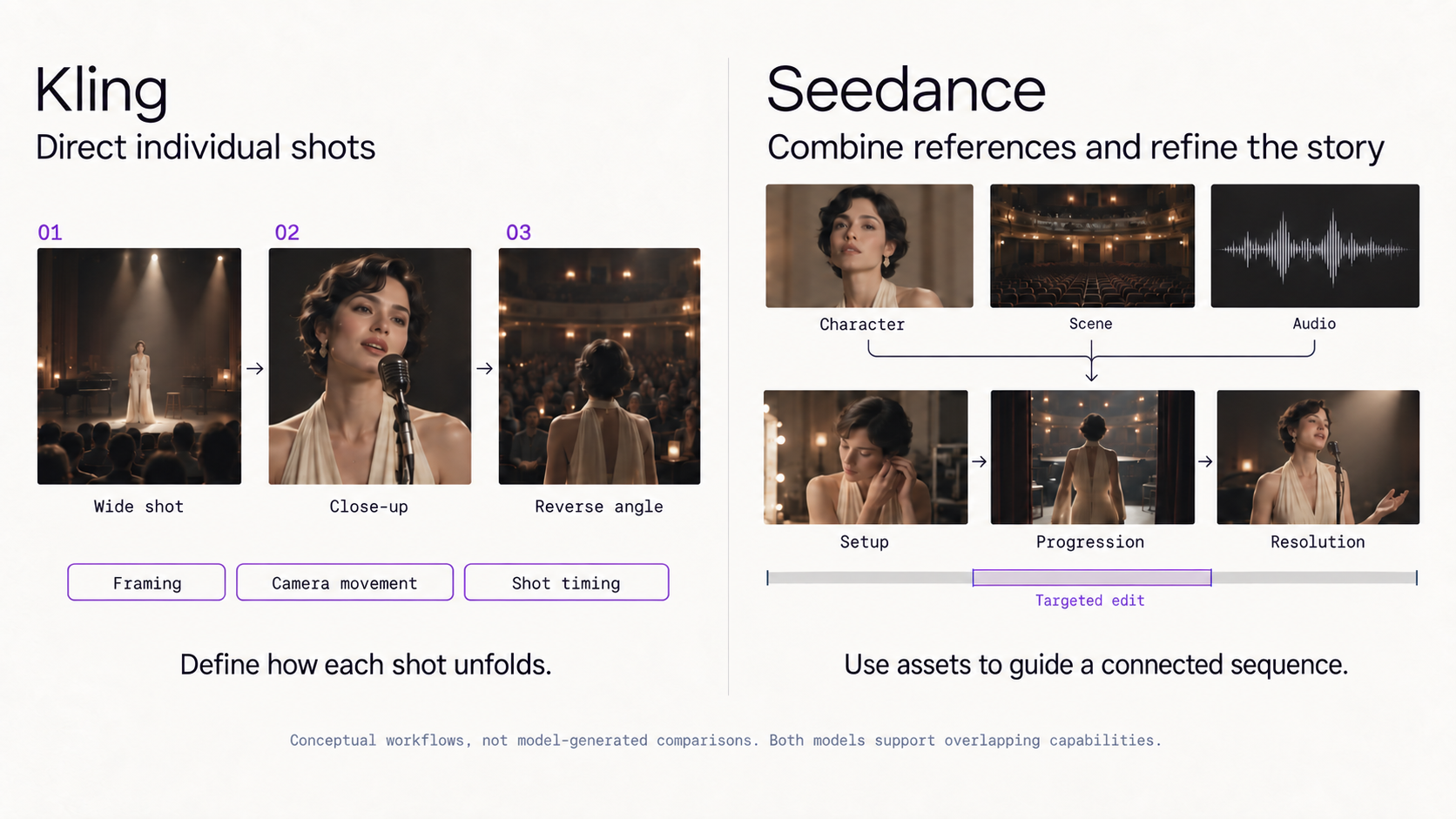
Kling Video 3.0 Omni adds deeper reference and storyboard functionality. Developers and creators can define the duration, framing, angle, narrative content and camera movement of individual shots inside one generation.
What Is Seedance 2.5?
ByteDance officially introduced Seedance 2.5 on July 31, 2026 as its next-generation audio-video creation model.
Seedance 2.5 builds around three areas: long-form storytelling, multimodal references and editing.
It can generate up to 30 seconds of audio-video content in one pass, twice Kling 3.0's documented 15-second maximum. ByteDance also supports multiple rounds of extension for longer sequences.
Its reference capacity is particularly large. ByteDance documents support for up to 30 images, 10 videos and 10 audio clips as reference material in one generation. The model can use those assets to understand characters, scenes, props, visual style and camera intent.
Seedance 2.5 also adds timestamp-level editing, camera-perspective editing, green-screen workflows and reference-based editing.
Seedance 2.5 API
Kling vs Seedance for Video Duration
This is one of the clearest differences.
Kling Video 3.0 currently supports flexible generation from 3 to 15 seconds.
Seedance 2.5 supports up to 30 seconds in one generation and can then extend the result through additional rounds.
So if the task is:
“Generate one 25-second narrative clip without manually stitching several generations together,”
Seedance 2.5 has the documented duration advantage.
If the task is:
“Generate a highly controlled 8–15 second advertising scene with several explicitly directed shots,”
Kling's shorter maximum may not matter.
Winner for duration: Seedance 2.5
But duration by itself should not be treated as a quality metric.
A good 10-second generation can be more useful than an inconsistent 30-second one. Production teams should test both models on representative prompts.
Kling vs Seedance for Multi-Shot Storytelling
Both models can create more than one visual beat in a single output, but their control systems are different.
Kling 3.0 places multi-shot storyboarding very visibly at the center of its workflow.
Kling's official documentation says custom multi-shot generation can specify shot duration, framing, angle, narrative content and camera movement within one sequence.
For example, a prompt structure can behave like:
Shot 1 — 3 seconds — wide shot
Shot 2 — 2 seconds — close-up
Shot 3 — 4 seconds — reverse angle
Shot 4 — 3 seconds — tracking shot
That resembles a lightweight storyboard.
Seedance 2.5 also handles connected multi-shot narratives. ByteDance describes the model as capable of organizing setup, development, turning points and resolution within a 30-second generation.
However, its documented strength is broader narrative continuity and timestamp-controlled creation/editing rather than Kling's especially explicit storyboard interface.
Better for explicit storyboard control: Kling 3.0
Better for longer connected narrative: Seedance 2.5
That distinction is much more defensible than simply saying “Kling is better at storytelling.”
Kling vs Seedance for Character Consistency
Both companies make consistency a major part of their current-generation models.
Kling Video 3.0 supports multiple images and video references as reusable elements. Its official documentation says these references can anchor the visual traits of characters, objects and scenes across camera movement and scene development.
Video 3.0 Omni goes further by allowing a 3–8 second character-reference video to capture both visual traits and voice characteristics. Kling can then reuse that character across other scenes.
Seedance approaches consistency through a larger multimodal reference context.
Seedance 2.5 can analyze dozens of images plus video and audio references and use them to preserve multiple subjects, appearances, voices, environments and props across a more complex sequence.
So the difference is less:
Kling = consistent, Seedance = inconsistent
and more:
Kling offers a particularly structured reusable-character/element workflow, while Seedance offers unusually large multimodal reference capacity.
For applications built around recurring digital characters or dialogue scenes, Kling's element system may be especially attractive.
For a campaign pulling together many assets, locations, products and visual references, Seedance may be more flexible.
Kling vs Seedance for Reference Images, Video and Audio
Seedance has the clearest documented numerical advantage in reference capacity.
ByteDance currently allows up to:
Kling Video 3.0 and 3.0 Omni also support multiple images, reference videos, character elements and audio/voice references, but Kling's public guide does not present an equivalent “30 + 10 + 10” reference allowance.
Better for very large reference sets: Seedance 2.5
This could matter significantly for film, advertising and complex branded content where one generation has to understand several actors, products, environments and reference shots.
Kling vs Seedance for Native Audio
Both models support native audiovisual generation.
That means dialogue and sound can be generated together with video rather than requiring the application to create silent footage first and then add audio through a second model.
Kling 3.0 has especially detailed public documentation around dialogue.
It currently supports dialogue generation in Chinese, English, Japanese, Korean and Spanish, including mixed-language scenes, accents and dialects. The model can also associate speech with particular characters.
Seedance 2.5 is also an audio-video joint-generation model. ByteDance emphasizes synchronized long-form audio-video generation and allows audio references as part of its multimodal input set.
Better documented for multilingual character dialogue: Kling 3.0
Better suited to large multimodal audiovisual references: Seedance 2.5
Again, that does not prove one model has universally better sound quality. It only reflects documented product capabilities.
Kling vs Seedance for Resolution
Kling currently has the clearer public advantage in headline resolution.
Its standard Video 3.0 guide documents 720p and 1080p, and Kling subsequently introduced native 4K video generation for the Kling 3.0 family in April 2026.
ByteDance's current Seedance 2.5 public launch materials emphasize duration, references and editing rather than presenting one universal output-resolution specification.
This matters because Seedance 2.5 is distributed through several delivery surfaces, and the exact resolutions exposed can vary by provider.
The official sources reviewed here do not establish that as a universal product limit.
Better documented for native high-resolution output: Kling 3.0
Kling vs Seedance for Editing
This is where Seedance 2.5 has one of its clearest differentiated strengths.
ByteDance explicitly documents:
timestamp-level content editing, camera-perspective editing, green-screen editing, reference-based editing, and targeted modification of characters, actions and plot elements.
That means the model is designed not only around:
prompt → generate
but also:
generate → revise a specific time range → preserve continuity.
Kling also integrates video editing inside its multimodal 3.0 architecture, so it should not be described as generation-only.
However, Seedance's current release puts significantly more emphasis on fine-grained post-generation editing as a core differentiator.
Better documented for detailed editing workflows: Seedance 2.5
For advertising and film teams, this may matter more than raw generation quality because fewer full regenerations can mean faster iteration.
Kling vs Seedance for Text-to-Video
For pure text-to-video, both models can translate complex written instructions into audiovisual scenes.
Kling is particularly interesting when the prompt describes explicit shots, speakers and dialogue.
For example:
Shot 1: wide shot of a woman entering a subway car.
Shot 2: close-up as she sits across from a man.
She asks in Spanish, “¿Nos conocemos?”
Cut to the man's reaction.
Kling's multi-shot and multilingual dialogue capabilities map naturally to this kind of structured prompt.
Seedance becomes especially interesting when the prompt needs a longer narrative progression.
ByteDance's own 30-second demonstrations show the model moving through multiple locations, interactions and camera changes inside one generation rather than simply extending one shot.
Choose Kling when:
The text prompt behaves like a shot list or screenplay.
Choose Seedance when:
The text prompt behaves like a longer narrative sequence.
Kling vs Seedance for Image-to-Video
Both models support image-driven video generation.
Kling Video 3.0 supports traditional image-to-video plus a start frame + element reference workflow, multiple image references and start/end-frame generation.
Seedance 2.5 expands image-driven work into a larger multimodal reference system where dozens of images can contribute characters, products, environments, style or composition.
For one portrait or character image, Kling's structured consistency workflow is attractive.
For an entire campaign asset set, Seedance's much larger documented reference capacity may be more useful.
Kling vs Seedance Pricing
Pricing is one area where an oversimplified comparison would be misleading.
Kling's current creator-side Video 3.0 pricing uses credits per second.
For example, Kling currently lists:
Seedance 2.5 through BytePlus ModelArk uses a different billing system based on tokenized video workload. BytePlus currently lists $10.70 per million tokens without video input and $6.40 per million tokens with video input for Dreamina Seedance 2.5.
Those figures are not directly comparable.
You cannot validly conclude:
Kling costs 9 and Seedance costs 10.7, therefore Kling is cheaper.
One is a credit-per-second billing unit and the other is a tokenized workload rate.
Production teams should calculate the cost of an identical workload at the actual API/provider they intend to use.
Kling vs Seedance API Access
Both model families can be accessed programmatically, but availability depends on the platform.
Kling operates its own API platform and publishes API/model documentation for Video 3.0.
ByteDance now exposes Seedance 2.5 through BytePlus, whose current AI catalog offers “Quick API access” to Dreamina Seedance 2.5.
Token360's current production model catalog explicitly lists seedance-2.5 as a live video model accessible through:
POST /v1/videos
with the model ID:
seedance-2.5
Do not currently claim that Kling 3.0 is live on Token360's production API unless engineering confirms it before publication.
As of September 10, Token360's live public production model list includes Seedance 2.5 but does not list Kling 3.0.
That's important. The old creator content references older Kling versions, but that is not enough evidence to call Kling 3.0 a current production API model.
Kling vs Seedance for Developers
If you are choosing at the API level, model quality is only part of the decision.
You also need to consider job architecture, request format, billing, versioning, retry behavior and how hard it will be to add another model later.
Token360 currently exposes Seedance 2.5 through its normalized video endpoint:
curl -X POST https://api.token360.ai/v1/videos \
  -H "Authorization: Bearer $TOKEN360_API_KEY" \
  -H "Content-Type: application/json" \
  -d '{
    "model": "seedance-2.5",
    "prompt": "A cinematic handheld shot following a singer from backstage onto a concert stage",
    "resolution": "720p",
    "duration": 8
  }'
The API returns an asynchronous video task that can then be monitored until generation completes.
Kling vs Seedance: Which Is Better for Advertising?
For advertising, the answer depends on the asset structure.
Kling may be a better fit when the campaign centers around a recurring character, explicit dialogue, product consistency and a carefully directed 5–15 second commercial sequence.
Its element-reference system, multilingual native audio and custom multi-shot controls map naturally to short-form advertising.
Seedance may be a better fit when the creative team has a large collection of campaign assets or needs longer sequences and iterative editing.
Its 30-image / 10-video / 10-audio reference capacity, 30-second generation and green-screen/timestamp editing are especially relevant to production workflows.
So for advertising:
Character/dialogue-driven short creative → Kling
Complex campaign assets / longer production → Seedance
Kling vs Seedance: Which Is Better for Film and Short-Form Storytelling?
Kling's strongest advantage is directorial control.
Kling 3.0 Omni lets creators explicitly define individual shots, including duration, framing, angle, story content and camera movement.
Seedance's strongest advantage is narrative runway.
Thirty seconds gives the model more space to build a sequence with setup, progression and resolution, while multi-round extension allows the story to continue beyond the first output.
Therefore:
Kling is compelling when you want to direct the shots.
Seedance is compelling when you want to extend the story.
Kling vs Seedance: Which One Should You Choose?
There isn't one universal winner.
The most useful conclusion is therefore not:
Kling is better than Seedance.
or:
Seedance is better than Kling.
It is:
Kling 3.0 currently emphasizes directorial control, reusable characters, dialogue and high-resolution cinematic generation, while Seedance 2.5 emphasizes longer storytelling, large multimodal reference sets and production-oriented editing.
Is Seedance Better Than Kling for Long Videos?
For single-generation duration, yes.
Seedance 2.5 supports up to 30 seconds in a single pass, while Kling Video 3.0 currently supports up to 15 seconds.
However, longer output does not automatically mean better output. If your project only needs a controlled eight-second clip, duration may not be a meaningful differentiator.
Is Kling Better Than Seedance for Character Consistency?
Kling 3.0 has a particularly strong documented workflow for reusable character and element consistency.
Video 3.0 Omni can create elements from image or video references and can bind a character's voice to that element for reuse across scenes.
Seedance 2.5 also supports subject consistency across complex multimodal references, so it would be inaccurate to say Kling universally produces more consistent characters.
The practical difference is that Kling exposes a more explicit reusable-character system, while Seedance focuses on interpreting a larger overall reference set.
Does Kling or Seedance Have Better Audio?
Both support native audiovisual generation, but their documented strengths differ.
Kling 3.0 has detailed controls for multilingual dialogue, character speech and voice consistency, including Chinese, English, Japanese, Korean and Spanish.
Seedance 2.5 supports joint audio-video generation and can incorporate up to 10 audio references alongside image and video references.
Without running a controlled audio benchmark, there is not enough evidence to claim that one has universally better sound quality.
Does Kling or Seedance Support 4K?
Kling 3.0 currently supports native 4K video generation. Kling announced the feature in April 2026.
Seedance 2.5's current official launch materials do not provide one universal native-4K specification, so the exact resolution should be checked against the API or platform through which Seedance is being accessed.
Do not convert that into:
“Seedance cannot generate 4K.”
The available source does not support that conclusion.
Can I Access Seedance 2.5 Through an API?
Yes.
BytePlus now advertises direct API access to Dreamina Seedance 2.5, and Token360 currently lists seedance-2.5 as a live production video model accessible through its /v1/videos API.
Can I Access Kling 3.0 Through Token360?
This needs to be phrased carefully.
Kling provides its own API access, but Token360's current public production model catalog does not list Kling 3.0 as of September 10, 2026.
So until the Token360 catalog or engineering team confirms otherwise, this blog should not tell developers to call kling-3.0 through Token360.
Try Seedance 2.5 Through Token360
Token360 currently provides production access to Seedance 2.5 through its unified video-generation API.
Developers can use the same Token360 platform for language, image, video and audio models while Token360 handles authentication, routing, usage metering and billing.
Explore the Token360 model catalog
Read the Token360 API documentation


 Tutorial
 Comparison
 Comparison