AI Video Generation API vs Streaming API: What Does Your App Need?
Generation creates footage; streaming delivers it. Compare the workflow, concurrency and cost units, with three reproducible video budget scenarios.
By Yuki Yu
An AI video generation API creates footage. A video streaming API prepares and delivers footage to viewers. An application that creates new videos and serves them at scale may need both. Compare generation attempts with generation attempts, and delivered minutes with delivered minutes. A low price for creating a clip does not tell you what it will cost to play that clip a million times.
Read first: Start with the text-to-video API workflow if you are still designing the creation stage. This article covers the boundary between making an asset and serving it.
What is the difference between generation, encoding and streaming?
Generation creates visual content from an instruction or reference. Encoding changes how existing content is represented. Streaming delivers media for playback. These jobs can appear in one product, but their inputs, outputs and failure conditions differ.
Start with the asset you already have and the action your user needs. Choose generation when the footage does not yet exist. Choose a playback pipeline when the footage exists and must reach an audience.
A product page using an approved supplier video may need upload, encoding, captions and delivery without any generative model. A creative team making downloadable drafts may need generation and controlled file storage without a full streaming product. A campaign application that creates approved ads and embeds them across many pages has both workloads.
Write the requirement as a verb: create, transform, store, authorize or play. Then ask vendors to demonstrate that operation. “Video API” is too broad a procurement category to establish feature equivalence. Preserve this distinction even when one vendor bundles several operations.
Connect generation to a playback pipeline
Use an explicit asset handoff after generation and review. Keep the generation job ID, your approved asset ID and the delivery asset ID separate, with a mapping between them.
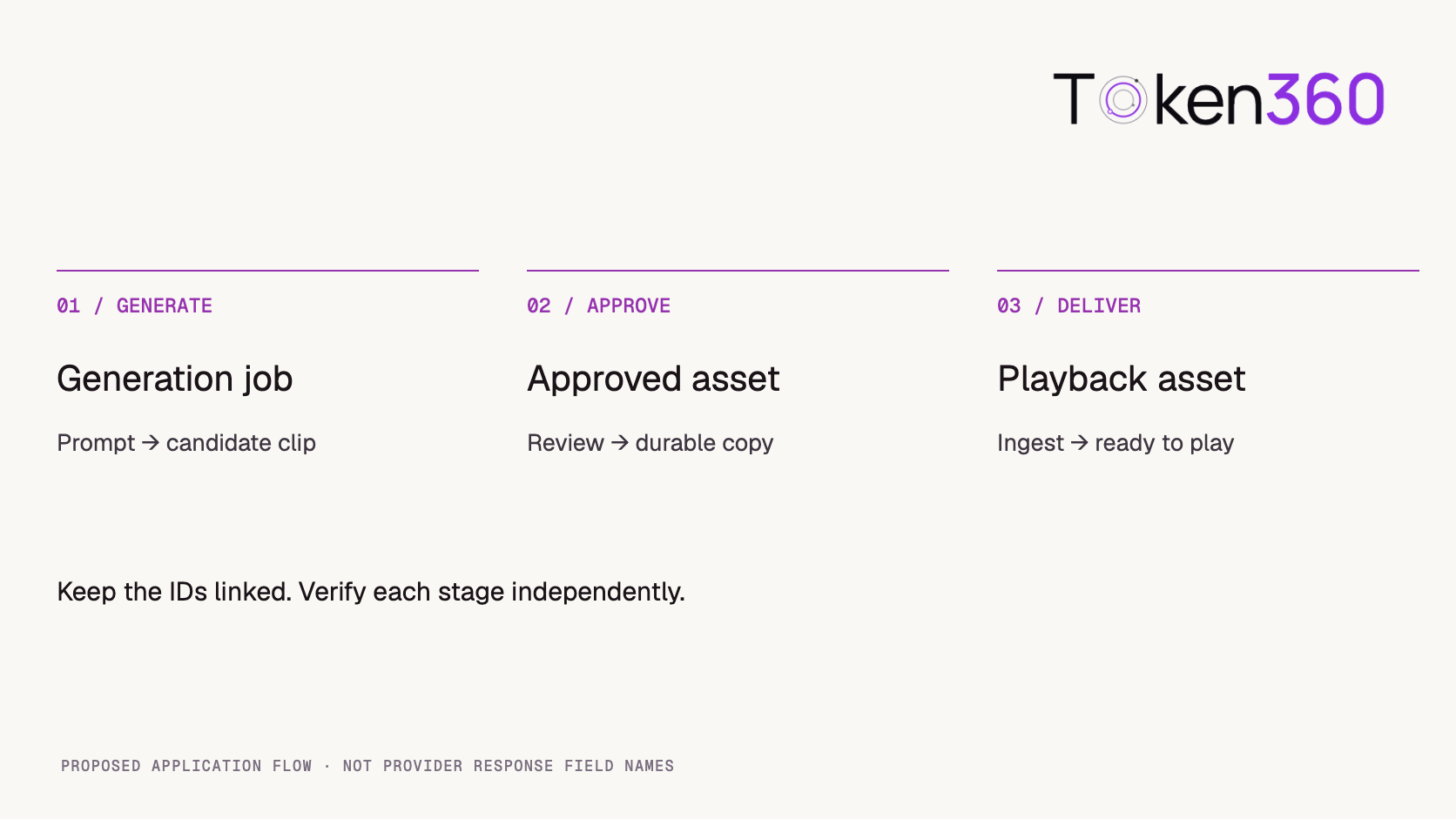
A proposed application flow is: submit generation, wait for completion, retrieve and validate the result, approve the selected take, ingest it into delivery storage, wait for playback readiness, then publish its playback reference. These are application states, not names of Token360 response fields.
A proposed handoff model. Completion at one stage does not certify the next stage.
Token360's API selection documentation identifies video generation as asynchronous, using polling or a supported callback. Check the selected model's documented parameters. Do not interpret that completion signal as a guarantee that your separate player or delivery service is ready.
Store a durable copy according to your access and retention policy before relying on a temporary provider result URL. The expired video download URL guide covers recovery at this boundary. A playback failure should first be traced to ingestion, access or delivery; it is not automatically a reason to purchase another generation.
How do generation and delivery costs grow differently?
Generation costs grow with billable creation work. Delivery costs grow with the provider's delivery meter. Replaying an approved clip does not inherently require generating it again.
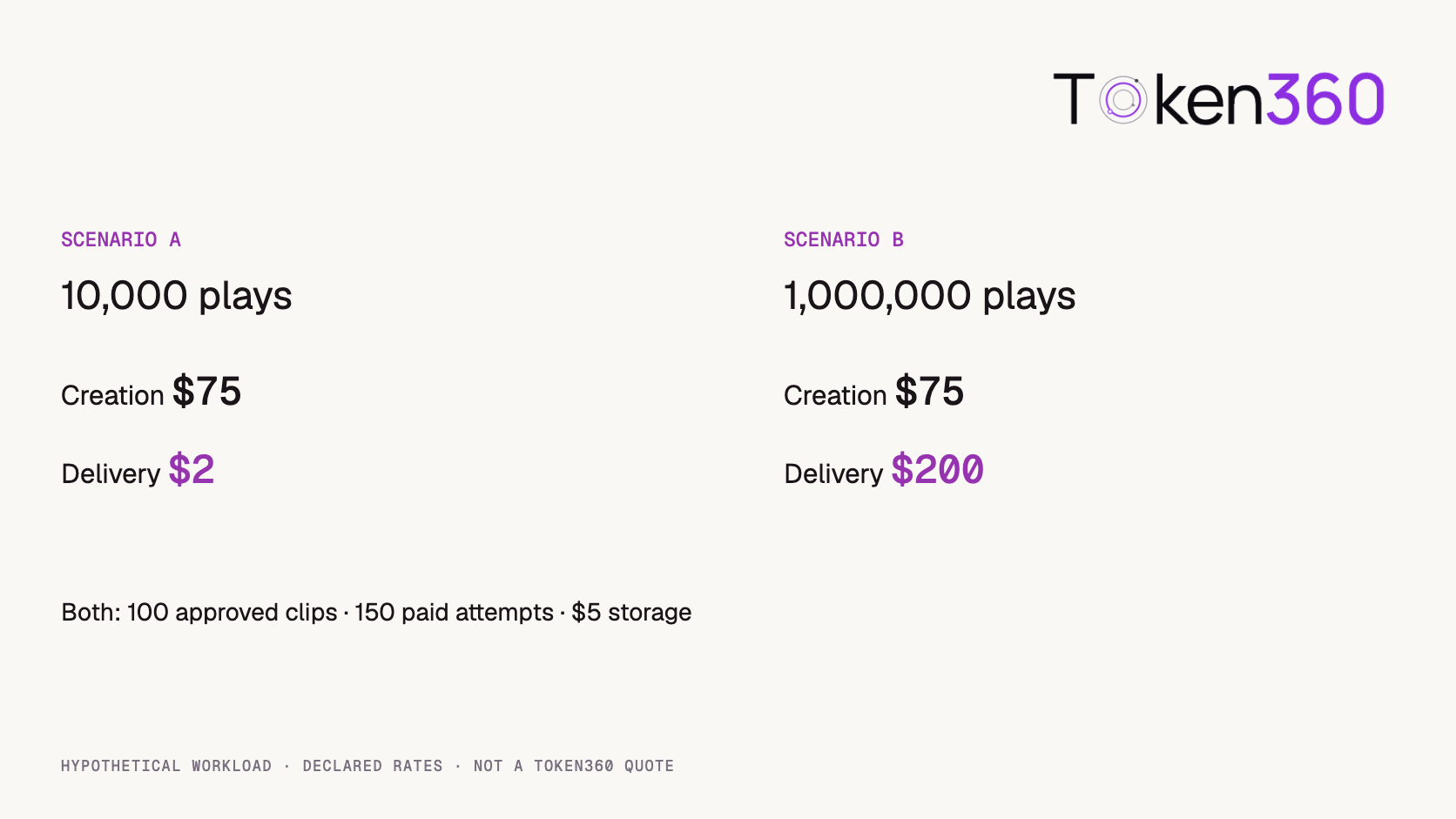
We built the following reproducible planning example on November 3, 2026. It is a calculation, not a production benchmark or a Token360 price quote. Every approved clip lasts 30 seconds. We assume 1.5 paid attempts per approved clip, a hypothetical $0.50 per attempt, and 12 billable delivered seconds per play.
For the delivery illustration, Cloudflare's checked pricing page lists $1 per 1,000 delivered minutes and storage capacity in $5 monthly blocks of 1,000 minutes. Each scenario fits one block. These rates illustrate a separate service; they are not Token360 charges.
Scenario
Approved clips
Paid attempts
Plays
Creation
Delivery
Storage
Included total
A: small library
100
150
10,000
$75
$2
$5
$82
B: larger audience
100
150
1,000,000
$75
$200
$5
$280
C: larger library
1,000
1,500
10,000
$750
$2
$5
$757
Scenario B increases plays 100 times while creation stays unchanged. Scenario C increases the approved library ten times while plays stay unchanged. The two growth paths call for different optimizations. Neither table row estimates staffing, moderation, application hosting, taxes, source storage or commercial rights clearance.
Hypothetical workload with a documented delivery tariff. Storage adds $5 in both displayed cases.
Actual delivered seconds need not equal watched seconds. The same pricing document counts preloading and buffering, rounds uploaded-video delivery to segment length, and excludes playback served from browser cache. Replace the 12-second assumption with your measured billing usage before forecasting. Our example assumes a newly provisioned storage block, not spare capacity in an existing account.
Does generation concurrency determine how many viewers you can serve?
No. Simultaneous generation jobs and simultaneous viewers stress different parts of the system. A finished clip can be served repeatedly without occupying a new model generation slot for each view.
Keep two capacity plans. The creation plan tracks submission rate, queued jobs, active generations and completion deadlines. The playback plan tracks simultaneous sessions, delivered traffic, startup behavior and errors by device and region. The generation concurrency planning guide addresses the first plan.
A million plays over a month is not a million concurrent viewers. Record when demand peaks, how long sessions overlap and whether viewers request the same asset. Do not buy more model concurrency to solve a delivery bottleneck unless new personalized generation is actually on the critical path.
Can you keep your existing video player?
Often, provided the delivery format, access scheme and player capabilities match. Verify the exact integration rather than assuming every video URL behaves the same way.
For example, Cloudflare's own-player documentation describes HLS and DASH playback. A useful test checks the real target browser, adaptive playback, signed access, captions, seeking and expiration behavior. It should include the player configuration your application will actually ship.
An MP4 download, a manifest URL and a model job endpoint are different resources. Maintain that distinction in the asset database. If the player fails, capture the playback asset ID and network response alongside the original generation reference, so support can investigate the right stage.
What should a vendor evaluation prove before you commit?
Require evidence for each layer you intend to buy. A beautiful generated sample cannot demonstrate delivery scalability, and a smooth player cannot demonstrate prompt adherence.
Use one approved clip through the complete handoff. Confirm ingestion, the exact playback URL, authorization behavior, a representative device matrix and the metered usage recorded after controlled plays. Separately evaluate generation quality and retry costs on your creative brief. Keep the acceptance records together while preserving their distinct denominators.
For Token360, begin with the documented generation endpoint and current model details. Then evaluate your chosen delivery service as its own dependency. This article does not establish that Token360 provides a streaming CDN or any particular third-party integration. Token360's resources provide the platform context.
Frequently asked questions
Is a video generation API also a streaming API?
Not necessarily. Verify creation, encoding, storage and playback capabilities separately, even if they share a vendor.
Do I pay for generation every time someone watches?
Reusing an approved asset does not inherently create a new generation job. Your delivery service may charge for playback usage.
Can I serve a generated MP4 directly?
Yes, if your hosting, access policy and target players support that file. Test the viewing experience and costs before choosing additional packaging infrastructure.
Is the lowest cost per generated second the cheapest complete solution?
No. Acceptance rate, paid attempts, delivery usage, storage and operational work also affect the complete budget.
Does a million monthly views mean a million concurrent viewers?
No. Monthly views count activity over time. Concurrency measures overlapping active sessions.
Are the cost examples measured Token360 results?
No. They combine declared hypothetical workloads and creation prices with checked Cloudflare delivery and storage rates. No provider calls or load tests were run.


 Prompt Library
 Guides
 Guides