AI Video API Concurrency Planning: From Job Time to Queue Capacity
Plan AI video API concurrency with arrival rates, job times, and burst calculations. Size queues, set deadlines, and validate capacity before production.
Six video requests per minute can require more than six concurrent jobs. If each job occupies a processing slot for 90 seconds, the average offered workload is nine slots. Whether nine slots are enough to meet a deadline is a different question: bursts, runtime variation, and retries can create a queue even when the average looks manageable.
Quick answer: estimate average active workload as arrival rate × mean slot-occupancy time, using matching units. Then check a candidate concurrency cap against burst size, queue deadlines, actual account limits, and measured runtime variation. Average workload is a planning baseline, not a guaranteed concurrency setting.
Evidence boundary: all numbers below are reproducible hypothetical calculations. They are not Token360 benchmarks, load-test results, account entitlements, or latency promises. No production traffic was generated for this article.
1. Separate request rate, active jobs, and waiting work
A submission request and a video generation job have different lifetimes. An HTTP submission may return quickly while the video continues processing. Limiting open HTTP connections therefore does not necessarily limit outstanding generation jobs.
Quantity
What it measures
Planning question
Submission rate
New attempts per minute
How quickly can work enter?
Active-job concurrency
Jobs occupying the defined processing boundary
How much work can proceed together?
Queue depth
Accepted work waiting to start
How much delay have we accumulated?
Outstanding jobs
Waiting plus active jobs
How much unfinished work do we own?
Completion rate
Terminal jobs per minute
Are departures keeping up with arrivals?
Confirm which boundary your provider actually limits. A quota may count in-flight requests, accepted jobs, or another account-specific resource. Your application semaphore and the provider’s limit need not represent the same thing. A shared organization quota can also be consumed by other services.
Token360 documents RPM, concurrency, spend controls, and upstream capacity as separate limit dimensions; applicable values depend on your agreement and console configuration. Check those values before translating an application estimate into a deployment setting. See Rate Limits, Timeouts, and Retries.
2. Estimate the average workload with consistent units
Define λ as the rate of work entering the boundary and S as the mean time each job occupies that boundary. For a stable processing system, the average active workload is λ × S. Little’s law more generally relates the average number in a system to its throughput and average time in that same system. Including queue time changes the quantity from active work to total work in the system. MIT’s queueing-model lectures explain these boundaries and steady-state quantities.
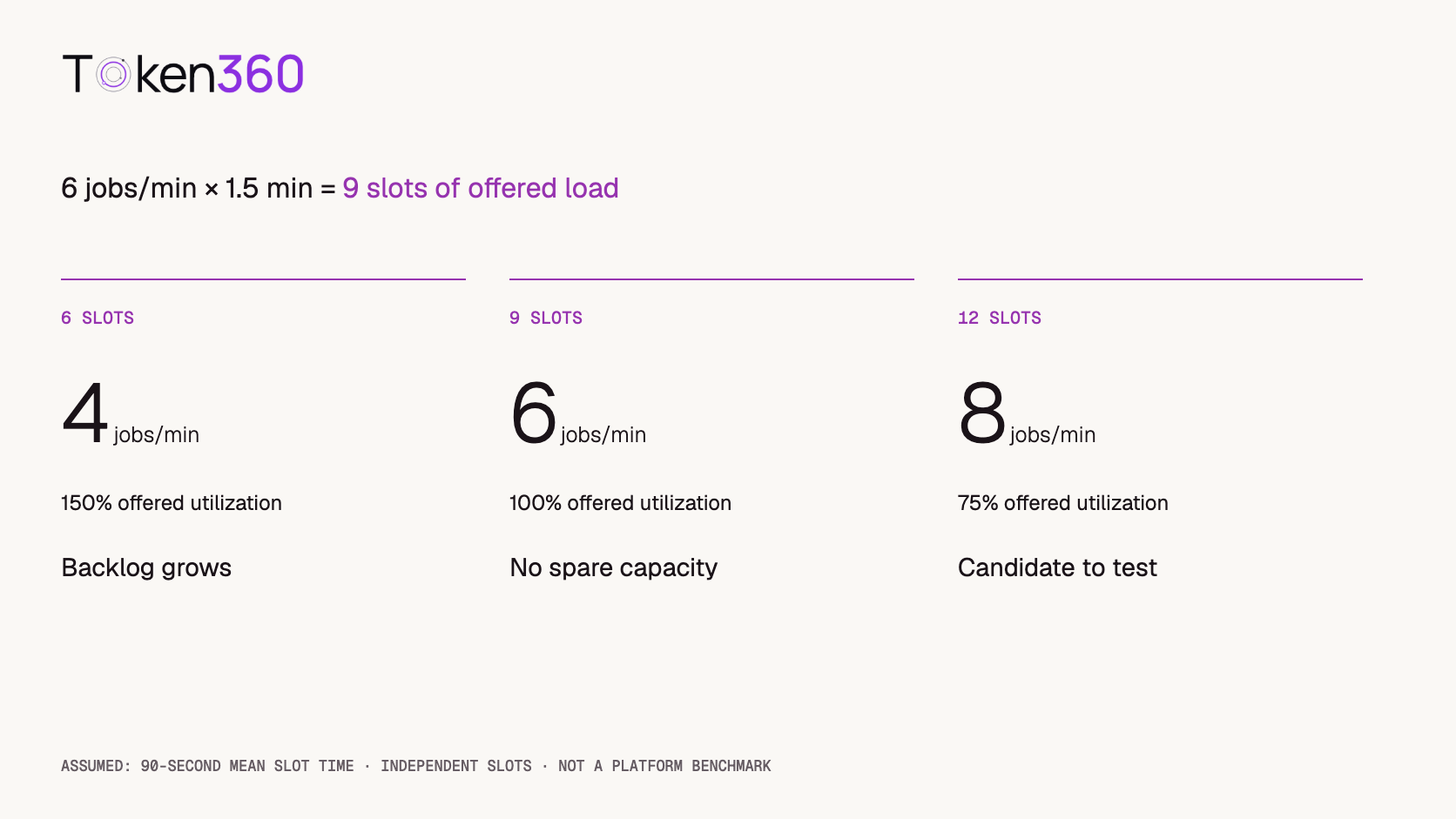
Assumed arrival rate:       6 jobs/minute
Assumed mean slot time:    90 seconds = 1.5 minutes
Offered active workload:   6 × 1.5 = 9 slots

Ideal capacity at cap C:   C / 1.5 jobs/minute
Offered utilization:       9 / C
These equations assume comparable jobs and effective parallel slots. They do not account for shared GPU contention, startup overhead, changing provider availability, or throttling. Increasing a client-side cap does not guarantee that the service supplies additional independent capacity.
Assumed cap
Ideal capacity
Offered utilization
Interpretation
6 slots
4 jobs/min
150%
Demand exceeds capacity; backlog grows about 2 jobs/min in a fluid approximation.
9 slots
6 jobs/min
100%
No spare average capacity to recover from variability or interruption.
12 slots
8 jobs/min
75%
A candidate for validation, not a guaranteed deadline solution.
“150%” describes offered demand relative to capacity; actual occupied slots cannot exceed the cap. Likewise, nine slots is not a recommendation simply because the arithmetic balances. With random arrivals or runtimes, operating at the average capacity boundary leaves no recovery margin.
Calculated scenario. Real limits and effective parallelism must be verified separately.
3. Calculate what a burst does to the queue
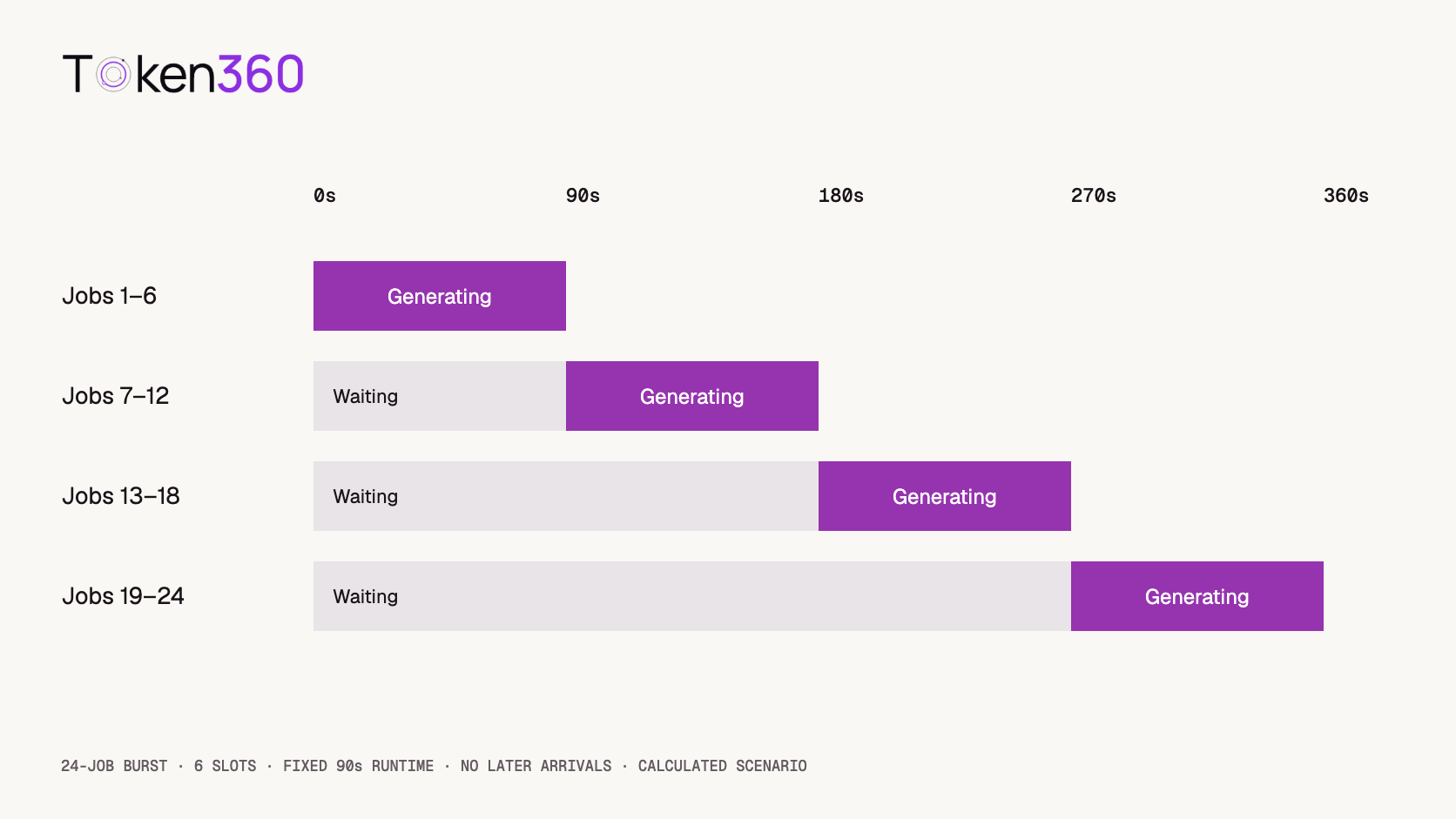
Now replace the steady stream with 24 jobs arriving together. Assume all slots are initially free, each job takes exactly 90 seconds, FIFO scheduling, no failures, no overhead, and no additional arrivals. This deliberately simple scenario isolates the effect of concurrency.
With six slots, the first six jobs start immediately. Six more start at 90 seconds, then another six at 180 seconds, and the final six at 270 seconds. The last group finishes at 360 seconds. A user in that final group waits four and a half minutes before generation even starts.
Slots
Waves
Mean queue wait
Maximum queue wait
Last completion
6
4
135 seconds
270 seconds
360 seconds
12
2
45 seconds
90 seconds
180 seconds
24
1
0 seconds
0 seconds
90 seconds
For job i, counted from 1:
start(i)  = floor((i - 1) / C) × S
finish(i) = start(i) + S

Last completion = ceil(B / C) × S
B = burst size; C = slots; S = fixed runtime
This is a deterministic schedule, not a prediction of p95 latency. Ongoing arrivals, variable duration, and occupied slots at the start would change it. If the illustrative requirement is that all 24 jobs finish within 180 seconds, twelve slots meets that requirement only under these assumptions.
24 simultaneous jobs, six independent slots, fixed 90-second runtime, and no later arrivals.
4. Give waiting work a deadline and an owner
A queue absorbs temporary imbalance; it cannot create processing capacity. An unlimited queue can make the submission endpoint look healthy while users accumulate unacceptable waits. Decide what happens before accepting more work than the product can reasonably finish.
For each workload, define a maximum queue age, maximum outstanding-job count, and explicit behavior when either is exceeded. An interactive preview might offer a later notification or ask the user to try again. An overnight batch might accept a longer wait but require a completion deadline. These are product decisions that should be visible to the user.
Keep a durable job record with an application correlation ID, provider job ID when available, timestamps, current state, and the next reconciliation action. Release a local slot according to the boundary it represents. A lost callback should trigger reconciliation, not silently leave a slot occupied forever; a local timeout should not automatically mark remote work cancelled.
Use separate workload classes when long videos would otherwise block short previews. Reserve capacity deliberately if interactive work needs protection, and document how unused reservations can be borrowed. Splitting queues without controlling their combined submissions can still exceed a shared account limit.
5. Measure runtime without mixing it with polling delay
Record at least application enqueue, submission, acceptance, processing start when exposed, terminal status, and application receipt of the result. Preserve the source of each timestamp. If the API does not expose processing start, you cannot cleanly separate provider queue time from generation time.
For client-side planning, accepted-to-terminal duration may be the relevant occupancy measure if your semaphore stays held for that entire interval. Call it that. Do not relabel it as GPU execution time. Polling also delays when your application learns that processing finished; a result discovered at the next poll is not an exact completion timestamp.
Measure representative model IDs and settings separately: video duration, resolution, input mode, and audio options can change workload shape. Report sample size, test window, errors, and timeouts alongside latency. Excluding unfinished jobs makes a stressed system look faster than it is.
Use the mean for average workload arithmetic and observed tail behavior for deadline evaluation. Multiplying arrivals by p95 duration can be a conservative scenario input, but it does not establish a p95 queue guarantee. Replay an observed arrival trace with measured durations to examine the deadline distribution, and label that replay as simulation.
6. Validate a candidate cap with a bounded test
Start within confirmed account limits and an approved cost budget. Use a small representative workload, then increase concurrency in controlled steps. At each step, record accepted submissions, terminal completions, queue age, outstanding jobs, errors, and actual charges. Include a drain period so pending jobs do not disappear from the result.
Test phase
What to observe
Decision
Low-load baseline
Runtime and correctness with little competition
Establish the workload definition.
Steady arrival stream
Whether completion rate keeps pace and queue age stabilizes
Reject caps with continuing backlog growth.
Bounded burst
Waiting-time distribution and drain time
Compare with the product deadline.
Recovery
Whether pending work reconciles after a controlled interruption
Confirm there are no stranded local slots.
Set stop conditions before running: budget reached, repeated provider errors, queue-age threshold exceeded, or user-facing traffic affected. Avoid using production customers as an uncontrolled load generator. A short successful run establishes only what happened during that test, not an SLA.
Count retry attempts as traffic. A workload producing six logical jobs per minute may submit more than six attempts. Token360 advises distinguishing transient capacity errors from funding or policy stops, respecting retry guidance, and reconciling ambiguous submissions before repeating them. A timeout does not establish that upstream work never began. Review the retry and duplicate-work guidance.
7. Send a capacity brief, not just a concurrency number
A useful capacity discussion includes exact model IDs and settings, expected average arrivals, largest expected burst, deadline by workload class, measured occupancy distribution, retry policy, and required test window. Add the scope of any existing limit: key, workspace, tenant, model, or provider route.
Ask which limits are enforceable today, whether queued jobs count toward them, and how capacity changes under contention. Request confirmation of available settings before making a launch commitment. Keep a fallback product behavior for cases where the requested capacity is unavailable.
The Token360 enterprise page is the starting point for discussing production requirements. As checked on October 23, 2026, it labels higher throughput limits and priority support/SLAs as “Coming Soon.” This article does not turn those roadmap items into present guarantees.
FAQ
Is RPM the same as video-generation concurrency?
No. RPM counts request arrivals over time; concurrency counts simultaneous work at a defined boundary. An asynchronous submission can return while its video job remains active. Verify whether polling requests and job submissions share a rate limit.
How many concurrent jobs do I need for six requests per minute?
At an assumed mean slot time of 90 seconds, offered load is nine slots. That is an average workload calculation. The suitable cap depends on bursts, runtime variation, deadlines, and effective provider capacity.
Should I use mean or p95 generation time?
Use the mean for average active-load arithmetic. Examine the observed distribution for deadline planning. Replacing the mean with p95 in a multiplication does not calculate the p95 of end-to-end latency.
Does increasing concurrency always make a batch faster?
No. It does in the simplified independent-slot example until all jobs fit in one wave. Real throughput may be constrained by upstream capacity, shared compute, rate limits, or contention. Validate the actual completion rate.
Should a failed submission immediately return its slot?
A definitive rejection and an ambiguous timeout are different. If acceptance is uncertain, reconcile the remote state before allowing a duplicate generation. Your slot-release policy must match the resource the slot controls.
When should I request a capacity review?
Before forecast arrivals or bursts exceed the limits you have confirmed, or when bounded tests miss the product deadline. Bring workload settings, measurements, failures, and budget constraints so the review can address a specific operating requirement.
Next step: collect one representative workload trace, calculate its average active load, and bring the resulting capacity brief to Token360’s enterprise team. Keep forecasts, simulations, and measured results separately labeled.
API
Video Generation
Developer Guide
Build faster with one AI API.
Use Token360 to call video, image, audio, and text models with one key and one bill.



 Tutorial
 Tutorial
 Tutorial