Last updated: September 10, 2026
A text-to-video API lets an application turn a written prompt into generated video without requiring a user to upload an image or source clip.
In 2026, developers have substantially more choice than they did even a year ago. Current APIs can generate synchronized audio, multi-shot stories, clips up to 30 seconds, high-resolution output, and production-ready asynchronous jobs.
But there is no single best text-to-video API for every product.
For developers evaluating current options, the strongest candidates include Token360, Seedance 2.5, Kling 3.0, Google Veo 3.1, Wan 3.0, MiniMax H3 and Runway Dev.
The short version:
There is no credible way to declare one of these models the universal “highest-quality” option without running the same prompts, settings and evaluation methodology across all of them.
This guide therefore compares documented capabilities, API architecture, pricing and production fit, rather than inventing numerical quality scores.
What Is a Text-to-Video API?
A text-to-video API accepts a text prompt and programmatically returns—or starts a job that eventually returns—a generated video.
A simple prompt could be:
A cinematic tracking shot of a red sports car driving through downtown Los Angeles at night, wet pavement reflecting neon signs.
The application sends that prompt to an API along with optional parameters such as duration, resolution or aspect ratio.
Because video generation is computationally expensive, modern APIs usually operate asynchronously:
Submit prompt → receive task ID → generate video → check status → retrieve output.
That differs from most LLM APIs, where a response can begin streaming almost immediately.
For production applications, API design is therefore almost as important as visual quality. Developers should evaluate task management, polling, webhooks, error handling, pricing and model versioning in addition to the generated videos themselves.
AI video generation API
How We Compared Text-to-Video APIs
This comparison focuses specifically on generating video from text alone. Image-to-video and reference-driven workflows matter, but they will be covered separately rather than mixed into the primary search intent of this page.
We evaluated each option based on prompt-to-video capability, maximum documented duration, output resolution, native audio, pricing transparency, API workflow, model flexibility and production fit.
Disclosure: This article is published by Token360, which is included in the comparison. Product facts are based primarily on first-party documentation available as of September 10, 2026. AI models and API pricing change frequently, so production teams should verify the exact model version before deployment.
Token360 — Best for Accessing Multiple Text-to-Video Models Through One API
Token360 is different from a single-model API.
Instead of requiring a separate integration for Seedance, Wan, MiniMax and other supported video models, developers submit video-generation jobs through the same normalized endpoint:
POST /v1/videos
The current production catalog includes models such as Seedance 2.5, Wan 3.0, MiniMax H3 and additional current video-generation variants. Developers select the desired model using the model field.
Best for: applications that expect to use or test more than one video model.
Token360's current API creates an asynchronous video task and returns an ID. Developers can then query GET /v1/videos/{video_id} for the job status, or provide a callback_url to receive a webhook when processing reaches a terminal state.
That creates a consistent application architecture even when the underlying model changes.
For example:
curl -X POST https://api.token360.ai/v1/videos \
  -H "Authorization: Bearer $TOKEN360_API_KEY" \
  -H "Content-Type: application/json" \
  -d '{
    "model": "seedance-2.5",
    "prompt": "A cinematic aerial shot over a futuristic coastal city at sunrise",
    "resolution": "720p"
  }'
Token360's documentation also explicitly warns that optional parameters such as resolution, duration, aspect ratio and audio are model-specific. Developers should inspect each model's parameter schema instead of assuming all video models accept identical settings.
That distinction is important. A normalized API does not magically make the capabilities of Seedance, Wan, Veo and MiniMax identical.
Why use a multi-model text-to-video API?
The main advantage is architectural flexibility.
With direct integrations:
App → Seedance API
App → Wan API
App → MiniMax API
App → another model API
With Token360:
App → /v1/videos → selected supported model
This can reduce separate authentication, billing and top-level integration work when a product uses several models.
Token360 trade-off
A model vendor's direct API can expose a brand-new model-specific capability before an aggregator supports or normalizes it.
So if your entire product depends on one model and you need every new provider-native feature immediately, a direct integration can still be the better choice.
Video Generation API · Supported AI models
Seedance 2.5 — Best for 30-Second Narrative Text-to-Video
ByteDance launched Seedance 2.5 on July 31, 2026.
Its most significant improvement for text-to-video workflows is duration: Seedance 2.5 can generate up to 30 seconds of audio-video content in a single generation, compared with the shorter clips common among earlier frontier video models.
Best for: longer narrative prompts, advertisements and story-driven video.
ByteDance describes Seedance 2.5 as an audio-video joint-generation model designed around longer storytelling, reference control and editing. For pure text-to-video use, its 30-second generation window is particularly significant because it gives the model enough time to construct multiple connected events rather than simply animate a single moment.
For example, instead of:
A man enters a coffee shop.
a developer can write something closer to:
A young architect leaves a rainy New York street, enters a warm coffee shop, shakes the rain from his coat, recognizes an old friend at the counter, and smiles as the camera slowly moves closer.
Longer generation windows make this kind of narrative prompt more practical.
Seedance 2.5 strengths
Seedance 2.5 stands out for long-form generation, integrated audio-video output, story progression and a broader creative workflow that also includes multimodal references and editing. ByteDance says the model can generate 30-second clips in one pass and supports additional extensions.
Seedance 2.5 trade-off
Do not assume every Seedance 2.5 distribution channel exposes exactly the same settings.
The underlying model's capabilities and the capabilities exposed through a specific API provider are separate questions.
Seedance 2.5 official page
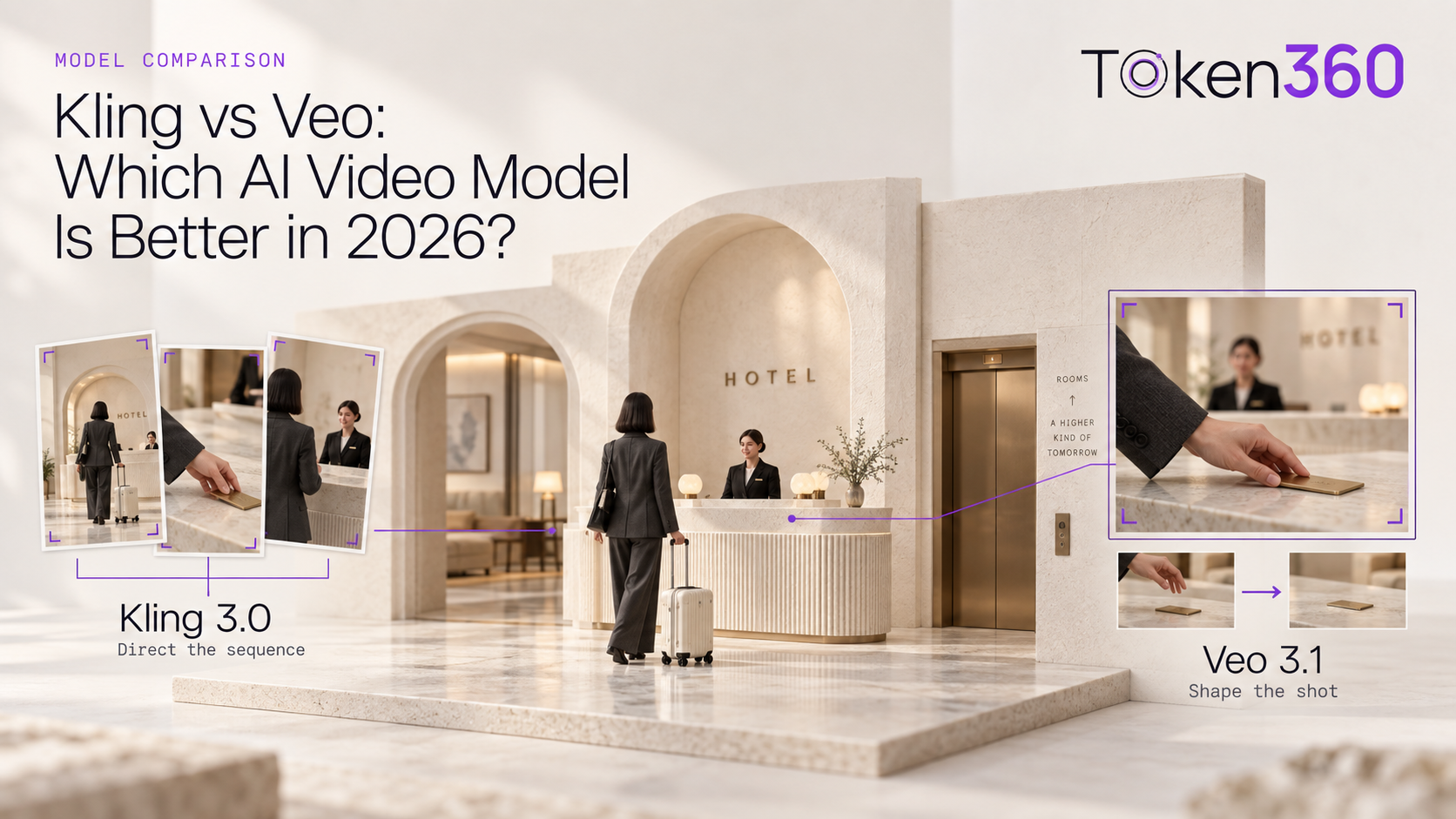
Kling 3.0 — Best for Cinematic Multi-Shot Text-to-Video
Kuaishou launched the Kling AI 3.0 series on February 5, 2026.
Kling 3.0 supports text-to-video as part of a broader multimodal architecture and extends video generation to up to 15 seconds. It also includes native audio generation across multiple languages, dialects and accents.
Best for: cinematic prompts, multi-shot storytelling and dialogue-heavy scenes.
A particularly useful capability is Kling's emphasis on narrative structure.
Instead of interpreting every text prompt as one continuous shot, Kling 3.0 is designed to handle more complex sequences involving multiple shots, narrative changes and controlled transitions. Kuaishou also highlights stronger consistency for characters, objects and scenes across frames.
Kuaishou later added native 4K video output to the Kling 3.0 series during Q2 2026.
Kling 3.0 strengths
Kling is especially interesting when a text prompt contains:
dialogue, multiple characters, scene changes, camera directions or a more cinematic sequence.
Its native audio support can also reduce the need for a separate text-to-speech or sound-generation stage in suitable workflows.
Kling 3.0 trade-off
Kling evolves quickly, and capabilities can differ between model versions and delivery surfaces. Production documentation should always be checked against the exact API version being used.
Kling AI 3.0 announcement
Google Veo 3.1 — Best for High-Fidelity Short-Form Text-to-Video
Google's current Veo family contains three principal 3.1 tiers:
Veo 3.1, Veo 3.1 Fast and Veo 3.1 Lite.
Google positions the standard model around maximum visual fidelity, Fast around production speed, and Lite around lower-cost, higher-volume generation. All three support native audio.
Best for: short, high-fidelity text-to-video generation, especially for companies already using Google Cloud.
Current Google documentation lists 4-, 6- and 8-second output durations and support for both landscape and portrait formats. Veo 3.1 can output up to 4K in supported configurations.
Veo 3.1 pricing
Google Cloud currently prices Veo by generated video duration, resolution, model tier and whether audio is generated.
For example, Google lists Veo 3.1 video-only generation at $0.20 per second for 720p/1080p, while video plus synchronized audio is $0.40 per second at those resolutions. Fast and Lite tiers are less expensive.
That means an eight-second standard Veo 3.1 generation would have a base generation cost of approximately:
Pricing can change, so the production article should identify these as current Google Cloud prices as of September 2026, not permanent rates.
Veo 3.1 strengths
Veo is particularly relevant where visual fidelity, Google Cloud integration, native synchronized audio and enterprise cloud infrastructure are important.
Veo 3.1 trade-off
Its documented single-generation duration remains shorter than Seedance 2.5 or Wan 3.0.
So Veo may be a better fit for an eight-second polished advertising shot than for a 30-second narrative generated in one pass.
Google Veo 3.1 documentation
Wan 3.0 — Best for Long Text-to-Video With Transparent Per-Second Pricing
Alibaba's Wan 3.0 is another current model capable of generating up to 30 seconds in a single pass.
It supports text-to-video as well as image, video, audio and document-driven workflows. For this article, the important point is that developers can start with nothing more than a text prompt and generate clips from 2 to 30 seconds.
Best for: long text-to-video generation and teams that want easy-to-understand per-second pricing.
Wan 3.0 pricing
Alibaba's standard international list pricing currently states:
As of September 10, Alibaba is temporarily advertising a 30% discount through September 24, 2026, but using the list price in evergreen SEO copy is safer because the promotion will expire.
This is an important SEO-content principle:
Do not build evergreen paragraphs around temporary sale prices.
Mention the promotion with an explicit expiration date if useful, but use list pricing for long-lived comparison tables.
Wan 3.0 strengths
Wan combines a long generation window, multiple resolutions, native audiovisual capability and relatively transparent pricing.
On Token360, the current Wan 3.0 endpoint supports 2–30 second text-to-video generations at 480p, 720p or 1080p.
Wan 3.0 trade-off
As with other models, the best choice depends on the desired aesthetic and workload. Duration and price alone do not establish superior output quality.
Wan 3.0 official page
MiniMax H3 — Best for Native Stereo Audio and an Open Model Path
MiniMax introduced H3 in July 2026 and open-sourced the model shortly afterward.
H3 can understand text, images, video and audio and generate video with native stereo audio, output durations of 4–15 seconds, and resolution up to 2K.
Best for: developers who want modern multimodal video generation plus an open-source deployment option.
For text-to-video specifically, H3 provides a useful middle ground between shorter premium models and 30-second systems.
MiniMax H3 pricing
MiniMax's current API pricing is straightforward:
So a 10-second base text-to-video generation would cost approximately $0.80 at 768p or $1.30 at 2K, before any applicable reference-material charges.
For pure text-to-video, those extra reference charges are irrelevant because there is no input image or video.
MiniMax H3 strengths
The combination of native stereo audio, up to 2K output, 15-second duration and an open-source model distinguishes H3 from many proprietary-only video systems.
MiniMax H3 trade-off
Self-hosting an open video model does not mean infrastructure is free or simple. High-end video inference still requires substantial GPU resources and engineering effort.
MiniMax H3 official release
Runway Dev — Best for Creative Apps That Want Automatic Model Routing
Runway Dev deserves inclusion because it is no longer simply an API for Runway's own models.
Its developer catalog now exposes several video models, including Wan 3, Seedance 2.5 and other current video options, and in July 2026 Runway launched its Model Router.
Best for: creative software that wants access to several generation models and would rather route based on cost, latency or quality than hard-code a single model.
With the Model Router, developers create a configuration defining their preferences. Runway then filters the eligible model set and selects one according to the chosen optimization objective: cost, latency or quality.
This creates an interesting alternative to model-specific integration:
Prompt → Runway Router → selected text-to-video model
The response also identifies the selected model and realized cost, giving developers visibility into the routing decision.
Runway pricing
Runway uses credits, with each selected model priced differently.
For example, its current developer pricing lists Wan 3 at 5 credits/sec for 480p, 10 credits/sec for 720p and 20 credits/sec for 1080p. Seedance 2.5 uses different rates and can include additional charges when input or reference video is involved.
For text-only Seedance generation, there is no input-reference video charge, but the output pricing still varies by resolution.
Runway trade-off
Runway is primarily a creative-media developer platform. If the same application also needs a broad catalog of LLM, speech and enterprise inference APIs, a broader multimodal gateway may better match the overall infrastructure.
Runway Model Router documentation
Which Text-to-Video API Is Best for Your Use Case?
A useful comparison is based on the workload rather than a generic ranking.
This is much more defensible than publishing an arbitrary “#1–#7 quality ranking.”
How Much Does a Text-to-Video API Cost?
Text-to-video pricing should be compared at the workload level, not by taking one provider's cheapest advertised number.
Three currently documented examples illustrate the range:
*Veo's documented output lengths are currently 4, 6 or 8 seconds, so the 10-second figure is shown only to normalize the rate mathematically; it is not a valid single 10-second Veo request. Google currently documents 4-, 6- and 8-second generation lengths.
What Makes a Good Text-to-Video API?
For production systems, visual quality is only one part of the decision.
A useful text-to-video API should also provide predictable task states, clear model versioning, programmatic output retrieval, understandable billing, error handling and a migration path when better models become available.
The last point is increasingly important.
In a short period, the market has moved through multiple generations of Seedance, Kling, Veo, Wan and MiniMax models. Building application logic too tightly around a single model-specific request format can therefore create future migration work.
That does not automatically make an aggregator better than a direct API. It means developers should make an explicit architectural choice between maximum provider-native control and lower model-switching friction.
Direct Text-to-Video API vs Multi-Model API
A direct integration is usually appropriate when one model is central to the product.
For example:
Application → Google Vertex AI → Veo 3.1
The advantage is direct access to Google's model-specific features, infrastructure and release cycle.
A multi-model architecture instead looks like:
Application → Token360 → Seedance / Wan / MiniMax / other supported video models
The advantage is reducing the amount of application infrastructure tied to a single model vendor.
Neither approach is inherently superior.
For a studio building specifically around Veo's capabilities, direct Vertex AI access may make sense.
For an AI creative product that regularly tests new video models, multi-model access may reduce integration work.
Example: Generate Text-to-Video With Token360
A simple text-only generation uses the same normalized endpoint as other supported Token360 video workflows:
curl -X POST https://api.token360.ai/v1/videos \
  -H "Authorization: Bearer $TOKEN360_API_KEY" \
  -H "Content-Type: application/json" \
  -d '{
    "model": "wan3.0-video",
    "prompt": "A cinematic drone shot following a vintage convertible along the Pacific Coast Highway at sunset",
    "duration": 8,
    "resolution": "1080p",
    "aspect_ratio": "16:9",
    "generate_audio": true
  }'
The API returns a task ID. The application then polls the corresponding video endpoint until the status becomes completed or failed. Token360 also provides a separate endpoint for retrieving the completed video as a redirect, signed URL or binary stream.
Full video generation API reference
Text-to-Video API vs Image-to-Video API
Text-to-video starts with language alone.
This gives the model broad creative freedom and is useful for ideation, scene generation and workflows where no visual asset exists yet.
Image-to-video starts from an existing frame or asset.
That usually gives developers more control over character appearance, products, composition and visual identity.
For example:
Text-to-video:
“A luxury watch floating above black volcanic rock in a dark studio.”
Image-to-video:
Upload the actual watch product image, then instruct the model to rotate the camera around it.
For branded production, image-to-video can therefore be more controllable.
For zero-asset generation and ideation, text-to-video is simpler.
Frequently Asked Questions About Text-to-Video APIs
What is the best text-to-video API in 2026?
There is no universal winner.
Seedance 2.5 and Wan 3.0 stand out for longer generation up to 30 seconds. Kling 3.0 is compelling for cinematic multi-shot storytelling, Veo 3.1 for high-fidelity short-form production, and MiniMax H3 for native stereo audio and an open deployment option. Developers who need several models through one integration can evaluate multi-model platforms such as Token360 or Runway Dev.
Which text-to-video API can generate the longest video?
Among the models compared here, Seedance 2.5 and Wan 3.0 both document up to 30 seconds of video in a single generation. Kling 3.0 and MiniMax H3 document up to 15 seconds, while Google's current Veo 3.1 documentation lists 4-, 6- and 8-second outputs.
Which text-to-video APIs generate audio?
Seedance 2.5, Kling 3.0, Veo 3.1, Wan 3.0 and MiniMax H3 all have current model capabilities that include native audiovisual generation. Exact dialogue, sound-effect, music and audio-control features vary by model and API implementation.
What is the cheapest text-to-video API?
There is no reliable universal answer because models use different resolutions, durations, audio settings and promotional pricing.
For current published base rates, MiniMax H3 lists 768p output at $0.08 per second, while Wan 3.0's standard 720p list price is $0.10 per second. Google Veo 3.1 Lite can be cheaper for supported shorter workloads, depending on resolution and audio settings.
The correct comparison is the cost of the same production workload, not the smallest number on each pricing page.
Can I use multiple text-to-video models through one API?
Yes.
Token360 exposes supported video models through a normalized /v1/videos endpoint, while Runway Dev offers both direct model access and a Model Router that can select among eligible models according to cost, latency or quality preferences.
Build Text-to-Video With Multiple Models Through One API
The video-generation market is moving quickly enough that locking an application to a single model can become an architectural decision, not just a creative one.
Token360 lets developers access supported video-generation models through one normalized API while using the same platform for language, image and audio workloads.
Explore video generation models
View the Video Generation API


 Tutorial
 Comparison
 Comparison