Code2Video-AA vs AI Video Rankings: What Are Buyers Actually Comparing?
Understand the Code2Video-AA benchmark, its model rankings, and how code-authored motion graphics differ from native AI video generation for product teams.
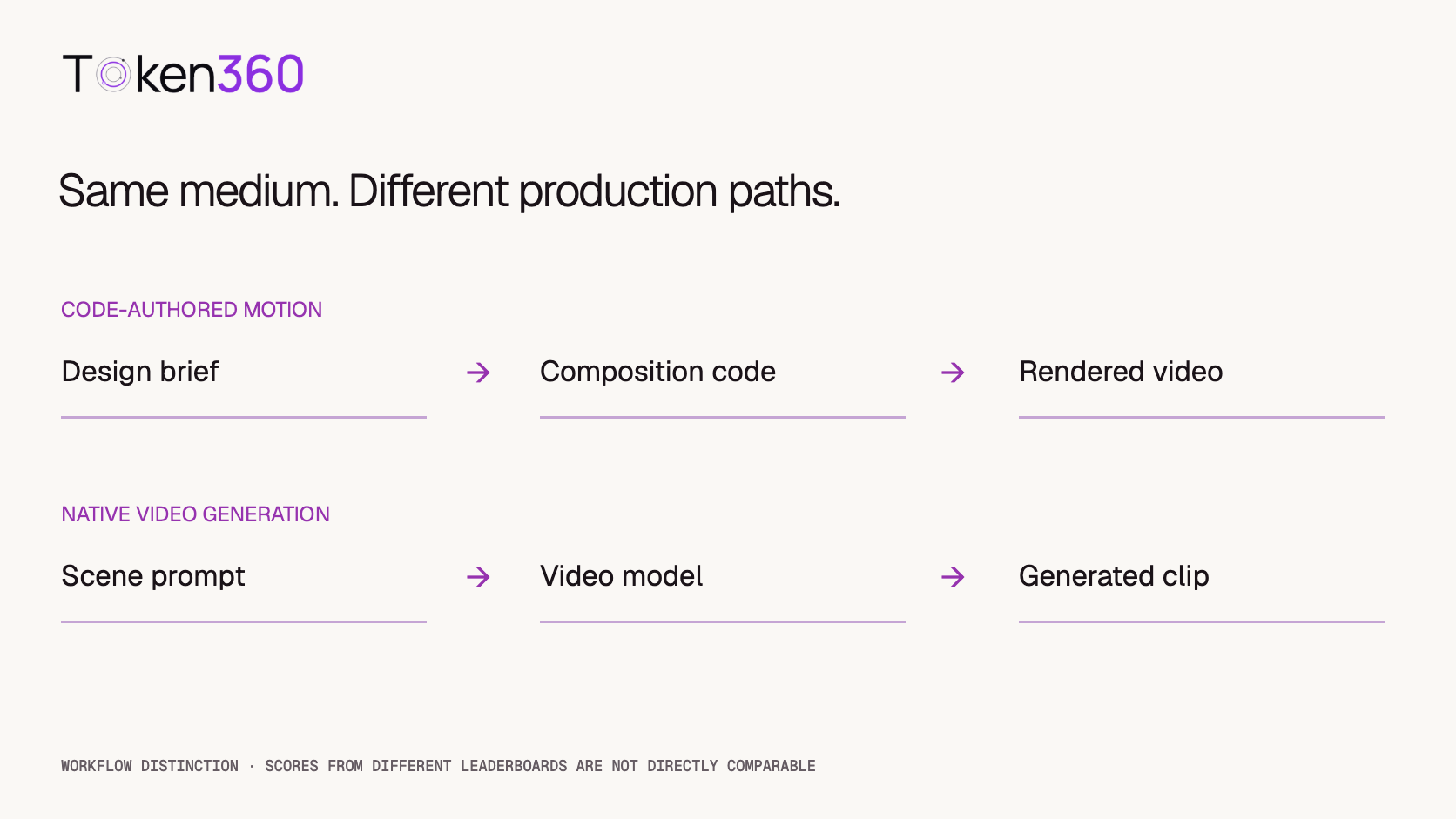
Code2Video-AA evaluates models that write code to produce designed videos. A text-to-video leaderboard evaluates video-generation models. Both deliver moving images, but their scores answer different buying questions. The distinction matters when a team wants an animated product announcement, a cinematic campaign shot, or a combination of the two.
Read first: our AI model evaluation framework explains how to turn external benchmarks into application-specific decisions.
This is a dated analysis of public evidence, checked October 29, 2026. Token360 is an AI API platform; the workflow recommendations below are our editorial interpretation. We did not run these benchmarks, and this article does not establish that every ranked model is available through Token360.
What does the Code2Video-AA benchmark measure?
Artificial Analysis gives a model a design brief and evaluates its rendered HyperFrames HTML composition. Gemini 4 Argon judges anonymous pairs of videos across engagement, prompt intent, composition, temporal consistency, and craft. The overall Elo combines those five axes. This is a test of producing designed motion through code, rather than generating a photographic scene directly. See the Code2Video-AA evaluation page.
The important buying question is therefore specific: can this model convert a communication brief into a visually coherent motion composition? That question is particularly relevant when the deliverable contains messaging, layout, staged reveals, and timing. It is less informative about whether a separate video model can synthesize believable rain, fabric movement, or a moving camera.
What the latest Code2Video-AA snapshot shows
Configuration
Displayed Elo and interval
Claude Opus 5.5 (Max, Default Fallback)
1536 ± 26
Claude Sonnet 5.5 (Max, Default Fallback)
1443 ± 24
GPT-6 Astra (Max)
1427 ± 24
GPT-6.1 Sol (Max)
1369 ± 23
Source: live Code2Video-AA leaderboard, checked October 29, 2026. These are configurations, including effort and fallback labels, rather than interchangeable family names. The October 26 launch analysis describes Sonnet and Astra as within noise of each other; the numerical ordering should not be presented as a decisive separation.
For a buyer, the leading score creates a candidate to inspect. It does not replace watching outputs that resemble the intended campaign. A model might make an impressive opening sequence while choosing a visual rhythm that feels wrong for a quiet enterprise announcement. That mismatch is a creative decision, even if the benchmark has been measured correctly.
Why this is different from a text-to-video ranking
Artificial Analysis’ text-to-video board uses human preference comparisons of generated clips. The with-audio view, labeled AA-Video-T2V v2.1 at our check, includes audio in the comparison. This is a different evaluation population and judging procedure from Code2Video-AA. See the text-to-video leaderboard.
Decision
Code-authored motion graphics
Native video generation
Starting point
A composition brief translated into code
A prompt, sometimes with reference inputs depending on the model
Does the layout and timing communicate the message?
Does the shot depict the intended scene and motion?
Revision question
Can the composition change without breaking the animation?
Can a new generation or supported edit preserve what already worked?
Evidence needed
Rendered output plus maintainable source
Output quality plus the specific model’s controls
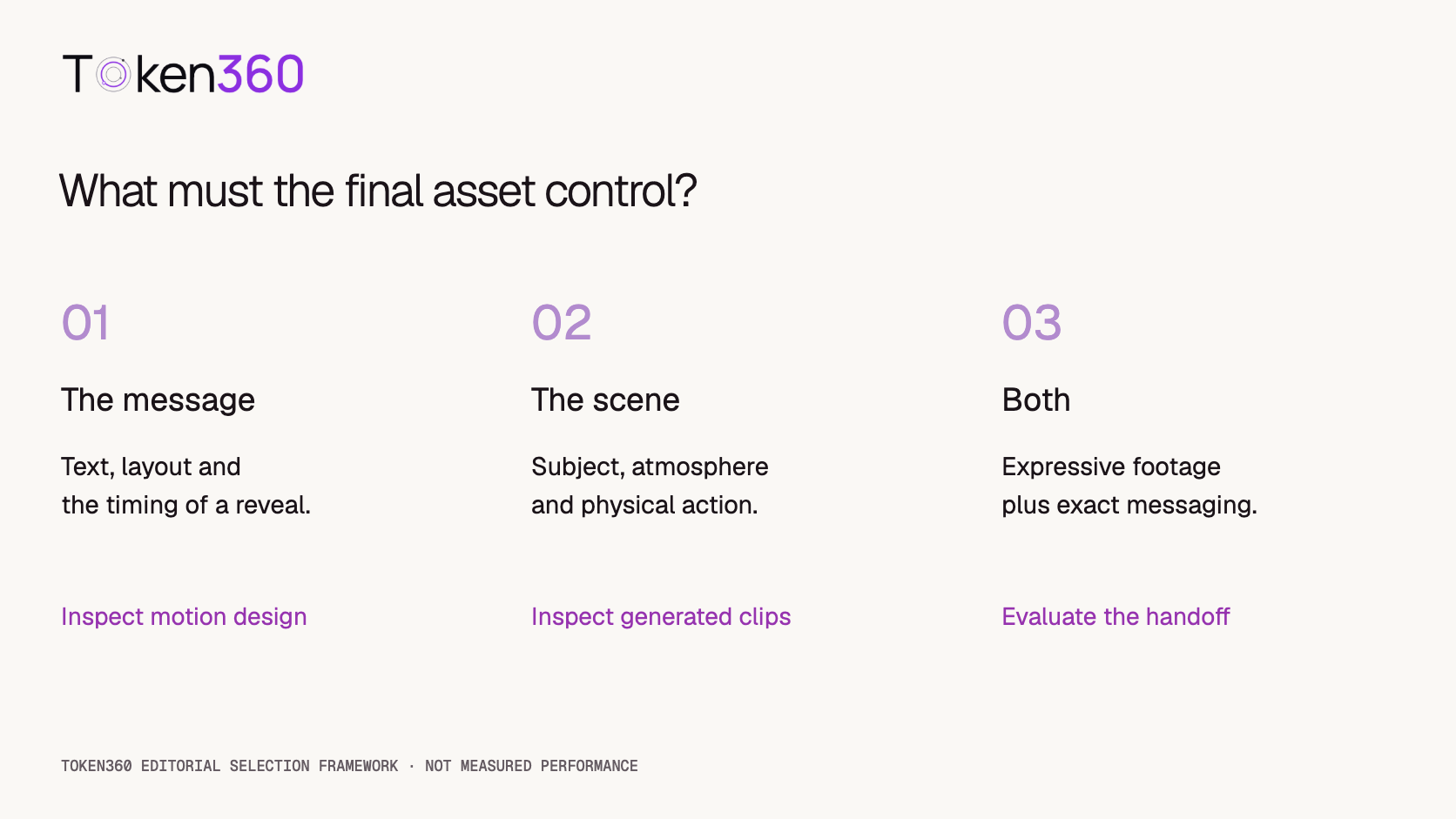
The use cases in this table are our selection framework, not measured advantages or exclusive capabilities. Native video can produce graphics, and code compositions can contain media. The distinction is where the team expects control to live.
Choose the production path before interpreting its leaderboard.
Never compare an Elo number on one board with an Elo number on the other. A larger number does not establish a better video product across different task sets, competitors, and judging systems. The same warning applies when a vendor places unrelated benchmark badges next to each other in a product announcement.
A rendered video is not necessarily a successful video
The launch analysis reports that 3,042 of 3,078 Code2Video-AA tasks rendered, a 98.8% rendering rate. That technical completion figure coexists with substantial differences in judged quality. The same source reports evaluation costs of $3.08 per task for Opus and $0.31 for Sol. These are benchmark-run costs, not Token360 prices or complete production budgets. See the dated launch results.
A render answers a narrow question: did the process produce a playable result? A marketing owner asks additional questions. Is the product claim accurate? Is the headline readable long enough? Does the ending leave space for the call to action? Does the composition survive a copy change? A technically valid clip can fail every one of those requirements.
This suggests keeping three acceptance decisions separate: technical completion, communication quality, and release readiness. Counting all completed renders as approved assets would hide creative rework. Conversely, treating a visually weak first draft as a platform outage would misdiagnose the problem. The team needs both operational and editorial evidence.
One campaign brief, three plausible production choices
Consider a hypothetical launch for a project-management app. The deliverable is a short announcement showing an overdue task becoming an organized plan, followed by a clear product name and a closing message. This example is an editorial scenario; we have not generated or scored these alternatives.
Choice A: a designed motion sequence
Represent tasks with simple shapes, animate their rearrangement, and control the product text in the composition. This makes the communication structure central to production. The evaluation should include headline readability, visual hierarchy, transition timing, and whether a reviewer can revise the wording without rebuilding everything.
Choice B: a generated cinematic shot
Use a visually expressive scene to convey the feeling of moving from overload to calm. The evaluation shifts toward subject coherence, motion, atmosphere, and whether the shot supports the intended emotional tone. Exact product messaging may be handled in a later composition stage rather than embedded in the generated scene.
Choice C: a hybrid deliverable
Generate the atmospheric shot, then compose the product message and ending around it. HyperFrames documents HTML-based compositions, media support, and a browser-to-video rendering pipeline. That provides a concrete example of how code-authored motion can incorporate media rather than compete with it. See the official HyperFrames repository.
The hybrid choice adds a handoff. A team must manage the source clip, placement, cropping, duration, and audio relationship. It may nevertheless be the right decision when the brief needs both expressive imagery and controlled messaging. The relevant comparison is the complete deliverable, not which subsystem won a different benchmark.
An original selection framework, not a measured performance comparison.
Read the methodology before turning a ranking into a claim
The original HeyGen benchmark contains 168 curated reference videos across product-launch communication stages. Artificial Analysis’ implementation uses a selected 114-brief subset. These are related evaluations, not identical experiments. Compare the original HeyGen research with the Artificial Analysis methodology.
AA specifies one generation per model per brief without tools, an offline rendering environment, and a standalone evaluation outside Intelligence Index v5. Its 95% intervals reflect comparison sampling, not variation across briefs or repeated generations. Those boundaries matter when interpreting close results or predicting a production workflow with iterative editing. See the methodology.
A one-shot result and a designer-assisted process answer different questions. A model with a weaker initial draft might become useful after targeted revision; a strong first draft might be difficult to maintain. Neither possibility is established by the ranking. If editability matters to procurement, collect editability evidence rather than assuming the overall score already contains it.
What this means for an AI API shortlist
Start with the asset requirement. For message-led motion design, inspect code-to-video examples and source quality. For a generated scene, inspect the relevant video board and representative clips. For a hybrid, evaluate both the generation and composition handoff. Then confirm the actual model ID, supported inputs, and response behavior on the deployment platform.
Token360’s model capability documentation is the appropriate place to begin platform-specific checks. A model family’s appearance on an external leaderboard does not prove a particular endpoint, configuration, or toolchain is supported. This article does not announce a Token360 HyperFrames integration.
When building an internal comparison, use the same communication brief and record revisions as well as first outputs. Separate model charges from rendering, asset preparation, and review labor. Mark results as your own only after running the test. The useful next step is a small, inspectable production comparison, with accepted deliverables and rejected attempts retained together.
FAQ
Is Code2Video-AA a text-to-video model leaderboard?
No. It evaluates code-authored video compositions produced by models. The resulting videos are judged, but the production task differs from native scene generation.
Which configuration leads the checked snapshot?
Claude Opus 5.5 (Max, Default Fallback) leads the October 29 snapshot shown above. Recheck the linked live board before making a current-ranking claim.
Can I compare Elo across the two boards?
No. Elo belongs to its evaluation context. Different opponents, tasks, and judges prevent a direct numerical comparison.
Does a high render rate mean the videos are ready to publish?
No. Rendering is technical completion. Brand accuracy, readability, message quality, and release requirements still need review.
Can code-authored videos use generated footage?
Yes, a composition workflow can incorporate media. Check the chosen tool’s asset and timing requirements, then evaluate the combined result.
Are the quoted task costs Token360 prices?
No. They are third-party evaluation figures from the dated launch report. They exclude any inference we might otherwise make about a complete production budget.



 Comparison
 Comparison
 Tutorial