AI for Property Managers: Organize Maintenance Requests
Use AI APIs to organize resident maintenance requests. Verify property, unit, related reports and access details before a reviewed vendor handoff.
INDUSTRY USE CASES · PROPERTY MANAGEMENT
Property managers can use AI model APIs to turn resident messages into structured maintenance requests, identify missing details and prepare a coordinator's handoff. The workflow must preserve the correct property, unit, reported issue and access arrangements. A clear summary is not a diagnosis, an authorized entry or a confirmed vendor appointment.
The enterprise opportunity is a better intake process across a property portfolio. Residents describe problems in different languages, attach photos and follow up through multiple channels. A reviewed assistant can organize that information before staff decide what happens next. It should make uncertainty visible rather than hide it behind a confident response.
Evidence boundary: This is a proposed workflow for property management companies and software teams serving them. Official platform documentation was checked November 14, 2026. The example is fictional; no Token360 property-management integration or measured operational result has been demonstrated.
Which property management task is a useful starting point?
Start with staff-reviewed maintenance intake rather than autonomous dispatch. The assistant can summarize the resident's report, extract the affected location and ask for missing information. Staff retain responsibility for escalation, access arrangements, vendor selection and commitments. This creates a bounded task with a result a coordinator can inspect before acting.
Consider a portfolio where requests arrive through a resident portal, email and transcribed calls. The task is not to generate more messages; it is to produce one coherent record without losing the original evidence. A good draft identifies what the resident observed, what remains unknown and which existing request may be related.
Check your existing platform first. Buildium's Resident Center already supports maintenance requests with details or photos, status updates and appointment coordination features. A model API should address a remaining interpretation or cross-system problem, rather than recreate a form or notification the business already owns.
Input problem
Useful AI assistance
Required control
Long or fragmented message
Summarize the reported issue and timeline
Keep the original report available
Ambiguous location
Identify missing property or unit details
Use trusted account records to resolve identity
Repeated follow-up
Suggest a related request for review
Do not silently delete or merge reports
Vendor handoff
Prepare a concise, source-linked brief
Coordinator approves assignment and shared information
What should a maintenance request record contain?
The record should identify the property and unit, the resident's observations, the affected area, timing, attachments and outstanding questions. Keep scheduling preferences and recorded access arrangements separate. Include the original source and update time so staff can verify the summary and recognize when a later message changes the situation.
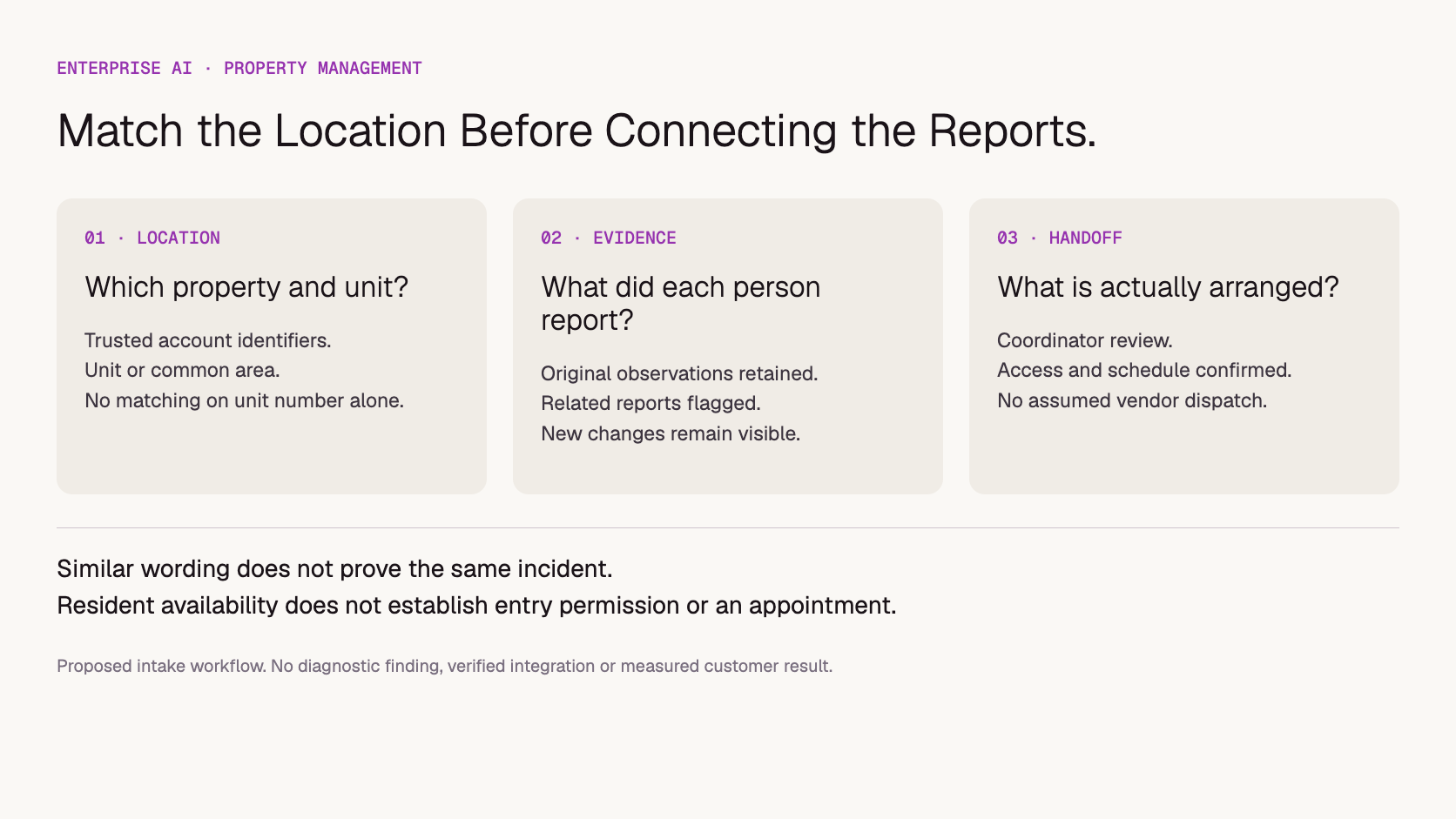
Use structured fields for identifiers rather than asking the model to choose a building from a familiar name. “Unit 204” is not unique across a portfolio. The application should resolve the authenticated account and allowed properties first, then provide the relevant context to the assistant. If the resident reports a common-area problem, do not force it into the resident's unit merely because that unit is on the account.
Preserve meaningful details in the resident's wording: when the issue began, whether it is intermittent, what location is affected and whether the condition has changed. A summary that removes “now spreading to the hallway” can be grammatically correct while losing the important update.
Photos can supplement the report but should not be treated as proof of the underlying cause. Record what the resident says and what is visibly present separately from any professional finding. This article does not propose that a general-purpose model diagnose building faults or determine whether an environment is safe.
How should repeated reports across units be handled?
Repeated reports should be linked for coordinator review while preserving each resident's observations and location. Similar wording can describe one shared incident or several unrelated problems. AI can suggest a relationship, but it should not close a request, suppress a new report or announce a common cause without operational confirmation.
Fictional example: A resident in Building A, Unit 204 reports a ceiling stain. Later, a resident in Building A, Unit 304 reports water near an appliance. Another message says “still happening,” but comes from Building B, Unit 204. The repeated unit number and related vocabulary create two different risks: missing a possible building-level connection and wrongly joining an unrelated property.
Report
Useful draft interpretation
What must not be assumed
Building A, 204: ceiling stain
Keep the exact location and reported condition
That the cause is already known
Building A, 304: water near appliance
Flag a possible relationship for staff review
That it caused the issue in 204
Building B, 204: “still happening”
Retrieve the correct property's earlier request
That matching unit numbers mean the same incident
Any later report of worsening conditions
Preserve the new observation and route for review
That it is merely a duplicate to discard
The coordinator's view could show “possible related reports in Building A” with both source messages. It should still retain separate resident contacts and work records. The Building B request remains separate unless staff find a legitimate connection.
If a shared incident is confirmed, the application can associate the records and track communication to each affected resident. Do not reveal another resident's private report in an automatically generated reply. A portfolio-level overview and a resident-facing update have different information needs.
Proposed intake controls, not a deployed property-management integration.
Why are resident availability and permission to enter different?
A resident's preferred time is scheduling information; it should not be rewritten as permission to enter or a confirmed appointment. Record the actual access arrangement through the organization's approved process. The assistant can expose missing information and prepare a clarification, while the application and staff enforce the applicable requirements.
For example, “I am home Tuesday afternoon” does not establish that a vendor has accepted that time. “Please call first” should remain visible in the handoff rather than disappear during summarization. Do not infer entry authorization from the existence of a maintenance request.
AppFolio's vendor portal documentation describes work orders, vendor coordination and resident availability information. These are useful examples of operational records an assistant may need to explain. They do not demonstrate a Token360 connector or establish the access rules for a particular property.
Keep sensitive access details out of general model context when they are not needed for the language task. A draft may only need to say “access arrangements require confirmation.” Authorized staff and systems can manage the underlying instructions through the appropriate channel. Local entry requirements and company policy should be handled by the responsible team, not improvised by a model.
How should urgency and escalation work?
Use the property's approved escalation process, and do not make a general-purpose model the sole gatekeeper for urgent reports. The assistant should preserve concerning descriptions and route uncertainty to a human. The workflow should offer a direct path to the organization's urgent-response channel without waiting for a generated summary or extra photos.
For the initial pilot, let the model identify missing information and draft summaries for staff. Do not let it downgrade a request, assure a resident that conditions are safe or issue improvised repair instructions. The organization must define who reviews uncertain cases and what happens when the assistant or integration is unavailable.
Test this as a workflow property, not just a prompt instruction. A resident must not be trapped in a clarification loop before reaching the designated response route. Measure whether the system preserves escalation cues during transcription, translation and summarization. A message can become less useful if any of those stages soften the resident's description.
This is an intake design recommendation, not emergency-response guidance. Deployment requires the property operator to validate its own procedures, staffing and escalation coverage.
Should you buy platform features or build with a model API?
Use the existing property platform when its request forms, communication and vendor workflows meet the need. Consider a custom API when intake spans systems or requires specialized language handling. Model access supplies inference; the property application still needs identity resolution, permissions, work-order connections and a supported review process.
Option
Useful fit
Buyer check
Existing portal and templates
Standard requests in one system
Can required fields and better routing solve the problem?
Platform-native AI features
Assistance within the current property workflow
Which actions, review controls and source records are supported?
Custom model API integration
Cross-system intake or specialized processing
Who owns identity matching, connectors, evaluation and support?
Before building, demonstrate read access to the necessary records with the actual account permissions. Then test a draft handoff that does not change the work order. Creating assignments, contacting vendors and sending resident messages should be separate capabilities with explicit controls.
The software-versus-model-API guide explains the commercial boundary. Do not buy inference expecting it to include a resident portal, vendor network or property-specific operational process.
How should a property portfolio evaluate a pilot?
Evaluate correct routing and preserved information before writing style. Include repeated unit numbers, common-area requests, follow-ups, changed conditions and unclear access preferences. Have an experienced coordinator define the expected record first, then measure review time and errors. Faster summaries do not prove a better process if they misroute work or omit important details.
Use authorized examples with personal information minimized. For each case, retain the expected property, location, relevant prior request and next review action. Compare the assistant with the existing intake process using the same source records.
Identity: Did the record resolve the right building and unit?
Evidence: Did the summary retain the resident's observations without inventing a cause?
Relationships: Were possible duplicates flagged without losing separate reports?
Access: Were availability, permission and appointment confirmation kept distinct?
Escalation: Did important changes remain visible and reach the required review route?
Effort: How much coordinator time was spent reviewing and correcting the draft?
Copy the blank property maintenance intake review register below. It contains no performance results. Track wrong-property errors and omitted escalation details separately from minor wording edits. Apply pilot-to-production readiness checks before extending automation beyond reviewed intake.
What should property management teams discuss with Token360?
Describe the input channels, languages, document formats, peak request volume and staff review process. Token360 provides enterprise access to text, image, audio and video models. Pricing, dedicated capacity, contracts and compliance requirements are scoped to the engagement. The property system remains responsible for resident identity, work orders, permissions and operational actions.
Start with text if portal messages and emails are sufficient. Add audio transcription only where voice reports are actually part of intake, and evaluate location names and changed-condition descriptions carefully. Images may help document a reported issue, but adding vision does not validate diagnostic or safety decisions.
As checked November 14, 2026, the Token360 enterprise page distinguishes current offerings from roadmap and sales-scoped services. Confirm the exact model, throughput, support and contractual requirements. About Token360 provides company context.
Token360 does not charge a separate service fee, according to confirmed company positioning. Model usage, property software, integration and review still contribute to cost. Prepare expected volumes with the enterprise quote checklist, and evaluate data retention and training separately. No reduction in maintenance costs or response times is claimed here.
A model can propose routing within approved rules, but assignment requires the operational system, current vendor information and appropriate authority. This article recommends beginning with a reviewed handoff rather than automatic dispatch.
Can a photo establish the cause of a maintenance issue?
Not in this proposed workflow. A photo can supplement a resident's report. A qualified assessment and the operator's process must establish any diagnosis or safety conclusion.
Should similar requests be merged automatically?
No. Suggest a relationship for review while preserving each report. Similar language or matching unit numbers can refer to different properties, causes or incidents.
Does submitting a request authorize entry?
The assistant should not assume that it does. Record and apply the organization's approved access process and applicable requirements separately from scheduling preferences.
Does Token360 include a property-management connector?
No specific connector has been verified for this article. Confirm integration scope with the property software provider and implementation team before procurement.
Read next: Use the AI API total cost framework to include integration maintenance, review and exceptions in the business case.
Enterprise AI
API
Bring your next idea to life.
Create a video scene in Creator, or explore models for images, audio, and text to find the right capabilities for your project.


 Guides
 Guides
 Guides