Shadow test an AI model with approved request copies. Isolate candidate outputs, control costs and side effects, and compare results before rollout.
ENTERPRISE AI · SHADOW TESTING
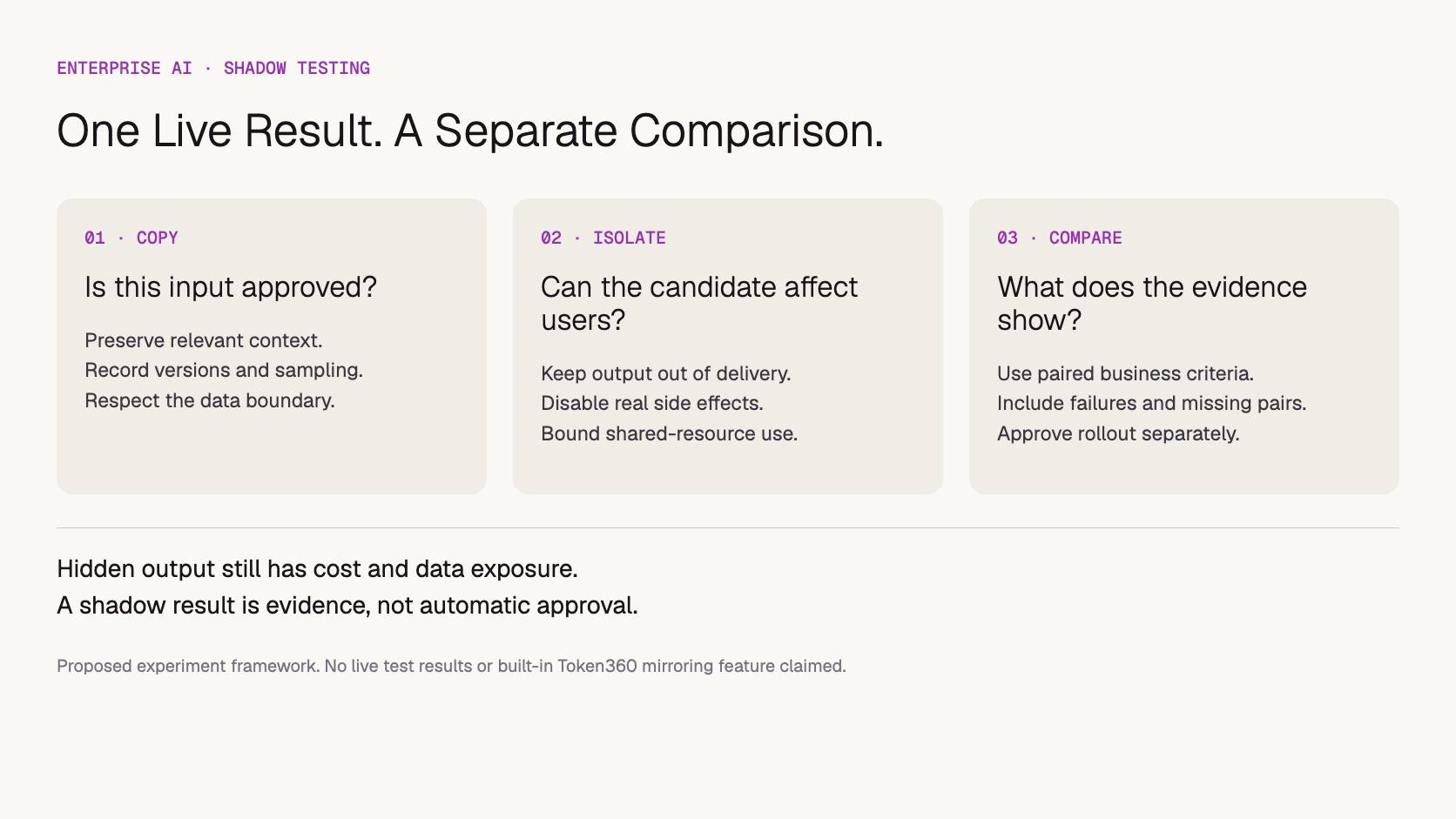
AI model shadow testing sends an approved copy of selected requests to a candidate while the existing model continues serving customers. Candidate results are evaluated separately and must not trigger customer-facing responses or business actions. This can reveal how the candidate handles realistic inputs before rollout, but it still consumes resources and processes data.
The enterprise decision is not just whether to duplicate traffic. It is whether the experiment can produce a useful comparison without changing the live experience, exceeding its budget, or expanding data access beyond the approved scope. A hidden output does not make a test harmless.
Scope: This is a proposed testing design, not a report of a Token360 experiment or a claim that Token360 has a built-in shadow-testing service. Examples are illustrative. Official sources were checked November 15, 2026; no performance, savings, or success-rate results are claimed.
Read first: The production model evaluation framework defines quality gates. This guide focuses on the narrower experiment between offline evaluation and exposing a candidate to customers.
How does shadow testing differ from A/B testing?
In a shadow test, only the established production path supplies the live result. In an A/B test, customers receive results from different variants so their outcomes can be compared. Offline replay uses previously captured inputs. These methods answer different questions, and shadow results alone cannot establish how customers will respond to the candidate.
Method
Input
Who receives the candidate result?
What it helps assess
Offline evaluation
A curated or captured test set
Evaluators
Defined task quality and integration behavior
Shadow test
Approved copies of selected current requests
Evaluators, not live users
Candidate behavior on the observed workload
A/B or controlled rollout
Assigned live traffic
Some live users
Actual user and operational outcomes under exposure
Amazon SageMaker AI's shadow-test documentation illustrates the distinction: requests are copied to a shadow variant while the production response is returned to the application. That is a documented AWS implementation with its own endpoint restrictions, not evidence that every model API offers the same feature.
Use shadow testing when the candidate already passes basic eligibility and offline checks, but you need evidence from the current input mix. Do not use customer traffic to discover that a model cannot accept the required format or that its processing scope has not been approved.
What should be copied to the candidate?
Copy the authorized task context needed for a fair comparison, not merely the last sentence a user typed. Depending on the application, that may include the system instructions, conversation state, retrieved evidence, tool definitions, or referenced assets. Record any differences so that an incomplete candidate input is not mistaken for weak model performance.
For a support assistant, both paths should see the same approved account context and knowledge version when the goal is to compare model behavior. If the candidate uses a different retrieval system, the experiment is comparing two broader configurations, which can be valid but should be named accurately.
Use a correlation ID to pair the records. Keep model/version, prompt version, settings, input transformation, and timestamps with each observation. Do not assume that the same parameter names or numeric settings mean equivalent behavior across models.
Before copying production content, verify that the candidate's processing arrangement permits it. The input-minimization guide helps define the smallest useful payload. If the required data cannot be sent under the approved arrangement, use an authorized offline or synthetic alternative instead.
How do you stop the candidate from taking real actions?
Keep the candidate outside the live action path. A shadow output must not send messages, change records, publish assets, or issue another real operation simply because the model proposed it. Enforce that boundary in the integration rather than relying only on a prompt saying “this is a test.”
Illustrative example: An assistant can draft a response and propose a ticket update. In the shadow branch, the proposed update is captured as a test artifact; an inert tool adapter records the intended operation without modifying the ticket. Reviewers can assess its target and arguments without allowing a duplicate update.
If a later reasoning step requires a tool result, choose deliberately between a controlled fixture, an approved read-only query, and a recorded production result. Each changes the interpretation. Reusing a production tool response may be inappropriate if the candidate requested a different operation.
A shadow test of a tool proposal is not a full test of action execution. Keep those findings separate. The tool-call execution guide explains the boundary between model output and application action.
Isolation needs to cover responses, tools, resources, and stored results.
Can the extra traffic slow down production?
Yes. Even when the candidate's answer is hidden, copying requests can consume shared connections, quotas, workers, storage, or model capacity. The production response should not wait for the candidate to finish. Bound the shadow branch and define how it sheds or stops work if it threatens the live path.
Do not assume that creating a separate API key creates separate capacity. Confirm the shared limits and give the experiment a submission cap, cost budget, maximum duration, and stop owner. Monitor both branches so that a candidate slowdown does not produce an expanding backlog of retained customer data.
Sampling can reduce load, but record how requests are selected and which are skipped. A test that drops every long request during busy periods may overrepresent easy work. Report skipped, expired, and failed cases instead of presenting only completed pairs.
The workload-prioritization guide covers admission and fairness. For this experiment, protecting production takes precedence over completing every shadow request. Record that limitation in the findings.
How should the results be compared?
Evaluate paired outcomes against the same business rubric, not against identical wording. The production answer is a baseline, not automatically the correct answer. Review both against source evidence and task requirements, while keeping latency, errors, cost, and incomplete comparisons visible alongside quality.
Dimension
Question
Common misleading shortcut
Correctness
Does each answer satisfy the task and evidence?
Treating similarity to the existing answer as correctness
Integration
Can the application use the returned structure or asset?
Accepting fluent prose while ignoring missing required fields
Latency
What timing boundary and queue conditions were measured?
Comparing isolated candidate calls with fully loaded production
Cost
What did all attempted candidate work and review cost?
Counting only successful generations
Coverage
Which tasks, languages, sizes, and failures were observed?
Generalizing from completed easy cases
Where practical, hide model identity from reviewers and randomize presentation order. Keep a process for disagreements, and audit any model-based evaluator on representative examples. An evaluator's preference should not override mandatory requirements such as source accuracy or an approved output format.
For image, audio, and video candidates, compare acceptance against the same brief rather than expecting matching pixels or waveforms. Keep generated files separate from customer deliverables. Include storage, processing time, and review effort in the experimental cost.
What can a shadow test not prove?
It cannot directly measure customer satisfaction, conversion, or task completion with an answer customers never saw. It also cannot establish full-load performance if only a small fraction of traffic reached the candidate. Treat results as evidence for a next decision, not as a universal production-readiness certificate.
Multi-turn products need special care. A candidate may produce a different reply, which could lead the user to ask a different next question. Feeding it the actual conversation that followed the production answer evaluates that supplied history; it does not recreate the candidate's own conversation trajectory.
Cached context, different queues, and tool-result substitutions can also affect the comparison. Document these differences. A useful report explains both the observed result and the conditions under which it might not transfer to rollout.
When the evidence supports progress, move to a separately approved, limited rollout with monitoring and rollback. The provider migration guide covers that wider transition. Do not automatically promote a candidate just because the shadow test ended.
What should the experiment plan contain?
Write the decision, eligible traffic, isolation controls, evaluation rubric, resource limits, and stopping conditions before starting. Assign someone to review the result and someone to stop the experiment. A test that produces logs but no acceptance decision is an ongoing duplicate workload, not a completed evaluation.
A proposed plan should answer:
Which candidate configuration is being compared with which baseline?
Which request categories may be copied, and under what data approval?
How are customer responses and real side effects excluded from the candidate branch?
What stops the test when cost, latency impact, errors, or retention limits are reached?
How are sampled-out requests and missing pairs reported?
What findings lead to rejection, further testing, or a controlled rollout?
Use the blank shadow-test plan to record these choices. It is a planning worksheet, not a tested configuration. Retain only the comparison evidence required under the approved policy, and include candidate files and diagnostic logs in cleanup.
Token360 can be part of the model-access layer for evaluating candidates across text, image, audio, and video. The application team still needs to define traffic selection, isolation, pairing, and acceptance. Confirm model availability, input support, capacity, and data requirements before sending mirrored requests.
Token360's enterprise offering, checked November 15, 2026, provides a starting point for discussing pricing and production requirements. Dedicated capacity, contracts, and compliance scope should be agreed for the engagement. This guide does not assert a built-in traffic-mirroring feature or free duplicate inference.
Bring the candidate model, expected test volume, largest inputs, run window, and stopping budget to that conversation. Use the enterprise quote brief to separate experiment usage from production demand. See About Token360 and resources for company context.
Use feedback on AI answers to carry reviewed failure cases from the live workflow into the next model evaluation.
Frequently asked questions
Is shadow testing free because users do not see the output?
No. Candidate inference and supporting infrastructure can incur charges. Agree a budget and include failed attempts, storage, and review rather than assuming hidden output is unbilled.
Must every production request be copied?
No. An approved sample may be sufficient for the question being tested. Describe the sampling method and coverage limits; a small sample cannot establish full-load behavior.
Can the shadow model become a fallback during the test?
Doing so changes the experiment because its output can reach users. Treat fallback as a separate authorized configuration with its own acceptance criteria.
Can I shadow test a model with a different prompt?
Yes, but you are comparing configurations, not isolating the model change. Record both prompts and explain which decision the comparison supports.
Does a successful shadow test mean migration is complete?
No. Real user exposure, operational ownership, rollback, and cleanup still require a controlled transition. Shadow evidence supports that decision; it does not replace it.
Enterprise AI
API
Bring your next idea to life.
Create a video scene in Creator, or explore models for images, audio, and text to find the right capabilities for your project.



 Guides
 Guides
 Guides