Prioritize AI requests by business deadlines and resource needs. Protect interactive work, keep background jobs moving, and test shared-capacity limits.
ENTERPRISE AI · WORKLOAD PRIORITIES
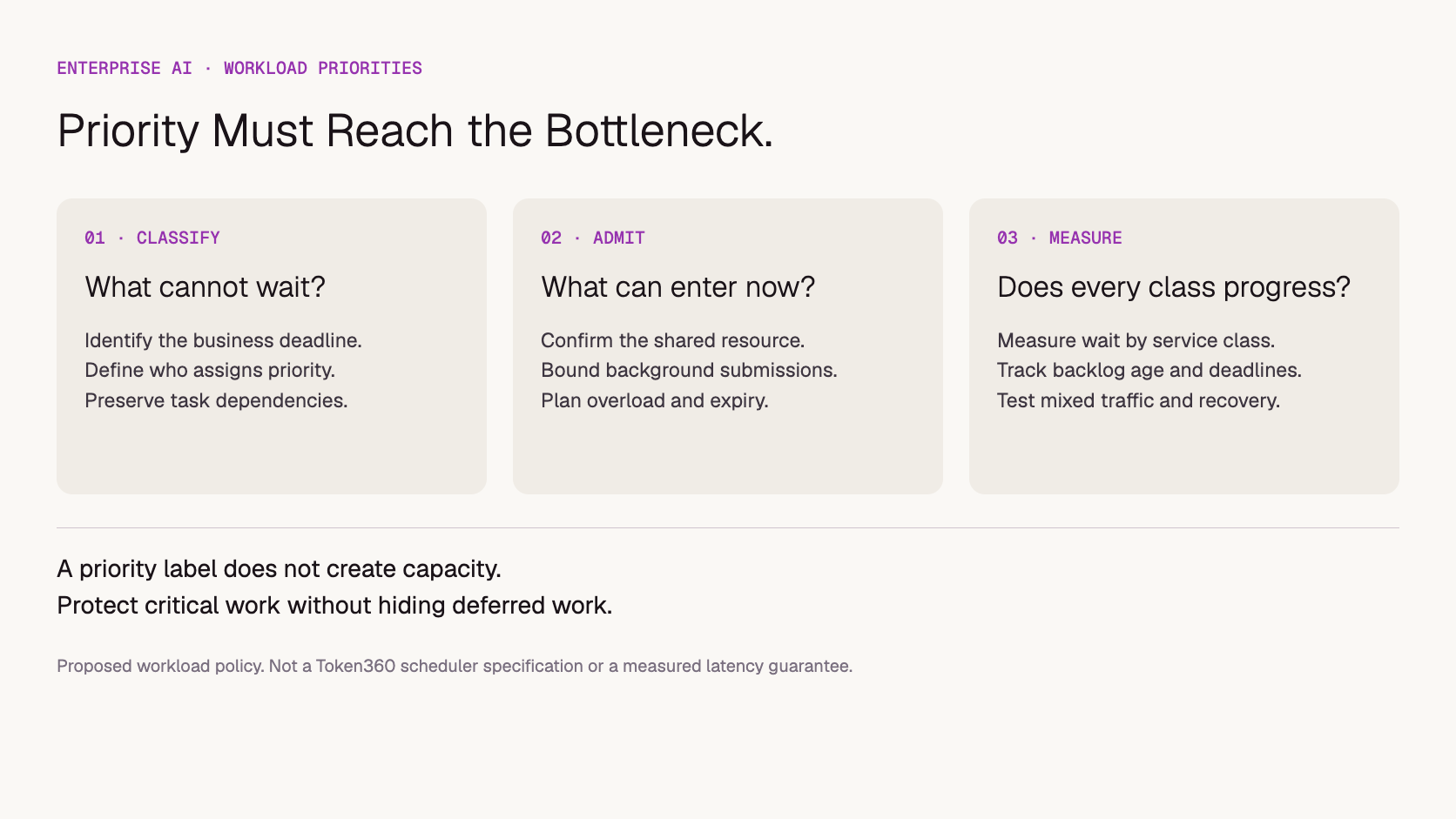
Prioritize AI requests by business urgency, useful deadline, and resource requirements—not simply by which team submits first. Protect capacity for interactive work, limit background admission, and give deferred work a way to make progress. The policy must operate where requests enter a constrained resource; adding a priority label to a prompt does not establish a service guarantee.
This matters when a company runs customer-facing assistance, internal document processing, and bulk content generation through shared infrastructure. A large background upload can consume the resources that a live interaction needs. Conversely, an unrestricted stream of urgent work can prevent scheduled jobs from ever finishing.
Scope: This is a proposed workload-management framework, not a Token360 scheduler specification or a performance benchmark. Examples are illustrative. Official architecture and enterprise sources were checked on November 15, 2026. No latency or capacity guarantee is implied.
Read first:Dedicated capacity versus rate limits explains what capacity purchases do and do not establish. This article addresses how a business allocates access among competing workloads.
Which AI requests should receive priority?
Give priority to work whose delay creates a defined business consequence, while accounting for how much processing it requires. A user actively waiting for assistance differs from a job that can finish overnight. Define the service classes centrally so that individual teams cannot make every request urgent by choosing a label.
Illustrative class
Example
Policy question
Interactive
A support agent waiting for a suggested response
How long is the answer still useful, and what happens after that?
Deadline-driven
A reviewed campaign asset needed for a scheduled launch
When must processing start to leave time for review?
Deferrable
Catalog descriptions for next week's refresh
What completion window and minimum progress are required?
Experimental
An internal prompt comparison
Which limits prevent the test from affecting production?
These classes need not correspond directly to departments. One marketing request may be deadline-critical while another is exploratory. A customer-facing request may also be too large to serve within an interactive deadline and need a different product experience.
The business owner should define the consequence of delay; engineering should verify whether the workload can meet the objective. If a promise is not achievable with the available model and capacity, a priority label does not make it achievable.
Where must prioritization happen?
Apply admission and scheduling rules before work occupies the constrained resource. Your application can control when it submits a request, but it cannot assume control over the provider's internal queue or an already-running generation. Identify the actual shared limits before deciding which local queues or reservations will help.
Microsoft's Priority Queue pattern describes processing work by relative importance rather than arrival order, using one or multiple queues. It also warns that lower-priority work can be indefinitely delayed. This supports separating urgency from FIFO order; it does not show that a particular AI endpoint accepts a priority parameter.
For an AI application, investigate shared request limits, token throughput, active-job limits, connection pools, and downstream review capacity. Text and video jobs do not necessarily use the same upstream resources, even if the company pays one consolidated bill. Confirm the constraint for the specific model and route.
For background work, keep control of how many jobs are admitted at once rather than submitting the entire backlog immediately. Once a long-running operation is accepted upstream, do not assume that a later urgent request can interrupt it. Cancellation and preemption are separate capabilities that must be verified.
What would a company-wide policy look like?
A practical policy assigns each workload an owner, service class, admission limit, deadline, and overload response. It also defines whether unused allocation may be borrowed and when that borrowing stops. Document the behavior at capacity limits so that teams know whether work will wait, expire, or require intervention.
Illustrative scenario: A company runs a live support assistant and a nightly knowledge-summary job against the same approved text-model deployment. The background producer submits many large documents just before support traffic rises. Both jobs are legitimate, but their deadlines differ.
A proposed design would admit only a bounded amount of background work while retaining headroom for live traffic. The background queue remains visible, and an owner is alerted if its completion window becomes unattainable. This is not proof that a particular allocation will work: the team must test mixed traffic using realistic input and output sizes.
Policy field
Decision to record
Priority authority
Who may assign or override the service class?
Resource scope
Which deployment, quota, pool, or active-job allocation is shared?
Admission
How much new work may enter while other classes are active?
Deadline
When does a pending result lose its value?
Borrowing
May a class use idle allocation, and how is new borrowing stopped?
Overload response
Wait, reject, defer, expire, or seek an approved alternative?
Recovery
Who owns the backlog and verifies completion after the peak?
Do not assign a universal percentage to each class without evidence. A short text completion and a long document response can have very different resource demands. An allocation expressed only as a request count may therefore be misleading.
Do separate API keys provide separate capacity?
Separate keys can support identification and accounting, but they do not by themselves prove resource isolation. Two keys may still draw from the same quota, deployment, or provider pool. Ask which resource is actually separated and what happens to one workload when the other reaches its limit.
Microsoft's Bulkhead pattern describes dividing resources into pools to limit interference and cascading failures. It also identifies tradeoffs in utilization and management complexity. For AI procurement, the relevant question is which layer is partitioned—not whether the architecture has more credentials.
The staging and production isolation guide covers environment boundaries. Production workload prioritization is a different decision: several production services can compete with one another even when testing is fully separated.
Dedicated capacity may help when its scope matches the contention, but do not equate a higher request limit with protected throughput. Discuss the actual workload and acceptance test using the capacity guide rather than relying on an account label.
How do you prevent background jobs from waiting forever?
Define minimum progress or a latest-start rule for deferred work, and monitor whether it remains achievable. Strictly serving urgent traffic first can starve the backlog. Choose an explicit fairness policy, then evaluate its effect on both live service and scheduled completion rather than hiding missed deadlines in a low-priority queue.
Possible policies include bounded service shares, scheduled processing windows, or promotion as a job approaches its deadline. These are design choices, not interchangeable guarantees. Promotion still cannot create more capacity, and blindly promoting every old item can recreate the same overload.
Preserve ordering dependencies. A revised document should not be processed and published before a required prerequisite simply because it has a higher priority. Track the work item's version and dependencies alongside its service class.
Also isolate persistently failing items from useful waiting work. Retries should retain an explicit budget and deadline, not repeatedly jump to the front. Coordinate this with SDK retry behavior so that hidden attempts do not consume the allocation you intended for new work.
Priority is a policy from arrival to completion, not just a queue label.
What should the user see when capacity is full?
Show a state that reflects what the system has actually accepted and can still deliver. Waiting locally, accepted upstream, running, completed, and expired are different states. Avoid presenting an optimistic completion promise when the queue has no evidence to support it, particularly for time-sensitive customer interactions.
For an interactive assistant, a clear temporary-unavailability response or an established non-AI support path may be preferable to an answer that arrives after the user has left. For a scheduled job, a delayed-start notification can be useful if an owner has time to adjust the plan.
Changing the model is a separate decision. A cheaper or more available model may have different output quality, input support, or data-handling scope. Prioritization should not silently bypass the approved model policy. Use the fallback guide for authorized alternatives and their validation.
Expired local work should not continue to be newly submitted merely because it reached the front of a queue. For work already running upstream, verify the supported cancellation behavior and account for any remaining result handling or charges.
How should you test and measure the policy?
Test classes together under a bounded, representative workload. Measuring the support assistant alone and the background job alone will not reveal interference. Compare queue wait, completion deadlines, accepted results, and failures for each class, and include the recovery period after a burst ends.
Use synthetic or approved inputs and begin in a controlled environment. Exercise normal demand, a background surge, simultaneous peaks, a slow dependency, and retry pressure. Stop before exceeding the agreed test budget or affecting unrelated users.
Interactive work: record application wait, time to first output where relevant, and complete-response time.
Deadline work: record whether usable output arrives with enough time for downstream review.
Deferred work: record oldest-item age and completion progress, not only total throughput.
All classes: record admission decisions, expirations, failures, retries, and approved model changes.
A global average can conceal a class that repeatedly misses its objective. Publish per-class distributions and deadline outcomes with workload sizes and model configuration. The latency measurement guide defines timing boundaries; this article adds the business-class comparison.
The blank workload-priority register records ownership, shared-resource scope, service objective, admission policy, fairness rule, and overload behavior. It contains no suggested capacity numbers or benchmark results.
What should enterprise teams confirm with Token360?
Bring the workload mix and service objectives, not only monthly usage. Explain which tasks are interactive, which can wait, their peak overlap, and the model requirements. Ask what capacity arrangement and limits apply, what evidence can validate them, and which scheduling responsibilities remain in your application.
Token360's approved scope includes enterprise model access across text, image, audio, and video, with dedicated capacity, pricing, contracts, and compliance requirements scoped to the engagement. The enterprise offering, checked November 15, 2026, is a starting point for a workload discussion. This article does not claim a generally available per-request priority parameter, automatic fair scheduler, or universal latency guarantee.
For the quote, include representative sizes, expected peak traffic, tolerated wait, and recovery requirements. Use the enterprise quote brief to capture those inputs. Company context is available in About Token360 and resources.
Frequently asked questions
Can I write “urgent” in the prompt to get faster service?
That is an instruction inside the task content, not evidence of infrastructure priority. Only documented and enabled scheduling controls can establish how the service handles priority.
Should every customer-facing request be high priority?
Not automatically. Consider deadline, resource demand, and the promised experience. A customer-requested long video can be asynchronous even though a live support reply needs quick service.
Is a Batch API the same as a low-priority queue?
No. Batch is a service interface with its own documented processing and billing behavior. An application-managed deferred queue is a scheduling choice. See Batch API versus real-time processing.
Does priority mean an active job will be interrupted?
No. Admission order and preemption are different capabilities. Do not assume an accepted or running job can be paused or canceled to free capacity.
Will priority reduce the bill?
Not necessarily. Protected allocation may be underused, and scheduling adds operational work. Evaluate whether the service outcome justifies the total cost rather than treating priority as a discount.
Enterprise AI
API
Bring your next idea to life.
Create a video scene in Creator, or explore models for images, audio, and text to find the right capabilities for your project.



 Guides
 Guides
 Guides