How Should Enterprises Collect Feedback on AI Answers?
Turn AI answer feedback into evidence and verified fixes. Learn what to collect, who should review it, and why ratings are not accuracy scores.
ENTERPRISE AI · USER FEEDBACK
Collect feedback against a specific AI answer, ask what prevented the user from completing the task, and route the report to an accountable owner. Keep enough approved context to investigate, separate preferences from verified errors, and test the proposed change before closing the report. A rating button starts this process; it does not complete it.
For an enterprise deploying models through Token360, the useful question is not simply whether employees like the assistant. It is whether the company can turn a complaint into a justified change: correct a source, repair an integration, adjust a prompt, evaluate a different model, or explain why the original answer was appropriate.
Evidence and scope: This article proposes an application-level feedback process. It is not a Token360 customer case study or a claim that Token360 provides an integrated feedback-management system. Examples and the downloadable worksheet are illustrative. Official sources were checked November 15, 2026.
Why are thumbs-up and thumbs-down ratings not enough?
A rating tells you how a user reacted, but rarely explains the cause. An answer can be accurate yet unhelpful, persuasive yet wrong, or correct for the wrong customer. Use the rating as an entry point for a short reason and task context, rather than treating approval as a correctness label.
Google's People + AI Guidebook distinguishes explicit feedback from behavioral signals and recommends explaining what feedback will influence. That distinction matters in enterprise products: copying an answer may mean it was useful, or merely that the employee needs to edit it elsewhere. A retry may signal an error, a preference, or exploration.
Make the first question specific: “Did this answer help you complete this task?” Then offer an optional reason. Avoid asking users to diagnose the underlying model. They can often identify a wrong date or missing step without knowing whether retrieval, instructions or generation caused it.
Keep positive feedback useful too. Ask what worked when appropriate, such as clear instructions or a relevant source. Preserve examples of acceptable behavior so a change intended to fix complaints does not remove something users need.
What should the feedback form ask?
Ask for the failed expectation, the affected answer and an optional explanation. Offer a small set of understandable reasons, an “other” option and a separate route for urgent sensitive-content reports. Require only information necessary for triage; a long mandatory form can make reporting a problem harder than abandoning the feature.
User-facing reason
Useful optional follow-up
Initial review direction
Incorrect or outdated information
Which claim is wrong? Is there an approved source?
Check evidence and applicability
Did not answer my question
What task were you trying to complete?
Check intent and workflow coverage
Wrong format or tone
What format would help?
Review output requirements
Action did not happen
What should have changed?
Check tool and application state
Unexpected sensitive information
Use the restricted reporting route
Escalate through security procedures
The form should allow users to skip free text and should not ask them to paste passwords, full customer records or entire conversation histories. Tell them what will be attached automatically. A message such as “This report includes the selected answer and its reference ID” is more informative than a generic thank-you if that is what the application actually sends.
Microsoft's Teams documentation provides a concrete implementation example: message-level reactions can open a feedback form, but the agent runtime must handle the submitted feedback. The existence of buttons does not establish that reports are stored, reviewed or resolved.
What context should be saved with a report?
Save the minimum authorized context needed to locate and reproduce the issue: the answer reference, task, application version, model identifier, prompt-template version and relevant source references. Record what the reviewer can actually access. If content cannot be retained, preserve permitted metadata and explain the investigation limits instead of silently collecting everything.
Separate the user's report from the technical trace. A product manager may need a sanitized problem summary, while a restricted reviewer needs a source excerpt. Keep tenant and access boundaries on both. A feedback spreadsheet should not become a new unrestricted copy of information the assistant was designed to protect.
For retrieval-based answers, retain permitted source versions or effective dates, not just a link to a document that may change tomorrow. For an action complaint, record the application outcome separately from the generated sentence. “Your request has been submitted” and a successful transaction are different evidence.
Apply the same data-minimization principles used before model submission to feedback collection. Decide who may inspect attached content, how long it is needed and how corrections or deletion requests affect the review record. Do not forward raw feedback to an external model provider by default.
How do you decide whether the AI was actually wrong?
Compare the reported answer with the task requirements and authoritative evidence before assigning a defect. Keep the original reaction, the reviewer's finding and the proposed cause as separate fields. User dissatisfaction is real evidence about experience; it is not automatic proof that the model made a factual error or that the suggested correction is valid.
Consider an illustrative employee assistant that says an expense is not reimbursable. The employee gives it a negative rating and cites an older policy. A reviewer finds that the newer rule applies to that employee's region. The response may be substantively correct but poorly explained. Replacing it with the employee's preferred answer would introduce an error.
Conversely, a confidently written answer may receive a positive rating because the user does not know it uses the wrong customer's terms. Sample some unreported and positively rated outputs for review; complaints alone cannot reveal every defect. Use a consistent rubric and retain “insufficient evidence” as a valid outcome.
When sources disagree, resolve which company source governs the answer before labeling either the output or user correction as correct. For consequential decisions, preserve the existing human approval process while investigating. A feedback feature is not a substitute for that control.
Who should act on the feedback?
Route reports by the problem they reveal, not automatically to the model supplier. Source owners handle incorrect reference content; application teams handle missing context and failed actions; prompt and evaluation owners assess generation behavior. Assign one case owner to coordinate the decision, including cases that cross several teams or cannot yet be reproduced.
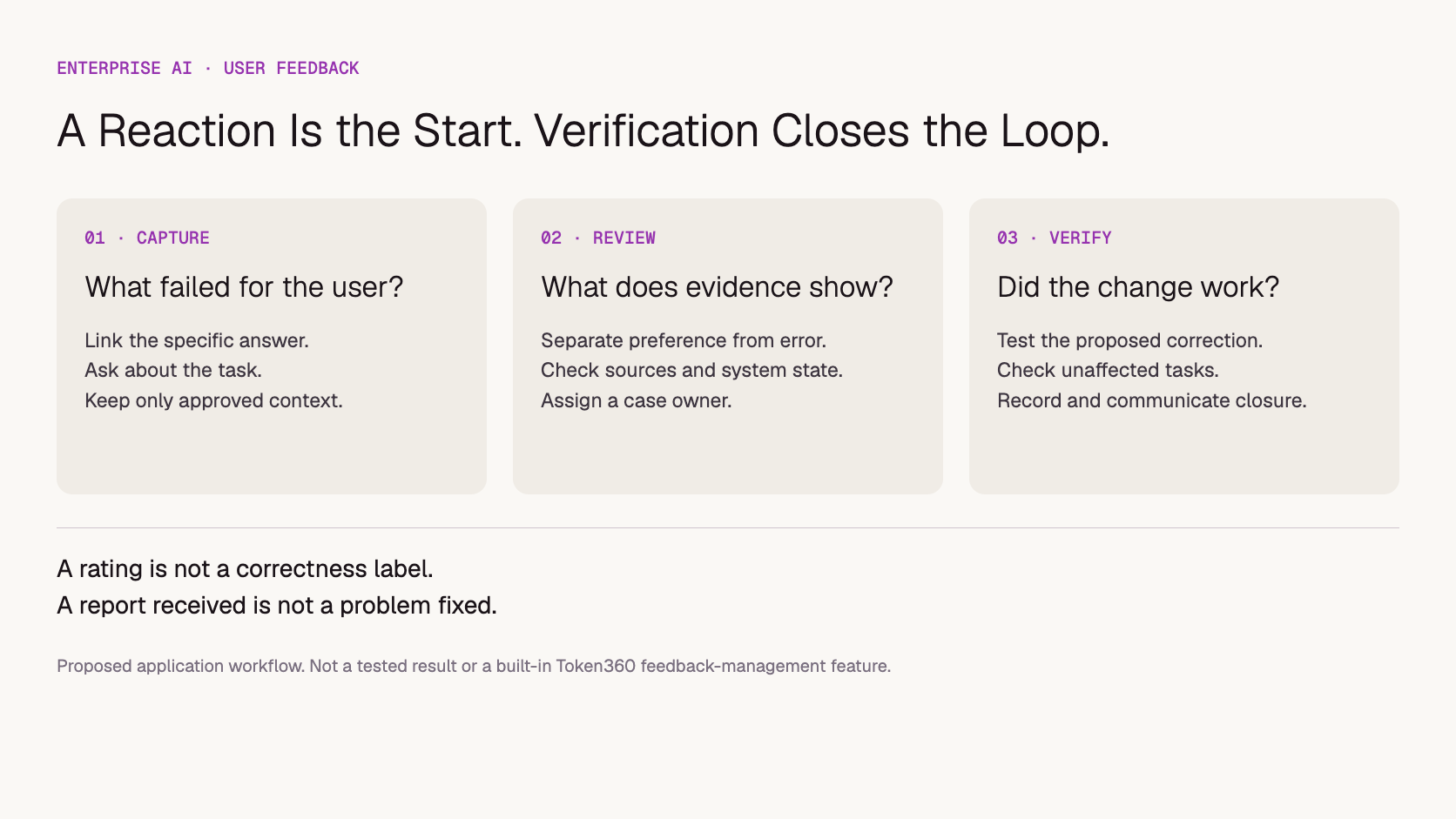
A useful sequence is: acknowledge receipt, triage impact, investigate, propose a change, verify it and communicate the disposition. Let urgent exposure reports enter the established incident process immediately. Routine writing preferences can enter a product backlog. Their response paths should not depend solely on how many users clicked a negative button.
Proposed feedback workflow. Reporting a problem and verifying a fix are separate steps.
For a possible model or API issue, assemble a sanitized reproducible example and relevant request identifiers through the approved support channel. For a broader pattern of worsening answers, use a dedicated quality-regression investigation. This article focuses on the feedback intake and resolution process, not the full diagnosis or model-selection framework.
Does feedback automatically train the model?
No. Collecting a report in your application does not by itself update a model. Feedback can inform a manual correction, a prompt change, a source update, an evaluation case or a separately governed training process. Explain which of these happens in your product, and never promise that one click permanently teaches the assistant.
A user correction also needs review before becoming a test label or training example. Check whether it is accurate, authorized for reuse and representative of the intended task. Remove unnecessary identifying details. Keep an evaluation set separate from examples used to tune the system, so testing can reveal generalization rather than familiarity with known cases.
For a proposed model change, compare the corrected behavior with unaffected tasks and important edge cases. A fix for short answers can damage completeness; a change to make the assistant more agreeable can weaken appropriate refusals. Promote the change only after the relevant acceptance checks, rather than declaring success because the originally reported prompt now looks better.
How should teams measure the feedback process?
Measure reporting coverage, investigation outcomes and verified resolution separately. Track whether users can report issues, whether reviewers can explain them and whether deployed changes reduce recurrence. A positive-rating share among respondents is a satisfaction signal from that group, not the accuracy rate of every answer the system generated.
Coverage: feedback submissions relative to eligible answers, with the collection method stated.
Investigability: reports with enough permitted evidence to reach a finding.
Disposition: confirmed defect, preference, correct behavior, duplicate or unresolved.
Resolution: time to an owned decision and, separately, time to verified correction.
Recurrence: repeated instances of the same confirmed issue after the change reaches production.
Compare like with like: task, language, user group, interface and release. A new feedback button can increase reports without a quality decline. A disappearing complaint stream can indicate a broken submission handler. Deduplicate repeated reports without losing the number of affected users or tasks.
Do not publish precise business gains from these measures without evidence. This article contains no benchmark for acceptable feedback rates or resolution times; set targets according to the consequence of the workflow and the team's operating capacity.
Where does Token360 fit in this process?
Token360 supplies enterprise model access across text, image, audio and video; the customer's application remains responsible for connecting user feedback to business tasks and review decisions. Model access can support a controlled comparison after a problem is identified. It does not establish the cause of a complaint or automatically validate a proposed fix.
The Token360 enterprise offering is relevant when the investigation leads to requirements for model access, pricing or capacity. Confirm the scope of support and available request evidence for the engagement. This article does not assert built-in feedback analytics, automatic fine-tuning or access to customer conversations.
Start with one application and a named owner. Use the blank feedback review worksheet to define what a report contains, who reviews it and what evidence closes it. Add more collection channels only when the team can process what they already receive. Company information is available in Token360's resources and About section.
Should employees have to explain every negative rating?
No. Keep an optional reason or comment and permit a quick report. Investigators may need follow-up for complex cases, but forcing detailed explanations on every interaction can discourage feedback. Label reports with insufficient evidence honestly instead of converting guesses into confirmed defects.
Can we use all user corrections as training data?
Not automatically. Review correctness, permission, sensitive content and relevance before reuse. Decide whether the example belongs in a source correction, test set or training process. A suggested answer can reflect one person's preference rather than the company's approved rule.
Should we switch models when users dislike answers?
First identify the failure. Missing data, the wrong document, unclear instructions or a failed integration may remain after a model switch. Evaluate a candidate model when the evidence points to a capability gap, using the same task requirements and appropriate controls.
What should users see after submitting feedback?
Confirm receipt and explain what happens next. Distinguish a report received from a problem verified or fixed. If individual follow-up is available, show the disposition and any required user action; otherwise explain the review process without promising a personal response or immediate improvement.
Enterprise AI
API
Bring your next idea to life.
Create a video scene in Creator, or explore models for images, audio, and text to find the right capabilities for your project.


 Guides
 Guides
 Guides