What Data Should You Remove Before Calling an AI API?
Reduce AI API inputs without losing useful context. Decide what to remove, replace, or retain, then check attachments, logs, and answer quality.
ENTERPRISE AI · DATA MINIMIZATION
Remove information the model does not need to complete the authorized task. That often includes credentials, unrelated customer records, contact details, signatures, and unnecessary document history. Keep the facts and relationships required for a useful answer. Where identity is needed only to reconnect the result to your application, consider a controlled placeholder instead of sending the original identifier.
AI API data minimization is a task-design decision, not simply a command to delete every name. A support summary may need the product, fault, and attempted repair, but not the customer's home address. A delivery-planning task may genuinely need location information. Decide what the specific operation requires before constructing the request.
Scope: This is an application-design guide, not a finding that a dataset is legally anonymous. Examples are fictional and the review method is proposed, not a measured Token360 customer test. Official sources were checked on November 15, 2026.
Read first:AI data readiness covers whether inputs are fit for a business task. This article focuses on reducing what leaves your application while preserving that task's meaning.
Which information does the model actually need?
Start with the output you want and work backward to the minimum supporting facts. For each field, ask whether removing or generalizing it changes the model's ability to produce an acceptable result. Keep a reason for including sensitive details instead of inheriting every field from an existing database export.
In a proposed support-summary workflow, the model might need the device model, symptoms, sequence of events, troubleshooting steps, and unresolved question. The application can retain the customer identity and ticket-routing details without including them in the model's content input.
Information
Possible treatment for a support summary
Reason to reconsider
Customer name and email
Replace with a scoped customer placeholder
Exact wording is needed for an explicitly approved identity task
Street address
Omit; retain region only if relevant
Location directly changes the required answer
Product model and fault code
Retain when needed to interpret the issue
Check whether either reveals restricted commercial information
Dates and elapsed time
Retain sequence or durations when sufficient
An exact deadline or chronological comparison requires actual dates
Password, access token, or connection secret
Exclude from content sent for summarization
Use a dummy representation for debugging; authenticate through the intended mechanism
Other customers' conversation history
Exclude
Only include separately authorized, task-relevant material
This table is not a universal removal policy. The right payload for a summary differs from the payload for an authorized address-verification task. Record the decision per workflow and review it when the task changes.
Should you delete, generalize, or replace a value?
Delete a value when it serves no purpose. Generalize it when a less specific version is sufficient. Replace it with a stable placeholder when the model needs to track an entity without knowing its real identity. Preserve relationships deliberately; careless replacement can turn several people or orders into one indistinguishable object.
For example, replacing every person's name with [PERSON] may make a dispute summary ambiguous. Scoped labels such as CUSTOMER_A and AGENT_B can preserve who reported a problem and who suggested a remedy. The application should generate and control those labels rather than letting the model invent the identity mapping.
Operation
Illustrative transformation
Important limitation
Omit
Remove an unrelated email signature
Check that it does not contain relevant instructions or context for the authorized task
Generalize
Use “three days after delivery” rather than a calendar timestamp
Do not use this where exact dates determine the answer
Replace consistently
Use ORDER_A throughout the same case
The mapping still needs protection
Retain under approved scope
Keep a required product specification
Necessary information can still be confidential
A replacement identifier does not establish anonymity. A mapping can reconnect it to a person, and surrounding facts may also reveal identity. Treat a transformed record according to its remaining sensitivity; do not label it “safe to share anywhere” just because direct names were removed.
What would a smaller request look like?
A useful reduced request keeps the task, evidence, and uncertainty while omitting identity that is irrelevant to the answer. It should still allow a reviewer to determine whether the model summarized the right events. The following fictional example illustrates the input design; it is not an API schema or a measured output.
Task: Draft an internal support summary. Do not decide eligibility.
Case: CASE_A
Product: countertop coffee machine, model CM-7
Reported issue: water leaks from the left side during extraction.
Timeline: delivered 3 days before the first report.
Checks completed: tank reseated; leak still observed.
Open question: whether the leak is from the tank or brew assembly.
Needed output: issue, checks completed, missing evidence, next question.
The customer's name, email, phone number, and address are absent because this summary does not require them. The unresolved source of the leak remains explicit. The application can attach the generated summary to the correct case using its internal mapping after checking the result.
If the next task is arranging a collection, the required data changes. Do not assume the summary model should receive shipping details merely because a later operational system will need them. Give each stage its own input boundary, as discussed in model roles within one workflow.
Where should removal happen?
Apply the intended transformation before the relevant external processing boundary. If the objective is to avoid sending a value to a model provider, asking that same provider to remove it first has already transmitted it. Map the complete path, including document extraction, OCR, transcription, logging, and fallback calls—not just the final generation request.
A locally managed preprocessing step is one possible design. A separate hosted redaction service is another, but that service becomes an additional recipient to assess. Choose the approach based on the approved data flow rather than assuming the word “redaction” means processing remains inside your environment.
Inspect the actual outbound request in a controlled test. A cleaned text prompt can coexist with an attached original PDF or an accessible image URL. Sending both defeats the intended reduction if the original still contains the removed information.
For images and PDFs, verify the transmitted asset rather than only the preview. An overlay that looks opaque is not evidence that underlying text or image content was removed. Also review filenames, document properties, and extracted text. For audio or video, consider spoken identifiers and visible details separately; editing a transcript does not change an attached recording.
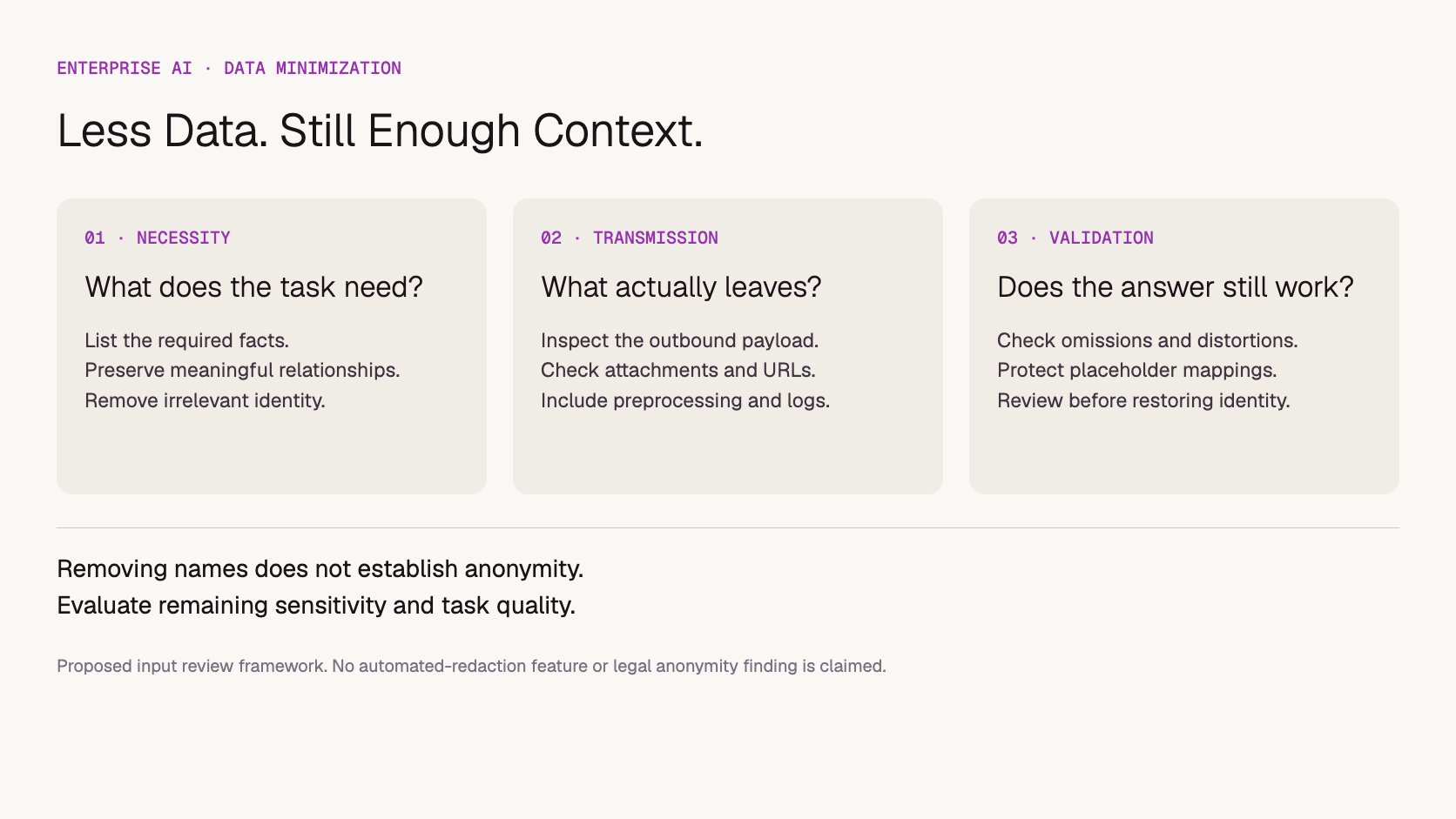
Validate what is needed, what is transmitted, and whether the reduced input still works.
Can an automated PII detector do all of this?
A detector can help locate candidate personal information, but it cannot define every business requirement or guarantee that nothing sensitive remains. Evaluate it on your document types, languages, and field conventions. Review both missed information and unnecessary removals, because either can undermine the intended workflow.
The Presidio project's documentation explicitly notes that automated detection does not guarantee discovery of all sensitive information. Its FAQ discusses customization, missed entities, false positives, and replacement mappings. These are reasons to evaluate a tool's configuration, not to treat a product name as proof of successful anonymization.
Personal-information recognition also does not cover every company secret. A commercially sensitive product roadmap, proprietary formula, or unreleased price may contain no obvious personal identifier. Your own field rules and document classifications need to supplement any generic detector.
Define what happens when preprocessing fails or is uncertain. For a workflow that depends on removal, silently sending the untouched original is not equivalent to successful processing. A proposed alternative is to hold the case for authorized review and record why it could not proceed.
How do you preserve useful answers without oversharing?
Evaluate privacy-related omissions and task quality together. A request can omit more fields yet become useless because it loses relationships, timing, or decisive facts. Compare the reduced version against an approved reference for the same task, using synthetic or appropriately authorized examples and explicit acceptance criteria.
For the fictional support case, useful checks include whether the model preserves the unresolved leak location, distinguishes attempted fixes from successful ones, and asks for missing evidence without inventing it. A fluent summary that declares the fault resolved would fail, even if all names were removed.
Use a review set with multiple entities, repeated identifiers, messy signatures, scanned pages, relevant dates, and legitimate business terms that resemble names. Include cases where the correct behavior is to stop because the permitted input cannot support the answer.
Record what changed, the fields still transmitted, the exact model/configuration, and the accepted or rejected result. Report observations only for the tested set. No benchmark or success rate is supplied here. The blank input-minimization review register helps document these decisions without including real customer values.
What about logs and putting names back into the answer?
The reduced request is only one part of the data flow. Review diagnostic logs, traces, cached assets, failed-job records, and any identity mapping used to reconnect the answer. Restoring a name for an authorized recipient may be useful, but it reintroduces information that downstream storage and sharing must handle appropriately.
OWASP's Logging Cheat Sheet advises against directly logging secrets and sensitive information, and discusses protection of access to logs. For this workflow, record operational identifiers and transformation outcomes without copying the entire original payload into a debug message by default.
Keep placeholder mappings scoped to the intended case or session and protected from unrelated requests. Reject unknown or altered placeholders instead of guessing which customer they represent. The returned identifier should not itself authorize a database lookup; the current user and operation still need permission.
When preparing a support report, use a synthetic reproduction if it explains the problem. If original content is essential, follow the agreed support-access process rather than assuming a redacted main prompt makes every attachment appropriate to share.
What should you confirm with Token360?
Describe the permitted data flow and the minimum payload for your use case, then confirm the selected model and service arrangement against that requirement. Data minimization complements retention, training-use, and location decisions; it does not replace them or establish that every model route has identical handling.
Token360's approved enterprise scope covers text, image, audio, and video model access, with pricing, dedicated capacity, contracts, and compliance requirements scoped to the engagement. The enterprise offering, checked November 15, 2026, is a starting point for that discussion. This article does not assert that Token360 automatically redacts every request or provides a universally applicable anonymization feature.
Bring a synthetic before-and-after payload, a list of fields that must not leave your environment, and the processing stages involved. Ask which party operates each stage and what evidence can verify the agreed behavior. Use retention versus training-use requirements and data-residency scope for those separate decisions. Company context is available in About Token360 and resources.
Frequently asked questions
Should every customer name be removed?
Not as a universal rule. Determine whether identity is required for the authorized task and whether that processing is approved. For tasks where identity adds no value, omission or a scoped placeholder can reduce unnecessary disclosure.
Does replacing a name make the record anonymous?
No automatic conclusion follows. Mappings and surrounding facts may reconnect the record to a person. Treat replacement as a transformation whose remaining risks need assessment.
Can I send the whole document and ask the model to ignore sensitive parts?
That does not prevent transmission. If a field must not reach that processing service, remove it before submission and verify that attachments or URLs do not provide another copy.
Will redaction reduce API costs?
It may reduce some input volume, but preprocessing and review also cost time or money. Measure the complete workflow; no savings follow automatically from removing fields.
Does removing personal information prevent prompt injection?
No. A document can retain malicious instructions without containing personal information. Indirect prompt injection requires separate controls over source authority and action execution.


 Guides
 Guides
 Guides