AI for Localization Agencies: Scope Before Translating
Use AI APIs to clarify localization briefs, target locales, source versions and deliverables before translation. Keep project scope and QA explicit.
INDUSTRY USE CASES · LOCALIZATION SERVICES
Localization agencies can use AI model APIs to organize client briefs, identify missing requirements and prepare a reviewed project scope. Confirm target locales, source versions, protected content and deliverables before generating translations. A fluent sample does not establish that the agency has translated the right files, preserved the required structure or included all the work the client expects.
For language service providers and localization technology teams, the opportunity starts before translation. A client may send a PDF, a spreadsheet, a glossary and an email saying “translate this for our European launch.” A project manager must turn that bundle into explicit work packages. The assistant can expose ambiguity and prepare questions while commercial and linguistic decisions remain with the agency.
Evidence boundary: This is a proposed workflow, informed by official documentation checked November 14, 2026. The example is fictional. No Token360 localization connector, language-quality benchmark or measured agency outcome is claimed.
Where can a model API help a localization agency first?
Start with brief preparation and clarification rather than unattended translation delivery. The assistant can inventory supplied materials, extract explicit requirements and identify gaps for a project manager. Its output should show the source of each requirement and distinguish confirmed instructions from proposals, enabling review before cost, schedule or quality commitments are made.
Useful tasks include consolidating a long client email thread, separating reference material from translatable files, listing target deliverables and preparing questions about terminology or audience. These tasks can be evaluated against the actual input bundle without pretending that a general model understands the client's entire account history.
If a standardized intake form solves the problem, improve that form first. Model APIs are more useful when the incoming material varies enough that a project manager still spends time interpreting it. The business case should be based on accepted briefs and review effort, not the number of words the model can generate.
Task
Useful assistance
Authority retained elsewhere
Client brief intake
Extract requirements and unresolved questions
Client confirmation and project manager review
Source inventory
Describe file roles and possible version conflicts
Verified file manifest and client-approved source
Work breakdown
Draft locale and deliverable mapping
Agency service scope and commercial agreement
Translation preparation
Organize supplied terminology and instructions
Approved linguistic resources and production workflow
What must the scope specify before translation starts?
The scope should name the source version, target locale, audience, intended use, terminology resources, content exclusions and delivery format. It should also identify the review owner and acceptance process. “Translate into Spanish” or “use the usual terminology” is incomplete when the relevant market or approved resource has not been established.
Keep language and locale explicit. A client asking for French has not necessarily selected the market-specific conventions the agency needs. Ask for the intended audience instead of choosing a region from the client's billing address or an old project.
Separate the deliverable from the source format. A PDF may be supplied as a reference, while the editable source is available elsewhere. The client might expect a formatted brochure, a bilingual review file, translated strings or copy for a designer. Those are different work packages even when they contain similar words.
Record which file is authoritative and how later changes will be handled. A helpful assistant can flag two files named “final” without choosing the newer filename as the truth. Ask the client or project owner to resolve the conflict, then retain the confirmed file identifier and revision in the project record.
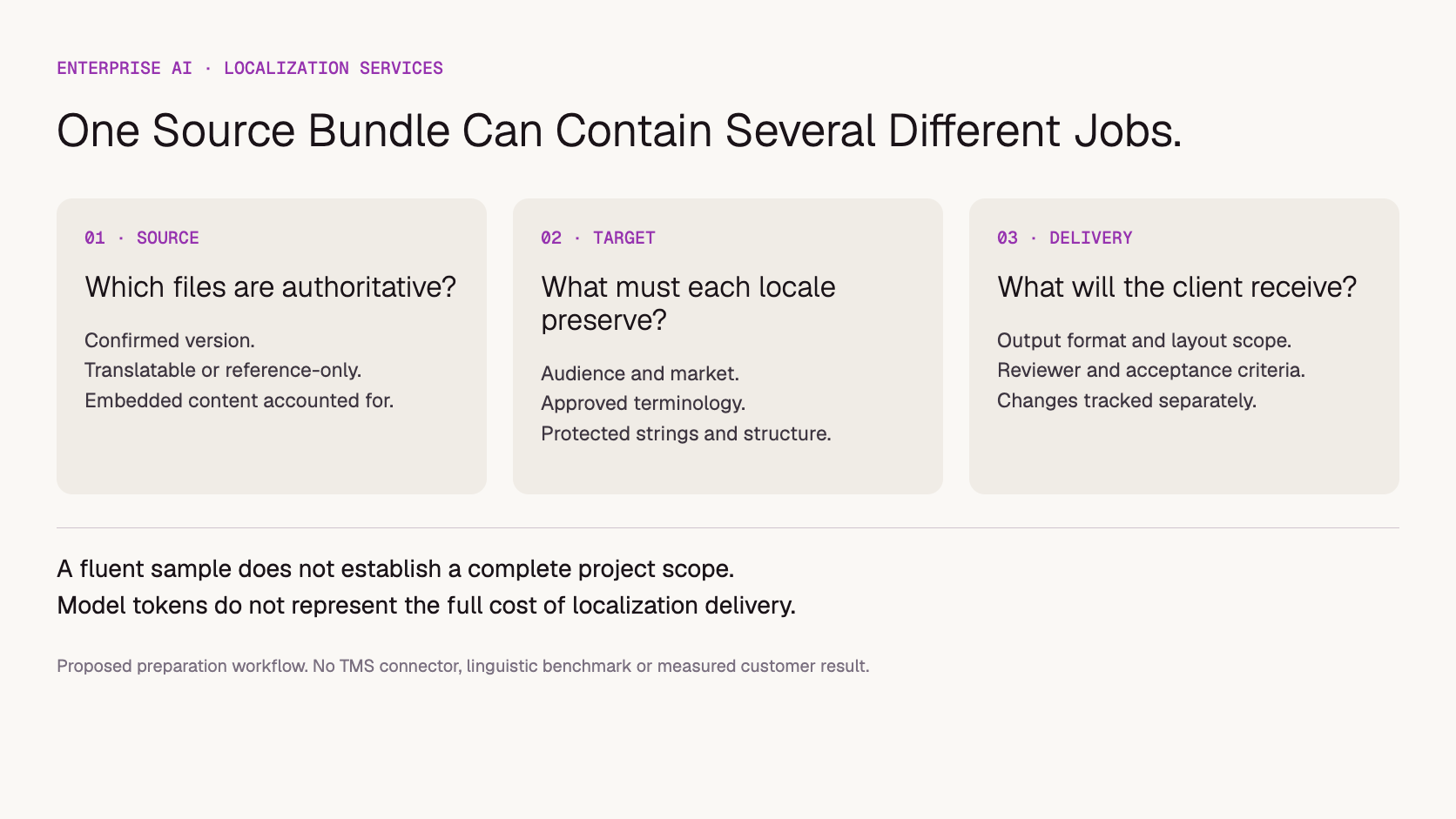
How can a launch brief hide several different jobs?
A launch bundle may combine translation, reference material, layout work and content that must remain unchanged. The assistant should separate these roles before creating target work packages. This prevents a plausible “translate everything” instruction from including excluded text, missing embedded content or promising deliverables the agency has not scoped.
Fictional example: A software company supplies a product PDF, a spreadsheet of interface strings and an older glossary. It asks for “French and Spanish for launch next month,” with the product name unchanged. Some spreadsheet cells contain placeholders, and several PDF diagrams contain text that is not supplied in an editable source.
Scope issue
Unsafe assumption
Clarification to record
French and Spanish
Choose target regions automatically
Confirm markets and audience
Product PDF
Deliver plain translated text only
Confirm editable source, layout and final format
Interface strings
Translate every visible character
Identify placeholders, keys and protected text
Older glossary
Treat every term as current
Confirm the approved terminology version
Launch next month
Promise delivery without review time
Agree milestones, client review and final acceptance
The assistant could draft: “Please confirm the French and Spanish markets, whether the PDF requires completed layout, and which glossary is authoritative. We also need the source files for diagram text or agreement on a separate handling method.” That is a scope clarification, not a translation output or a price quote.
After confirmation, create a deliverable matrix: one row per source-and-locale combination, linked to the required output and reviewer. Record excluded material explicitly. If the client later adds another market or replaces the source PDF, the agency can assess the change rather than treating it as an invisible addition to the original job.
Proposed project preparation checks; no deployed integration or translation-quality result is represented.
Why are model tokens not the same as a translation quote?
Model tokens measure part of the inference workload; they do not define the agency's complete service. A translation quote may also depend on repetitions, translation memory, source preparation, terminology work, review and output formatting. Keep model usage estimates separate from the agreed commercial scope and the production system's analysis.
Phrase's TMS analysis documentation describes counts and categories including repetitions, translation-memory matches and non-translatables. It also distinguishes analysis counts from other billing measures. This is a concrete reason to use the relevant system's documented analysis rather than ask a language model to estimate a definitive billable word count.
The assistant can explain an analysis report and note which files it covers. It should not invent match bands, discounts or post-editing effort. A high match category is not permission to bypass whatever review the client has purchased.
For model procurement, estimate the calls your workflow actually makes: brief extraction, terminology preparation, draft generation, revisions and any review assistance. If one client revision triggers another round, that usage belongs in the operational estimate. Compare cost per accepted work package, including human effort, instead of treating token price as the full delivery cost.
What happens to placeholders and formatting?
Protect structural content through the localization workflow and validate it after generation. A model should receive clear instructions about what may change, but instructions alone are not proof of preservation. Check the actual output for missing or altered placeholders, identifiers and required structure before handing it to a linguist, developer or client.
Phrase's tag documentation explains how tags represent items such as variables, formatting and non-translatable content, and why correct tags matter when exporting target files. The exact representation depends on the tool and file format; do not assume a prompt convention works identically across systems.
A practical design is to keep stable segment or string identifiers outside the editable language text, use a validated exchange format and compare protected elements mechanically. Then use qualified review for meaning, terminology and context. Passing a structural check does not prove linguistic quality, and fluent language does not prove a file will export correctly.
Keep client resources isolated. A term preferred by one customer should not silently become the default for another. Attach the relevant glossary, style guidance and source context to the specific project, with access controlled by the application.
For the model-selection decision, compare LLMs and translation APIs against the languages, terminology and delivery requirements in the approved brief.
Should an agency use its TMS or a custom model API?
Use the translation management system's existing analysis, workflow and file-handling capabilities where they meet the need. Consider a custom model API for a defined gap such as brief interpretation or specialized drafting. The agency still needs production tooling and reviewers; a model API does not replace the entire localization delivery system.
Approach
Appropriate starting point
Buyer question
Intake templates and TMS workflow
Repeatable jobs with clear inputs
Can better required fields remove the ambiguity?
TMS-integrated language capabilities
Need processing inside established file and review workflows
Which models, resources and controls are available for this configuration?
Custom model API workflow
Specialized interpretation or integration requirements
Who owns file exchange, permissions, validation and maintenance?
Start by producing a read-only project brief alongside the existing TMS record. Let the manager correct it and confirm whether it is useful. Moving into translation generation or automatic project creation adds a different risk and evaluation scope.
The software-versus-model-API guide explains the procurement boundary. No native Token360 connector to Phrase or another TMS is verified in this article.
How should an agency evaluate the first workflow?
Evaluate whether the assistant finds scope gaps without inventing requirements. Use representative briefs with conflicting versions, unclear locales, reference-only files and protected strings. Have an experienced project manager establish the expected interpretation, then measure omissions, unsupported assumptions and correction time. Translation quality needs a separate language-specific evaluation if translation generation is later added.
Source control: Is the authoritative version identified or explicitly pending?
Locale: Are market and audience confirmed rather than inferred?
Coverage: Are all requested files and embedded-content issues accounted for?
Constraints: Are protected terms and placeholders preserved in the preparation brief?
Delivery: Is the expected format and review responsibility clear?
Commercial scope: Are extra services and open questions separated from accepted commitments?
Use authorized examples with confidential material minimized. Include simple briefs as well as difficult ones, and keep the source bundle fixed when comparing outputs. Record a wrong locale or omitted deliverable separately from a stylistic edit.
Copy the blank localization scope review register below. It contains no measured results. Expand only when the agency can show that the reviewed brief improves the existing process; use pilot-to-production readiness checks for the broader decision.
What should localization agencies discuss with Token360?
Describe the workload, languages, file formats, client data requirements and review process. Token360 offers enterprise model access across text, image, audio and video, with pricing, dedicated capacity, contracts and compliance requirements scoped to the engagement. The agency remains responsible for its localization workflow, approved resources and final acceptance.
Text may be sufficient for brief preparation. If source images or audio need interpretation, evaluate those stages separately and preserve the original evidence. Access to multiple modalities does not establish a tested end-to-end translation service.
As checked November 14, 2026, the Token360 enterprise page distinguishes current offerings from roadmap or sales-scoped services. Confirm actual model availability, throughput and support terms. About Token360 provides company context.
Token360 does not charge a separate service fee, according to confirmed company positioning. Model usage, TMS costs, integration and linguistic review still belong in the budget. Prepare workloads using the enterprise quote checklist, and review retention and training separately for client material. No quality improvement, savings or turnaround result is claimed here.
Frequently asked questions
Can AI choose the target locale from the client's country?
It can propose a clarification, but should not silently decide. The client's billing country may differ from the intended audience. Record the approved market and locale in the scope.
Can a model replace TMS analysis?
Not for the workflow described here. Use the production tool's documented counting and matching process. The model can help explain that report, with the relevant settings and file versions preserved.
Does a glossary guarantee correct terminology?
No. It supplies a constraint and reference. Evaluate whether the output uses it correctly in context and whether the glossary is the approved version for the client and project.
Should every file in the client bundle be translated?
No. Some files may be references, terminology resources or superseded versions. Confirm each file's role before creating target work packages.
Is this a tested Token360 localization solution?
No. It is a proposed project-preparation workflow. A connector, linguistic quality results and business outcomes would require implementation and testing.
Read next: Use the AI API total cost framework to budget for review, integration maintenance and revisions alongside inference.
Enterprise AI
API
Bring your next idea to life.
Create a video scene in Creator, or explore models for images, audio, and text to find the right capabilities for your project.


 Guides
 Guides
 Guides