An LLM may replace a translation API for selected tasks. Test meaning, terminology, placeholders and review costs before switching production traffic.
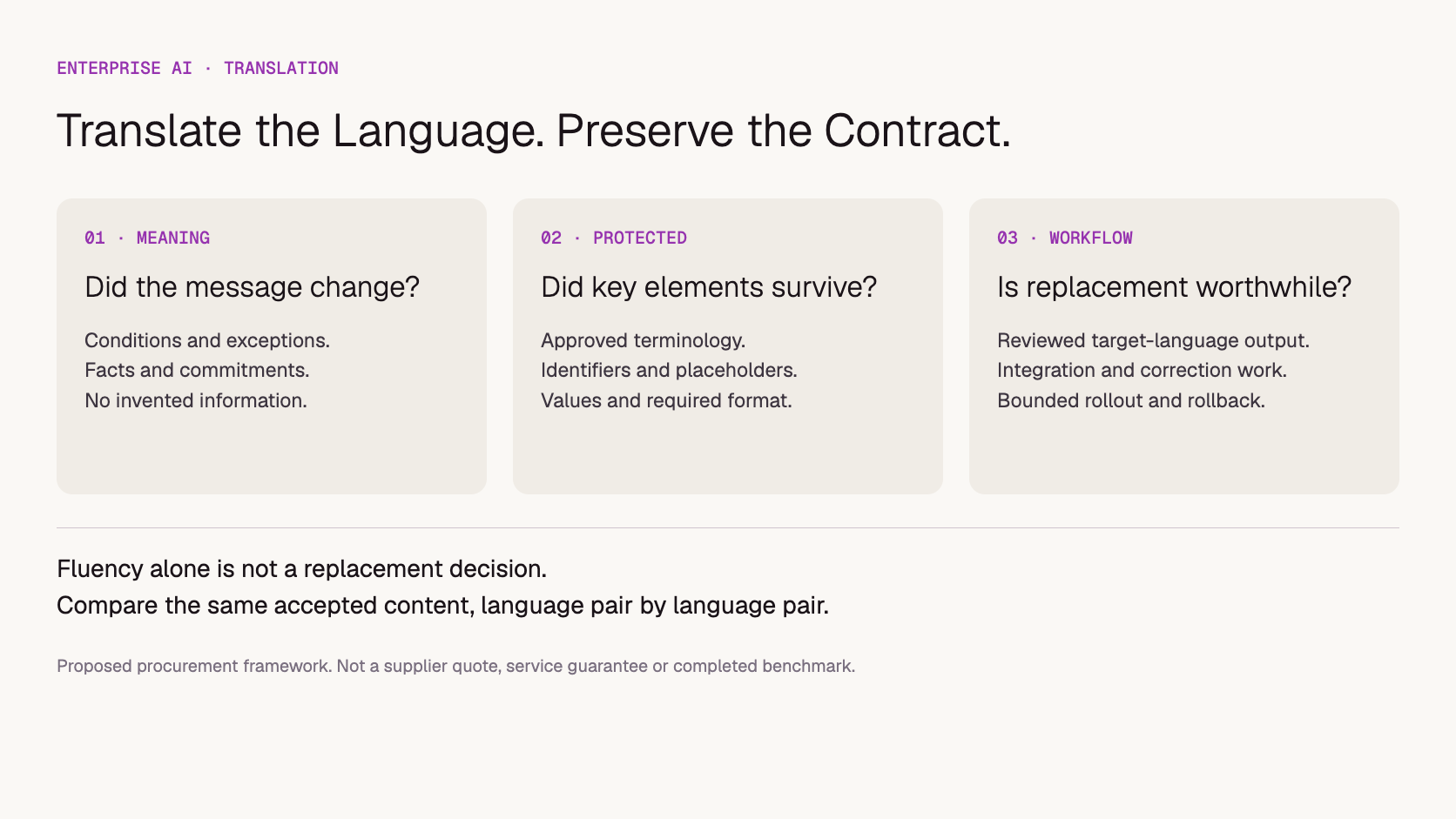
An LLM can replace a translation API for a bounded workload if it meets the same language, terminology and integration requirements at an acceptable total cost. Do not replace a working service merely because the model produces fluent text. Compare accepted translations and migration work before changing the production route.
The purchase is not simply “AI versus traditional translation.” A specialized translation API may already use a language model. The useful distinction is between a translation-specific service and a general-purpose model endpoint whose behavior your team must configure and validate.
This article provides a replacement decision framework. It does not report a translation benchmark or recommend a universal winner. Official documentation was reviewed on November 17, 2026; the examples and worksheet are proposed evaluation tools.
How does a general LLM differ from a translation API?
A general LLM accepts instructions for many tasks, including translation. A translation-specific API presents a service designed around language conversion, with documented controls that may include language selection, terminology and document handling. The underlying technology can overlap. Compare the interface, controls and contractual scope instead of assuming the categories imply different model quality.
Translation instructions supplied by your application
Terminology
Inspect available glossary controls and limitations
Supply approved terms and validate adherence
Output contract
Documented translation response and supported formats
Define the required response and reject unwanted content
Adaptation
Check supported context, style or customization features
Can be instructed to adapt, subject to evaluation
Operational work
Integrate and validate the specialized service
Maintain instructions, parsing, validation and model-change checks
Neither column guarantees the right result. A general model can omit a sentence; a specialized translation service can mistranslate a domain term. The evaluation must inspect the actual outputs.
When should you keep the existing translation API?
Keep the current service when it already meets the acceptance criteria and the proposed replacement offers no demonstrated improvement after migration and review costs. It may also remain the better fit where existing terminology, file handling or integrations are important. Replacement should solve a documented limitation rather than follow a general claim that newer models translate better.
Product interfaces illustrate the point. A sentence may be natural but unusable if it changes a variable name, breaks markup or exceeds a fixed display area. Your current pipeline may already protect these elements and connect results to the release process.
Before switching, list what the existing system does beyond producing translated text. Include supported language variants, source-to-output mapping, glossary management, export formats and error handling. A replacement quote that covers only model calls leaves the rest of that service unpriced.
This article focuses on replacing the translation endpoint. For broader agency deliverables, client approval and project boundaries, see scoping an AI localization project.
What must a translation preserve?
A business translation must preserve the intended meaning and any elements designated as unchanged. Define approved terminology, facts, qualifications, identifiers and application placeholders before testing. Judge natural wording separately from correctness, and decide which failures require rejection. Some errors matter more than an overall impression of fluency.
Approve the translated result against a written output contract.
Source requirement
What to preserve
Example failure to look for
Conditional delivery statement
The condition and degree of certainty
“May ship” becomes a definite promise
Product terminology
Approved target term or unchanged name
Different names for the same feature
Application string
Protected token such as {order_id}
Token translated or removed
Price or quantity
Value, unit and intended formatting rules
Changed quantity or unintended currency conversion
Complete paragraph
All required information
Exception omitted while the main sentence remains
These are hypothetical failure examples, not observed model results. Give reviewers the source, target-language requirements and protected-element list. Checking the translated text without the source can miss a polished omission.
Automated checks can detect missing placeholders or malformed output. They do not establish that the target-language meaning is correct. Similarly, valid JSON proves a response can be parsed, not that a translated field is faithful.
How should you run a replacement pilot?
Use a representative approved sample, run the current service and proposed model against the same requirements, and have qualified language reviewers assess the results. Record the language pair, content type and configuration for each case. Set rejection criteria before seeing outputs, and include review effort alongside quality rather than ranking by fluency alone.
Build the sample from the actual workload: short interface labels, longer explanations, domain terms, ambiguous phrases and protected tokens where relevant. Keep a separate check set that was not used to refine prompts. Otherwise, repeated adjustment to the same examples can make a narrow result look broadly reliable.
Record omissions, additions, terminology errors, changed commitments, formatting failures and time spent correcting the result. Keep those categories visible by language pair. An average across languages can conceal a failure in a market that matters to the business.
Use the blank translation replacement worksheet for this comparison. It contains no measured scores. A valid outcome may be partial adoption: retain the existing endpoint for interface strings and pilot a general model for reviewed support drafts.
If approved, roll out a bounded content class with a rollback route. Recheck after material model or prompt changes. Moving all production traffic on the strength of a few attractive samples skips that evidence.
How do you compare translation costs fairly?
Compare total cost for the same accepted content, including context, retries, validation, correction and integration. Character-based and token-based prices are different billing units, so their headline numbers cannot be compared directly. Measure representative requests and use the actual contract terms instead of a universal character-to-token conversion.
A long glossary or surrounding conversation may be part of a general-model request. The output may also be billed separately. Inspect each provider’s treatment of these elements and any minimums or additional processing charges; do not assume one supplier’s meter applies to another.
Keep one-time migration work separate from recurring expense. That work can include replacing a connector, recreating terminology controls, validating outputs and updating review tools. Lower inference charges do not automatically offset those costs.
The practical denominator is an accepted translation unit defined by your team—such as an approved interface string or document—not an arbitrary request that may contain different amounts of work.
Where does Token360 fit in the decision?
Token360 can be part of the enterprise model-access discussion when a team is evaluating a general language model for its translation workflow. Confirm the selected model, target languages and commercial scope. Model access should not be described as a complete translation-management service or a guarantee of language quality.
Token360’s enterprise offering describes model access, pricing and technical support. Bring the language pairs, sample request sizes, expected volume and review requirements to that discussion. The company’s model catalog is a starting point for checking available models, not a translation benchmark. See About Token360 for company context.
Scope any glossary storage or translation-memory service separately from model access. This page owns the decision to replace an existing translation endpoint. Use multilingual model selection for a new cross-language shortlist and localization project scoping for agency delivery responsibilities.
How should a company glossary be included in the evaluation?
Specify the approved terms and exceptions, then test whether the chosen model preserves them in context. Supplying a glossary in instructions is not the same as buying a service with persistent glossary management. Confirm how the proposed endpoint receives the terms and how updates reach subsequent requests.
Count human correction and any extra input in the cost comparison. Do not claim that a general LLM interface inherits a translation vendor’s glossary API or guarantees every protected term.
Frequently asked questions
Are translation APIs already using LLMs?
Some are. Google Cloud Translation, for example, documents a Translation LLM option. Compare the specific service and model configuration rather than assuming that “translation API” means a non-LLM system.
Does a glossary guarantee terminology accuracy?
Do not assume that it does for every sentence or language pair. Check the service’s supported controls and test adherence in context. A prompt containing a glossary also needs output verification.
Can back-translation replace a bilingual reviewer?
It should not be the sole acceptance check. A plausible return to the source language does not establish that the target text is natural, complete or appropriate for its audience. Use it only as supplementary evidence.
Must we replace the entire translation pipeline?
No. Start with a bounded workload where a measured benefit exists. Preserve the approved path for other content and verify how both routes share terminology, review records and version control.
Case ID,Language pair,Content class,Protected elements,Current service configuration,Candidate model and prompt version,Omission,Addition,Terminology error,Changed commitment,Format failure,Correction minutes,Processing cost,Accepted,Reviewer note
Enterprise AI
API
Bring your next idea to life.
Create a video scene in Creator, or explore models for images, audio, and text to find the right capabilities for your project.


 Guides
 Guides
 Guides