AI APIs for Market Research: Keep Findings Traceable
Use AI APIs to organize interview evidence, verify quotes and preserve counterexamples before turning research themes into client findings.
INDUSTRY USE CASES · MARKET RESEARCH
AI APIs for market research can help organize interviews, propose themes and draft evidence-linked findings. Researchers still need to verify quotations, preserve contradictory responses and keep claims within the study's scope. The useful deliverable is a reviewable analysis with source references, not a confident narrative that turns a handful of interviews into a market-wide conclusion.
An insights agency has finished a round of buyer interviews. Its analysts need to compare purchase barriers across participants, prepare a client presentation and answer questions about the evidence. A model can accelerate parts of that preparation. It can also create convincing mistakes: merging separate speakers into one quotation, counting repeated comments as independent respondents, or omitting an interview that contradicts the dominant theme.
This article focuses on qualitative interview synthesis for market-research agencies, customer-insights teams and research-software builders. It presents a proposed workflow and an illustrative evidence example. It does not report a Token360 research deployment, a model benchmark or measured analyst time savings.
Which research tasks can model APIs assist?
Useful tasks include transcript preparation, evidence retrieval, provisional coding and drafting summaries that point back to their sources. Keep the research question and inclusion rules explicit. A model can suggest an interpretation of the supplied material, but it cannot establish that the sample represents a broader population merely by producing a coherent answer.
Start with a defined question, such as why a particular group of buyers delayed adoption after a product trial. Supply the relevant interviews and context rather than mixing every available sales call, support ticket and survey response into one undifferentiated input. Those sources may answer different questions and reflect different selection processes.
A practical output is a theme proposal containing supporting excerpts, participant identifiers, counterexamples and a tentative interpretation. It lets an analyst decide whether to retain, split or reject the theme. Generating the final client narrative first makes it harder to see which evidence was lost along the way.
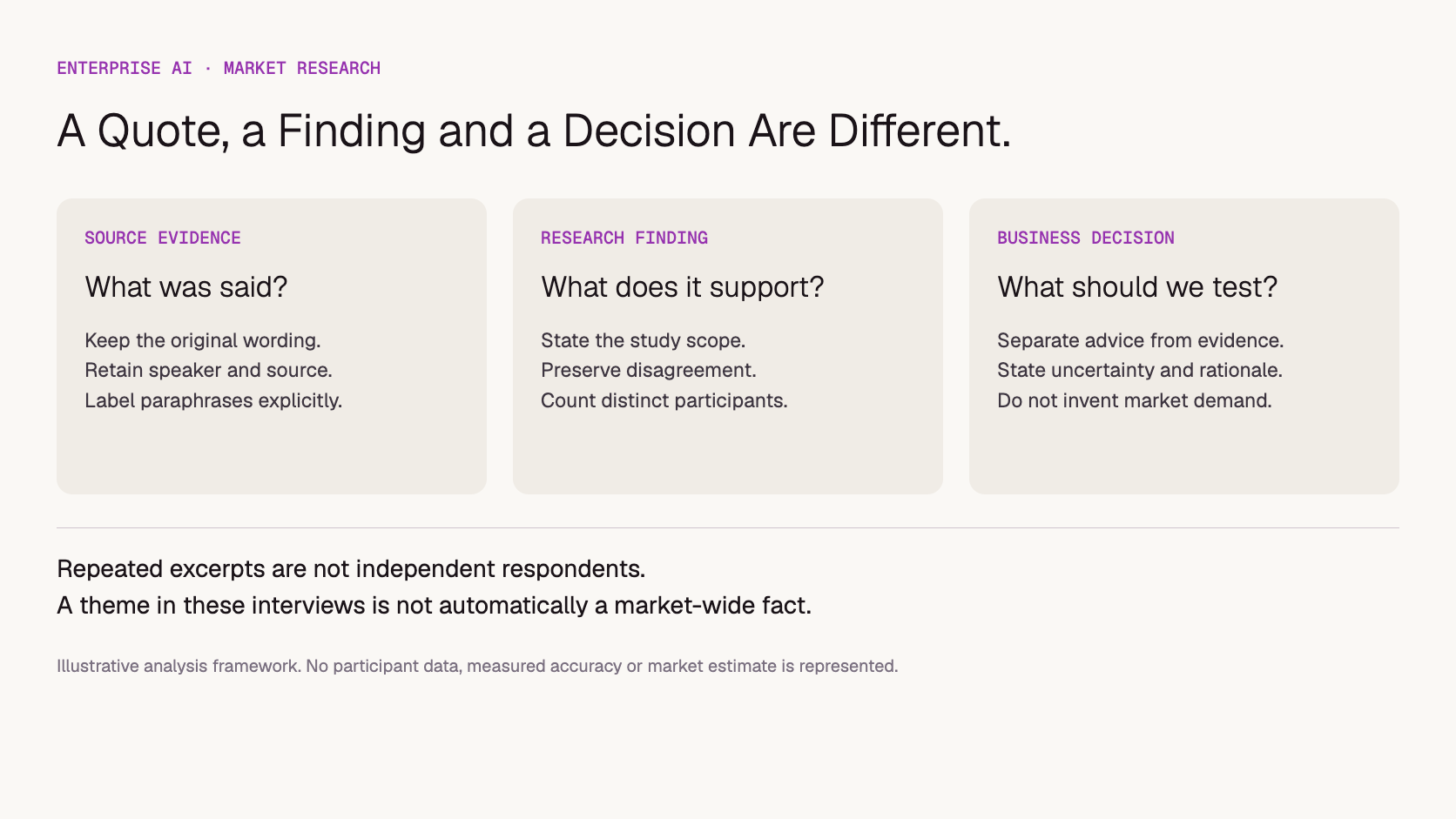
Distinguish three layers: what a participant said, the analyst's interpretation of that statement, and the business recommendation drawn from the research. They may belong in the same report, but should not be presented as interchangeable facts.
What must stay attached to each excerpt?
Retain the source interview, speaker, location within the source and relevant context for every excerpt used as evidence. Separate verbatim quotations from paraphrases and translations. If an analyst cannot recover the original passage and inspect the question that prompted it, the excerpt is not ready to support a client-facing finding.
Evidence field
Purpose
Failure it helps expose
Study and participant ID
Keep evidence within its permitted study and participant context.
Combining clients, counting one participant more than once or attributing words to the wrong person.
Transcript version and location
Allow retrieval of the exact passage.
A quotation no longer matches after transcription corrections.
Speaker and surrounding question
Distinguish participant views from interviewer prompts.
Treating a leading question as the participant's spontaneous opinion.
Original wording and output type
Identify a quote, paraphrase or translation.
Presenting polished model prose as verbatim speech.
Theme and review state
Separate model suggestion from analyst approval.
An unreviewed label appearing as an established research finding.
Use restrictions
Control who may see or reuse the material.
Exposing participant information or reusing a client's evidence outside the agreed project.
Store source references in the application rather than asking a model to invent timestamps or identifiers. Where possible, validate a proposed quotation against the stored transcript. A text match can establish that words occur in the source; it does not prove that the excerpt preserves the speaker's intended meaning. Analysts still need context.
This is a concrete capability to evaluate in existing software. Dovetail's official answer-verification documentation describes interactive citations and source previews. That supports source inspection, but the presence of a citation alone is not evidence that a particular interpretation is correct. Documentation checked November 13, 2026.
How can a plausible theme become an unsupported finding?
A theme becomes misleading when its wording exceeds the underlying evidence, hides disagreement or changes the unit being counted. Keep the proposed finding narrower than the sources permit. Make exceptions visible, and distinguish a pattern observed in the supplied interviews from a claim about the entire customer base or market.
Illustrative example, not real study data: consider three fictional interview excerpts about a product trial:
Participant
Fictional excerpt
Defensible interpretation
P01
“I could afford it, but connecting our records looked like too much work.”
Perceived setup effort was a barrier in this account.
P02
“The price was fine. I did not know who on our team would own the setup.”
Unclear implementation ownership was a barrier.
P03
“Setup was straightforward. We stopped because the monthly price was too high for us.”
Price was a barrier; setup was not reported as a problem.
A poor synthesis would say, “Customers reject the product because onboarding is difficult.” It removes P03's experience, generalizes beyond these excerpts and collapses two different implementation concerns into one statement. An even worse version would fabricate a quotation combining P01's setup comment with P02's ownership concern.
A more defensible draft is: “In these three illustrative interviews, two participants described implementation-related barriers: perceived effort and unclear ownership. The third described setup positively and identified price as the barrier. These accounts suggest separate questions to investigate about setup support and pricing; they do not establish how common either barrier is in the market.”
The arithmetic here is simply two distinct fictional participants versus one. It is not a benchmark, survey result or market percentage. In a real study, also record whether all included participants were asked the relevant question. A missing mention does not automatically mean disagreement or absence of a problem.
The research finding should preserve differences between participants before it informs a business decision.
How should an API-based synthesis workflow be designed?
Build a sequence that preserves the original material, generates provisional analysis and requires evidence review before reporting. Use stable source identifiers and a versioned analysis brief. Keep model suggestions separate from accepted codes and findings so a later revision does not overwrite the basis of an earlier client deliverable.
Define the analysis brief. Record the research question, included study, relevant segment, exclusions and output expectations. Specify whether you are exploring new themes or applying an existing codebook.
Prepare the sources. Check transcript quality, speaker labels and participant IDs. For recordings, assess transcription separately. Remove or restrict unnecessary identifying information before sending material to the selected model.
Extract evidence with references. Request candidate passages relevant to the research question, with stable IDs and sufficient surrounding context. Mark uncertain transcription rather than repairing it through guesswork.
Propose and review themes. Apply agreed definitions, allow an unclassified category, and inspect counterexamples. Retain the model proposal and the analyst's decision separately.
Draft findings from accepted evidence. Include scope, supporting sources, differences and unresolved questions. Validate quotations and participant counts in application code where possible.
Approve the deliverable. Review claims and source links before exporting the client report. Keep an approved version and record which source and analysis versions produced it.
Study context is more useful than a generic instruction to “find insights.” Dovetail's project-context announcement describes supplying objectives and business context before classification. A custom application can adopt that design principle without assuming that context guarantees correct results. Checked November 13, 2026.
For large studies, avoid treating summaries of summaries as a substitute for source access. A staged workflow can help process the material, but the final reviewer still needs access to relevant excerpts and counterevidence. Keep track of which interviews were actually included in each run; do not describe a partial retrieval as a review of the entire study.
If sentiment labels are part of the analysis, use the customer sentiment API guide to define the label, uncertainty and review process for each excerpt.
How do you preserve disagreement and count participants correctly?
Keep counts tied to an explicit unit and inclusion set. A person can mention a concern repeatedly, and one passage can support several themes. Count distinct participants separately from excerpts, and inspect opposing or qualifying evidence before approving a theme. Neither frequent wording nor a model-generated confidence score establishes a representative market estimate.
For example, five excerpts from one interview are five excerpts, not five respondents. A theme table should let a reviewer switch between the number of supporting excerpts and the number of distinct participants. If participants were asked different questions, record that limitation instead of presenting their responses as if they came from the same prompt.
Set rules for mixed views. A buyer may praise setup assistance while criticizing the time required. Forcing that interview into a single positive or negative bucket can remove the useful distinction. Preserve both statements and explain whether the analysis treats them as separate themes or as a qualified view.
A counterexample search should be an explicit review step: ask what passages weaken the proposed finding, whether another segment reports a different experience, and whether the interviewer introduced the topic. Absence of a retrieved counterexample is not proof that no counterexample exists. Reviewers need visibility into retrieval scope and source coverage.
Do not generate synthetic participant responses to fill missing interviews and then mix them with actual evidence. Hypothetical examples may help plan a discussion guide, but they need a separate label and must not contribute to reported participant counts.
Should a research firm use a repository platform or custom APIs?
Use an existing research platform when its source storage, coding, collaboration and review features already satisfy the project. Consider custom model APIs when you need different integrations, model choices or client-specific analysis workflows. Compare the entire analyst experience and operating responsibility, not just the price of generating a summary.
Dovetail's data-summary documentation covers AI summaries, frameworks, language selection and citation checks. Those are capabilities to inspect before rebuilding similar functionality. This is not a ranking or hands-on comparison; verify current plan limits and data-handling terms against your own requirements.
Option
Useful fit
Buyer questions
Research repository platform
Analysts need an integrated workspace for sources, coding and sharing.
Can reviewers inspect evidence easily? How are permissions, exports and version changes handled? What is included in the plan?
Custom API application
Research spans several systems or requires a specialized client workflow.
Who builds evidence retrieval, review UI, model evaluation, storage and access controls? Which usage charges and maintenance costs remain?
Existing tools with manual analysis
Small or unusually sensitive studies where automation adds little.
Would improved templates or source organization solve the bottleneck more simply?
The software-versus-model-API framework helps clarify the purchase boundary. A model API is not automatically a research repository, consent-management system or analyst review interface.
What should you measure in a research pilot?
Evaluate whether analysts can verify and use the output without losing important evidence. Check quote accuracy, source attribution, scope and counterexample handling alongside review effort. Compare against an analyst-reviewed reference set and record disagreements rather than assuming there is one perfect thematic structure that every model must reproduce.
Quote fidelity: exact wording, speaker, source location and distinction between quotation and paraphrase.
Claim support: whether cited passages actually support the proposed finding at its stated scope.
Coverage: important omitted views, unprocessed interviews and overlooked counterexamples.
Counting: correct unique-participant totals, inclusion sets and treatment of repeated excerpts.
Analyst effort: time spent reviewing, correcting, locating sources and reworking themes, not merely generation time.
Release readiness: whether the approved output meets project-specific sharing and evidence requirements.
Keep transcription errors, retrieval gaps and synthesis errors separate. Changing the language model will not necessarily fix the wrong participant label in the source. Similarly, a larger context window does not establish that the model considered every relevant passage.
The blank research-evidence review register records proposed claims, references, counterevidence and review decisions. It contains no fabricated study results. Track rejected outputs and total review effort alongside accepted findings; do not claim research productivity gains from a stopwatch measuring generation alone.
Token360 can supply model access for a custom research workflow, while the agency or software partner manages source permissions, evidence storage, analysis rules and review. Select the actual models and endpoints needed for transcription or text analysis, test them on authorized material, and scope commercial terms around the resulting workload.
Token360 provides access across text, image, audio and video model categories. For interview synthesis, transcription and language analysis may be relevant; image and video generation are separate tasks and should not be confused with evidence analysis. Check each selected model's supported inputs rather than assuming one model handles every modality.
The Token360 enterprise offering describes model access and custom pricing. Capacity, contracts and compliance requirements can be discussed for the engagement, with specific availability and terms confirmed separately. Product information checked November 13, 2026. No native research-platform connector or blanket certification is claimed here.
Token360 has no separate service fee; model usage remains chargeable. The total project still includes integration, storage, transcription where applicable and analyst review. See the service-fee explanation before comparing quotes.
For an enterprise discussion, bring interview hours, transcript lengths, languages, expected analysis reruns, selected models, turnaround requirements and client-specific data restrictions. Keep projects separated according to your agreed access rules; a shared API account should not mean that every client's material can enter the same retrieval pool.
Can AI replace the analyst in qualitative research?
This workflow uses AI to assist evidence preparation and provisional analysis. The researcher remains responsible for study design, interpretation, scope and release. A model's fluent account does not independently validate the research conclusion.
Can an AI-generated paraphrase be used as a participant quote?
No. Label it as a paraphrase. A quotation should match the source and retain relevant context. Translations should also be identified, with the original passage retained for review.
Can theme frequency be reported as market demand?
Not from thematic counts alone. State what was counted and which study material was included. Claims about wider prevalence need a study design and analysis that support them; repeated mentions do not establish that basis.
Can interviews in several languages be analyzed together?
They can be included in a designed multilingual workflow, but check terminology and meaning with qualified reviewers. Retain original-language passages, distinguish translations from verbatim quotes and test whether language differences change theme assignment.
Does this article contain a real Token360 research test?
No. The participant excerpts are explicitly fictional and the workflow is proposed. The article cites official product documentation but does not claim measured accuracy, savings or a deployed customer solution.
Enterprise AI
API
Bring your next idea to life.
Create a video scene in Creator, or explore models for images, audio, and text to find the right capabilities for your project.


 Guides
 Guides
 Guides