An LLM API can classify customer sentiment. Define aspects, validate labels and keep reporting separate from satisfaction scores or churn predictions.
An LLM can be evaluated for sentiment classification when your team supplies a clear labeling rubric and checks the results against reviewed examples. Compare whole-message and aspect-level labels according to the business task. Token360’s language-model access is relevant to that inference step, not a promise of a customer-insights platform.
For an enterprise receiving reviews, survey comments and support messages, the purchase question is not simply whether a model can say “positive” or “negative.” It is whether the output helps the team identify a particular problem without losing mixed views, inventing intent or overstating what the collected feedback represents.
This is a procurement and evaluation framework, not a sentiment benchmark. Official documentation and research were reviewed on November 17, 2026. Example comments and test materials below are illustrative; no Token360 model accuracy or customer result is claimed.
What does sentiment analysis actually return?
Sentiment analysis assigns an interpretation to language, often using positive, negative, neutral or mixed labels. Some services return scores and more detailed targets or aspects. Decide whether your workflow needs a label for the whole message, each sentence or each discussed topic before comparing services that may produce different kinds of output.
These are examples of output contracts, not proof that a general LLM endpoint exposes the same native features. An LLM-based workflow needs its own instructions, response structure and acceptance checks. Research on aspect-based sentiment analysis with LLMs also treats sentiment by aspect as a distinct evaluation task; it does not establish performance on your customer messages.
Why is one label per customer message sometimes misleading?
A customer can praise one part of an experience and criticize another in the same message. A single overall label compresses that distinction. If different teams own the product, delivery and support experience, aspect-level labels with supporting excerpts can be more actionable than an undifferentiated positive-or-negative score.
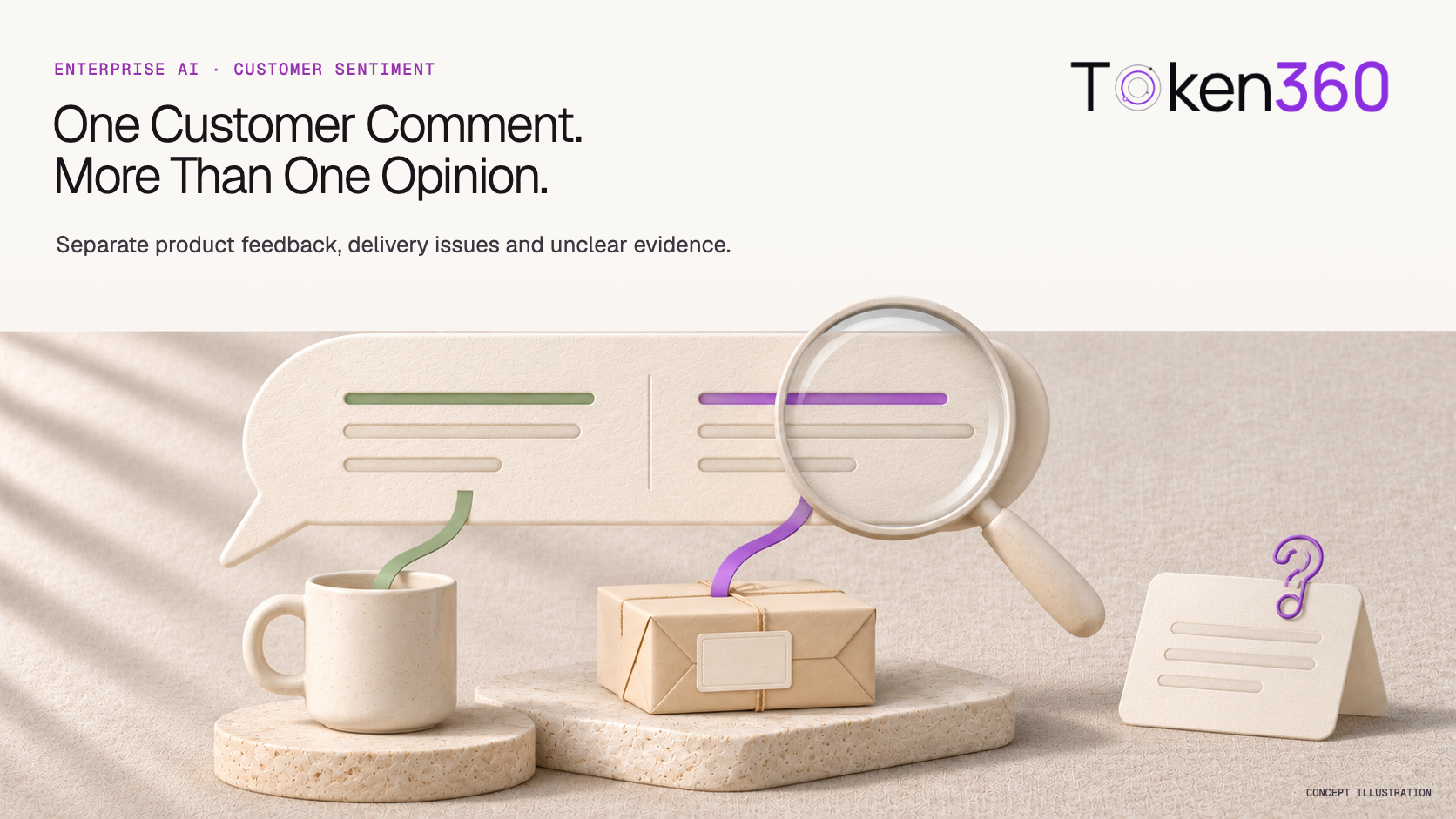
Consider this invented comment: “The mug feels great, but the parcel arrived cracked and I am still waiting for a reply.” A proposed annotation separates product feel, delivery condition and support response. It should not transform praise for the mug into praise for the whole purchase.
Aspect
Proposed label
Supporting text
Boundary
Product feel
Positive
“The mug feels great”
Does not establish durability
Delivery condition
Negative
“the parcel arrived cracked”
Does not identify who caused the damage
Support response
Negative
“still waiting for a reply”
Does not establish the actual response time
This table is a human-designed example, not a model output. A production rubric should define how to handle implied dissatisfaction and disagreements between annotators. Keep an “unclear” outcome available when the evidence is insufficient; it serves a different purpose from “neutral.”
Should you buy a sentiment API or use a general LLM?
Compare a dedicated sentiment service when its labels, languages and granularity match the job. Consider an LLM workflow when you need a business-specific rubric, topic extraction or a structured explanation alongside labels. Neither option is automatically better; test the outputs and operating costs against the same annotated examples.
Decision
Dedicated sentiment service
LLM-based workflow
Label definitions
Confirm the provider’s fixed meanings
Specify and test the requested rubric
Granularity
Check document, sentence and target support
Validate requested aspects and evidence spans
Output contract
Inspect documented fields and scores
Validate schema and allowed values
Operational comparison
Measure your data’s errors and charges
Include instruction tokens, retries and review
Do not assume that a longer explanation means a better classification. Verify that quoted evidence actually appears in the input and supports the assigned label. A correctly formatted response can still describe the wrong target or infer an opinion the customer never expressed.
What should the evaluation set contain?
Use representative messages with agreed reference annotations, including the difficult cases your team expects to encounter. Cover languages, channels, mixed opinions, neutral requests and ambiguous wording. Keep evaluation examples separate from the examples used to refine instructions, and inspect errors by category rather than relying on one aggregate score.
Mixed feedback: praise and criticism about different aspects.
Neutral requests: “Please send the invoice” should not automatically become dissatisfaction.
Context changes: an initial complaint followed by a resolved issue.
Quotation: distinguish the customer’s view from text they quote from an agent or another reviewer.
Informal language: sarcasm, abbreviations and local phrasing relevant to the audience.
Insufficient evidence: short or unclear replies that should remain unresolved.
Have reviewers annotate independently where practical, then resolve disagreements in the rubric. Otherwise, inconsistent reference labels can make a model comparison difficult to interpret. Record both missed negative examples and neutral examples incorrectly flagged as negative; they create different operational burdens.
For a proposed alerting workflow, precision asks how many negative alerts are truly negative under the rubric; recall asks how many reference-negative items were found. Report both with the sample counts. The acceptable tradeoff depends on what happens after an alert, not on a universal target invented for the article.
Proposed evaluation framework. No measured classifier results are shown.
What should you ask Token360 before buying?
Bring Token360 the languages, label definitions, expected volume and proposed evaluation set. Token360 provides enterprise model access across text, image, audio and video; a sentiment workflow still needs application logic and validation. Confirm the chosen model’s output requirements, data-handling terms and commercial scope instead of assuming an included customer-feedback analytics product.
Review candidates in the model catalog and discuss workload requirements through enterprise procurement. Include expected message lengths, processing frequency and review needs in the quote request. The About page provides company context.
Download the sentiment evaluation worksheet to record reference labels, aspect targets, evidence, disagreements, review effort and actual charges. It is a blank template, not an accuracy claim or a completed deployment.
Keep the classification rubric and expected response structure fixed across candidate models. A sentiment-specific comparison requires category-level errors and correction effort; a general model benchmark cannot replace that acceptance record.
Who owns the action after the model classifies a message?
A classification response and a business action are separate deliverables. If a model labels a support message, the application still needs rules for assigning it and handling an uncertain result. Compare models against the classification rubric without attributing the helpdesk’s complete routing behavior to the inference supplier.
Request a sample response format and name the integration owner. Keep customer entitlements, queues and operational priorities in the appropriate business system rather than assuming they follow from a sentiment label.
Can sentiment analysis predict which customers will leave?
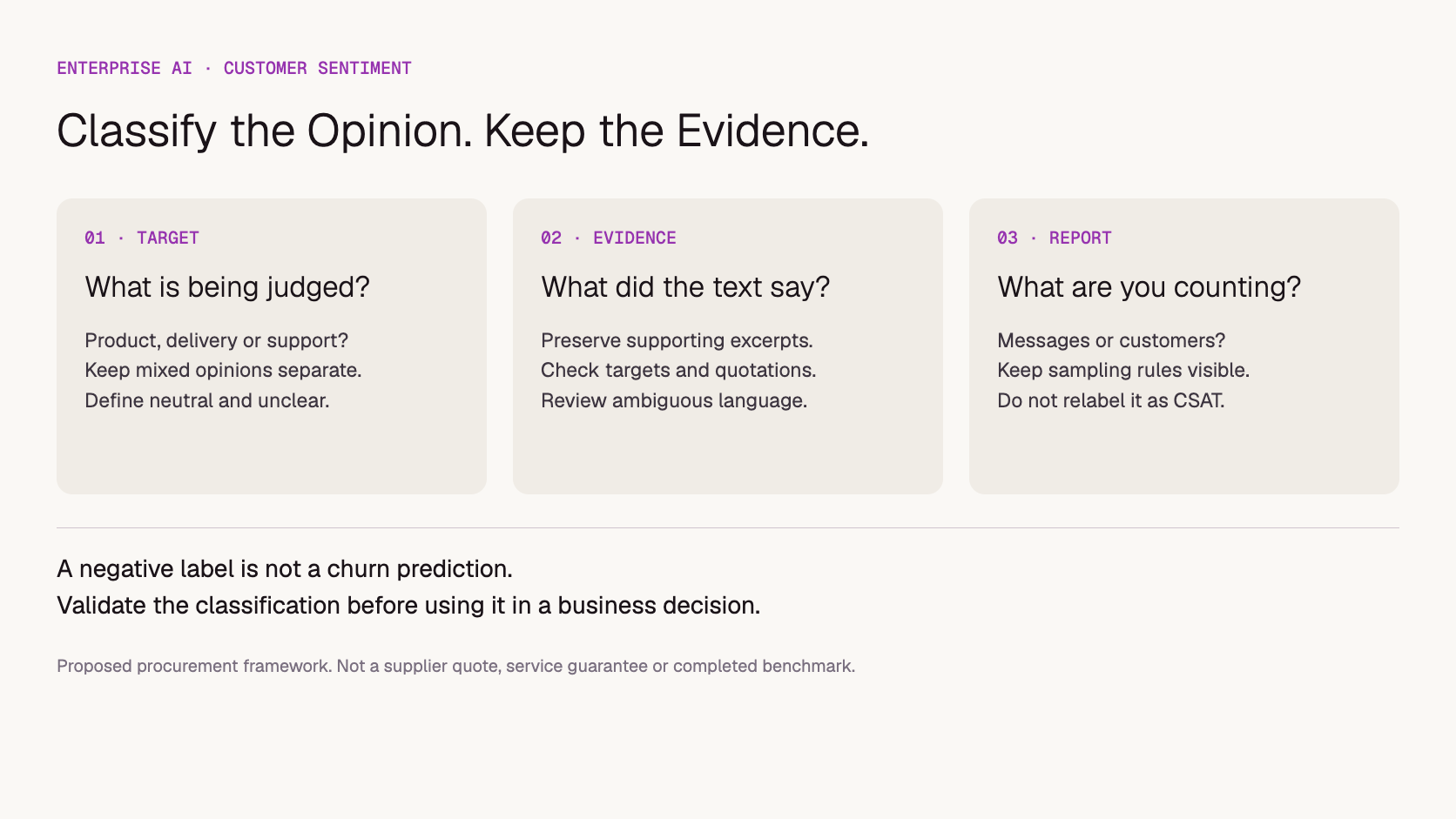
A negative label alone does not establish churn risk. Predicting future behavior requires a separate task definition and validation against relevant outcomes; do not present sentiment classification as that proof.
Can the API analyze call sentiment from a transcript?
It can be evaluated on transcribed text, but that is not the same as analyzing tone of voice. Transcription errors and missing conversational context must be considered in the test.
Should mixed feedback count as negative?
Only if your reporting policy defines and explains that choice. Preserve the original mixed label or aspect-level distinctions so the policy does not erase useful evidence.
Can one prompt cover every language?
Do not assume equivalent results. Validate the required locales with appropriate reviewers and confirm supported languages for the selected service. Report language-specific gaps rather than hiding them in an overall average.


 Guides
 Guides
 Guides