AI APIs for Repair Businesses: Keep Customers Informed
Use AI APIs for repair updates that preserve findings, estimate approvals and job status. Compare options and test drafts before sending them.
INDUSTRY USE CASES · REPAIR OPERATIONS
Repair businesses can use AI APIs to turn ticket records into clear customer updates, explain estimates and identify missing information. The assistant should preserve the difference between a reported symptom, a technician's finding, authorized work and a completed repair. It should not invent a diagnosis, approval or collection date to make a message sound helpful.
For repair chains, depot service providers and after-sales software teams, the practical opportunity is a communication layer around the existing repair system. Staff need a draft that reflects what has actually happened and what the customer must do next. A polished update that moves the job to a later stage in words can create more work than it saves.
Evidence boundary: This article proposes a reviewed workflow based on official software documentation checked November 13, 2026. The case below is fictional. No Token360 repair connector, diagnostic capability, customer deployment or measured productivity result is claimed.
Which repair communication task should you automate first?
Start with staff-reviewed updates for jobs whose records are sufficiently complete: awaiting inspection, awaiting customer approval, waiting for a part or ready for collection. The model can translate the verified record into understandable language. Keep diagnosis, price approval, warranty decisions and changes to the work order with their designated owners.
Choose a message category with a clear success condition. An approval reminder should identify the current estimate and the customer's next action. A parts-delay message should explain the known dependency without converting an uncertain arrival into a promised completion date. A collection message should require the operation's own release criteria.
Do not assume every message needs a model. If a reliable status code already supports a clear fixed notification, use the template. AI is more useful where staff must combine an approved technical explanation, a changed estimate and the latest customer question. Compare that extra value against the maintenance and review required.
Message type
Useful AI contribution
Required source of authority
Inspection update
Explain what is known and still unconfirmed
Technician-approved findings
Estimate explanation
Explain approved line items in plain language
Current estimate version and commercial terms
Progress update
Summarize actual dependencies and next action
Repair status, parts records and assigned staff
Collection message
Prepare customer instructions
Completed checks and authorized release status
Why must symptoms, findings and approvals stay separate?
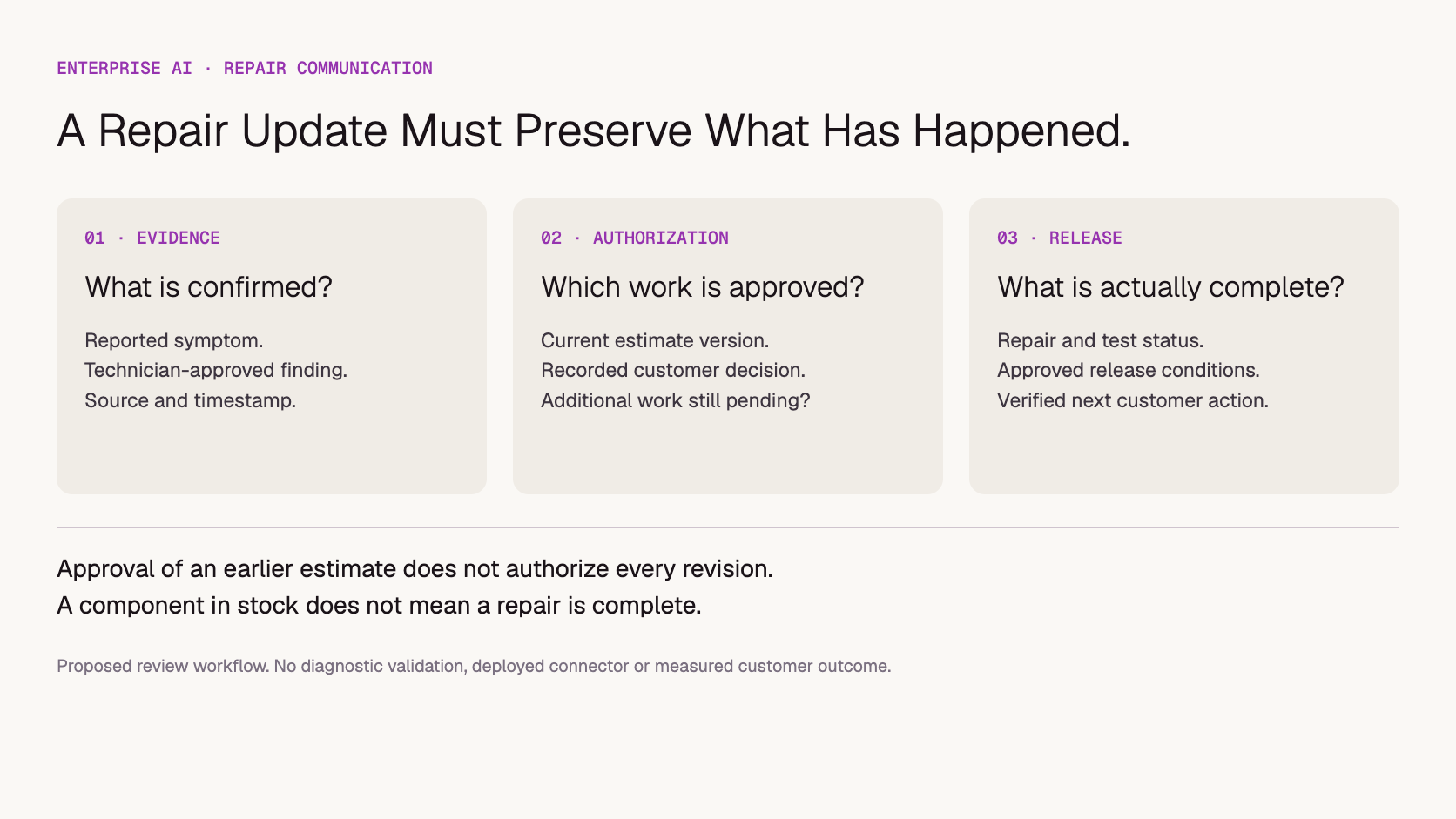
A customer's description explains why an item was submitted; it does not establish the cause. A technician's proposed repair does not establish customer authorization, and authorization does not establish completion. Keeping these facts separate prevents an assistant from turning a plausible narrative into a false statement about the job.
Consider these three notes: “Customer reports intermittent charging,” “Technician recommends connector inspection,” and “Estimate sent.” Together, they do not support “We have replaced the charging connector.” The output must preserve the verbs and their status, not merely retain the relevant component name.
The distinction is reflected in operational software. RepairDesk's estimate documentation describes customer approval, rejection and change requests, with settings that can hold a ticket until approval. Treat those recorded decisions as inputs. A model's interpretation of a friendly email should not silently replace the configured authorization process.
Build the input around distinct fields: reported symptom, verified finding, proposed work, estimate version, approval state, parts state, repair state and release state. Attach a source and timestamp to each. An empty field should remain unknown; the assistant should not fill it from general repair knowledge.
What does a misleading update look like in practice?
A misleading update can contain individually plausible details while joining them into an unsupported conclusion. Review the relationships between the facts: which estimate was approved, which work has been performed and which checks remain. A safe draft explains the current dependency and requests the next action without implying later stages have occurred.
Fictional example: A customer submits headphones with intermittent sound in one channel. A technician records a cable fault and proposes replacement. The first estimate is approved. During inspection, the technician identifies additional connector work and issues a revised estimate. Approval of the revision is still pending; no final functional test is recorded.
Available record
Incorrect inference
Appropriate communication
First estimate approved
All subsequent work is authorized
Identify the revised estimate as pending
Replacement component is available
The component has been installed
Report availability only if useful to the customer
Technician proposes additional work
The customer agreed to it
Explain the requested decision
No final test recorded
The device is ready for collection
Do not send a collection notice
A reviewed draft might read: “Inspection identified additional connector work beyond the first estimate. Please review the revised estimate before we proceed with that work. We have not confirmed a collection time yet.” It should link to the actual estimate through the application's approved customer channel, rather than copying an internal link or inventing an approval button.
This is not a rule that every repair must follow the same commercial process. The repair business must define what changes require renewed authorization. The important design requirement is that the assistant applies that process to the correct version, rather than treating any historical approval as permission for everything.
Proposed communication checks; not a tested repair-system integration.
How should the assistant handle stale or conflicting records?
When records disagree, the assistant should identify the conflict for staff instead of selecting the most reassuring statement. Use explicit precedence rules for authoritative fields, and require fresh checks for promises such as collection readiness. A newer free-text note should not automatically override an approved estimate or a controlled release status.
For example, a message may say “should finish today,” while the parts record still shows an unresolved dependency. The right output is a review flag, not a definitive completion promise. Similarly, an old customer request to cancel should be reconciled with the current order before a progress email is drafted.
Preserve the ticket and asset identity throughout retrieval. One customer can have several devices under repair, and the same model name can appear on many jobs. Select the record using trusted identifiers and access permissions before asking the model to write. Avoid requesting the entire customer history when a limited set of relevant fields is sufficient.
Keep internal notes out of customer copy unless they are approved for disclosure. Supplier cost, staff discussion and device-access credentials are not necessary just because they appear near the diagnosis. Decide which fields can be sent to the model and which can be included in the final message. For related procurement questions, see data retention versus model training.
Should you buy repair software features or build with an API?
Use existing repair software when its templates and approval workflows meet the need. Evaluate an API-based assistant when your team must explain complex notes, support several languages or combine records across systems. The model provider supplies inference; your application still needs permissions, record access, review and message delivery.
Approach
Where it fits
Procurement question
Fixed status notifications
Simple, repeatable updates
Can better status hygiene solve the problem without AI?
Repair-platform AI features
Assistance within an established ticket workflow
What sources, actions and review controls are actually supported?
Custom model API workflow
Cross-system or specialized explanation requirements
Who owns integrations, evaluation and ongoing support?
Do not confuse access to a repair record with reliable execution of the repair workflow. Odoo's repair-order documentation separately describes repair operations, parts and quotations. The linked guide covers Odoo 19.0. Confirm behavior against your installed version before designing an integration. This is an example of an operational system, not a verified Token360 integration.
A read-only pilot is a practical starting point. Retrieve the necessary record, generate a draft, show its sources to a coordinator and retain the correction. Sending messages or changing statuses can be evaluated later with separate permissions and acceptance checks. The broader software-versus-model-API decision helps clarify what your purchase includes.
How do you test whether the updates are useful?
Test factual state preservation before tone. A useful update must identify the right item, retain the current authorization scope and avoid unsupported promises. Compare staff-reviewed drafts with the existing process, recording correction work and serious errors separately. Faster first drafts alone do not establish a better customer communication workflow.
Use authorized historical cases with personal information minimized, or staff-created cases whose expected answer is defined in advance. Include straightforward jobs and difficult transitions: a revised estimate, a declined repair, a delayed part, a completed repair awaiting testing and multiple devices belonging to the same customer.
Identity: Does the reply describe the correct ticket and asset?
Evidence: Is a reported symptom falsely presented as a confirmed cause?
Authorization: Does it preserve the current estimate version and approved scope?
Timing: Does it invent a completion or collection date?
Disclosure: Does it expose internal notes or unnecessary personal data?
Next step: Is the requested customer action clear and supported by the system?
Measure reviewer time, correction time, accepted drafts and unsupported statements. Label a wrong collection promise separately from an awkward sentence. For translated updates, have a qualified reviewer check that uncertainty and authorization conditions survive translation; fluent wording is not enough.
Copy the blank repair update review register below for ticket identity, estimate version, evidence checks and reviewer decisions. It contains no experimental results. Decide escalation conditions before allowing unattended messages; use pilot-to-production readiness checks when extending beyond the reviewed workflow.
What should a repair business discuss with Token360?
Describe the communication workload, input formats, languages, peak volumes and required review process. Token360 provides enterprise access to text, image, audio and video models. Contracts, negotiated pricing, dedicated capacity and compliance requirements are scoped to the engagement; they do not imply an included repair application or diagnostic service.
Text may be sufficient for ticket-to-message drafting. Voice transcription or image interpretation should be separate evaluated stages when actual incoming records require them. Do not add customer device photos or recordings merely to make the system multimodal, and do not treat an image-model interpretation as a technician's verified finding.
As checked November 13, 2026, the Token360 enterprise page distinguishes current model access and custom pricing from roadmap or sales-scoped services. Confirm the actual throughput, support and contract terms for the workload. About Token360 provides company context.
Token360 does not charge a separate service fee, according to the company's confirmed positioning. Model usage, repair software, integration and review still contribute to cost. Prepare expected request volumes using the enterprise quote checklist, then compare total reviewed-message cost with the current process. No savings or latency figure is established here.
Frequently asked questions
Can AI diagnose the fault from the customer's message?
This proposed workflow does not use AI as a diagnostic authority. It organizes the reported symptom and communicates verified technician findings. Any diagnostic use requires its own evaluation, qualified oversight and applicable operational requirements.
Can AI tell customers that a repair is ready?
Only when the verified release conditions support that message. A part being available, work being authorized or a technician expecting to finish does not establish readiness for collection.
Can the assistant explain an estimate without changing it?
Yes, that is a useful proposed drafting task. Give it the current approved line items and terms, then check that it does not add work, alter prices or imply approval. Calculations and commercial decisions remain with the relevant system and staff.
Does every update need customer approval?
No. An informational update and authorization for additional work are different actions. Your business must define the applicable process and record the required approval. The assistant should follow that process rather than invent a universal rule.
Is there a ready-made Token360 repair connector?
No such connector has been verified for this article. Confirm integration scope with your software provider and implementation team before procurement. The workflow described here is a proposal, not a deployed customer case.
Read next: Use the AI API total cost framework to budget for the full operation, including maintenance, review and exceptions.
Enterprise AI
API
Bring your next idea to life.
Create a video scene in Creator, or explore models for images, audio, and text to find the right capabilities for your project.



 Guides
 Guides
 Guides