AI API budget alerts tell someone that spending needs attention. Spend limits restrict activity under a defined policy. Use both, and track work already admitted but not yet settled: a warning, a request limit, and a final billing record answer different questions.
Read first: place these controls within AI API cost management and assign responsibility through AI API governance.
A warning and a stop are different controls
An alert should identify a condition, a recipient, and an expected response. For example, a project owner may investigate unusual usage after a threshold is crossed. Unless an explicit action is configured and successfully executed, the notification itself does not stop application requests.
A spend limit has an enforcement scope: one key, one account, one project, or another defined boundary. Its behavior also depends on when usage is recognized and which operations it controls. Ask what is rejected, when the check occurs, and what happens to work already running.
Do not infer a real-time spending barrier from an email notification. As an example from a different service, AWS Budgets documents notification delays between usage, billing, and alerts. That is a reason to inspect each product’s contract, not evidence that Token360 uses AWS’s timing.
| Control | Main question | What to verify |
|---|
| Budget alert | Who should respond to this spending signal? | Threshold, data freshness, recipient, follow-up action |
| Spend limit | Which activity is blocked under this policy? | Scope, reset period, enforcement behavior |
| Application admission check | Should this next operation start? | Settled spend, unresolved commitments, estimated new cost |
| Billing reconciliation | What was actually charged? | Request identity, final usage, adjustments, settlement state |
Understand the controls documented for Token360
Token360’s billing guide distinguishes key spend limits, account daily spend protection, available credit, and warning alerts. It states that daily protection stops new billable calls for the current UTC day and that the most restrictive active control wins. An alert does not add funds or raise a limit.
The API keys guide documents lifetime, daily, weekly, and monthly key limits. A key’s setting is evaluated alongside account controls. Organizing services into workspaces and separate keys supports attribution, but does not by itself establish an aggregate workspace spending cap.
Consequently, increasing a service key’s allowance is not a universal remedy for blocked requests. Inspect the actual blocking condition and obtain the appropriate owner’s decision. Do not silently swap to a less restricted key to bypass an intended control.
The reviewed documentation does not establish that changing a cap cancels accepted jobs or eliminates charges from already admitted work. Keep stopping new submissions separate from stopping existing operations, and confirm any cancellation behavior through the relevant operation’s documentation.
Account for unsettled work before admitting more
A dashboard total can be accurate for settled requests while still omitting future charges from work in progress. The billing guide notes that asynchronous billing can finalize after a resource reaches a terminal state. Therefore, “the job finished” and “the final charge is known” need separate records.
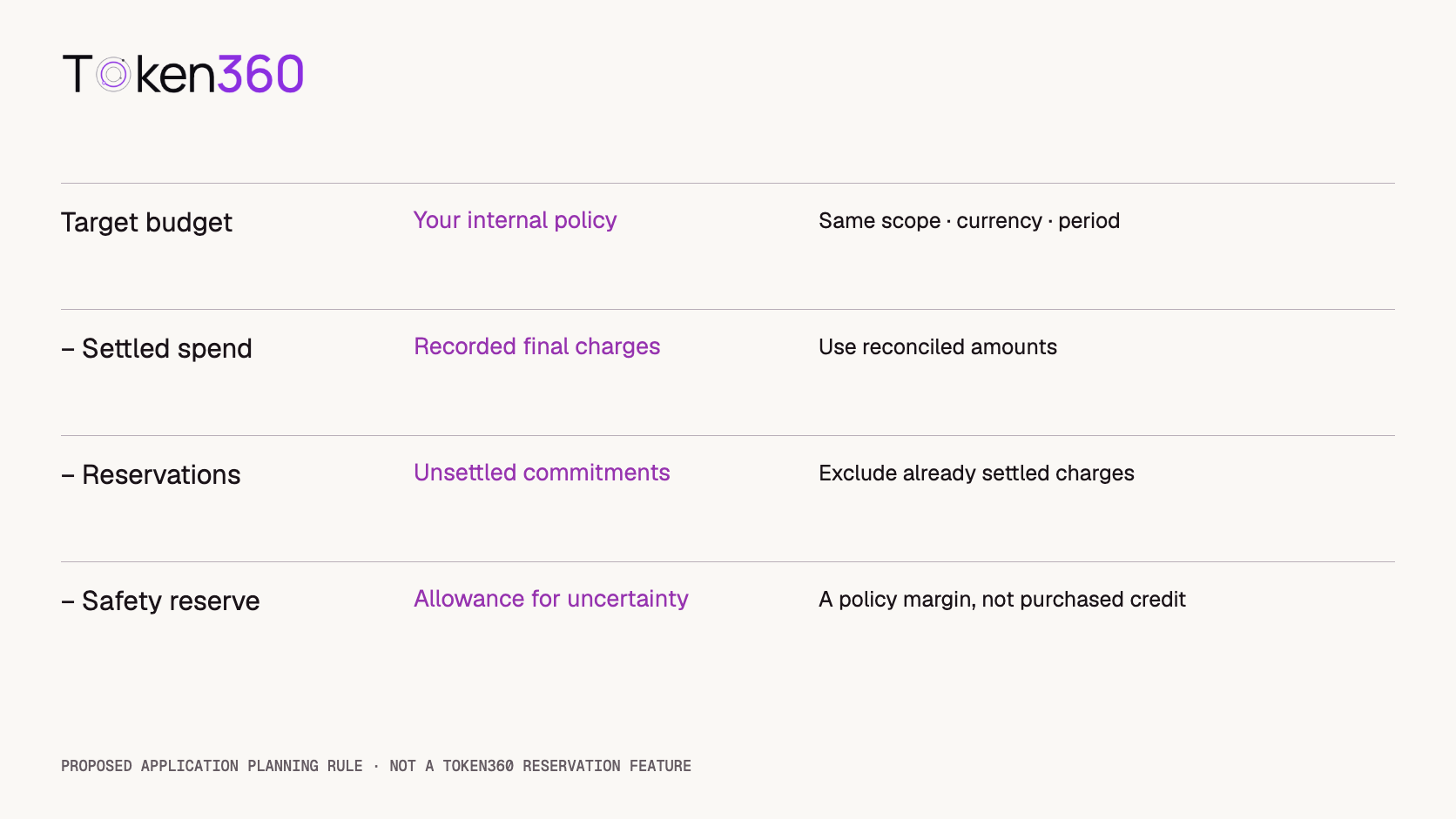
An application can maintain its own reservation ledger to reduce the gap between settled spending and outstanding commitments. This is a proposed application design, not a claim about a built-in Token360 reservation feature. Reserve an estimate when admitting work, then reconcile that reservation against the actual result.
A simple planning rule is:
available planning budget = target budget
                          - settled spend
                          - outstanding reservations
                          - safety reserve
All four terms must use the same currency, accounting scope, and budget period. Reservations must exclude charges already counted in settled spend, or the same operation is counted twice. The safety reserve is a policy allowance for uncertainty, not a provider balance or additional purchased credit.
This rule is only as reliable as its inputs. An estimate is not a guaranteed upper bound. If final charges can exceed the reservation, the application must handle the difference and may still exceed its internal target. Hard financial guarantees require stronger, documented bounds and enforcement than this illustrative formula provides.
A $100 example: the dashboard is not the whole budget
Suppose a project has an internal $100 target. Settled spending is $72, outstanding reservations total $18, and the team keeps a $5 safety reserve. The available planning budget is $100 − $72 − $18 − $5 = $5.
Looking only at settled spending would suggest $28 remains. That view ignores $23 already assigned to reservations and uncertainty. The difference is important even though neither figure changes the provider’s actual account balance.
| Planning component | Hypothetical amount |
|---|
| Internal target | $100 |
| Settled spend | $72 |
| Outstanding reservations | $18 |
| Safety reserve | $5 |
| Available planning budget | $5 |
If a proposed operation needs a $3 reservation, it fits this policy. After admitting it, outstanding reservations become $21 and available planning budget becomes $2. A second identical operation would not fit unless something settles, the estimate changes legitimately, or the owner changes the policy.
Two workers must not independently read the original $5 and each reserve $3. Use an atomic admission-and-reservation step appropriate to your storage system. Otherwise, the ledger can promise $6 of capacity that only had $5 available.
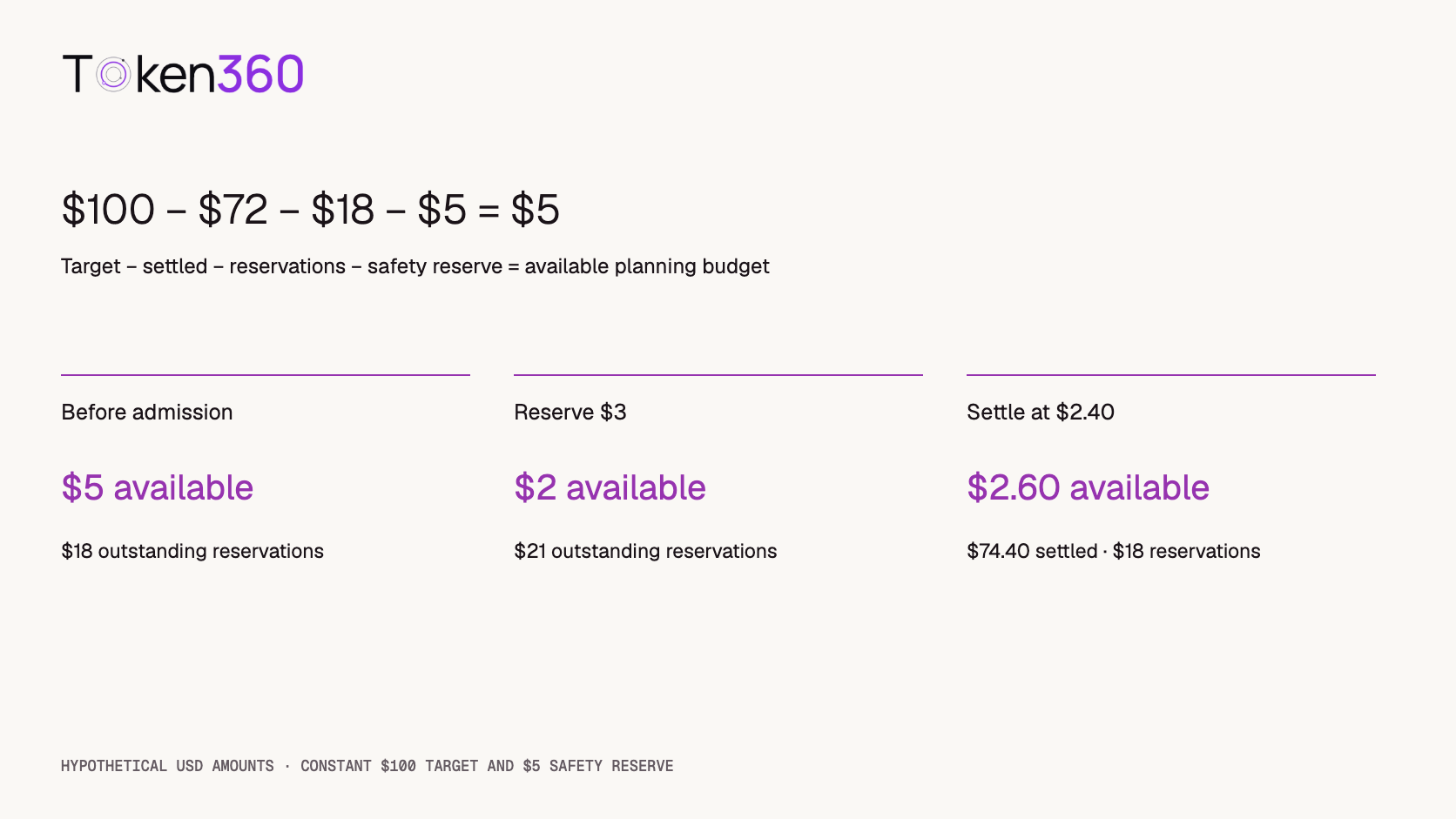
The example is arithmetic, not a Token360 pricing quote or production test. It does not measure alert delay, overspend, or savings. The amounts were selected to make the accounting distinction visible.
Reconcile reservations without losing uncertain requests
Link each reservation to a stable intended operation and retain its submission attempts. When a final $2.40 charge replaces a $3 reservation, add $2.40 to settled spend and remove that $3 reservation in one consistent update. Under the same example, settled spend becomes $74.40, outstanding reservations return to $18, and available planning budget becomes $2.60.
Do not release a reservation merely because the client timed out. The operation may have been accepted. Keep an explicit unresolved state until evidence supports settlement, non-acceptance, or another documented outcome. Otherwise, the application may spend the same apparent capacity twice.
A retry also needs accounting rules. If it can create additional billable work, it cannot automatically reuse a reservation that only covered the first operation. Preserve the relationship between attempts while reserving for the liability your policy actually admits.
Handle final charges above estimates explicitly. Record the variance, reduce available planning budget accordingly, and prevent further admissions if the policy no longer allows them. Do not modify historical estimates afterward simply to make the estimator appear accurate.
Choose alert thresholds from response time
A useful warning arrives early enough for someone to act. Choose thresholds from the expected response process and spending pace, not only from convenient percentages. Identify who receives the warning, how quickly they are expected to respond, and which actions they can take.
For another purely illustrative calculation, if spending continues at $4 per minute and the response process takes five minutes, $20 can accrue during that response window. That estimate excludes any detection delay and assumes a constant rate. It is not a recommended threshold or a measured Token360 spending pattern.
Use a lower-severity warning for investigation and an explicit escalation path when capacity becomes critical. Avoid repeatedly notifying everyone for every request. Group related signals, retain the first detection time, and show whether an owner has acknowledged the condition.
An alert should include the accounting scope and freshness of its data. “Project A: settled $72, reservations $18, last reconciled at 14:05 UTC” is more actionable than “budget almost exhausted.” Do not include secret keys in notifications; use safe display identifiers.
Handle resets and policy changes deliberately
A period reset changes the accounting window, not the history of a request. Work admitted before the boundary may settle afterward. Define how your internal ledger attributes that work and reconcile it with the provider’s actual billing treatment. Do not discard unresolved commitments when a local calendar date changes.
Use explicit time zones and boundary timestamps in reports. Distinguish your project’s management budget from provider enforcement periods. If they differ, explain the mapping instead of assuming that a local midnight resets every upstream control.
Record policy changes with the owner, reason, previous value, new value, and effective time. A temporary increase should have a review or expiry plan. Confirm which control caused the block before changing anything, and check that the new setting serves the intended business requirement.
Validate the control path with simulated charges
Before allowing a ledger to govern production traffic, exercise it with a local fake billing source. Test simultaneous admissions, a final charge below its estimate, a charge above its estimate, an unresolved timeout, and a settlement that crosses a period boundary. This is a proposed test plan, not an executed Token360 integration.
Also test the human path: a warning reaches the intended owner, the displayed figures are understandable, and an approval changes only the intended policy. A technically delivered alert that nobody owns is not an effective operating process.
Keep three outcomes in the report: what the application admitted, what the provider accepted, and what was finally charged. Those counts and amounts need not become available at the same time. Reconcile discrepancies before presenting a savings or budget-compliance claim.
The original contribution here is the reservation-aware planning example and its settlement transition. The arithmetic was checked locally. No live spend control was changed, no paid model calls were made, and no real budget-overrun prevention result was measured.
Define what happens when the planning ledger is unavailable or stale. A development tool may pause new work until reconciliation recovers, while a critical service may need an explicitly approved emergency allowance. Make that exception bounded and observable. An accidental fallback that ignores every reservation during an outage can defeat the control precisely when its accounting is least reliable.
FAQ
Does a budget alert stop AI API requests?
A notification alone does not establish enforcement. Check whether a separate action or spend control is configured and what operations it actually blocks.
Can a higher key limit override an account limit?
Token360 documents that applicable account controls still constrain the key. Raising one key’s limit does not override a stricter account restriction.
Do workspaces automatically create shared budget caps?
Do not assume that. Workspace grouping and an aggregate enforced spending cap are different capabilities; verify explicit support before relying on one.
Should pending jobs count toward my planning budget?
Account for their unresolved cost exposure. An application reservation ledger can help, provided estimates, settlement, and double-counting rules are explicit.
Can I release reserved budget after a timeout?
Not solely because of the timeout. Determine whether the operation was accepted and whether a charge is still possible before releasing its reservation.
Does an application reservation guarantee no overspend?
No. Estimates can be wrong, updates can race, and settlement can arrive later. Treat it as a planning control with stated limits, alongside documented provider controls.
Read next: investigate request-level evidence with AI API observability and assign operational ownership using the enterprise AI gateway checklist.



 Prompt Guide
 Prompt Guide
 Tutorial