AI Video Production Economics: Why Cheaper Generations Can Cost More
AI video production economics depends on accepted work, review labor, repairs, and delivery constraints. Compare the full workflow, not request price.
By Yuki Yu
The economically useful unit in AI video is the work a team can deliver, not simply the number of clips a model returns. Generation price matters, but acceptance, review effort, repair work, and delivery constraints determine what that price buys. A cheaper request can be the better choice—or a costly way to accumulate unusable footage.
Our position is that buyers should compare complete production paths for a defined creative job. They should also resist the opposite mistake: assuming that a more expensive model must save money downstream. That is a hypothesis to test, not a premium feature to take on trust.
This is an analysis of AI video production economics, not a model ranking or a pricing tutorial. The numerical examples are original, explicitly hypothetical scenarios. They do not represent Token360 customer results, current provider prices, or measured model performance.
A price table tells a buyer how usage is billed. It does not tell them how many attempts a specific brief will require, how long their editor will spend reviewing them, or whether the selected clip will survive a client revision.
For example, fal’s pricing page lists prices by billing unit. Token360’s Model Capabilities documentation likewise directs users to model-specific pricing rules, limits, and supported parameters. These are necessary inputs for comparison. They are not promises about completed production cost.
The distinction becomes important when two offers use different units. A per-second rate and a per-output rate cannot be compared without fixing duration and the relevant configuration. Even after that normalization, the comparison still concerns generation, not approval. A finance-friendly unit can conceal a creative bottleneck.
For a monthly purchasing decision, use the API versus subscription clip-budget guide to put the planned volume and production assumptions into a comparable scenario.
Why can review become the production bottleneck?
More candidate footage increases the amount of material that must be inspected and compared. Review capacity can become the constraint even when generation is inexpensive.
Consider a team that can generate far more candidates than it can inspect carefully. Increasing throughput may expand the shortlist, but it also creates more decisions. Someone still has to judge whether the product is recognizable, the movement makes sense, the ending works, and the shot fits the edit.
This is an operational argument, not a claim that AI video always increases labor. For some briefs, one good output may replace hours of manual work. For others, a large batch may consume an afternoon without producing a usable result. The relevant question is where the constraint moves in the actual workflow.
There is evidence that vendors themselves package more than a generation step. Runway’s Workflows documentation describes pipelines that can combine models and editing steps through one request. That product direction supports a limited observation: generation is one component of a production path. It does not prove that any particular pipeline reduces review time.
Which three production cost measures should stay separate?
Unit
What it establishes
What it does not establish
Generated candidate
An output was returned and can be inspected
The brief was met
Accepted clip
A defined quality gate was passed
The clip was delivered or used
Delivered asset
A finished item reached its intended destination
It produced business results
A clip can be acceptable but never selected. A delivered advertisement can be technically excellent but commercially ineffective. Treating all three stages as “success” makes a business case look stronger than the evidence permits.
Define the unit before comparing vendors. If one workflow delivers complete ten-second advertisements and another supplies five-second shots for an editor, cost per output is not a fair comparison. Normalize to a shared deliverable or keep the two capabilities separate. Do not count a second crop as a new creative concept unless that is explicitly your unit of work.
How can a cheaper generation become a more expensive deliverable?
A workflow with a higher generation price can cost less per accepted deliverable if it requires fewer rejected candidates or less review. Compare both under the same brief and acceptance rules.
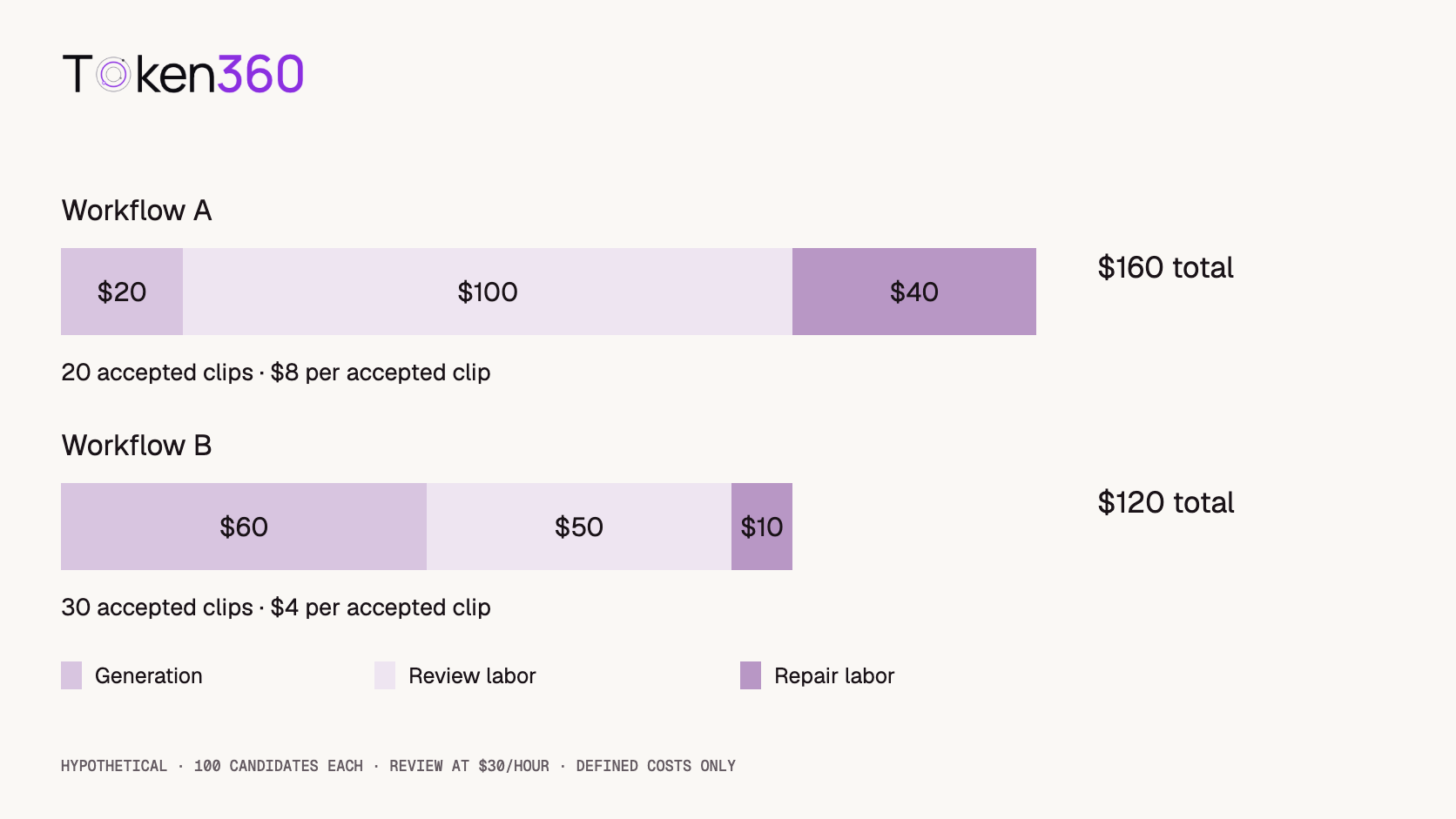
Imagine two workflows for the same shot brief, duration, delivery format, and acceptance standard. Each generates 100 candidates. All candidates in this illustration are accessible, and all generation charges are included. Neither workflow is a named provider or a measured benchmark.
Assumed batch input
Workflow A
Workflow B
Price per generated candidate
$0.20
$0.60
Generation charges: 100 candidates
$20
$60
Active review time
200 minutes
100 minutes
Review cost at assumed $30/hour
$100
$50
Additional repair labor
$40
$10
Distinct accepted clips after repair
20
30
Included batch cost
$160
$120
Included cost per accepted clip
$8
$4
Workflow B costs three times as much per generation but half as much per accepted clip under these assumptions. The difference comes from both less labor and more accepted outputs. It is not evidence that a higher-priced model is generally superior.
Review means active viewing and scoring; repair means separate editing time. They must not overlap. This illustration excludes shared preproduction, integration, storage, taxes, distribution, and campaign measurement. Add costs that differ materially in a real comparison. Call this “included production cost,” not a complete total cost of ownership.
Illustrative assumptions only. The generation line item points in the opposite direction from the included production total.
How do labor and acceptance change the cost comparison?
The same example provides a useful counterargument. If review and repair carried no incremental cost, A would cost $20 ÷ 20 = $1 per accepted clip, while B would cost $60 ÷ 30 = $2. On generation charges alone, A wins. Choosing a denominator does not eliminate the need to choose a relevant cost boundary.
In the original scenario, B must deliver at least 16 accepted clips to beat A’s $8 per accepted clip, assuming B’s included batch cost remains $120. At 15 accepted clips, B ties: $120 ÷ 15 = $8. Below 15, it loses. That threshold is a sensitivity check, not a forecast; labor costs may change as acceptance changes.
“Our staff are already paid” is not the same as “their time has no value.” An allocated labor rate can describe consumed capacity without implying a cash saving or headcount reduction. Report those separately. Freeing an hour only creates operational value if that hour can be used for something that matters.
When is cheaper generation useful for exploration?
Early concept development rewards variety. A storyboard team may need to discover a promising direction rather than deliver finished frames. Imperfect identity, loose continuity, or temporary artifacts may be acceptable if the outputs help choose a concept quickly.
In that setting, a strict finished-asset acceptance gate can misrepresent the job. The relevant outcome might be an approved concept or a useful creative decision. A low-cost workflow with many rough candidates can be economically appropriate, particularly when review is quick and the stakes of rejection are low.
The danger is carrying exploration economics into final production. A promising animatic and a client-ready product shot are different outputs. A workflow can be excellent for the first and poor for the second without being an inferior product overall.
Why does production need controllability as well as visual quality?
A beautiful sample is compelling, but production also needs change to be manageable. When a buyer requests a different ending, can the team preserve the useful opening? When a product detail must remain exact, can it survive the necessary motion? When the crop changes, does the composition still work?
These questions should influence evaluation without becoming unsupported feature claims. The exact model, input method, and accepted parameters matter. Access through a shared API does not make every model interchangeable or guarantee equivalent editing controls.
Deadline exposure is another separate dimension. A slow but predictable path may suit scheduled production; a fast path with inconsistent turnaround may require more buffer. Record wall-clock delivery time alongside active labor. Multiplying every minute spent waiting by an hourly labor rate would overstate cost when the operator can do other work.
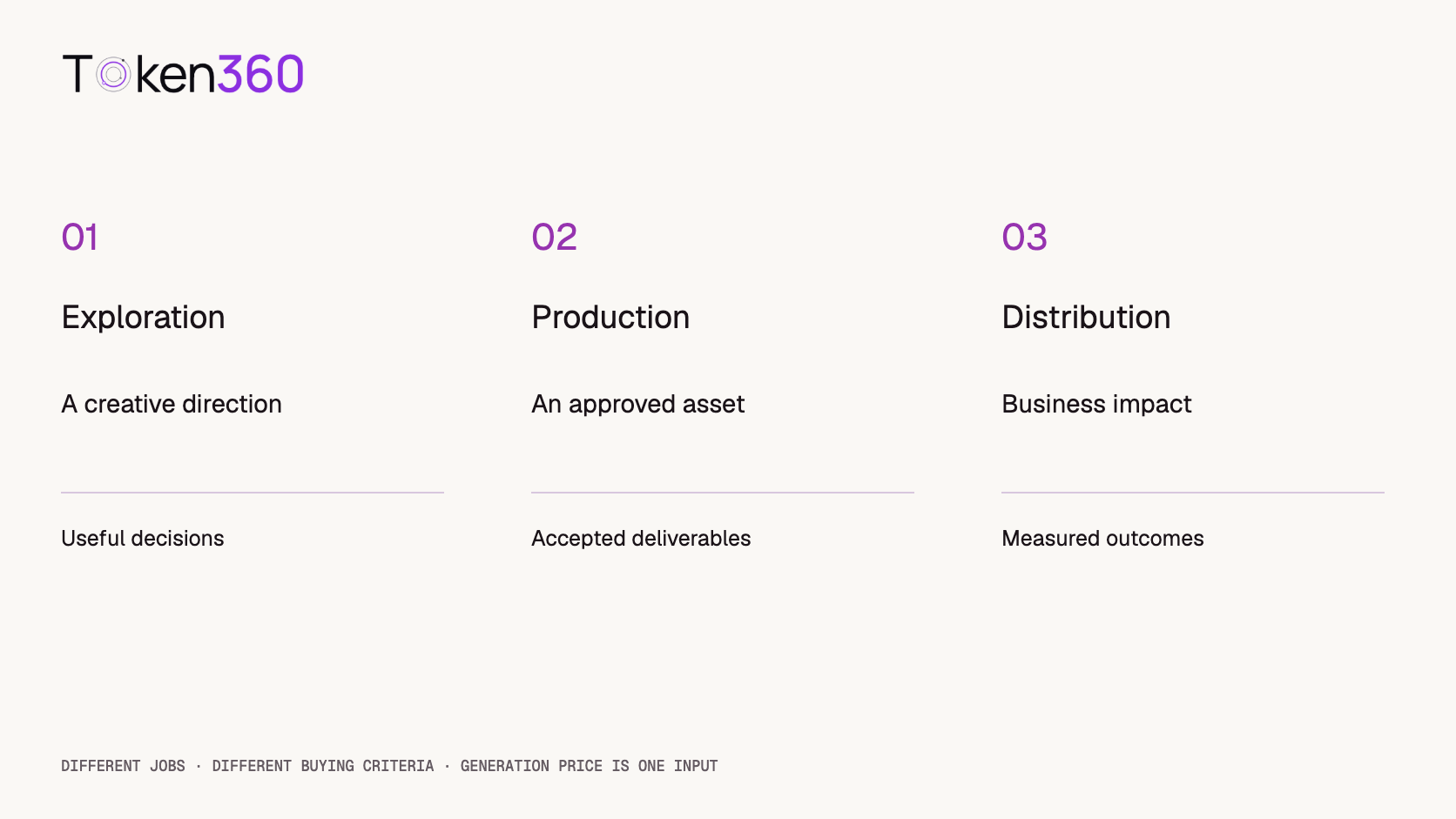
The best buying criterion changes with the job. A single generation-price ranking cannot represent all three stages.
What can a gateway change about production economics?
For a team using several models, a gateway may be useful as an integration choice. That is a different claim from saying it automatically improves creative results. Model access, application integration, creative evaluation, and asset finishing each have their own costs and responsibilities.
Token360 should therefore be evaluated against the buyer’s actual model and workflow requirements. Confirm the selected model’s inputs, pricing meter, and parameters in its public documentation, then judge its outputs against the same acceptance standard used elsewhere. Do not assume that adding a routing layer removes model limitations or editorial review.
Our commercial perspective is explicit: Token360 focuses on enterprise inference supply across text, image, audio and video, including model-rate negotiation and project-scoped capacity and contracts. Compare that offer against accepted production outcomes. A lower negotiated unit rate cannot by itself establish savings after rejected generations, editing and delivery costs.
What would make the business case credible?
A credible comparison preserves ordinary outputs, not just a highlight reel. It states the brief, model configuration, sample size, selection criteria, billed attempts, active review effort, and repair work. It identifies who made the acceptance decision and whether that person knew which workflow produced each candidate.
The most persuasive evidence is specific to the buyer’s recurring work. Three beautiful hero shots tell a different story from a month of routine catalog clips. A small sample can reveal failure modes, but should not be promoted into a universal reliability or savings claim.
Buyers should also ask what would reverse the recommendation. A lower acceptance rate, more expensive review, or less frequent reuse can overturn a favorable calculation. A business case that includes those boundaries is more useful than a single confident percentage.
FAQ
What are AI video production economics?
They describe how generation charges, labor, usable output, and delivery constraints combine to determine the cost and value of an AI video workflow. The relevant unit depends on whether the job is exploration, production, or distribution.
Is cost per generated second a bad metric?
No. It is useful for understanding generation spend when settings are comparable. It becomes incomplete when used as the only measure of finished production cost or creative value.
Does a higher-priced model usually cost less overall?
This article provides no evidence for that generalization. Higher generation cost is justified economically only when the additional value or avoided work is demonstrated for the intended job.
Should employee review time be included?
Include it when assessing resource consumption, using an explicit rate and active time measurement. Distinguish allocated capacity cost from incremental cash expenditure and from savings actually realized.
Is an accepted clip the same as a successful advertisement?
No. Acceptance establishes that production requirements were met. Advertising effectiveness requires separate distribution and outcome evidence; it cannot be inferred from visual quality or low generation cost.
What should a team compare before committing?
Compare the same brief, deliverable, quality gate, and relevant cost boundary. Retain the rejected cases and report uncertainty. A good decision explains both where a workflow wins and where it stops being the right choice.
Published by Token360, a platform providing shared access to supported language, image, video, and audio models.
Commercial scope reviewed November 4, 2026. Token360 pricing and engagement scope are company-confirmed; individual discounts, capacity commitments and compliance evidence require a written proposal. fal pricing and enterprise scope. Token360 enterprise page. Historical test charges remain dated observations, not current universal quotes.



 Guides
 Guides
 Guides