AI Video API vs Subscription: Budgeting for 300 Clips a Month
Compare AI video APIs and subscriptions for 300 monthly clips. Calculate retries, credit allowances, annual commitments, and the cost of accepted results.
An AI video API is not automatically cheaper than a subscription. The better option depends on whether you need 300 generated clips or 300 approved clips, how much of a plan's allowance you use, and whether the workflow needs programmatic access.
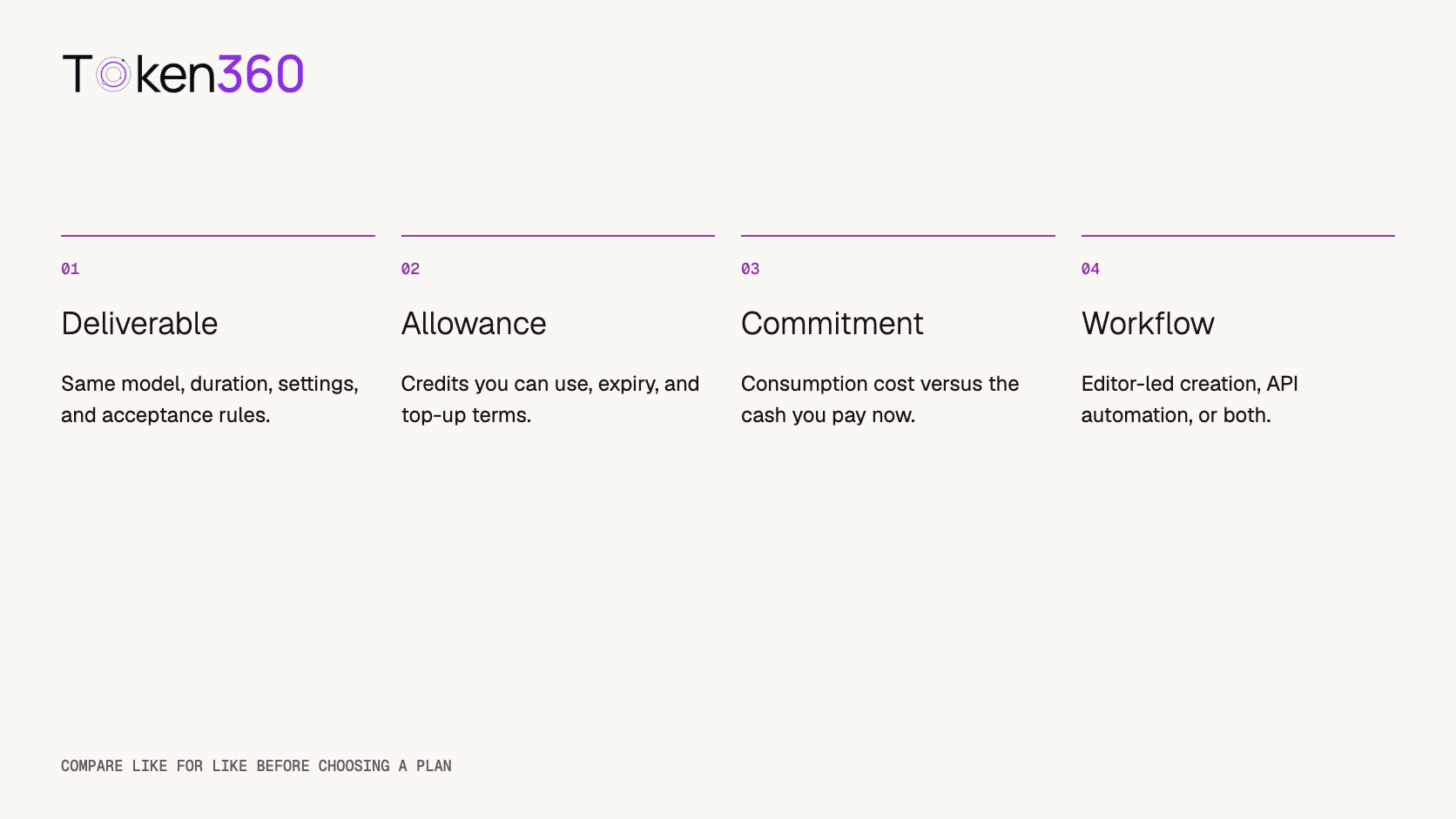
Compare the same model, output settings, acceptance criteria, and billing period. Then separate consumption cost, cash paid, and operating effort. A low monthly headline price and a low per-second rate answer different questions.
Published by Token360. Public pricing checked October 23, 2026. The calculations below are budget scenarios, not measurements from 300 completed jobs. Official list-price inputs are labeled separately from assumed acceptance rates; taxes, editing, and labor are excluded unless stated.
Read first: our AI video API pricing guide explains billing units and accepted-clip cost. This article focuses on the monthly API-versus-subscription decision.
Define what “300 clips” means
If the target is 300 attempts, the budget can be estimated from those attempts and their settings. If the target is 300 usable deliverables, rejected outputs increase the required generation volume.
For planning, let N be the desired accepted clips and p the assumed proportion of attempts that produces an accepted clip. Under a simplified model with comparable attempts, expected attempts are approximately N / p. Round up when reserving a whole-job budget. This is an expectation, not a guarantee that a fixed batch will deliver the target.
Acceptance assumption
Expected usable clips from 300 attempts
Planned attempts for 300 usable clips
100%
300
300
80%
240
375
60%
180
500
40%
120
750
These acceptance rates are scenarios, not claims about any model. They also assume every attempt is billed at the same rate. If a technical failure is refunded, or retries use different settings, replace that simplification with the actual charging rules.
Count delivered clips consistently. A 30-second ad assembled from six five-second shots is one deliverable but at least six source clips. Do not mix finished ads, generated shots, and exported variants in one denominator.
Build an API budget from a stated unit price
For a simple per-second route, multiply attempt count by clip duration and the applicable rate. Add reference-media charges, separately billed outputs, or platform fees only where the chosen service actually applies them.
Generation spend = attempts × seconds per attempt × price per second
Planning attempts ≈ accepted-clip target / acceptance assumption
As a public worked example, Runway Dev's pricing documentation lists Gen-4.5 at 12 credits per second and API credits at $0.01 each. That converts to $0.12 per second, or $0.60 for a five-second generation. This is a rate-card calculation, not a measured bill or a statement that another vendor offers an equivalent result.
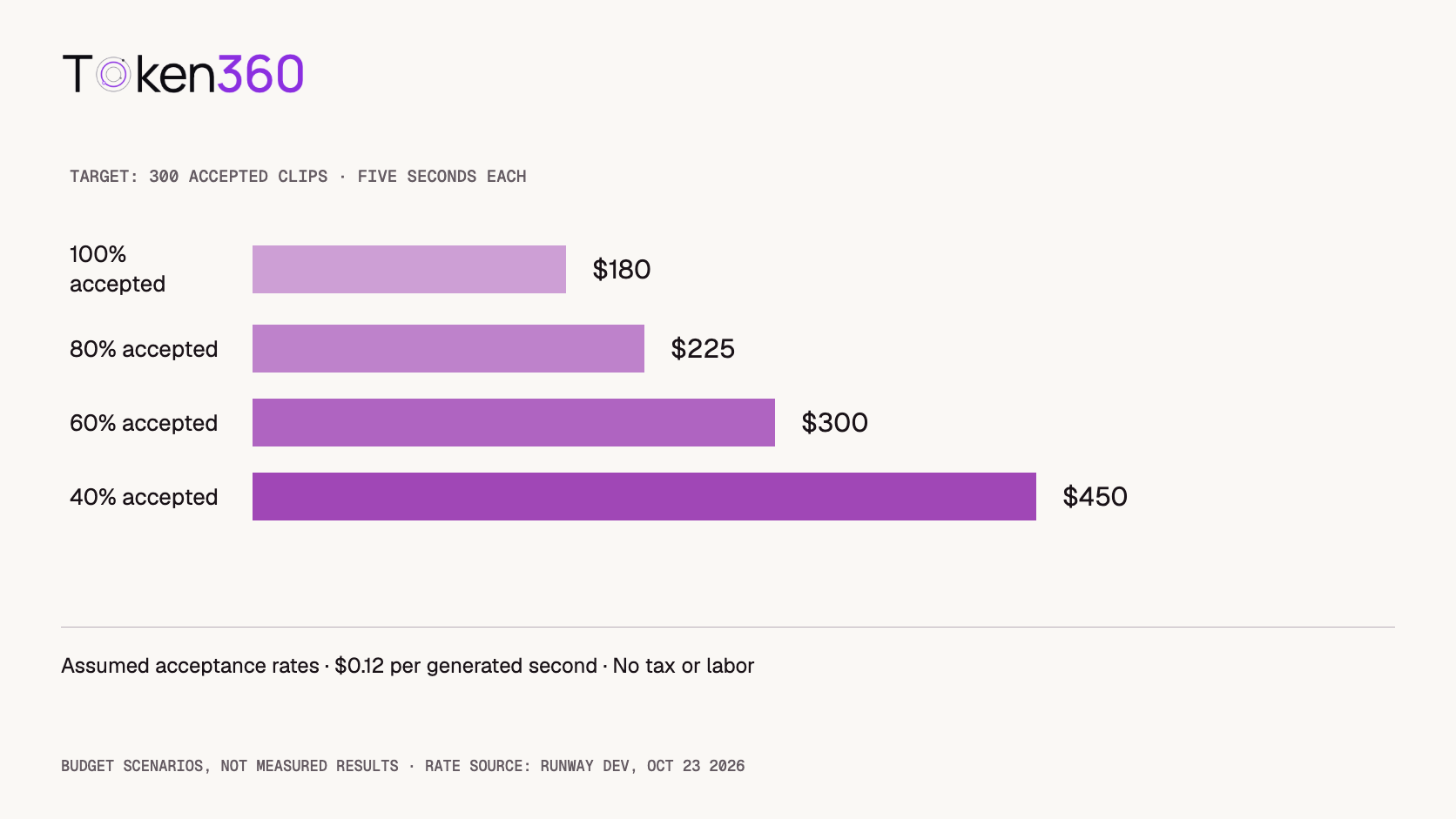
Using that stated generation rate, 300 five-second attempts consume $180 of API usage before taxes or additional services. To plan for 300 accepted clips, change the attempt count:
Assumed acceptance
Planned attempts
Generated seconds
Generation spend
Spend per target accepted clip
100%
300
1,500
$180
$0.60
80%
375
1,875
$225
$0.75
60%
500
2,500
$300
$1.00
40%
750
3,750
$450
$1.50
The acceptance assumptions are illustrative and held independent of the quoted rate. Actual results may require more or fewer attempts. A small pilot should inform a range rather than a confident monthly forecast.
Calculated scenarios at $0.12 per generated second. Acceptance rates are assumptions, not measured performance.
Translate a subscription into the same workload
A plan needs three numbers before it can be compared: the recurring charge, the usable allowance, and credits consumed by the exact task. Also record whether the advertised monthly equivalent requires an annual commitment.
At the review date, Runway's public pricing page lists Pro at $28 per month billed annually, with 2,250 monthly credits. It lists Gen-4.5 at 60 credits per five-second generation. Those inputs imply a $336 annual plan commitment and 37 complete five-second generations within one month's allowance, leaving 30 credits. They do not imply 300 monthly clips.
For 300 attempts at 60 credits each, the workload requires 18,000 credits. After a 2,250-credit allowance, the gap is 15,750 credits, assuming the entire allowance is available for this workload. At the illustrative 60% acceptance level, 500 attempts require 30,000 credits, leaving a 27,750-credit gap.
The same pricing page says Pro's monthly credits do not roll over. Confirm current top-up pricing and purchase increments in the account before calculating a full subscription-plus-top-up total. We have not applied the API credit price to web-app top-ups or assumed that their balances are interchangeable.
This is an allowance calculation, not a complete vendor cost ranking. A subscription can include editing tools, storage, and other workflow value; whether those benefits matter depends on your production process. Conversely, unused included credits are not automatically savings.
Do subscription credits work through the API?
Check the specific plan and contract. Do not infer API entitlement from the presence of credits or a model name in a creative application.
Runway's API FAQ describes separate web-app and API credits. Its September 2026 unified-pricing announcement describes shared credit commitments and administration for enterprise customers. The public wording therefore needs an account-specific check rather than a blanket statement that every plan shares—or never shares—credits.
For an automated application, ask which endpoint the agreement covers, which balance it charges, and whether usage limits differ from the web app. For a creator using a browser interface, ask whether the required model, output settings, and expected generation volume are included.
“API” and “subscription” are not strict opposites. An API can be funded through credits or a commitment, and a subscription can expose automation features. Compare the actual commercial and technical terms.
Separate consumption, cash outlay, and effective cost
Three cost views help avoid misleading comparisons:
Consumed generation value: the metered usage associated with this month's work.
Cash outlay: what you must pay now, including annual billing or a minimum top-up purchase.
Effective production cost: attributable charges plus the review, editing, and operating work needed to deliver acceptable assets.
A prepaid API credit purchase can exceed this month's consumed usage. An annual plan can look inexpensive when divided by twelve while requiring a larger commitment. Show both the monthly allocation and the actual payment obligation.
For a generic subscription, use the following worksheet. The symbols describe a planning model, not any vendor's actual tariff:
A = required generation attempts
k = credits consumed per attempt
Q = eligible included credits remaining this cycle
S = subscription cost allocated to this month
P = purchasable top-up pack size in credits
T = price per top-up pack

Extra credits = max(0, A × k − Q)
Top-up packs = ceil(Extra credits / P)
Monthly cash-cost allocation = S + Top-up packs × T
Use the formula only when top-ups really are sold in fixed packs at a known price. If the plan meters differently, has restricted usage modes, or permits rollover, adapt the worksheet. Preserve any unused purchased balance in the ledger rather than treating it as both spent consumption and future credit.
Why there is no universal break-even clip count
A simplistic calculation divides a monthly fee by the API cost per clip. That only works under restrictive conditions: the subscription fully covers the relevant output, the same quality and settings are available, and there are no additional charges or limits.
For illustration, a hypothetical $60 plan covering 200 equivalent attempts and a hypothetical $0.60-per-attempt API would intersect at 100 attempts before considering labor. But beyond the included allowance, the plan's top-up rules change the curve. If acceptance differs between workflows, even the first comparison must be adjusted.
Use this as a decision method, not a prediction. Evaluate at your likely low, typical, and high monthly demand. A team with irregular campaigns may value flexibility more than a theoretical unit saving at full utilization; a team using an integrated editor daily may value the subscription beyond its generation allowance.
Make the units and entitlements comparable before calculating a winner.
Include retries, drafts, and review time
A completed generation can still be rejected for product deformation, a continuity error, or incorrect dialogue. Those creative rejections are different from technical failures. Track whether each attempt was billed, refunded, accepted, or discarded.
Draft and final workflows can also create multiple billable events. For example, Token360's Seedance 2.5 page describes separately billed drafts and final renders. Price both stages if that is how your team works.
Record hands-on review time separately from generation waiting time. As a hypothetical labor estimate, 500 attempts reviewed for 30 seconds each require about 4.17 reviewer hours before editing. Those are assumptions, not timings observed in our pilot. Parallel generation does not eliminate the need to inspect the output.
For product demos, define acceptance before the test: geometry, identity, motion continuity, and usable composition. Our image-to-video workflow guide covers the production process. Use your own acceptance record rather than borrowing a success rate from a different model or task.
When to evaluate an API, a subscription, or both
Workload
Option worth evaluating
Evidence to collect
Video generation inside your product
An API with the required capabilities
Actual request flow, charges, retry behavior, and job completion
Human-led creative iteration in an editor
A subscription with useful included tools
Allowance utilization, editing time, and full purchase terms
Occasional campaigns with unpredictable volume
Usage-based access or a flexible short commitment
Low-month spend, top-up rules, and credit expiry
Creative exploration followed by automated variants
A combined workflow or suitable enterprise agreement
Credit eligibility, asset handoff, API access, and contract scope
Token360 is one option for supported models through a shared API. Its public pricing page labels per-second rates as representative estimates, so confirm the current model configuration rather than treating a broad pricing table as a final quote. The article's worked Runway calculation is not evidence that Token360 is cheaper.
Is an AI video API always cheaper than a subscription?
No. Compare equivalent output, actual allowance utilization, fees, and accepted-result cost. Included creative tools may also change the value of a subscription for a human-led workflow.
How much should I budget for 300 AI videos a month?
First define duration and whether 300 means attempts or accepted clips. In the five-second, $0.12-per-second scenario above, 300 attempts cost $180 in generation usage; 300 accepted clips at an assumed 60% acceptance level require about $300. Neither is a universal price or guaranteed outcome.
Can I use my subscription allowance with an API?
Only if the applicable plan or contract permits it. Check the actual balance charged by the endpoint, including any enterprise provisions. Do not assume that credits with the same name are interchangeable.
Should I use the annual monthly-equivalent price?
You may use it for allocation, but disclose the annual commitment and cash payment schedule. Compare it against an API budget over the same period.
What happens if I do not use all included credits?
That depends on the plan's rollover and expiry rules. Budget using credits you can actually consume within the eligible period, and keep purchased top-ups separate if their rules differ.
How do I know whether the acceptance assumption is realistic?
Run a small, representative pilot with written pass criteria and retain every attempt. Use a range for planning, especially with a small sample. Do not generalize audio tests to video or a simple product shot to dialogue-heavy scenes.



 Tutorial
 Tutorial
 Tutorial