What Does an AI Inference Provider Actually Provide?
An AI inference provider supplies model execution through a service. Learn what access, capacity and support include, and what your team still owns.
An AI inference provider makes trained models usable as a service: your application sends an input and receives a prediction or generated output. The purchase may include a model endpoint, execution capacity, usage metering and operating support. Exactly which features, controls and commitments are included depends on the service and agreement.
For a business buyer, the useful question is what the purchased service delivers—and where its responsibility ends. Access to a model is not automatically a finished application, a reserved production allocation or a guarantee that every answer is correct. Those are separate deliverables to identify before comparing offers.
Scope of this guide: This article explains the components of an inference purchase, not a ranking of providers. Official documentation was reviewed November 17, 2026. The service-scope worksheet and example below are editorial planning tools, not a tested deployment or a Token360 quotation.
What are the main parts of an inference service?
Separate the offer into model access, request execution, operating controls and commercial support. A supplier may provide several of these through one interface, but the interface does not establish their scope. Ask what is included for the specific model, account and workload, rather than relying on the size of the catalog.
Service component
What it delivers when included
What to confirm
Model endpoint
A callable operation using a supported model
Model identifier, operation, inputs, outputs and supported settings
Execution
Processing of accepted requests and return of results or job status
Request limits, queue behavior, timeouts and output delivery
Access and usage controls
Authentication, usage records and any available account controls
Which controls exist and who configures them
Commercial arrangement
A billing basis and applicable service terms
Billable units, commitments, exclusions and change conditions
Operating support
A defined route for service questions and incidents
Coverage, escalation and any separately agreed response obligations
These are review categories, not a promise that every provider includes every item. A basic endpoint can be useful without a custom support package. A company with strict production requirements may need additional arrangements. The buying mistake is treating an unspecified feature as included because it would be convenient.
Are you buying model access, compute or a managed deployment?
Look at the purchased unit and the work the supplier undertakes. A model API sells access to a supported operation; compute rental supplies infrastructure resources; a managed deployment adds specified model-serving work. These arrangements can overlap, but they should not be compared as though they deliver the same finished service.
As an official example, Hugging Face describes Inference Endpoints as bringing model artifacts, an inference engine and production infrastructure together. Its documentation identifies provisioning, deployment and API accessibility as part of that managed offering. This is a concrete service description, not a definition of what every inference supplier includes.
Separately, Hugging Face's Inference Providers documentation describes access to models through provider routing and distinguishes that service from dedicated endpoints. The same ecosystem can therefore offer different purchasing units. Ask which product your proposal actually covers.
This article focuses on the deliverables in the purchase. Use the separate API versus self-hosting guide when deciding whether your company should operate the serving stack itself.
What should “access to a model” specify?
A usable model entitlement specifies an operation and its supported interface, not only a familiar model name. Establish what inputs the service accepts, what outputs it returns and which features are available. A catalog entry alone does not confirm that every capability associated with the underlying model is exposed through that endpoint.
For a text workload, this could include streaming, structured responses, tool-call output and input limits. For media generation, it could include reference inputs, duration, resolution and audio support. Treat unsupported or undocumented settings as questions to resolve, not as features inherited automatically from the model's reputation.
Request examples should demonstrate the operation you intend to buy. A successful plain-text response does not validate your structured-data workflow; a generated image does not validate image editing. Record the model identifier and relevant settings alongside the acceptance example.
Who publishes a model and who operates its execution are separate questions. The model publisher versus hosting provider guide explains that role map. Here, the deliverable is a clearly specified callable service, regardless of how many organizations contribute to it.
Does API access include production capacity?
API access establishes a way to submit requests; it does not by itself establish a reserved allocation or a performance commitment. Ask what happens under the workload you expect, including bursts and long-running jobs. Any commitment should identify the covered models, traffic conditions, measurement and applicable limitations.
Distinguish an account limit from a guaranteed ability to process that many simultaneous requests. Also distinguish a successful response from a response delivered within your application's time budget. These are different acceptance criteria, even when the service exposes them through the same endpoint.
For asynchronous video, specify how the application receives a job identifier, checks completion and retrieves the result. For interactive text, specify the response behavior the application needs. The provider's service scope should explain what happens when a request cannot proceed; your application still needs an appropriate user experience.
Unless separately included, application logic, business data preparation and output acceptance remain work for the buyer. An inference endpoint supplies a model operation inside a larger workflow. Name the owner of each surrounding task so that purchasing a service does not leave critical product responsibilities unassigned.
For example, a model can return a proposed tool call, while the application must decide whether to authorize and execute it. A summarization request can produce text, while the business still needs to determine whether the summary accurately represents its source. A generated video may need review before it is suitable for a campaign.
Do not assume a provider supplies your customer interface, retrieval index, integrations, editorial review or business-policy enforcement. Some suppliers sell additional services, but those need explicit deliverables. Likewise, a supplier's documented data-handling controls do not remove the buyer's responsibility to determine whether a particular dataset may be submitted.
Keep access permissions and customer-facing distribution rights in their own review. The customer-facing API integration guide explains why a working integration is not sufficient evidence of permitted downstream use.
How can a buyer turn the offer into a clear scope?
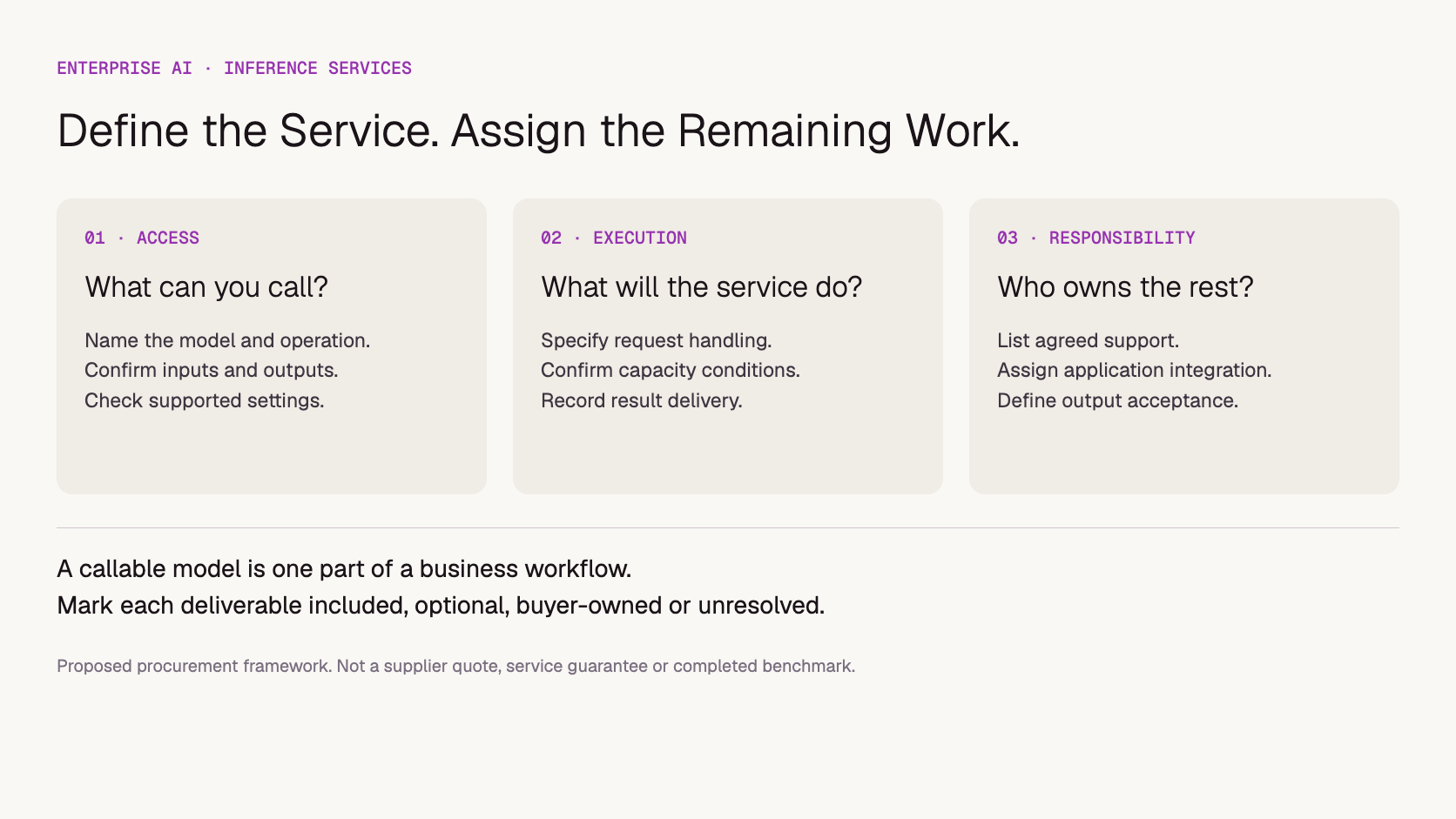
Write one row per deliverable and classify it as included, optional, buyer-owned or unresolved. Attach the supporting document or acceptance condition. This creates a practical description of the service and exposes assumptions before engineering, procurement and the supplier begin using the same words to mean different things.
In this hypothetical example, a company buys model calls for a product-description feature. The table shows how its proposed scope could be recorded; it does not describe a current Token360 package.
Deliverable
Illustrative allocation
Evidence or acceptance condition
Generate a description through a named endpoint
Included in the model service
Documented operation and representative request
Read the company's product database
Buyer-owned integration
Application owner validates the data mapping
Enforce required product attributes
Buyer-owned acceptance rules
Outputs checked against a defined rubric
Capacity during the catalog refresh
Unresolved until confirmed
Written scope and an agreed validation approach
Custom support coverage
Optional, if offered and agreed
Named coverage and escalation terms
Download the blank service-scope worksheet. It includes fields for the service component, model and workload scope, allocation, evidence, owner and acceptance condition. Start blank: a worksheet should reveal missing decisions, not pre-approve them.
Describe the purchase as deliverables, then assign the surrounding work.
What can enterprise buyers discuss with Token360?
Token360 focuses on enterprise access to text, image, audio and video models. Buyers can discuss their model mix, usage and engagement-specific commercial requirements. Confirm the relevant capabilities and commitments in the current service description and proposal rather than assuming all enterprise options form one standard package.
As checked November 17, 2026, the enterprise page describes model access, custom pricing and technical support discussions. It also places several support and infrastructure options in a roadmap or contact-sales section; priority support and SLAs are marked Coming Soon. The pricing page separately describes SLAs for qualifying enterprise agreements. Because the public pages frame availability differently, confirm the current account-specific offer in writing rather than assuming a standard entitlement.
Which deliverables require more than model access?
Ask the supplier to identify the boundary between inference and application delivery. A model can produce text or structured output without supplying the software that retrieves business records, renders a final file or changes an operational system. Put those deliverables in the proposal separately so the quoted model access is not mistaken for a complete product.
Requested outcome
Model contribution to evaluate
Additional scope to confirm
Answers from a database
Interpret supplied records or produce a proposed query
Database access, authorization, execution and result validation
A ready-to-send PDF
Draft text or structured fields
Template rendering, approval and delivery
A matched CRM account
Extract a name or other evidence from text
Account lookup, disambiguation and authorized updates
These are proposed scoping examples, not native Token360 product claims. If the requirement is complete application delivery, compare the responsibilities in API provider versus application developer. Otherwise, keep the model contract focused on the confirmed input, output and operating conditions.
Frequently asked questions
Does an inference provider train a new model for us?
Not necessarily. Inference uses a trained model to process inputs. Training, fine-tuning or deploying customer-supplied weights are separate capabilities to confirm; access to a model catalog does not establish that those services are included.
Does paying per token mean we are renting a GPU?
No. A token rate describes a billing unit for the service. It does not by itself give the buyer a machine allocation, infrastructure control or ownership of the underlying hardware.
Does a managed service include a finished AI application?
Only if that application is explicitly part of the offer. Managing model execution is different from building your workflow, connecting business systems and accepting outputs. Identify the actual deliverables behind the word “managed.”
Does a more expensive service necessarily include more support?
No. Verify the scope rather than inferring it from price. Rates can reflect different models, usage conditions or commercial arrangements. Compare named support deliverables and commitments separately from inference unit charges.
Service component,Required deliverable,Model and workload scope,Allocation: included / optional / buyer-owned / unresolved,Evidence or agreement reference,Owner,Acceptance condition
Model access,,,,,,
Request execution,,,,,,
Capacity,,,,,,
Usage records,,,,,,
Data handling,,,,,,
Operating support,,,,,,
Application integration,,,,,,
Output acceptance,,,,,,
Enterprise AI
API
Bring your next idea to life.
Create a video scene in Creator, or explore models for images, audio, and text to find the right capabilities for your project.


 Guides
 Guides
 Guides