Dedicated AI Inference Capacity vs Higher Rate Limits
Higher API limits do not prove reserved capacity. Compare allocation, isolation, overflow and acceptance tests before buying enterprise inference.
ENTERPRISE PROCUREMENT · BLOG 147
By Token360 · Editorial review: November 5, 2026
A higher API limit changes how much traffic an account is permitted to submit or run. Dedicated inference capacity is a separate service arrangement whose allocation, scope and conditions need to be specified. Do not infer reserved resources, isolated hardware or a completion guarantee from an increased limit alone.
An enterprise launch can expose the gap between permission to send traffic and the ability to finish it on time. A sales proposal may mention higher concurrency, priority service or a private endpoint. Those terms are useful only when the team knows which constraint each one addresses.
This guide focuses on reviewing a capacity offer and agreeing evidence for acceptance. It does not calculate your required concurrency, rank suppliers by speed or report a load test. The worked example and test worksheet are proposed buyer-side tools, not measured Token360 performance.
Read first: the Token360 model capability guide helps define the exact model and input/output settings that a capacity proposal must cover.
How do rate limits, reserved capacity and dedicated deployments differ?
Rate and concurrency limits govern admission or simultaneous work. Reserved capacity specifies a service allocation under stated conditions. A dedicated deployment describes a deployment boundary, but its hardware, network and operational isolation still need clarification. These arrangements can coexist; none of their names supplies the complete commercial or technical specification.
Offer term
Question it should answer
What not to infer
Higher rate limit
How many requests or units may be sent in a stated interval?
Reserved execution resources or faster results.
Higher concurrency
How many jobs may occupy the counted state simultaneously?
A fixed number of completions per minute.
Priority service
Which traffic receives preference, and under what conditions?
Exclusive resources or an unconditional deadline.
Reserved capacity
What service allocation is committed to this workload?
A particular number of physical GPUs unless specified.
Dedicated deployment
Which model-serving resources and boundaries are dedicated?
Automatic failover, private networking or all-model coverage.
Private endpoint
Who can discover or access the endpoint, and where does it route?
The same isolation architecture across every supplier.
Ask how a supplier counts concurrent work: queued, admitted, actively running or outstanding until completion. Two identical concurrency numbers can describe different states. Keep the unit and counting rule next to the number in the proposal.
Official product descriptions illustrate why the distinction matters. fal’s FAQ discusses account concurrency limits and queuing, while its enterprise offering separately describes dedicated serverless infrastructure. OpenRouter’s private endpoint documentation describes routing to a customer’s dedicated or fine-tuned deployment with approved-user access. These are different scopes, not interchangeable labels.
What exactly must a capacity commitment specify?
A capacity commitment needs a workload definition, a measurement unit, a service window and a boundary for exceptions. Name the model and version, region, input/output profile and allowed traffic pattern. Then state what the supplier commits to delivering, how it is measured and what happens when the workload falls outside that scope.
For text, a request count alone may hide large differences in input and output lengths. For video, the relevant configuration can include duration, resolution, audio and reference inputs. A capacity demonstration on short text requests does not validate a production mix containing long-context requests or media generation.
Specify in the proposal
Useful clarification
Covered workload
Exact models, versions, configuration ranges and excluded operations.
Allocation
Unit, quantity, account/workspace scope and whether capacity is shared among your applications.
Time and location
Activation date, service hours, region and reservation term.
Performance boundary
Admission, queue time, first-token latency, total completion time or another defined metric.
Isolation
Which serving, network, data and administrative boundaries are isolated.
Changes and interruptions
Model upgrades, maintenance, capacity resizing, notice and fallback conditions.
A statement such as “supports production traffic” is not an acceptance criterion. A stronger specification names the traffic profile and the observation period. If a supplier cannot commit to a particular metric, record that explicitly rather than treating a marketing adjective as a guarantee.
Why does a higher concurrency number not prove delivery capacity?
Concurrency describes simultaneous work under a defined counting rule; throughput describes completed work over time. A higher concurrency ceiling may remove an account-level restriction without establishing how quickly jobs finish. To evaluate a delivery requirement, preserve the arrival pattern and job configuration, then measure completion separately from request acceptance.
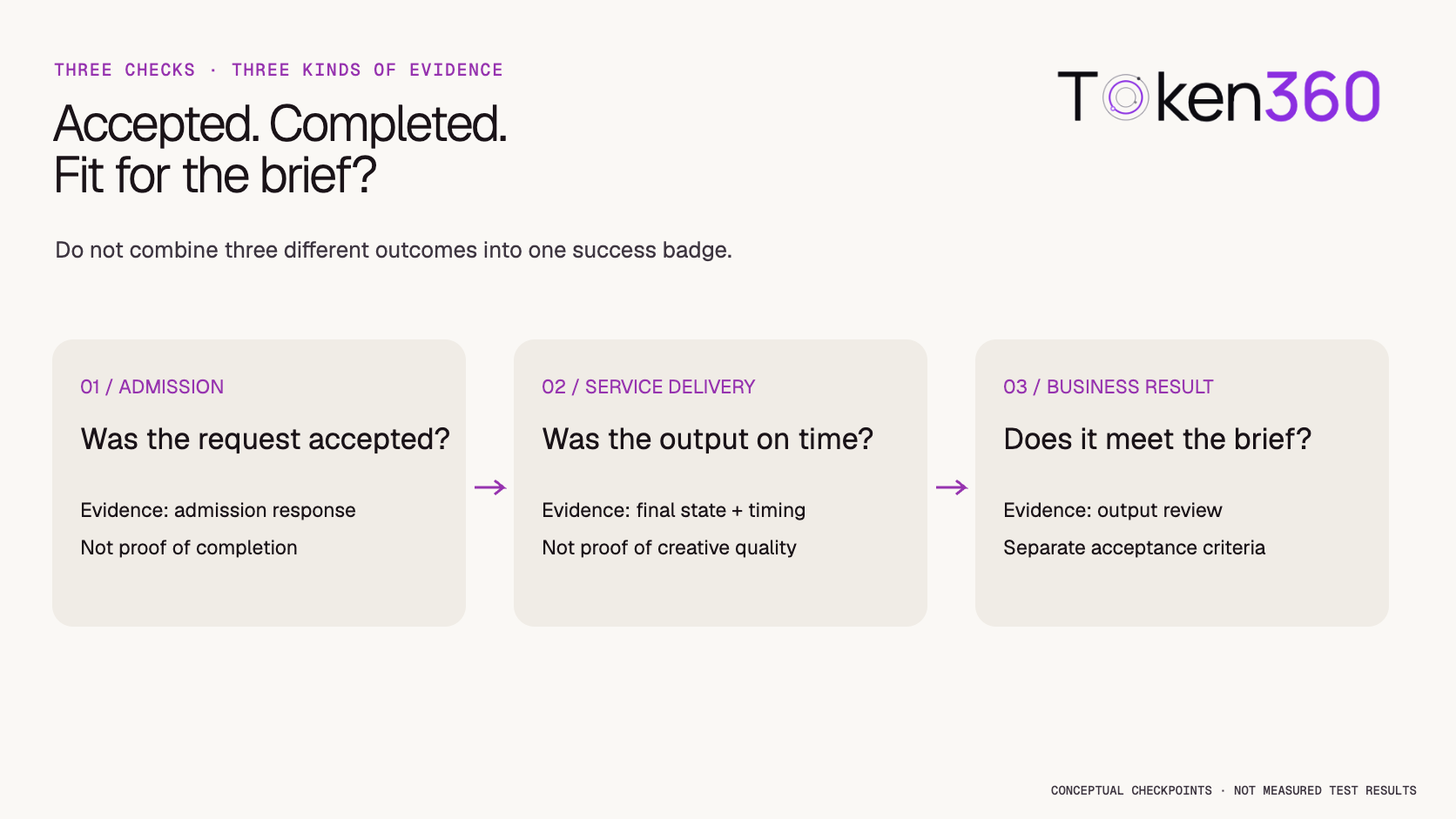
Three different acceptance questions. Passing an earlier checkpoint does not establish the next one.
Consider a hypothetical team submitting 120 eight-second video jobs at 09:00 and wanting every output available by 09:30. Raising its concurrency limit from 20 to 100 describes a change in allowed simultaneous work. It does not tell the team whether the 120 jobs will finish within thirty minutes.
The supplier would still need to clarify queue behavior, execution time for the specified settings and the handling of the remaining jobs. “All requests were accepted” is evidence about admission. It is not evidence that all outputs were ready by the deadline.
Even a completed file can fail a creative brief. Keep service acceptance and creative review separate: one asks whether a job returned a valid output on time; the other asks whether that output shows the intended product and action. A capacity arrangement alone does not establish visual accuracy or a usable-asset rate.
What happens when traffic exceeds the purchased allocation?
Agree an explicit overflow policy before relying on reserved capacity. Excess work might be rejected, queued, sent to shared capacity or routed elsewhere, depending on the service. Each choice can change waiting time, cost or the applicable processing boundary. The policy should cover both expected bursts and failures of the primary route.
This is a documented implementation choice, not merely a theoretical distinction. Google Cloud’s Provisioned Throughput guide provides a dedicated-only mode that rejects excess requests with a 429 error and distinguishes provisioned traffic from pay-as-you-go spillover. That behavior is specific to the documented service; it should not be assumed for Token360 or another supplier.
Ask four concrete questions: Is overflow enabled by default? Who pays for it? Does it keep the required model and region? Can an operator distinguish reserved and overflow traffic in the records? If the answer is unknown, a successful burst test may conceal that some work used a different service arrangement.
Failover needs the same precision. A replacement route may preserve availability while changing the model version, processing location or completion behavior. The buyer should identify which substitutions are permitted and what should happen when no permitted route remains.
How should an enterprise validate a capacity offer?
Agree a representative validation plan before the test begins. Use the workload and arrival profile named in the proposal, define the success metrics and collect all outcomes. Include ordinary load, a permitted burst and the agreed overflow behavior. A short demonstration supports only what it measures; it cannot prove future uptime or physical isolation.
Freeze the test scope. Record models, versions, settings, request sizes, region, timestamps and client location. Identify any difference from the production workload.
Define the counting rules. Count submitted, admitted, failed, timed-out and completed jobs separately. Do not remove failed attempts from the denominator without stating the exclusion.
Record timing boundaries. Distinguish client-observed elapsed time from server-side execution time. For async jobs, record when completion was detected and the polling interval used.
Exercise the expected traffic pattern. A smooth stream does not validate a sudden batch. Agree test windows and limits with the supplier before sending load.
Inspect boundary behavior. Verify whether excess work is rejected, queued or served elsewhere, and whether the resulting billing and route records match the proposal.
Review the result against the agreed target. Keep every run and explain exclusions. An average alone can hide slow requests; use the agreed distribution metric and observation period.
Do not select arbitrary thresholds after seeing the results. The appropriate target comes from the application and the proposed service. If only a small pilot is available, label it a pilot and identify the risks it leaves unresolved, such as longer operating windows, maintenance or uncommon bursts.
Copy the worksheet below into a local CSV file. Blank fields are for your own review:
Check,Buyer requirement,Supplier response,Evidence / test result,Status
Model and version,,,,Not assessed
Input/output profile,,,,Not assessed
Region and service window,,,,Not assessed
Allocation unit and quantity,,,,Not assessed
Concurrency counting rule,,,,Not assessed
Arrival profile and allowed burst,,,,Not assessed
Admission target,,,,Not assessed
Completion target and timing boundary,,,,Not assessed
Observation period and sample size,,,,Not assessed
Failure denominator and exclusions,,,,Not assessed
Overflow destination and price,,,,Not assessed
Permitted fallback routes,,,,Not assessed
Isolation evidence,,,,Not assessed
Maintenance and change policy,,,,Not assessed
Activation date and billing start,,,,Not assessed
Reservation term and resizing,,,,Not assessed
Unused allocation treatment,,,,Not assessed
Support/remedy scope,,,,Not assessed
Pilot limitations and open questions,,,,Not assessed
. It provides blank columns for the requirement, supplier response, evidence and status. It is a planning aid, not a completed test report.
Which commercial conditions change the value of reserved capacity?
The value of a capacity arrangement depends on its utilization, term, flexibility and the cost of exceeding it. Compare the service you actually need across the intended operating window. A lower nominal unit rate can be outweighed by unused commitments or unsuitable overflow rules; a higher rate may still fit a brief, irregular workload.
Ask whether unused allocation carries forward, whether a reservation can be resized and whether changing models requires a new agreement. Record activation lead time and the point when billing starts. A capacity commitment that becomes usable after a launch is not equivalent to one available for the launch window.
Review what is included in the price and what remains separate: model usage, reservation, support, overflow and any implementation work. This article does not assume that every supplier charges all of those items. The purpose is to avoid comparing two totals with different scope.
Performance testing also cannot establish every contractual fact. Dedicated hardware, approved access and data handling require appropriate supplier evidence in addition to observed speed. Use Token360’s security and data handling guidance to separate processing, logging and storage questions when preparing the review.
How should you discuss capacity with Token360?
Bring Token360 a specific workload and ask which service arrangement can meet it. Separate a higher API limit from any proposed allocation, deployment isolation or contractual performance requirement. Treat the resulting scope as something to confirm for your project, rather than assuming every enterprise account receives the same dedicated-capacity package.
As checked on November 5, 2026, the Token360 enterprise page lists custom pricing and distinguishes contact-sales and roadmap capabilities. Higher throughput limits are a sales discussion; priority support and SLAs are marked Coming Soon on that page. A requested term is not evidence of general availability.
Ask for the covered models, settings, service window and overflow policy to be documented together. If dedicated capacity is proposed for an engagement, have the allocation and acceptance conditions confirmed explicitly. There is no verified universal capacity quantity, price or uptime guarantee in this article.
Does a higher rate limit mean my requests will run faster?
No. It may remove an admission restriction. Actual completion time still needs to be measured for the workload and service arrangement.
Is reserved throughput the same as a dedicated GPU?
Not necessarily. A supplier may describe a service allocation rather than identify hardware. Ask what is reserved and what isolation is included.
Does a private endpoint guarantee private networking?
Do not infer that from the name. Check the access model, network path and deployment boundary of the specific offering.
Can dedicated capacity guarantee usable AI video?
Capacity and creative quality are separate evaluation dimensions. A file delivered within the service target may still fail the product or action brief.
Has this article tested Token360 dedicated capacity?
No. The example and worksheet are proposed procurement tools. No paid load test or dedicated deployment benchmark was performed for this article.



 Insights
 Guides
 Guides