Can We Use an AI API in a Customer-Facing Product?
Check whether AI API access can power your customer-facing product. Separate software integration, output rights, credentials and API resale.
ENTERPRISE AI · CUSTOMER-FACING USE
Customer-facing use depends on the applicable platform agreement, model terms and the way customers access the service. Embedding model calls behind your application is different from handing customers provider credentials or reselling API access. Describe the proposed arrangement and confirm the permitted scope before promising the feature to customers.
The practical buying question is not simply whether the API works. A company may want to power a paid writing feature, generate campaign assets for clients, or sell an API under its own brand. These uses have different access patterns and should not be approved under an undefined “commercial use” label.
This article provides a procurement framework, not a determination of rights for a particular deployment. Public terms were checked November 17, 2026. No customer-specific agreement was reviewed. Have the appropriate contract reviewer resolve the permitted scope for your intended use.
What exactly are you providing to your customers?
Classify the customer experience before reviewing permission. State whether customers receive finished content, interact with a feature in your software, call an API you operate, or access a supplier account directly. The same underlying model can support these architectures, but technical feasibility does not establish identical contractual rights.
Arrangement
Example
Permission to clarify
Finished deliverables
An agency sends a generated campaign asset to a client
Service use and relevant input/output rights
Embedded application feature
A paid SaaS feature calls a model from your backend
Customer-facing integration and end-user obligations
Your own downstream API
Your customers submit requests through your endpoint
Whether this distribution or resale arrangement is permitted
Supplier account access
Customers receive provider credentials or account access
Credential sharing, authorized-user and transfer restrictions
Customer-supplied key
A customer connects its own supplier account to your software
Account-holder terms and your credential-handling responsibilities
Labels such as “white label” are not sufficiently precise. They may describe removing branding from a finished asset, presenting an embedded feature under your brand, or offering a pass-through API. Explain the actual request path and who holds the supplier account.
Why is commercial output permission a separate question?
Permission to use an output does not necessarily authorize redistributing access to the generating service. Review both the product's use of the API and the resulting content. A buyer can otherwise clear one issue while missing the other, particularly when converting an internal content workflow into a customer-facing feature.
The commercial-use checklist covers input permissions, model licenses and output considerations. This article focuses on who can access the service through your business and under which agreement. Neither review replaces the other.
For example, delivering a final image to a client does not give that client your supplier account. By contrast, allowing arbitrary downstream requests through an API introduces a different access and enforcement arrangement. Describe the difference explicitly in the approval request rather than relying on the word “commercial.”
What do public provider terms show about these boundaries?
Public terms demonstrate that customer-facing integration can be addressed expressly while remaining subject to conditions. Read the platform terms alongside supplements and model-specific rules. Do not extract one favorable sentence and treat it as permission for every downstream business model, geography or category of end user.
OpenRouter's terms address incorporation into customers' products and services, while retaining applicable model terms and customer responsibility for authorized users. They also explain that platform terms do not generally waive model terms. These provisions illustrate why an integration review needs more than an API compatibility check.
fal's API Services terms describe an integrated client solution used by end users, require appropriate end-user agreements and prohibit exposing the service APIs directly to those users. Read that supplement with the main agreement. The scope of a proposed downstream API should be clarified rather than inferred from the existence of integration permission.
These are examples of published contractual structures, not a ranking of suppliers or advice that your particular implementation qualifies. An enterprise agreement may add relevant provisions. Your review should identify which agreement actually governs the purchase.
What needs clarification for a Token360 integration?
Ask for written confirmation that the intended customer-facing arrangement is covered by the applicable agreement. Token360 markets services to software businesses, but a use-case page is not a substitute for a grant of rights. The permitted use should match your application, account structure, customers and selected model services.
The AI-native SaaS page presents a product use case. Meanwhile, section 2.1 of the published terms describes access for internal business purposes; section 2.2 preserves third-party provider terms. That combination warrants clarification for an external product. It does not establish either universal permission or a universal prohibition.
Send a short description through the enterprise contact route and ask how the agreed use is documented. Specify whether you provide a user interface, a downstream API or completed deliverables. Do not assume that purchasing more usage changes the license scope. Company background is available on the About page.
What should the written scope request contain?
Give the supplier enough information to evaluate the actual arrangement: the product, paying entity, end users, model access, request flow and commercial presentation. Ask for a response that identifies applicable conditions and exclusions. A generic “yes, commercial use is allowed” can leave the main product-access question unanswered.
Proposed request template: We plan to use [model services] within [product]. Our company holds the supplier account and sends requests from [backend]. Customers receive [feature, deliverable or API response] and do not receive supplier credentials. Users are [audience and relevant locations], and inputs contain [data classes]. Please confirm whether this arrangement is permitted, which model and end-user terms apply, and whether a separate written agreement is required.
If you are offering an API, say so rather than describing it only as an application feature. If customers supply keys, identify that arrangement instead of using the template's account-holder wording. Retain the supplier's response and the accepted agreement in the vendor approval pack.
Define the arrangement before designing promises around it.
What responsibilities remain with the product company?
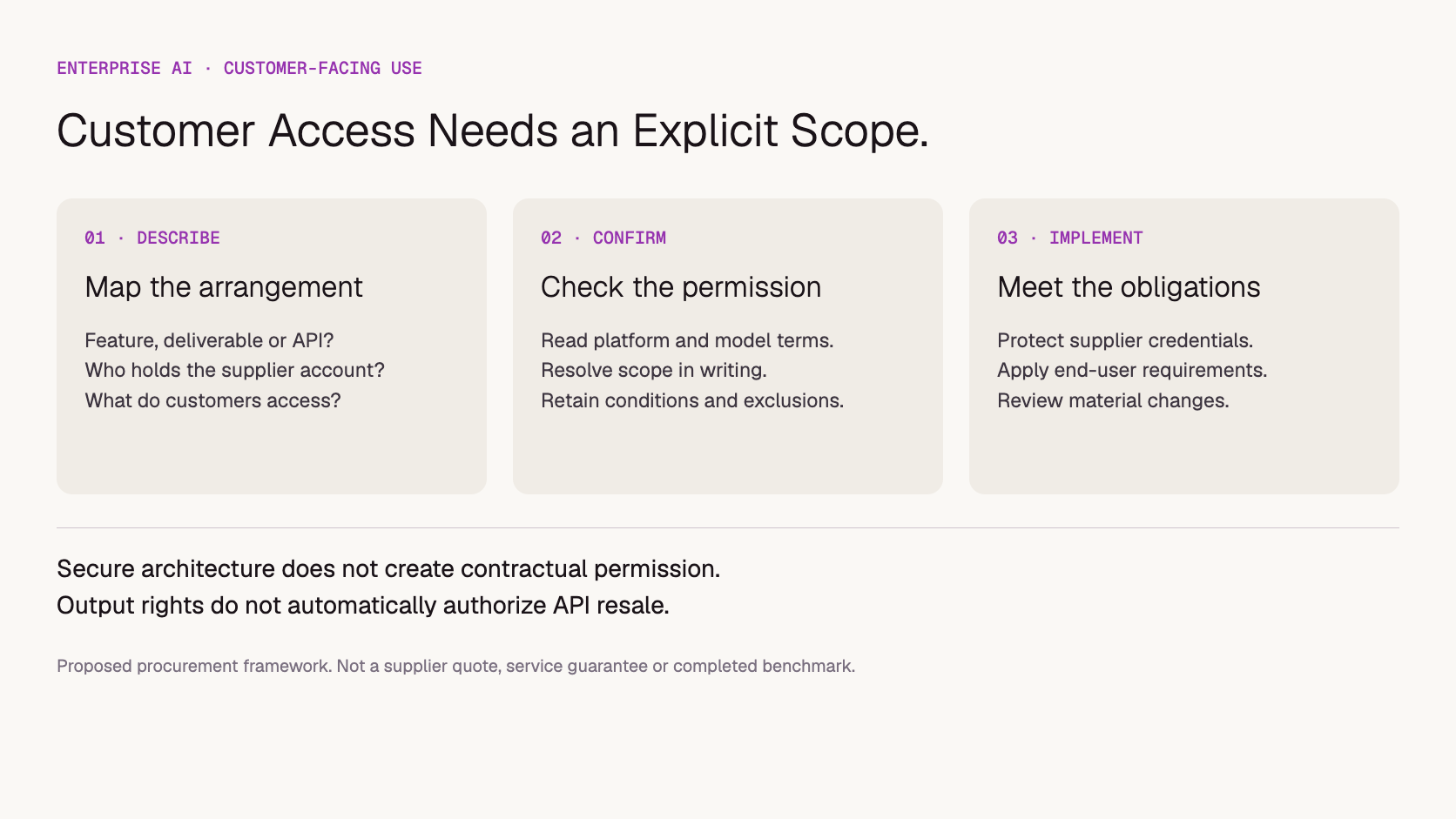
After confirming permission, translate the relevant obligations into product controls and customer terms. Identify who handles user access, prohibited use, customer data, support and service changes. A supplier's permission to integrate does not automatically provide those controls or remove your responsibilities to the people using your product.
Keep provider credentials out of client-side code and customer-facing responses. Assign account ownership, internal access and billing responsibilities deliberately; the API account ownership guide treats those operational decisions in more detail. A secure architecture supports the agreed use, but cannot create rights absent from the agreement.
Map customer commitments to what you can actually deliver. If you advertise a particular model, consider how a model change will be reviewed. If you promise retention behavior, check the full processing path. Assign a product owner to update disclosures and controls when the approved scope changes rather than assuming the original procurement approval lasts unchanged forever.
How should a buyer decide whether to proceed?
Proceed when the permitted arrangement is clear enough to implement and the responsible reviewers accept the remaining conditions. If a material point is unresolved, narrow the launch scope or obtain clarification. Do not present an internal technical test as evidence that a customer-facing business model has been contractually approved.
Use three decision records: what customers can do, which agreement permits it, and how the required obligations will be enforced. Record excluded models or uses where relevant. This creates a usable handover for engineering and customer operations without turning a legal review into a vague “approved vendor” badge.
Frequently asked questions
Can we charge customers for an AI-powered feature?
Potentially, where the applicable agreements permit that arrangement. Charging a subscription does not itself determine whether the service use is authorized. Confirm the feature and model scope before setting customer expectations.
Does hiding the provider name make this resale?
Brand presentation alone does not settle the classification. Explain what access customers receive, whose account is used and whether you expose an API. Check any attribution or branding requirements separately.
Does bring-your-own-key remove the need for review?
No. The customer account remains subject to its supplier terms, while your software still handles access and possibly customer data. Review the architecture and responsibilities rather than treating BYOK as a universal permission shortcut.
Can we reuse approval when adding another model?
Check the existing scope first. A new model can introduce different provider terms or use restrictions. Record whether the addition is covered or needs a new decision; a shared endpoint does not establish shared permissions.
Enterprise AI
API
Bring your next idea to life.
Create a video scene in Creator, or explore models for images, audio, and text to find the right capabilities for your project.


 Guides
 Guides
 Guides