AI Model Publisher vs Hosting Provider: Who Runs It?
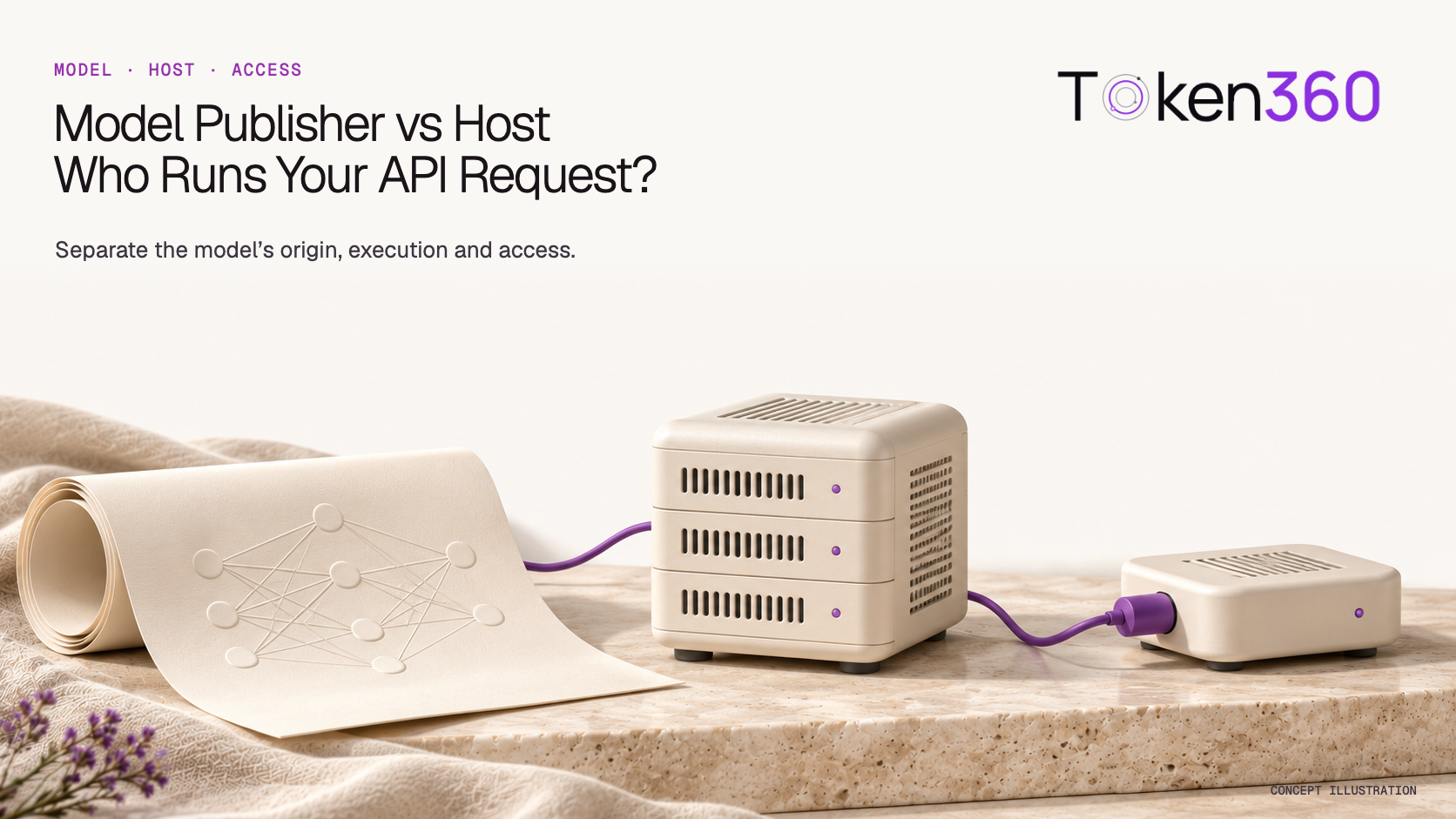
A model publisher creates or releases a model; a hosting provider runs inference. Map these roles separately from your API access and billing platform.
ENTERPRISE AI · BLOG 155
By Token360 · Editorial review: November 5, 2026
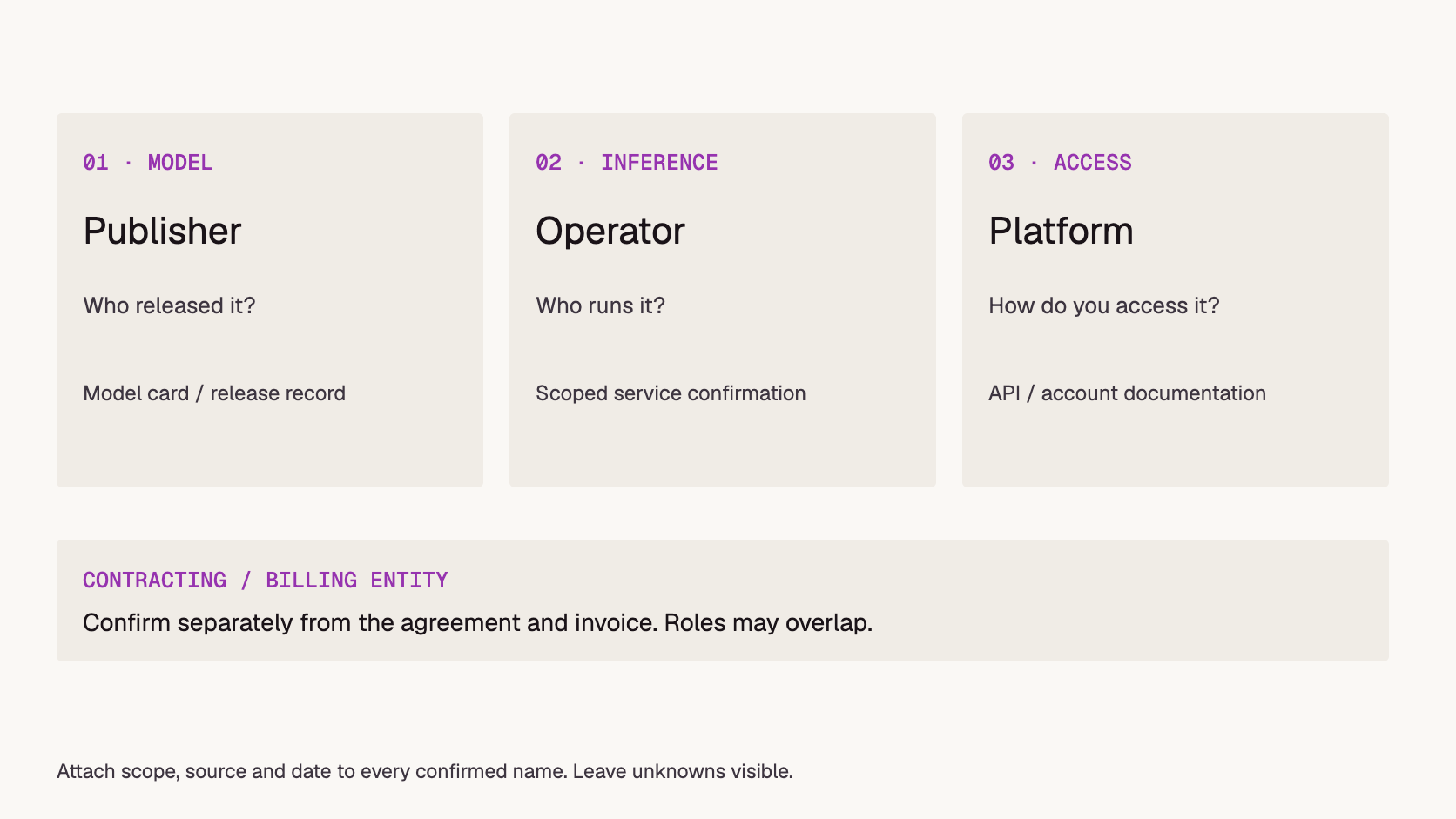
An AI model publisher releases the model, a hosting provider operates its inference service, and an access platform provides the interface through which you use it. One company may perform several roles. For enterprise review, identify each role separately: a familiar model name or a single invoice does not establish who executes every request.
The practical question is not simply “Which AI vendor are we buying?” It is “Which organization does which part of this service, and what evidence confirms that?” A model catalog can answer what you can call while leaving the execution arrangement unresolved.
This article provides a role map and a blank verification worksheet. It does not audit any supplier’s infrastructure, identify undisclosed Token360 upstream providers or report performance tests. The examples below separate documented facts from questions that need an account-specific answer.
Read first: Token360’s model documentation provides the starting point for identifying the model you intend to call. This article addresses the organizations behind that call, rather than choosing between a gateway and a direct integration.
What is the difference between a model publisher and a hosting provider?
A publisher is responsible for releasing a model or model variant; an inference operator runs a service that executes it. An access platform presents the customer-facing API or purchasing interface. Treat these as roles rather than mutually exclusive company categories, and record the relevant model, service and account scope beside each name.
Role
Question it answers
Useful evidence
Does not prove by itself
Model publisher
Who released this model or variant?
Official model card, release documentation, version identifier.
Who serves your request.
Inference operator / hosting provider
Who operates this inference service?
Endpoint documentation or a scoped provider confirmation.
Who owns the model, physical hardware or customer contract.
Access platform
Through which interface and account do you submit work?
API documentation, account configuration and applicable service terms.
That the platform developed every listed model.
Contracting and billing entity
Who is your commercial counterparty?
Executed agreement and invoice details.
That the counterparty operates every underlying service.
“Hosting provider” in this article means the organization operating the inference service, not necessarily the owner of the building or GPU hardware. If infrastructure ownership matters to a purchasing requirement, add it as a separate question. Do not silently substitute it for the operator’s identity.
These distinctions are also not assignments of legal liability. Responsibility for support, remedies and contractual obligations comes from the applicable arrangement. A technical diagram should help locate the questions that need answering, not replace the agreement.
What does fal’s Partner API FAQ actually tell us?
A partner-hosted label can identify an execution arrangement that is not apparent from the platform’s name alone. Read the label’s documented meaning and apply it only to the models carrying it. It is evidence about a particular service arrangement, not a quality rating or a universal description of the platform’s catalog.
The fal Model APIs FAQ, checked November 5, 2026, states that models marked Partner API are hosted by fal’s partners and that availability is managed by the partner. This is the competitor FAQ behind this article’s topic. It does not mean that every fal model uses that arrangement.
The useful purchasing follow-up is precise: “For the selected endpoint, what does the partner designation cover, and which contact handles a service issue?” The answer should be tied to that endpoint and the applicable service arrangement. Avoid converting an interface badge into assumptions about regional processing, contractual guarantees or model ownership.
Can one API expose models from different inference operators?
Yes, a consistent API can sit in front of several inference services. Consistency at the client boundary answers how an application sends requests; it does not establish a single operator behind every model. Separate the model identifier, the chosen service arrangement and the customer-facing interface when documenting a multi-model integration.
Hugging Face’s Inference Providers documentation, checked November 5, 2026, describes access to models powered by inference providers through integrated client SDKs and a consistent API. Its partner listing makes the distinction visible: the access interface and inference-provider role are not interchangeable.
For your own integration, the important record is not a diagram with the largest number of vendor logos. It is a small set of verified relationships for the workloads you actually plan to run. A text endpoint and a video endpoint should have separate rows if their service arrangements differ.
Review each role separately. Multiple columns may name the same organization; unknown fields should remain explicitly unresolved.
What does a Token360 model name tell you about the route?
A public model name identifies the product-facing model to request; it should not be treated as proof of a particular upstream deployment. Check the platform’s route documentation and the configuration applicable to your account. If a requirement depends on a fixed execution arrangement, obtain explicit confirmation of its scope and limitations.
Token360’s routing documentation, checked November 5, 2026, describes public model names as product-facing identifiers and allows one or more eligible service routes. It describes session affinity as a preference constrained by policy, compatibility, residency, capacity and provider health—not an unconditional guarantee.
For a review record, distinguish three statements: the model you requested, any route information actually exposed, and any separate arrangement confirmed for your account. Do not fill missing provider details by guessing from the model’s brand. The documentation also limits provider-routing fields to those published in the selected model’s schema; this article does not promise arbitrary provider selection.
An enterprise requirement such as “only an approved execution arrangement may process this workload” should remain an open requirement until it is explicitly confirmed. A model catalog entry alone is insufficient evidence. Discuss it through Token360’s enterprise channel with the model and workload scope attached.
How should a team fill in a provider role map?
Start with one real workload and record only supported facts. Give each role an evidence link, date, scope and confidence status. Where the inference operator is not confirmed, write “unconfirmed” and name the person responsible for obtaining an answer. An incomplete but honest map is more useful than a fully populated guess.
Hypothetical example, not a Token360 deployment: a team requests “Model M” through Platform C. The model card identifies Publisher A. The team has a Platform C agreement and an invoice, but no document identifying the inference operator for that endpoint.
Field
What the team can record
What remains unresolved
Publisher
Publisher A, supported by the model card.
Whether the requested alias maps to the reviewed version.
Inference operator
Unconfirmed.
Operator and scope of any route changes.
Access platform
Platform C, supported by the integration configuration.
Which operational details the platform exposes.
Commercial counterparty
The entity named in the applicable agreement.
Any mismatch between contracting and invoicing records.
Support contact
The channel specified for the account.
Escalation process for an upstream issue.
The team should not replace “unconfirmed” with Publisher A merely because that publisher’s name appears in Model M. It should also not assume Platform C operates the service solely because Platform C receives the request.
If the missing information is essential to approval, define a specific completion condition: a dated confirmation covering the named endpoint and account arrangement. If the supplier cannot provide it, record that limitation and let the responsible reviewer decide whether the requirement is met. Do not describe a pending clarification as a completed supplier audit.
Copy the worksheet below into a local CSV file. Blank fields are for your own review:
Role,Organization or unconfirmed,Workload/model/version,Endpoint/account scope,Evidence link or document,Evidence date,Confirmed/requested/unresolved,Open question,Review owner,Review trigger
Model publisher,,,,,,,,,
Inference operator,,,,,,,,,
Access platform,,,,,,,,,
Contracting entity,,,,,,,,,
Billing entity,,,,,,,,,
Support contact,,,,,,,,,
Infrastructure owner if required,,,,,,,,,
. It includes separate fields for evidence, scope, unresolved questions and review ownership. It contains no pre-approved providers or assumed Token360 supply-chain details.
Who should receive a support or procurement question?
Use the account’s documented support channel for an operational incident, and the designated commercial contact for a service-scope question. Include the model and relevant request context without assuming which organization caused the issue. A role map helps the receiving team investigate; it is not proof of fault or permission to bypass agreed support routes.
For example, “Which model release is this endpoint intended to serve?” is a version-identification question. “Which execution arrangement applies to our account?” is a service-scope question. “Why did this request fail at this time?” is an incident question. Sending the same vague “Who is the provider?” question for all three can produce answers that sound consistent but address different things.
For Token360 incidents, the published troubleshooting guidance calls for information including the UTC time range, model, endpoint, error details and correlation identifiers, with secrets removed. Provide available evidence rather than attempting to infer the upstream operator from an error’s wording.
A useful support record states observed behavior and expected behavior separately. A useful procurement record states a requirement and the supplier’s confirmed answer separately. Keeping those records distinct prevents an incident response from being misquoted later as a permanent commitment about the whole service.
When should the role map be reviewed again?
Review the map when its scope changes: a new endpoint, model version, account arrangement or supplier notice may make an earlier confirmation insufficient. Preserve the original evidence date and add the new scope explicitly. Do not assume either that every change alters the operator or that an unchanged model name proves nothing changed.
Assign a review owner and a trigger rather than an arbitrary claim of continuous verification. For example, adding a new video endpoint can trigger a new row; renewing a contract can trigger a check of the named counterparty and support route. An old screenshot should not silently become evidence for a new account configuration.
This review is narrower than choosing an API architecture or evaluating all enterprise controls. The deliverable is a defensible answer to who publishes, who operates, who provides access and who your team contacts—with uncertainty visible wherever evidence is missing.
These answers address common role-identification errors. They do not identify undisclosed infrastructure or provide account-specific commitments. Use model documentation for model provenance, service documentation for the execution arrangement, and the applicable agreement for commercial obligations. Keep the evidence attached to the endpoint and account it actually covers.
Is a model publisher always the inference provider?
No. The roles may belong to one organization or different organizations. Confirm the service arrangement rather than inferring it from the model’s name.
Does the company on my invoice own the GPUs?
The invoice identifies a billing relationship. It does not by itself establish infrastructure ownership or identify the inference operator.
Does partner hosting mean lower quality?
No quality conclusion follows from the label alone. Evaluate the selected service against your workload and acceptance criteria; this article contains no comparison benchmark.
Can I identify the operator from a model ID?
A model ID can help identify what was requested, but it is not sufficient evidence of who executed a particular request. Use documented service information and any confirmed account-specific scope.
Does this worksheet replace a security or SLA review?
No. It identifies roles and evidence gaps. Security requirements, data handling and contractual commitments need their own review.
Enterprise AI
API
Build faster with one AI API.
Use Token360 to call video, image, audio, and text models with one key and one bill.


 Guides
 Guides
 Guides