AI API Provider vs AI Development Company: Which to Hire?
An AI API provider supplies models; a development company builds applications. Compare deliverables and identify which supplier your project needs.
Choose an AI API provider when you need model access for an application your team can build and operate. Choose an AI development company when you need someone to design and deliver that application. Many projects need both roles. Select suppliers by the missing deliverables, not by whether they describe themselves broadly as an “AI company.”
An enterprise brief such as “we need an AI assistant” can produce incomparable proposals: one quotes model usage, another quotes a software project, and a third proposes an ongoing managed service. None is necessarily wrong. They may simply be pricing different work. Define the required outcome before treating those proposals as alternatives.
This guide compares supplier roles for a custom application. It does not rank vendors or claim that all companies fit one category. Official sources were checked November 17, 2026. The example and scope worksheet are proposed procurement tools, not customer results or tested cost estimates.
What is the difference between the two supplier roles?
An AI API provider supplies callable model capabilities under an agreed service scope. A development company supplies engineering work that turns capabilities into an application or workflow. These roles can overlap within one business, but purchasing one does not automatically include the other. Ask which deliverables the proposed agreement actually covers.
For example, Hugging Face’s Inference Providers documentation describes access to models through interfaces developers can integrate into applications. By contrast, AWS’s consulting-partner description includes building, testing, operating and maintaining generative AI applications. These illustrate different service roles, not a universal division between named companies.
Buying question
AI API provider role
AI development company role
What is being supplied?
Model access and agreed inference services.
A scoped software implementation or engineering service.
What should a proposal identify?
Models, supported requests, usage terms and service boundaries.
Workflows, integrations, deliverables, milestones and exclusions.
What should acceptance check?
The agreed model service works under specified conditions.
The complete workflow satisfies defined business and technical tests.
What remains to be confirmed?
Whether application implementation is separately available.
Who supplies and pays for inference and ongoing operation.
If an existing packaged product could meet the requirement, first consider AI software versus a model API. This article addresses who supplies the model component and who builds a custom solution once development is relevant.
When is an API provider enough?
An API provider may be enough when your team already owns a functioning application and has the capability to integrate, test and maintain the model connection. The unmet need is model supply rather than application delivery. Confirm that the team can handle the surrounding workflow before concluding that access to a model completes the project.
For instance, a software team might already have authentication, source-data access, a review screen and deployment processes. It needs a model to produce a draft from approved inputs. Its supplier brief can focus on the required model capabilities, expected usage and service conditions.
A successful request demonstrates access, not completion of every application requirement. If nobody can connect the returned output to the existing review and publishing steps, the project still has an implementation gap. The inference-provider service-scope guide explains the component-level purchase; it should not be read as a promise that every provider builds the surrounding product.
When should you involve a development company?
Involve a development company when the missing work is designing, connecting or delivering the business workflow and your team cannot cover it internally. Look for a proposal that names the application behaviors and systems it will implement. A general promise to “add AI” is not a sufficient description of the software you will receive.
Consider a hypothetical customer-support assistant. Model access can help produce text, but the application may also need to identify the customer, retrieve permitted records, display source material, escalate uncertain cases and record the final action. A developer’s proposal should explain which of those behaviors it will deliver, not merely show a chatbot answering a sample question.
Ask the candidate to walk through a difficult case: the source is missing, the user lacks permission, or the model service times out. Which behavior is part of the delivered application? Which dependency belongs to you? This makes the scope concrete without assuming that one demonstration proves production readiness.
How do you send a brief that produces comparable proposals?
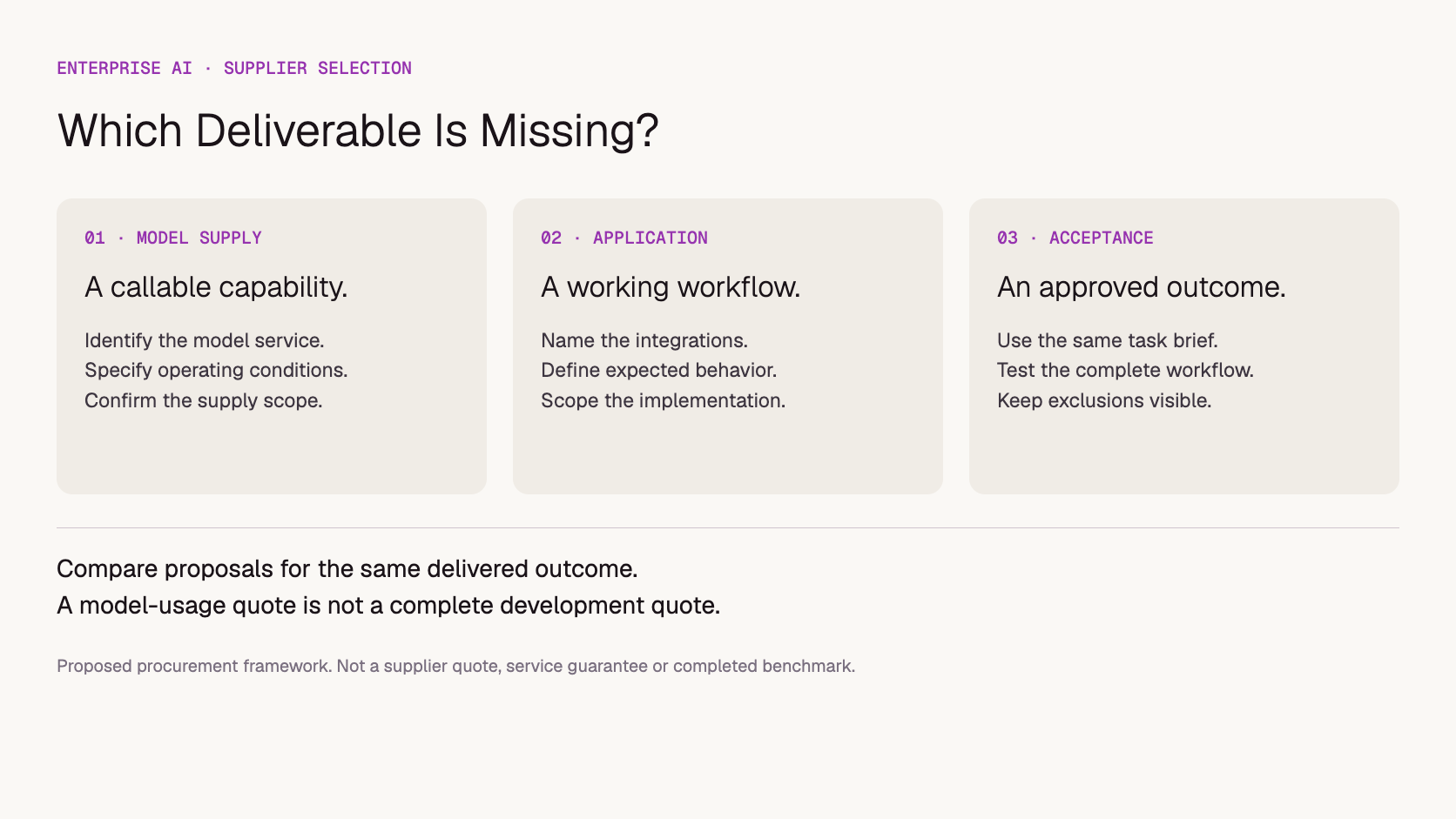
Send the same business outcome and acceptance conditions to each candidate, then separate model supply from implementation work. Require suppliers to mark what they deliver, what they depend on and what they exclude. This gives procurement a way to compare complete scopes without mistaking an inexpensive component quote for an inexpensive finished application.
A useful brief states the user, the task, the source systems, the allowed action and the required review point. Instead of “build an AI assistant,” use a description such as: “Draft a support response from approved account information, show the source to an agent, and require approval before sending.” This is a hypothetical scope example, not a proven implementation.
Model service: who selects, supplies and validates the required model capability?
Application: who builds the interface, integrations and business rules?
Dependencies: what data access, approvals and existing systems must your company provide?
Acceptance: which observable behaviors must pass, including failure cases?
Ongoing work: which maintenance tasks are included after delivery, and for how long?
Download the supplier-scope worksheet and attach it to each request for proposal. Keep unclear items visible rather than assuming an unpriced requirement is included.
Can one supplier provide both roles?
Yes, one supplier may offer both model services and application delivery, directly or with partners. Evaluate that offer as two scopes with an explicit connection between them. A single commercial contact can simplify coordination, but it does not remove the need to identify who delivers the application and who operates the model service.
Ask which work is performed by the named supplier, which uses subcontractors and which requires a separate agreement. Establish who is responsible for coordinating a failure that crosses those boundaries. If the application sends the wrong input, a working model endpoint will not correct the integration by itself.
Do not infer full implementation from the presence of technical support. The article on support versus implementation during provider onboarding covers that distinction in detail. If both roles are bundled, retain separately identifiable deliverables so that acceptance is still possible.
Proposed scope map: select the supplier for the work that is actually missing.
How should you compare price and acceptance?
Compare the same delivered outcome over the same operating period. Separate implementation charges, inference usage, application hosting and ongoing maintenance where applicable. Then attach an acceptance test to each deliverable. A lower model rate and a lower project fee answer different questions; neither alone establishes the lower cost of an accepted workflow.
For the support-assistant example, model-service acceptance might check that the agreed capability is available through the required interface. Application acceptance would check the entire path from permitted source retrieval to a reviewed draft, including missing-data and failure behavior. Business approval determines whether the resulting workflow is acceptable for use.
There is no cost benchmark in this article. Use matched proposals and your intended operating period. The broader AI API total-cost guide covers cost categories; keep this comparison focused on whether both quotes include the same work.
Where does Token360 fit in the supplier brief?
Token360’s confirmed positioning is enterprise model access across text, image, audio and video, with commercial and service requirements scoped to each engagement. Start a Token360 brief with the model capabilities and operating requirements you need. Do not assume custom application development is included unless that deliverable is explicitly agreed.
The enterprise page, model catalog and pricing page provide starting points for the model-supply discussion. Your internal development team or an appointed implementation partner can supply the application requirements that make that discussion specific.
If you need both roles, ask each party to confirm the boundary in writing before kickoff. This article does not claim Token360 offers a standard application-development package or identify an approved implementation partner. The next step is a complete scope, not an assumption based on a company category.
Frequently asked questions
Do we need an AI development company if we already have engineers?
Not necessarily. Assess whether the existing team can deliver the required integrations, application behavior and evaluation work within the project constraints. An API supplier may cover the missing model-access component while your engineers handle development.
Does API technical support include building our application?
Not automatically. Support may help resolve service-use issues without implementing your workflow. Ask for named implementation deliverables if you expect the supplier to build or modify software for you.
Should the development company choose every model?
It can recommend candidates, but your company should approve the business criteria and relevant procurement constraints. Require the proposal to explain the selection and its dependencies rather than accepting an unexplained model choice.
Who should own the API account when an agency builds the app?
That depends on the purchased service and agreed operating arrangement. Decide it explicitly rather than letting the first developer’s signup determine it. Our AI API account-ownership guide covers company and agency arrangements.
About the publisher: Token360. Written by Yuki Yu. This is a supplier-scoping framework, not a vendor ranking, customer case study or claim of measured cost savings.
Deliverable,Supplier responsible,Included or excluded,Acceptance evidence,Dependencies
Model access,,,,
Application interface,,,,
Source-system integration,,,,
Permissions and review workflow,,,,
Failure handling,,,,
Deployment,,,,
Maintenance scope and period,,,,
Business acceptance owner,,,,
Enterprise AI
API
Bring your next idea to life.
Create a video scene in Creator, or explore models for images, audio, and text to find the right capabilities for your project.


 Guides
 Guides
 Guides